Archive

Genre

image

There is a certain kind of self satisfied dramedy that can only be written by a child of the affluent, over educated and beleaguered by the misery of his suburban upbringing, yet oh so smitten with its quirky coolness. Tragedy brings this writer into contact with his or her estranged family. Their hypersexualized mother (Jane Fonda) is overbearing and positively lords her “hip for her age” persona over them. One brother is the unreliable, manchild rebel (Adam Driver), one sister (Tina Fey) the angry perfectionist. Then there is the long suffering, stodgy older brother (Corey Stoll) and finally, there is the sarcastic, sad brother (Jason Bateman). What unites them is their fealty to stereotype and ostentatious progressivism, a condescension to every other non-familial character, 80s pop, odd folks from the old neighborhood, the fact that nothing that happens in the story would ever happen in real life, secrets revealed (“Mom’s a lesbian!”; “Dad was a bad businessman!”; “You slept with HIM?”), assigned stem winders, a scene where the sons smoke weed (found in Dad’s jacket!  Crazy!!!!) and heartfelt tributes immediately followed by crass one-liners.

And that is This Is Where I Leave You.

Truly terrible in every way.

I caught this the other night and of the mockumentary films written and/or directed by Christopher Guest – This is Spinal Tap, Waiting for Guffman, A Mighty Wind, For Your Consideration – this is my favorite.  Perhaps not coincidentally, it’s also the sweetest on its subjects, an assortment of purebread dog owners who are competing at The Mayflower Kennel Club Show.  Catherine O’Hara and Eugene Levy stand out as the impoverished Florida couple who, unfortunately for Levy, run into O’Hara’s old lovers on their way north, but Jane Lynch shines as a driven, lesbian handler who has found a Sugar Mommy (Jennifer Coolidge) to fund her efforts, as well as the magazine American Bitch (“it’s a focus on the issues of the lesbian pure bred dog owner”).

But Fred Willard, as the disinterested but garrulous TV announcer, and Jim Piddick, who has to suffer him, steal the picture.

image

It can be clever, and the intersection of several fairy tales is occasionaly ingenious.  But there are no standout numbers (indeed, the movie appears to have cut the best song), and a musical rises or falls on its music.  The “Into the Woods” riff that snakes through the movie becomes tiresome, there are too few interesting exchanges between the characters, there is an entirely unnecessary and intrusive narration and the entire thing feels small.  It’s also not very funny, and from what I can see from the stage play, it’s supposed to be.

Though he’s been off his game of late, this project would have been better in the hands of Tim Burton.

A film that got away from me, perhaps because it gave off such an air of discomfort, I watched There Will Be Blood this weekend. The movie is very good, but my instincts were correct.  It is a very difficult movie to endure.

Daniel Day Lewis plays a Charles Foster Kane-esque Daniel Plainview in Paul Thomas Anderson’s sprawling tale of an oil man who rose from a single claim prospector to a wealthy oil magnate through sheer will and a ruthless brutality that destroyed everything in its wake. Whereas Welles’ Kane, obsessed though he was, could enjoy the taste of his success and the fruits of his labor, Plainview cannot. He is a tortured, singular man, made dangerously distrustful the moment he gets close to anyone for fear of what that person will take. Worse, he cannot abide a slight, and when a young preacher (Paul Dano) fences with Plainview, forcing him to endure a humiliating baptism in exchange for the rights to a critical tract of land, the incident burns in Plainview. As played by the spellbinding Day Lewis, it damn near appears to eat his insides out.  Anderson’s representation of California – be it the barren oilfields or the lonely mansion Plainview inhabits at the end of the movie – becomes more forbidding and cruel as Plainview descends into madness.

All well and good, especially near flawlessly rendered, and yet, this is a cold, one-note film, devoted near completely to a terrible, monochromatic character. What is Anderson telling us about ourselves, or, is he telling us anything? Many cite the picture as an evocation of the American experience, a “portrait of a young nation struggling to find itself, torn between religious and business values” or “a harrowing cautionary warning to a country with oil pumping through its veins, clouding its judgment and coarsening its soul.”

If only. Anderson’s vision is too personal and too specific to Plainview, and it is a testament to the director’s gifts and Day Lewis’s skill that such a narrow focus remains compelling. The result is a lot of blood and guts but no real heart, which keeps it from being great.

Inventive, scrupulous and at times, bone chilling, It Follows is yet another nail in the coffin of gore porn and a heck of a scary move to boot. The set-up is simple (stop reading if you don’t want to know even this much): a “thing” that can take many forms follows its target, and you become a target through having sex with someone the thing is following. If you have sex with someone else, it throws the follower off, until it gets that someone, and then it is back on your trail.  No one can see the thing except its targets.

It Follows adroitly handles the revelation of the curse, and what ensues is a terrifying spook story in which Kelly (Lili Sepe) must run from what follows, with the assistance of her sister, friends and neighbor, while weighing the moral implications of buying herself more time.

Writer-director David Robert Mitchell knows his stuff; the film is a near homage to John Carpenter’s Halloween, with its dreamy sense of suburbia and techno-synthesized score. His actors approach the material in a studied, restrained manner, further emphasizing the hazy unreality of the entire endeavor. He also incorporates Detroit and its desolate environs, as near an urban haunted ruin as this country has.  Finally, the film trusts your intelligence rather than being explicit, no mean feat in this genre.  It gets a tad ragged in the end, but closes smart.

One of the charms of The Blair Witch Project was a nostalgic authenticity, which transported you back to a younger time and made the actions of the hikers seem like exactly the kind of hubristic, stupid thing you would do at that age. It Follows has the same trait: this feels like your childhood neighborhood, and evokes the times you looked out the window and saw something that seemed off, or something you were not supposed to see, or even something your fevered mind conjured after watching too many Kolchak The Night Stalkers.

I watched this flick with my son and 5 of his high school friends; they all agreed it would be significantly more effective as a sex-ed tool than what they were currently enduring.

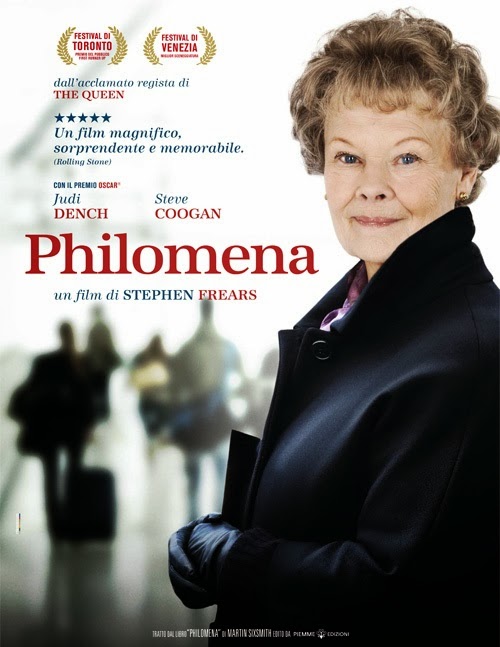
This Oscar nominated film got past me in 2013, and I am all the sorrier for it. Judi Dench is Philomena, a provincial, sweet Irish retiree in London who, living with her adult daughter, reveals a long-hidden secret – that she gave birth to a son in Ireland out of wedlock in the 1950s, and subsequently, was forced into labor in a Catholic abbey as penance while her child was relocated, at a price, to the United States. Philomena’s daughter enlists the assistance of a recently sacked Blair-administration official, Martin Sixsmith (Steve Coogan), who, grudgingly and rather condescendingly takes on her “human interest” story to find her son. What follows is a trip (yes, another Steve Coogan trip movie), first to the abbey, and them after receiving no help there, to America. Along the way, Coogan’s cynicism, self-importance and emptiness tangles with Dench’s faith, sincerity and essential decency.

This is a beautiful, kind-hearted, witty movie. Dench is moving as a mother haunted by the absence of a child she kept firmly in her mind (the nuns at the abbey allowed the shamed mothers to visit their children an hour a day, making their inevitable separation even more traumatic), and Coogan is firmly cold-hearted and self-pitying without being a caricature. Their scenes together are sensitive and comedic without lapsing into treacle or schmaltz, and the impact each has on the other is believable.  My only mild criticisms are a few too-cute moments for Dench and a juiced-up ending, pouring it on the nuns.  While it works dramatically, it paints a picture even the real Philomena was uncomfortable with, and upon reflection, it’s too much (we are provided an evil nun who spits a final rejoinder of, “self-denial and mortification of the flesh is what brings us closer to God. These girls have no one to blame except themselves”).

Nonetheless, this is largely true to the incredible true story, and I can’t recommend it enough.

image

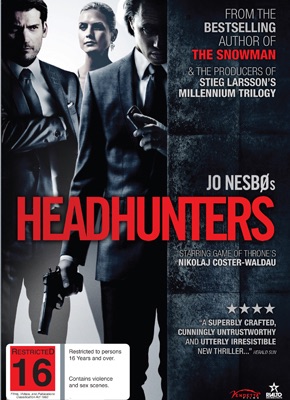
If you want to learn how a little-known director gets a big budget, Oscar-bait vehicle, watch Headhunters, a clever, fast-paced thriller about a corporate recruiter/art thief who gets in over his head financially and otherwise.  An engrossing thrill ride with a “wrong man” Hitchcockian vibe, the film’s only stumble is an overly intricate initial plot device that introduces the protagonist to his tormentor.  Otherwise, this is a cool, steady, occasionally grisly film in the vein of Blood Simple.

Headhunters was a massive success in Norway, which translated to about $14 million foreign but just over a mere million here in the U.S.  Still, Hollywood noticed and selected director Morten Tyldum to helm a picture that had absolutely nothing in common in style, substance, or feel with his breakout movie, the woeful The Imitation GameOf course, that film was nominated for Best Picture, so what do I know.  I just hope Hollywood similarly rewards Jeremey Saulnier (Blue Ruin) and Jennifer Kent (The Babadook).

Available on Netflix streaming.

A hilarious mockumentary done in the style of The Real World and other reality dramatizations of domestic life. Four mates, distinct in style and manner, share a house in Wellington, New Zealand, and a documentary crew shadows them for a period of months to capture their lives. In the style of the genre, we get to witness petty fights about house rules, dirty dishes, who can have friends over and which clubs to frequent on the weekends. The twist is that our flat mates are all vampires of varying ages, and soon, they add a fifth (Nick) to their coterie, which rapidly undoes their dynamic. As the youngest, Nick is my second favorite, simply because he is so enthused by his new powers, repeatedly telling anyone who will listen that he is a vampire. My favorite of the household, however, is the oldest, Petyr, for the obvious reason that he is a Nosferatin curmudgeon who cannot speak and presents a brilliant deadpan:

This is consistently funny, with particularly great bits about the vampires’ fascination with technology and run-ins with self-improving werewolves.

Currently available on Netflix streaming, this almost 3 hour documentary essay presents as both art exhibit and graduate course (it is written and narrated by the sleepy-voiced Thom Anderson, a filmmaker and film theory and history teacher at the California Institute of the Arts).  Los Angeles Plays Itself is textually interesting, the visuals of the city’s depiction in film are always entertaining, and accompanied by Anderson’s incisive narration, often illuminating.

Anderson can also be very funny, in a dry “this is Carlton, your doorman” way. On a scene from Michael Mann’s Heat:  

 [In Heat, Neil McCauley (Robert DeNiro) is briefing two members of his gang. He tells them, “Saint Vincent Thomas Bridge, that’s escape route number one.“]  Vincent Thomas was San Pedro’s representative in the state assembly for many years, but he hasn’t been canonized yet, not even in Pedro.

And on the perpetual destruction of LA in the movies:

Mike Davis has claimed that Hollywood takes a special pleasure in destroying Los Angeles, a guilty pleasure shared by most of its audience. The entire world seems to be rooting for Los Angeles to slide into the Pacific or be swallowed by the San Andreas fault. …In Independence Day, who could identify with the caricatured mob…dancing in idiot ecstasy…to greet the extraterrestrials? There is a comic undertone of ‘good riddance’ when kooks like these are vaporized by the earth’s latest ill-mannered guests.  But to me the casual sacrifice of Paris in Armageddon seems even crasser. Are the French being singled out for punishment because they admire Jerry Lewis too much? Or because they have resisted Hollywood’s cultural imperialism too fervently?

Of course, if you let an academic talk long enough without interruption or query, he’ll eventually meander into overstatement and grandiosity, and as Anderson moves from LA’s history, architecture, sprawl and patterns in film to politics, race and class, we get poetic broadsides, against the cops and the modern Noah Crosses and skyscrapers. This is all part of the condescension of most any “true” city dweller who presumes to know the authentic heart that beats in his city, and for the most part, that’s part of Anderson’s charm.  Anderson has a grievance, as he concedes at the outset:  That’s another presumption of the movies: that everyone in Los Angeles is part of their industry or wants to be. Actually, only one in forty residents of Los Angeles County works in the entertainment industry. But the rest of us simply don’t exist.  We might wonder if the movies have ever really depicted Los Angeles.

But doleful mouthfuls like “White America had declared a crisis of the black family as a cover for its campaign of incremental genocide against its expendable ex-slave population, rendered superfluous by immigrant labor power, so black film-makers responded by emphasizing families and children” are waiting at the end, so you have been warned.

Though it limps a little at the finish, I really dug this movie, and it is a must-see for any film buff.

 

image

J.C. Shandor wrote and directed my favorite film of 2011, Margin Call, a verbose, intricate “what if?” financial thriller set before the crash of 2008. Last year, Shandor made the critically acclaimed All is Lost, a tale of survival on the sea starring Robert Redford and featuring a script of a mere 31 pages (it is now on Netflix streaming but I’ve neglected to see it). If there was any doubt, Shandor’s third film cements that he has no interest in doing the same thing again.  A Most Violent Year is the anti-crime picture, a meticulous thriller set in the suburbs of 1981 New York City revolving around the intricacies and corruption of . . . the home heating oil business. Oscar Isaac and Jessica Chastain are a married couple working to expand their reach in the business, in the face of union troubles, a prosecutor’s investigation, the hijacking of their trucks and the intimidation of their sales force. Isaac, an immigrant, is resolute in combating these obstacles in a legal and above-board manner. Chastain is the daughter of a mob boss, and her fealty to the straight-and-narrow is less stringent. As the screws turn, you think you can see where this is going.  You’re wrong.

Chandor’s medium cool meditation emphasizes Isaac’s passion, ethics, and larger vision and while the stakes are small in the scheme of things, to Isaac, they are everything, and Shandor effectively invests the audience in his struggle without infusing the narrative with the expected fleshy, pulpy, satisfying retributive violence. I’ll admit:  bloodletting is what I wanted and expected and as the tension mounted, Chandor’s resolution felt unsatisfying. In that way, Chandor transforms the genre.

This is an ingenious, unique movie.  Chandor’s feel for 80s New York is sharp, his pacing is tight and he never veers far from the heart of the picture, the unswerving devotion of Isaac and Chastain to their business and to each other. Their performances are riveting; they feel like a married couple who melded passionately but never addressed longstanding disputes in their view of the world.  Like a real married couple.

One of the best of the year.