Archive

Genre

Director-writer John Maclean has crafted a hypnotic fable, an ingenious tweak on the western that bundles the innocence of Wes Anderson, the sly cynicism of the Coen Brothers, and the quiet, stunning visuals of Terence Malick. Maclean has us follow a Scottish naif (Kodi Smit-McPhee, presenting more Australian than Scottish, but no matter) as he travels through the Colorado territory, clueless and not long for the world until he is taken under the wing of an experienced gunman (Michael Fassbender). Smit-McPhee is on a quest to find his true love and Fassbender is in it for the cash, but as they wend their way through an expanse that is vast, surreal and sporadically lethal, they develop a bond that seals their fates. The cinematography is stunning, and Maclean’s confidence and patience are all the more impressive given this is his first feature. There are times you feel the scene has near been painted, until Maclean shatters it with violence. I was surprised to see many critics hail the picture as a revisionist western or an action film. It dabbles a little in both, but the heart of the picture is in the dreamy world of child’s myth and unrequited love. This is a beautiful, patient picture, to be watched on a large screen with no interruption. Available on Amazon Prime streaming.

image

I loathe artistic political correctness in all its forms, be it the soul-sucking idiocy of demanding cultural authenticity in casting, the blanket condemnations of some “ism” by the cultural debt counters, or the wails of some grievance group as one of their own is skewered for comedic purposes (Robert Downey Jr.’s “retard” riff in Tropic Thunder comes to mind).  The effect is the same – to straightjacket creative endeavor so it presents like a PSA. The only good that comes of the p.c. influence are–

* the groveling apology (Cameron Crowe bootlicking because he cast Emma Stone as a quarter-Asian, quarter Hawaiian: “I have heard your words and your disappointment, and I offer you a heart-felt apology to all who felt this was an odd or misguided casting choice”);

* the unctuous backpedaling (Matt Damon, after having been caught on camera rejecting affirmative action and using the word “merit”: “My comments were part of a much broader conversation about diversity in Hollywood and the fundamental nature of ‘Project Greenlight’ which did not make the show. I am sorry that they offended some people, but, at the very least, I am happy that they started a conversation about diversity in Hollywood. That is an ongoing conversation that we all should be having”), and

* inane public proclamations (Viola Davis, who, when receiving an award for a TV drama, without a hint of irony or self-awareness equated her struggle to that of Harriet Tubman).

That said, Welcome to Me is an offensive film, and the heart of its offense is in how it portrays mental illness.   Kristen Wiig plays a sad shut-in, obsessed with Oprah, who wins the California lottery. She suffers from borderline personality and is off her medication, yet that doesn’t stop a local production company run by Wes Bentley and James Marsden from taking her millions so she can develop her own show. That show is a stage for Wiig to exhibit all the debilitating aspects of her un-medicated disease in a manner that at best is quirky and at worst is truly disturbing.

If done well, I don’t have a huge problem with making a dark comedy about a mentally disturbed person being taken advantage of.  I’ve gone down weirder, filmic roads.

So, to be clear, my objection is not to the premise nor do I advocate for the babying of any protected class in art.

But when you take this on, you can’t have your cake (using the disability as comedic tool) and then ask the audience to regurgitate it in shame after the eating.

Essentially, that’s what writer Elliot Lawrence does here. It’s not that the picture is poorly acted or directed or that there aren’t even a few funny scenes. Rather, the film is an exploitative movie about a sick person being exploited, and it wants to use mental illness for yucks while pretending to be brave in showing the true face of that illness.

You need a really deft hand for that kind of trick, and Lawrence and sophomore feature director Shira Piven do not have it.

Worse, the movie condescends with a throw-away lame anti-television theme, and in the end, Wiig is transformed into a “winner” with the help of a mere few pills.

image

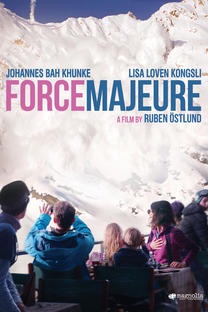
This is a disquieting look into how a single failure, even one that is in no way fatal, can fray the bond of an entire family. Tomas, Ebba and their two young children are on a ski vacation. While having lunch at the resort’s outdoor patio restaurant, at the base of the slopes, a controlled avalanche gets a little out of control and for a moment, threatens to engulf them.

How Tomas and Ebba react, and the aftermath, reveals a great deal about fear, commitment, gender expectations, the frailty of masculinity, the dangers of self denial and the ability of people ostensibly in love to casually, cruelly gut each other.  I know that seems a mouthful, but it’s all there in this literate, intelligent picture. See it with spouse, boyfriend/girlfriend, and/or friends, and you’ll be chatting deep into the night.

The film was rightly bandied as a potential Best Foreign Film nominee, but it did not make the cut,  perhaps because it never takes a strong stand. It is as gray as gray gets.

Remade, horribly, as a Julia Louis Dreyfus/Will Ferrell picture.

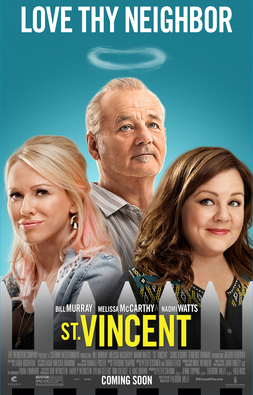
The film has aspirations to Wes Anderson, but you’ll learn quickly, having Bill Murray in your cast isn’t enough. Murray plays an old Brooklyn codger, a man who drinks, smokes, and consorts with a pregnant Russian stripper/prostitute (Naomi Watts, sporting an accent so thick and implausible it would make Gary Oldman recoil and say, “no, no . . . too much”).  He also gambles at the track, is in deep with a bookie, and spits in the eye of anyone who might show him kindness. Yet, he’s cool because he listens to a Walkman that plays kitschy 70s pop or Dylan. So rest assured, this guy has a heart of gold. Naturally, when he gets new neighbors (newly divorced and fed up nurse Melissa McCarthy and her impossibly wise yet innocent son Jaeden Lieberher), he opens up a crack, takes the kid under his wing, and to the track, and to the bar, and in the vicinity of the prostitute.  Predictable hijinks ensue, but when the son gets the assignment at his Catholic school to find a saint here on earth, well . . . guess who?

It’s a testament to the effectiveness of first time writer-director Ted Melfi that he can get you to well up a little on occasion, but that doesn’t change the fact you want to punch him in his face for manipulating you so brazenly.  This is paint by numbers, hip treacle that might make even Zach Braff a little queasy.

I Am Chris Farley - Rotten Tomatoes

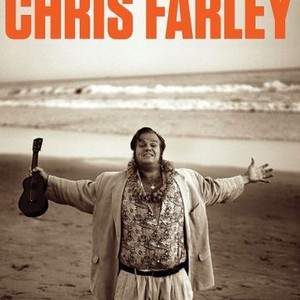
Slapdash, clunky and almost obstinately uninteresting, this 90 minute documentary (of which I watched about 64 minutes) tells us nothing about the comedian that we didn’t already know. He was funny, crazy, sweet, insecure and had a large appetite for drugs and alcohol, which led to his untimely death. He was also surrounded by family, friends and colleagues who I am sure had much more interesting things to offer about him than what was presented here, which comes off as generic or even dull. Some amusing childhood remembrances and cuts of some great Saturday Night Live clips don’t make the effort a total disaster, but it’s a tough slog nonetheless. There is not one anecdote that meets the quality of the dozens reported in Live from New York: An Uncensored History of Saturday Night Live. Worse, the quality of the documentary is shoddy. There is a persistent and annoying background musical track, interviewees are filmed in unnatural poses (Farley’s sister gets a side view that is both unflattering and bizarre), and when we see Adam Sandler, the filmmakers find it necessary to remind us in writing the next time he is shown that, in fact, it is still Adam Sandler.  Poorly done all around.

image

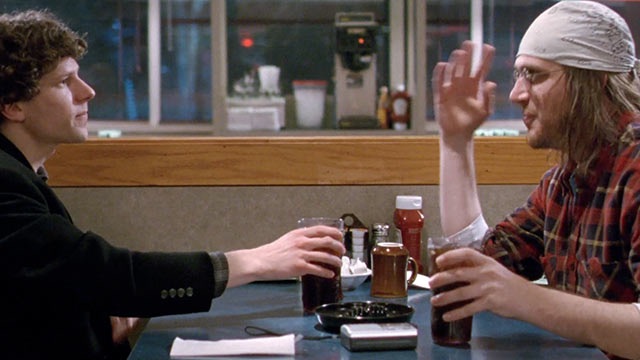
The film is a flawless meander over a few days with an enigmatic and at times debilitatingly insecure novelist.  Jason Segal’s turn as author David Foster Wallace is soul-deep, a particularly impressive performance given that it is from a light comedian. As a film about a doomed man (Wallace hung himself 12 years after the events depicted), the picture is also refreshingly light on foreboding. We are not here to observe the clues that led to Wallace’s demise.  Rather, we are here to enjoy the mind of the author, while being made privy to some of the demons within him, as he is interviewed by a Rolling Stone writer, played by Jesse Eisenberg. We are allowed to hang out with two writers as they discuss their craft, their fears, and America; fence over their different viewpoints and goals through the interview process; and eventually, form a fleeting friendship. Thankfully, the movie is so self assured it doesn’t feel the need to provide the expected big reveal or the emotional paroxysm.

But perhaps what is best about this film – a film about a writer where we do not hear him recite his prose – is the fact that you’ll become affected enough to go read his work after the movie is over. I generally do not read fiction, I have never read Wallace (with the exception of a few magazine pieces), but on the strength of this very personal and intriguing film will read one of his novels.

Image result for Red Army movie

This a great time capsule documentary, providing insight into the post WW II Soviet Union cult of supremacy as manifested in its hockey program. The Soviet military actually ran the tryouts at the Red Army school, winnowing out of the weak and fusing sport with propaganda. The result was a juggernaut that came of age right at the moment it ran into the American team in 1980 at Lake Placid. After that ignominy (the Russians had just beaten the Americans in an exhibition 10-3), the team did not lose a game for the two years prior to Sarajevo, where they won gold, and again, in 1988.

However, the toll on the players was brutal. They spent their time in hockey camps 11 months of the year, and the coach, Viktor Tikhonov, would not even allow a player see his dying father. Perestroika loosened some of the restrictions, but still, Tikhonov, would not permit his best defenseman, Slava Fedisov, to go to the NHL.   Fedisov quit over the prohibition, made his displeasure public, and was ostracized for his impunity.  On the light side, he was denied training facilities. On the harsher, the police in Kiev picked him up, beat him, and then called Tikhonov to pick him up. Eventually, the Soviets allowed the players to play in the NHL, but they took half their salaries (Fetisov said no and was the first Soviet hockey player to get his full check) .

The footage – especially of the fluidity of the Soviet team – is dazzling, and the interviews of any number of direct but impatient Russians are sharp and revealing. The documentarian, Gabe Polsky, is to be commended for including footage of his broad questions, where he stretches to get a response on larger geopolitical issues, only to get a “stupid question” from the “suffer no fools” Fedisov. In fact, it was a stupid question, but we learn more in Fedisov’s curt comment than had he answered the stupid question.

image

First time film director Yann Demange’s cat-and-mouse historical thriller is taut and assured, blending wrenching action sequences with emotional and historical authenticity.  A Brit soldier (Jack O’Connell) detailed to Belfast in 1971 is stranded after a riot in the Catholic section, and he must negotiate an internal power struggle amongst IRA strongmen, retribution from Protestant terrorists, army incompetence, and double-dealings amongst the intelligence personnel that have rank over his unit, to get out alive.

Belfast is portrayed as nothing less than the white man’s Mogadishu, and while there are some intelligent exchanges in first-time screenwriter Gregory Burke’s script, thankfully, there is no time for an examination of the various political agendas and hypocrisies at play.  Instead, the dismal backdrop of Belfast does most of the political talking, taking a backseat to the heart-pounding chase of O’Connell (who played the lead in Unbroken, so he’s created a niche for characters who have been put through the wringer).  It’s realistic, engrossing and heart-pounding.

In an interview, Demange gives a sense of his perspective on balancing the historical and the dramatic:

At first you can say, “It’s ‘Apocalypto’ in Belfast!” And yes it is, but you can’t just exploit a recent and painful period in people’s lives to make a fucking genre picture. And we all knew that. So we knew it had the shape of a genre picture, that’s how we’ll get a 20-year-old to watch it. But it had to have an honesty, a humanity, a soul.

What was hardest was bringing in shades of grey. Because I’m not like a Greengrass, you know? I’m not that bright, I didn’t go to good schools, I’m not a historian. I’m not interested in lessons. I just wanted to connect in a human way.

And I really struggled, when I began, to understand the Loyalist point of view. It was all white noise when I grew up. I was born in Paris, and plonked into Streatham in the late ’70s, ending up in West London, and this thing was just on the news constantly. But no one in my house understood it, it was just, “there’s been another bomb” “Who is it?” “The IRA” “Oh right.” It was like hearing Brits trying to talk about the Algerian conflict: Algeria? Where’s that? Eastern Europe?

We were so parochial, you know? I was amazed how ignorant I was, once I started meeting people and talking about it. I had no idea the level of sectarian division. I had no idea, and why they don’t put it on the curriculum?

Demange does owes a bit to Paul Greengrass’s Bloody Sunday and some more to the Red Riding trilogy, but his vision is unique.  His camerawork alternates between shaky documentarian and lyrical, giving you a breather while amping up the suspense.

As with those films, I recommend use of the subtitles.  I couldn’t understand a damn thing most folks were saying.

.

Image result for ex machina

Writer director Alex Garland has written several very distinct dystopian films (28 Days Later, Dredd) and his directorial debut is assured and not unexpectedly, unique. Oscar Isaac is Nathan, a Steve Jobs-esque reclusive titan who invites Caleb (Domnhall Gleeson), a coder at his web service monolith, to his retreat deep in the mountains to conduct the testing of an artificial intelligence being (Alicia Vikander) he has created. While Nathan and Caleb start off in an awkward forced friendship hampered by their employer-employee dynamic, and the fact that the reason for Caleb’s selection seems flimsy, they soon become adversarial – with Nathan chastising Caleb for his unscientific approach and Caleb increasingly distrustful of Nathan’s methods. It then becomes unclear exactly who is being tested, Eva, Caleb or Nathan, as the three negotiate their roles while strategizing to achieve their aims.

Expertly paced and beautifully photographed, there is a little bit of Her and Spielberg’s A.I. in here, but ultimately, the film that best captures the ethos of this picture is Mousetrap. This is an intelligent, absorbing and imaginative sci-fi thriller which rejects shocks for a slow dance and smartly realized  dawning at the end.

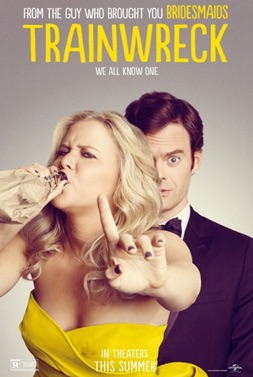
imageAfter the gruesome This is 40, it’s good to see Judd Apatow back.  He owes it to Amy Schumer’s crackling script and impressive breadth, as well as an unexpected Bill Hader as a rom-com lead and fantastic support, especially cameos by non-actors LeBron James and John Cena.  Schumer is a loose narcissist who shuns intimacy when she is given the assignment to write a magazine piece on Hader, surgeon to sports stars.  They click and he weans her off her casual cruelty, but, of course, she relapses and then . . .

Schumer is very funny, as evidenced by her Comedy Central sketch show, where she melds winning and loathsome, no small feat (Lena Dunham has mastered the same trick).  Schumer digs a little deeper here, showing some real depth in a few scenes of despair, so you’re rooting for her, a critical element for a rom-com.  As noted, she’s well-supported, and James is particularly memorable as himself, although I don’t know if he is notoriously cheap, into Downton Abbey, or so relentlessly competitive that he wouldn’t let up on the likes of Hader in a game of one-on-one.

There are some problems.  The film is too damn long at two hours, and the scenes that could be cut (an unfunny intervention, a scene where Schumer condescends to two stock, unhip suburbanites who don’t stand a chance, an overlong wacky seduction, one scene too many of an otherwise hilarious and barely recognizable Tilda Swinton as Schumer’s boss) are obvious.

Still, what’s funny is very funny and the picture sticks the landing.