Archive

Genre

image

Grim. Dreary and grim. As grim as any trench in World War I, where the entire film is set. We spend four days with a British unit about to be overrun by the Germans in the spring 1918 offensive.   There is no story arc, just the pitiful and doomed interplay between several officers.  War remains hell.

Mostly well acted, and in particular, Paul Bettany stands out as a doomed and comforting older officer, but that’s about it. This is a hard slog, though, mercifully short.

d714221b-26f1-468b-b825-744fd2f9179f

A technical advance in both sound and movement, and a caustic, first-of-its-kind black comedy, Robert Altman’s M*A*S*H was once deemed a masterpiece. Alas, now, it is as culturally atonal and offensive as Gone With the Wind.

The women in the film are nothing but sexual playthings, constantly subject to the predations of Trapper John, Hawkeye and all the rest of the misogynists who inhabit the camp. The nurses are first and foremost flesh to be pawed at, conquests to be made. Add an indelible strain of homophobia, a black character named “Spearchucker” and Trapper John and Hawkeye in Japan yukking it up with racist Charlie Chan imitations, and you end up with the transformation of what used to be an iconic, anti-establishment, anti-Vietnam (Korea just plays the part) film into a vessel for the most retrograde and debilitating of social views, a moral blight as offensive as blackface.

Mind you, I do not come to this conclusion lightly or happily. Before my own reeducation, I would have found this a clever, funny and brash film. The characters possess incredible medical gifts and live in an untenable situation, surrounded by gore and death, and they resort to sophomoric gags and easy sex because that’s what some people under stress do, especially in dark comedies. The old me would view this film as cruelly hilarious. I might have also found the treatment of the women tempered by their corresponding consent, agency and obvious value to the camp.

But that was before I understood the power of patriarchal constructs. My God, at one point, Hawkeye brings a female nurse to a depressed colleague as if she were a comfort girl to a marauding victor. And she is dreamily driven off, her lust was so sated.

The brutal ouster of the pious Frank Burns and the ritual humiliation of Hot Lips Hoolihan aren’t the mere comeuppance of villains. Watch again as she is unbared in the shower. The leering men settle a bet as to whether she is, in fact, a true blond; she writhes, naked, abused, on the shower floor while they hoot and holler and jeer.  Despicable.

God help the campus movie house that accidentally runs this baby.


image

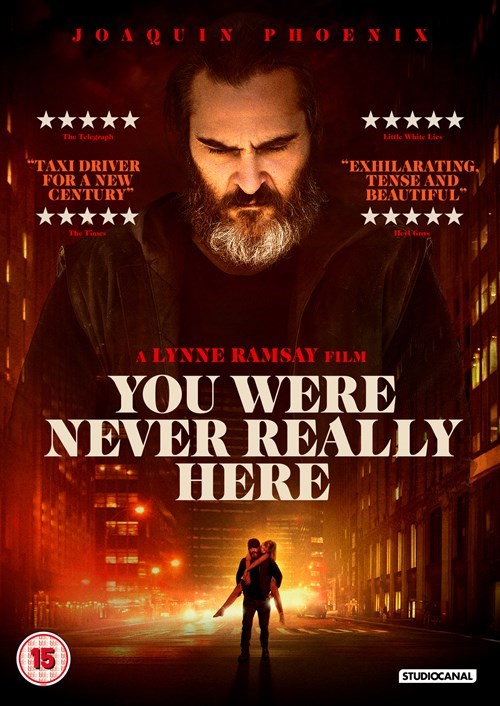
Arty, messy, self-indulgent and obtuse, a very bad movie. Joaquin Phoenix plays a violent loner with a side line finding missing children and beating their abductors with a ball peen hammer. He himself is plagued by childhood trauma, trauma from the Iraq war, and even more trauma from his time as a border agent? I don’t know. It’s all in flashback and unnecessarily muddled.

He catches the wrong case, saving a pre-teen girl from a sex ring who just happens to be the favorite sexual partner of the governor (Allesandro Nivola, who has zero lines). That’s right, the governor of the state of New York is a pedophile, and at his disposal are numerous police officers and security men who will murder on his behalf so he can continue his disgusting practice. Hell, Trump can’t even get people to shut up about cadging Hillary’s emails.

But I digress.

Really dumb, with the primary feature of creating lethargy and numbness in the viewer.

But what do I know?  It got 89% from rottentomatoes.com. Currently on Amazon.

Image result for First man

Damien Chazelle has directed two gems (Whiplash, La La Land) that could not be more different, and his third picture is every bit as accomplished and even further afield tonally from his prior movies.  On the surface, the film is the story of Neil Armstrong (Ryan Gosling) and the Moon landing, but this is not the gripping, white-knuckle paean to American ingenuity that was Apollo 13 or the sweeping, ironic The Right Stuff, both exquisite films in their own right.  Instead, this is the personal story of Armstrong and his wife Janet (Claire Foy), who, after having lost a young daughter to a malignant tumor, forge ahead in the space program, where calamity is a daily feature.  It’s a beautiful, personal picture, seamlessly melding the grit and determination of one family with an overarching, monumental and patriotic (more on that below) achievement.  It is one of the more moving yet subtle films I’ve ever seen.

Two addenda.  First, the omission of Gosling and Foy in the acting categories for the Oscars is, in my view, the filmic version of the Saints-Rams no-call.  Gosling’s driven and emotionally-stunted introvert is meticulous and engrossing, a master class in precision (think Casey Affleck in Manchester by the Sea).  Foy, as the wife holding it all together, is simply heartbreaking.

Second, this film caught some flack for failing to depict Armstrong planting the American flag on the Moon.  When asked (and never ask an actor anything), Gosling took as stab at an answer, observing that the landing “was widely regarded in the end as a human achievement” and that he didn’t think Armstrong “viewed himself as an American hero.”

And . . . .kaboom!  The culture dummies – this time on the right – went after the picture, as some sort of anti-American agitprop.  Little Marco Rubio was particularly incensed:  “This is total lunacy. And a disservice at a time when our people need reminders of what we can achieve when we work together. The American people paid for that mission,on rockets built by Americans,with American technology & carrying American astronauts. It wasn’t a UN mission.”

The criticism is moronic.  Films are not required to meet a quota of patriotic content.  Worse, though, the charge is false.  The singular American achievement of the landing is represented by footage of JFK literally crowing over, well, the race to that achievement.  Moreover, there is footage of a French woman who observes, “I always trust an American. I knew they wouldn’t fail.”

As if that idiocy wasn’t enough, the left weighed in to label the film a right wing fetish object with a “misbegotten political premise that America used to be greater—and that the liberating and equalizing activism of the sixties ignored, dismissed, and even undermined that greatness” or, gasp!, potentially dangerous for reinforcing the “pervasive notion about achievement—that it occurs when people toughen up and don’t let feelings impair their judgment.”

What a bunch of fucking losers.

Image result for Annihilation

I loved Ex Machina but Alex Garland’s follow-up falls short.  Given the film’s ambition, however, it is a noble failure.  Natalie Portman is an ex-military, now-professor whose Special Ops boyfriend (Oscar Isaac) goes missing after a clandestine mission.  When he returns, in very bad shape, she is drawn to the mission herself, and soon finds herself part of a five person team entering “The Shimmer”, a disorienting, disturbing, inexorably expanding mass of acreage that started when something from the sky hit the ground.  As the team enters to get to the source, they are transformed by their environment, and I’ll leave it at that.

It’s pretty damn cool.  But ultimately, Garland relies so much on the visual for his message that the picture serves as more of an aesthetic treat than a compelling story.  The ideas are boffo, but the execution is a bit dreary and drawn out, and frankly, like Arrival, this film may just be over my head.

There are other problems.  Portman’s harkening back to her transgressions in her relationship with Isaac seems silly given the gravity of her situation.  I was reminded of a stupid movie I saw years back about a group of gals who decided to have a bachelorette weekend spelunking, as most women do, and as hideous mole people chased them through caves, the fact that one of the women slept with the fiancée of another actually loomed large.  “Okay, okay.  I slept with your boyfriend.  Not cool.  Now, can we get back to the mole people?”

One last note – I’m down with 5 women on a military/scientific exercise, but one should be aware of the Ghostbusters re-make and maybe switch up the uniforms.  I half expected

Image result for Ghostbuster green ghost
to show up.

On Hulu now.


Related image

Barry Jenkins’ Moonlight was the best film of 2016, and his latest picture is of the same high quality, with the same dreamy, contemplative finish.  Told in flashback and forward, Jenkins’ script is based on a James Baldwin novel set in 1970s Harlem.  We meet childhood friends Tish (Kiki Layne) and Fonny (Stephan James) as young adults who have become lovers.  Fonny is imprisoned for a crime he did not commit, and a pregnant Tish, with her family and Fonny’s father, work to pay the legal fees and perform the legwork to free Fonny from prison.

While this film is about many things, at its core, it is a love story, and Baldwin lovingly melds the city and the courtship with great care.  There are scenes that seem almost like portraits, sensuous and evocative, such is the care he takes with his actors and the setting.

The film is also about race, and in this regard, it is subdued in its expression but forthright in its message.  Baldwin is not interested in a political discussion, but instead, a demonstration of how racism pervades the lives of his characters in the seams, adding just another weight to an already heavy institutional burden.  In the wrong hands, the theme would be overwritten and perhaps worse, overacted.  Not here.  The drag of the inequity is not sugarcoated but rather, presented as an open, inescapable legacy for the characters, which leaves a deep impression.

I have two criticisms.  First, Tish often speaks in voice over, which I am not opposed to in all circumstances, but which also suggests a little distrust in the narrative.  Given the ethereal nature of the picture, Jenkins likely felt it necessary to have Tish’s voice explicitly draw us back to the story, but I found it obtrusive and unnecessary.  Second, a racist cop sends Fonny away, and when we meet him, he is so gruesome, so cartoonishly evil, it almost felt as if he would twirl his mustache.  Perhaps that is what Jenkins was going for, to show the cop as the bogeyman the characters see, but I have to say, it was discordant.

Finally, all of the performance are impressive, but as Tish’s mother, Regina King is understated, yet commanding.  She is a veteran of many movies (Ray, Enemy of the State) and even more TV series where she’s mostly powerful and overt, but here, she transcends anything she has done before with a subtle, restrained, nuanced performance.


image

The film is conceptually ingenious, spooky, nerve wracking, terrifying and meticulously paced and acted. This tale of a family’s descent into madness and the occult scared the bejeezus out of me. Only slightly gory, the horror is all psychological. It is, however, very cruel to its characters, sometimes too cruel even for me.

I’m getting too old for this shit.

The Death of Stalin (2018) - Rotten Tomatoes

Imagine HBO’s Veep, but instead of the made-up travails of a narcissistic, ambitious politician in the form of Julia Louis Dreyfus, you have Khrushchev, Beria, Molotov, Zhukov and Malenkov, all jockeying for power and survival after Stalin has passed.  Like Veep, writer-director Armando Iannucci’s movie is undeniably hilarious, providing the entire swath of the comedic, from slapstick (the scene where each central committee member arrives at Stalin’s unconscious body on the floor, only to engage poorly with his urine, is gut-busting) to sharp wit delivered so fast, you catch it 30 seconds later.  Steve Buscemi’s scheming Khrushchev is inspired, as is Jeffrey Tambor’s vain toady Malenkov (good to see him again since his banishment for his own crimes against the state).

The only aspect that drops this a half point is the milieu.  It is undeniably funny, but we are dealing not with the trials and tribulations of Vice President Selena Meyer, which are ultimately trivial, but the terror and horror of the Soviet state, which sometimes tempers the laughs.

But only a little (at least, for me).  It is, after all, a very black comedy.  The film is currently on the Showtime schedule and was also one of The New York Times top 10 for 2018.  It’s also one of mine, thus far.

Image result for Dead Man Walking

I caught this a few rainy days ago.  There are very few films that deal with contemporary hot button issues well. Most of the time, the inclination of the writer and director is so patently obvious that the art is robbed of plausibility and force.

This movie is an exception.  The issue is subordinate to the human story, and while that story is primarily told from the viewpoint of an anti-death penalty character (Susan Sarandon as Sister Helen Prejean) ministering to convicted murderer and rapist Matthew Poncelet (Sean Penn), that in no way colors the message, which is admirably equivocal, even, to my mind, shockingly, a hair pro-capital punishment. That is probably just me, given the hackneyed uniformity of most such films, but that the picture provides an emotional and almost ethical argument for the practice is astonishing.

Sarandon is restrained and effective as a woman of faith called to provide spiritual comfort to a man who has committed a monstrous crime, and as that man, Penn exhibits all the bravado, self-pity, cruelty and narcissism of a thug.  Eventually, she learns she is not there to redeem him in any way, and shucks off her self-comforting fantasies that he was just a good boy led astray,  and focuses on simply leading him to confession.

Director Tim Robbins takes meticulous pains to display the brutal toll on the victims’ families and has the balls to juxtapose the execution with an unforgiving flashback of the crime, and unlike what Poncelet has been selling Prejean up until the last moments before he is executed (he is innocent, he was stoned, his accomplice did the killing and raping and things just got out of hand), those flashbacks show him as a vile, entirely in control piece of shit.

Nobody is caricatured. No easy rhetorical gotcha’ lines are delivered.  The employees of the prison, the medical professionals involved in the process, the families, they are treated with rare grace and equanimity.  An example: Sarandon has dinner with her wealthy family, some of whom question her service to Poncelet.  In the wrong hands, they would have been portrayed as the aristocratic, privileged rich, more concerned with their name and espousing small, likely bigoted views.  Robbins, however, shows them as loving and concerned, with questions (“Why spend so much time on this cretin when you could be helping young children not to grow up into becoming this cretin?”) similar to that of the audience.

Similarly, Poncelet is never a beatific victim.  Near the end, he praises Hitler, he spews racist invective, he even makes a sexual come on to Sarandon.  But she works with him, to help him find a dignity within himself through the sole act of the admission of his guilt and contrition.

Great film.