Archive

Genre

Us - Official Trailer [HD] - YouTube

One of the few movies I can recommend you see IN the theater.  I didn’t hear a murmur.  Not one popcorn chomp, not one whisper.   We did, however, all scream at the right places.

A  fun, terrifying roller coaster ride meant to be enjoyed communally, Jordan Peele’s second film ain’t deep, but it is accomplished, devastatingly funny and thoroughly engrossing.

I can’t speak much to the plot, as it would just give it away, so I’ll leave it at the following.  The film is spine-tingling, brilliantly scored, and Peele never makes a wrong step.  His ken for arresting and creepy imagery is stunning, the script is clever, and the twists are well-founded and earned.

Afterwards, you will find that it does not hold up to logical scrutiny yet that failure doesn’t make a damn bit of difference to your enjoyment of the picture.

7C9B9607-6014-41E4-8234-36FA8FCA7AC5

A filmmaker who can communicate his vision entirely is a rare thing, even if the vision is too reliant on cruelty.  Yorgos Lanthimos’ The Lobster was as original as it gets, but also sterile, unfeeling and unpleasant. The Favourite, a period piece of court intrigue, is more traditional but it shares The Lobster‘s iciness.

Rachel Weisz and Emma Stone attend court and vie for the attentions and favor of Queen Anne (Olivia Coleman). Weisz wants power, Stone security. They share a weary, dim view of their male dominated world; the men are for the most part fops, suck-ups, and/or brutes, and it is amusing to watch Weisz and Stone endure them.  And while their war has its moments, their single-minded pursuit of the upper hand is rooted solely in the base instincts of survival, so it’s hard to gin up any empathy. You’re detached from their fates, and the accompanying pain. They flash as human, but they don’t really seem it.

The performances, however, are stellar.  Coleman’s turn as the mercurial and insecure queen, for which she won the Oscar, is a masterful blend of the sympathetic and comic. She is the ultimate tormentor, but ironically, she’s the only one you feel bad for.

It’s a technically adept yet a frigid and un-involving picture.  Lanthimos (who reminds me of Darren Aronofsky in his penchant for brutalization) also has a morbid fascination with bodily functions, which doesn’t help.

Image result for Solo movie

The crossover movie that speaks to kids and adults is a tough trick.  Guardians of the Galaxy is the model.  The characters have to be winning, It has to be smart but not obtuse, and what can be mutually enjoyed (action, wise-crackery) must be primo.

Solo fails all of these prerequisites.  At the outset, we get “Long ago, in a galaxy far far away . . . “  Followed by several more paragraphs setting the scene and presenting the quest, which in this case, is the obtainment of everlasting life and power enough to challenge evil in the galaxy.

I’m fucking with you.  The quest is for fuel.  Yup.  Fuel.  I mean, not as bad as one of the Lucas pictures (1, or 4, who knows?), where, if memory serves, the primary issue was taxes.  But still, pretty bad.

The dull goal is matched by duller characters.  Young Han Solo (Alden Ehrenreich) apes the original via the sole utilization of a smirk.  He’s a better choice for a young Paul Rudd, not Harrison Ford.  He’s not as bad as Hayden Christenson as Darth Vader the teen, but he’s close.  After him, bad guy Paul Bettany, well, his thing is that he gets angry.  And then there is Woody Harrelson, the grizzled smuggler and thief, who keeps telling Han, “Don’t trust anybody.”  Then he pulls him close, points to his own head, snaps a Polaroid, waves it, blows on it, shoves it in Han’s pocket, and says “Anybody!”

After these dolts, it’s just a bunch of facsimiles of all the weird variations one can find in the galaxy.  “Hey look, it’s clarinet head!”  “And there’s suckhole face!”  “And does he have 5 arms?”  “Ah, I get it!  That’s why they called him ‘handy’ a minute ago.”

And then there are the droids.  In the first picture, we had the gold guy who spoke with a British accent and was amusing, like having a character from Downton Abbey in the future.  He said things like “Goodness!  Oh my!” and “My heavens!” whenever someone shot a laser near him.  I could see a droid maker coming up with such a program, a little pizzazz in the automaton that normally performs light-dusting and household repairs.

Now, however, all droids have been imbued with feelings and opinions and agency.  Who the hell wants a droid that may start a wage strike?  The writers, that’s who.  It’s too ridiculous, even for this pretty ridiculous vehicle.

The script itself is similarly idiotic.  The characters just bounce from place to place for small and uninteresting reasons.   “Who is that?” Is generally followed by a long definitional response.  “That was close!” elicits “Not as close as the parseck gleep glop on Miki Roo Roo!”  Characters say banal things to Solo throughout, followed by or including “kid”, as in “You got moxie, kid!” Or “I’ll give you this.  The kid’s got guts.”

That leaves the action sequences, which are required to dazzle.  They don’t.  They’re rote and uninspired, delivered in a look dark as dishwater.  Worse, the soundtrack is phoned in, as if the John Williams score was presented as Muzak on an AM radio in Harrelson’s pocket.

This entire picture feels like a 4-D Disney ride that would be fun for 7 minutes.

But trapped in it for over 2 hours? Excruciating.

And you know Han and Chewy make it. They have to. So, there’s no drama. Nothing hangs in the balance.

Donald Glover does a decent young Billy Dee Williams and Emilia Clarke (Game of Thrones) lends some gravitas to the endeavor.

On Netflix.



FDEE7D08-09FB-462C-859E-80CC4A421583

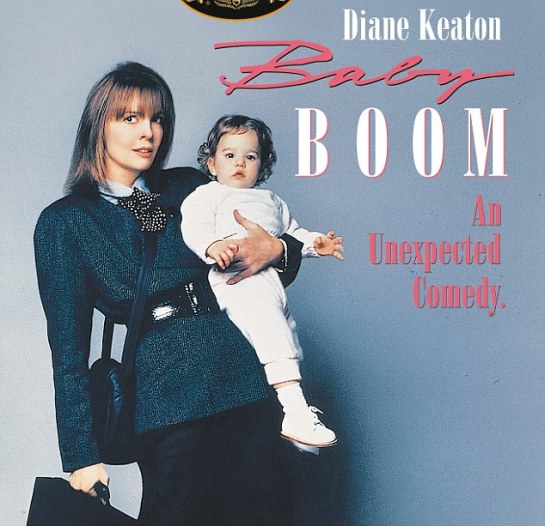
We always loved Baby Boom because the toddler reminded us so much of our daughter, in that she was adorable. I concede, one’s own daughter is always adorable. But our daughter was and is, objectively, adorable.

I digress.

Baby Boom is currently on the Showtime rotation and in watching to see the facsimile of our daughter, we caught the entire picture. The little girl is still cute. The 1987 film, however, does not travel as well as the kid.

Diane Keaton is the go-go Manhattan executive on an upward trajectory when a long lost and recently deceased relative delivers her a beautiful little girl via will.

It’s a broad comedy.  I can accept that a baby would be delivered at the airport at the mere stroke of a pen. I can accept that the cutest baby in the world would almost be transferred from a Manhattan agency to a cold, poor, backward Iowa couple. I can accept that James Spader in a suit is a villain. Well, that last one is a requirement for 1980s films.

But after Keaton keeps the baby, she is so inept – as demonstrated by numerous silly vignettes of a Weekend at Bernie’s stripe –  it becomes unfunny.  She deposits the baby at a coat check. She can’t negotiate a disposable diaper. She feeds the doll pasta and red sauce.  Hilarity does not ensue

It’s just easy, schlocky and weak. And when she is jettisoned by her company, you don’t have the sympathy for her that you should.

After getting demoted, Keaton takes the baby to Vermont, buys a dream house that is actually falling apart, meets rustic veterinarian Sam Shepard, fights with him until he forcibly kisses her, then has rewarding and fulfilling sex with him, and then starts her own successful baby food chain, all to the standard twinkly saxophone and Kimball organ score of the time. Whereupon, the corporate heels call her back to offer her the moon for her little company.

She declines, delivering a confused declaration of independence, a stemwinder announcing that 1) she should not have to choose between family and work; 2) she should not have to move operations from quaint Vermont to Cleveland; 3) James Spader is a rat; 4) she may just take her baby food company national herself; and 5) oh, she’s having rewarding sex with Sam Shepherd.

Except 1) they offered her $3 million and a COO job at nearly $1 million per, but it was the opening offer and she could have asked double, while getting a ceremonial board seat or do-nothing exec slot with an ample salary; 2) they said at the outset the move to Cleveland was negotiable; 3) she could have insisted Spader work the account and tormented him unmercifully, or she could have asked for his head to seal the deal; 4) there is no way she could take this company national; she can’t operate a pair of Pampers; and 5) swooning, with an actual sigh, about Sam Shepherd in a business meeting reinforces a lot of the stereotypes the stemwinder was supposed to rebut.

But the baby is adorable.
EFDFA64D-0815-48BE-B103-65A482CB8851

When Spike Lee acted like a petulant fool after BlackKKlansman lost Best Picture to Green Book, it seemed silly, and given the mediocrity of his own picture, a sad stunt.  But I get it Spike. I apologize.

The story of classical pianist Dr. Don Shirley (Mahersheela Ali) who enlists Italian bouncer Tony Lip from New Yawk (Viggo Mortenson) for a Southern swing of concerts in 1962 is so chock full of cliche’, it borders on spoof.  Ten minutes in, you know that the hotheaded Tony will hit a cracker cop, the cultured Shirley will play boogie woogie in a honkey tonk, and they will teach each other, oh, so many things.

Sadly, it is not a spoof.

This picture is atrocious. Simplistic, repetitive, nonsensical, and boring.  It has no idea what it wants to be. A civil rights era Odd Couple?  A moral tract about role reversal and rejection by one’s own race?  A road movie?  It does none of it well.

But it has a white guy teaching a black guy the joys of fried chicken, so, there’s that.

The characters lack any consistency. When black men perform repairs at his apartment, Tony throws away the glasses the men drink water from, such is the viral nature of their cooties. But in the blink of an eye, he is driving a black man around, comfortable not only with his boss’s skin color, but his homosexuality.

’Cause he’s been around nightclubs, and tings, day get, complicated. Mangia, manigot, caprese, spumoni, to da’ moon, Sbarro!

And while Shirley is supposedly working the southern swing in solidarity with Nat King Cole, who was beaten years earlier for playing white music, he also inexplicably plays private affairs at the homes of cartoon bigots. For what, I don’t know. Cash?  Self flagellation?  And when rich Southerners have a cultured pianist perform at their homes and eat dinner at their table, he is still sent to the wooden outhouse to pee.  Jesus, even in The Help, the bathroom had plumbing.

Making matters worse, Viggo Mortenson’s tough guy driver from da’ Bronx is so broad, so exaggerated, you can’t believe what you’re seeing. He’s half Joey from Friends, half The Fonz. He actually says Ba Fongool.  Or Ba Fon Goo. Or whatever they say in Chef Boyardee commercials.  He’s brutal to watch, yet, a thing to behold.

It ends sweet and there is charm in its insouciance as to its own plausibility or depth, but that gets you exactly one star.

Oscar?  Fuggedaboutit!!!

Image result for Studio 54 documentary

This received an 89% on Rottentomatoes.  I can’t imagine why, unless the answer can be found in the desire for heartfelt tributes to other trivialities, like Luke Perry.  Or Silly String.

The film is mundane, there is nothing new to learn (“oh look, Andy Warhol . . .oh look, Truman Capote”), and ultimately, the story of a disco nightclub open for less than three years can only be so compelling.  Of course, when the various interviewees fix the heyday of that nightclub into the fabric of our times and who we are as a people, all the coke, sex and disco balls in the world can’t erase that blot.

I will give it this:  I laughed when one of the employees explained that Mick and Keith could get in for free but the rest of the Stones had to pay the cover.

Currently available on Netflix.


88500353-FBE8-4895-81A4-D9BC86BE1862

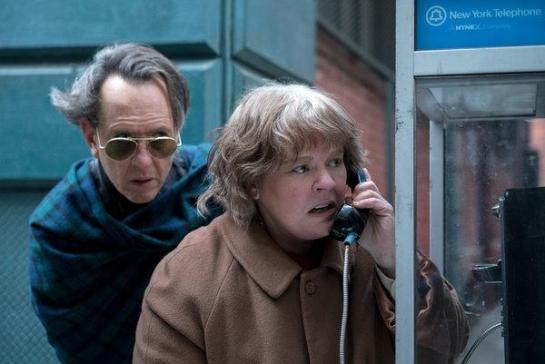
One of the best of the year, powered by Melissa McCarthy’s misanthropic turn as a struggling biographer in the leanest of times. Unemployed, unpublishable and unliked, McCarthy (playing writer Lee Israel) hits upon a scheme to forge letters from the ranks of Noel Coward and Dorothy Parker and soon, her money woes are over. The endeavor also fills an artistic void. She takes pride in her turns of a phrase and bon mots, her work put in the mouths of giants, and she is invigorated. It all goes bad, as it must, but it is eventually to the good.

I can’t say enough about McCarthy. She inhabits the skin of Israel, with a vicious self-protective quality and a reflexive meanness. Yet you invest in her. Her bitter exchanges with her agent and attorney are both hilarious and poignant.

There is good in her, and a hell of a lot of hurt, both of which are unearthed by her chance friendship with an elegant scammer and libertine, Richard E. Grant.  McCarthy and Grant were rightfully nominated for Oscars and it is a joy to watch him match McCarthy’s desire to be left alone with an insistence that they will be friends.  Their hi-jinx and commiseration are the heart of the film.

I was blown away by the fact that this is director Marielle Heller’s first major feature.  It felt like the work of an old hand, steady, confident and mature. The movie skips with ease but pauses for moments of true beauty and consideration.

This is an elegant movie, folding how much people need each other into a very funny, well-told story.

190D5A0E-F567-4FE3-ABF0-126B8A846388

I always thought Queen was camp, a goof, and their primary contribution was “We are the Champions” and “We Will Rock You” which you sang in the bleachers during CYO basketball games. When I realized some people thought they were a great band, I was surprised. So, I walked into this as if it were a biopic of Emerson Lake & Palmer. Or Kansas.

Still, a great movie does not have to be about a great band. This, however, is not a great movie. It is cookie cutter, inoffensive, as risk-averse a biopic as you’ll find (it’s clear why Sacha Baron Cohen was jettisoned from the project), but well-paced and energized by the erstwhile Bryan Singer and made a little more interesting by Rami Malek’s weird, lizard-like performance (he’s just this side of Bela Lugosi, you never know if he’s just about to bite someone on the neck).  To be fair, Malek is also very moving towards the end.

The scenes of the band playing live and in studio are silly. The scenes of the band talking about the music and themselves are like a slightly more serious episode of the Monkees.  The rendition of the creative process is hilarious.

The primary feeling you’re left with is foreordained watching any story sanctioned by its subjects (the band had script approval) – it’s pleasant.  Rock and roll, drugs, cats and AIDS, brought to you by Disney.  It’s formulaic, harmless and overlong at two hours and fifteen (ending with an extended scene of their set at Live Aid, which is dull in that Malek is lip-synching), but not unentertaining.

C69F2668-7D2E-4686-AF37-4725FE485E36

Starts out strong, a big, sweeping saga, great chemistry, starry and charming. There is even a real connection on stage.  Twenty minutes in, I thought I was in for a treat, and I was enthused to see an old fashioned big star Hollywood love story instead of a tired rom-com with an ugly dude, snark and irony

And then it just drags, with nothing occurring you don’t expect to occur, and what you do expect is very humdrum in the way it occurs.  Lady Gaga is not godawful but she is not good.  She is too raw, too one-note, and has no real feel for the moment, just doe-eyed insistence.  Bradley Cooper is effective as a haunted guy in a stupor with the biggest Daddy issue ever, but it ain’t heavy lifting, just a lot of looking down and slurring.

As the relationship goes longer, you realize, not only are they banal, but so are their circumstances.  She’s a bit of a petulant dummy and he’s an underdeveloped weakling.  One would think the glitzy world they inhabit would be treacherous and exciting, loaded with landmines and seductions.   One would be wrong.  They spend most of the time in bathrooms or in front of dining room or coffee tables, warbling on about nothing.

When not boring, the script is just a jumble of cliche’.  They have the same damn argument and Gaga gets worse as it goes on, more Snooki than Streisand.

It is also poorly edited. Scenes just abruptly and jarringly end. There is no flow.

This is not a good movie. It was good to see Andrew Dice Clay (as her father), though.

FC2209D5-D8AC-4A9A-9DEB-858C1B287A29.jpeg

Captain Fantastic was about a father who raised his kids in the woods because he did not trust modernity. It was a terrible movie, mainly because the grown man (Viggo Mortensen) wouldn’t shut up about his philosophy and how superior it was. This movie is about another father (Ben Foster) who insists on living off the grid with his teenage daughter. This is a better film, and the relationship between Foster and Thomason McKenzie is well developed.  But their circumstances suffer from too little explication.  Why are they off the grid? What brought them to this extremist situation? All we really know is that Mom is dead, Foster is introverted and plagued and that as much as he appears to love his daughter, he is really just making her share his demons.

McKenzie is accomplished as the girl torn between loyalty to her Dad and a need to connect with and be in the wider world.  Her desire to commune, to be a part of, is heart-rending.  Writer-director Deborah Granik’s Winter’s Bone put Jennifer Lawrence on the map and I can see this film doing the same for McKenzie.  Foster, as always, is stellar as the troubled father, economical and precise.  There is a scene where he is required to answer a computerized voice asking him true or false questions to determine his mental health that he handles beautifully.

There is also a thematic bright spot.  The duo are consistently helped by people who are outgoing, caring and supportive, and yet, Foster rejects all their assistance, underscoring just how near impossible it is to deal with many mentally ill people. The system and surrounding community are, for a change, not the villains. They’re the heroes. And for the most part, it ain’t enough.

On Amazon.