Archive

Musical

Great, wondrous fun, a spectacle that exceeds its promise.

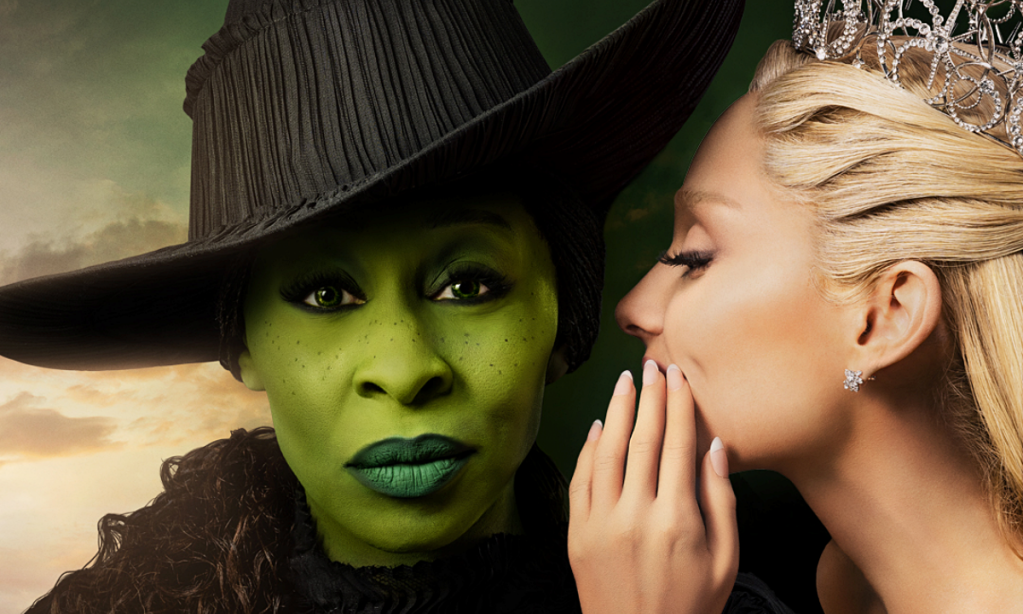
Ariana Grande (Glinda the Good) and Cynthia Erivo (Elphaba the Wicked) are young schoolmates in the land of the Emerald City (at a brighter, more colorful Hogwarts), immediately antagonistic, then fast friends, and we see them as they begin their journey to Elphaba’s ultimate end (“I’m melting!”). History, as they say, is written by the winners, and now, we have the real story, to song.

Both actors are splendid, mastering very difficult vocals while establishing strong chemistry and exhibiting astute comic timing. Director Jon Chu (Crazy Rich Asians) moves the film at a dizzying pace but keeps space for the tender moments. And while I always felt the Broadway musical was marred slightly by a few uneven or underwhelming numbers, as committed to screen, “Dancing Through Life” is majestically choreographed and “I’m Not That Girl” subtly moving.

A few issues. First, there is an underdeveloped subplot of official antipathy to animals, who were once contributors to Emerald society but are now being shunned and caged. Not that this is a political potboiler, but the issue is presented perfunctorily as a fait accompli. Given that the matter is the breaking moment between the Wicked Witch and the Wizard (underplayed in a disinterested, almost blase’ manner by Jeff Goldblum), there needed to be more, and it could have been provided in the existing framework.

Similarly, when the girls get to Oz to meet the Wizard, there is an expository number to provide the basis for the rise of the Wizard and the source of his power. The number allows for the return of the Broadway originals Idina Menzel and Kristin Chenoweth, but it is clunky and not really all that explanatory. I needed my daughter to explain to me what the hell was going on.

Again, minor nits. Total blast!

For a music bio, you can max-mythologize a dolt and maybe no one will notice the subject is super boring.  See The Doors. Elvis. Bohemian Rhapsody.

Or you can play it straight and overarching, maybe puncture the myth in parts, but ultimately, tell a big, soup-to-nuts, rags to riches story rather than create more ornament for the church.  See Ray. Straight Outta’ Compton. La Bamba.

But when you add kick-ass performances from people who can really sing, and a thoughtful, tight script, then I’m in.  See The Buddy Holly StoryCoal Miner’s Daughter. Walk the Line.

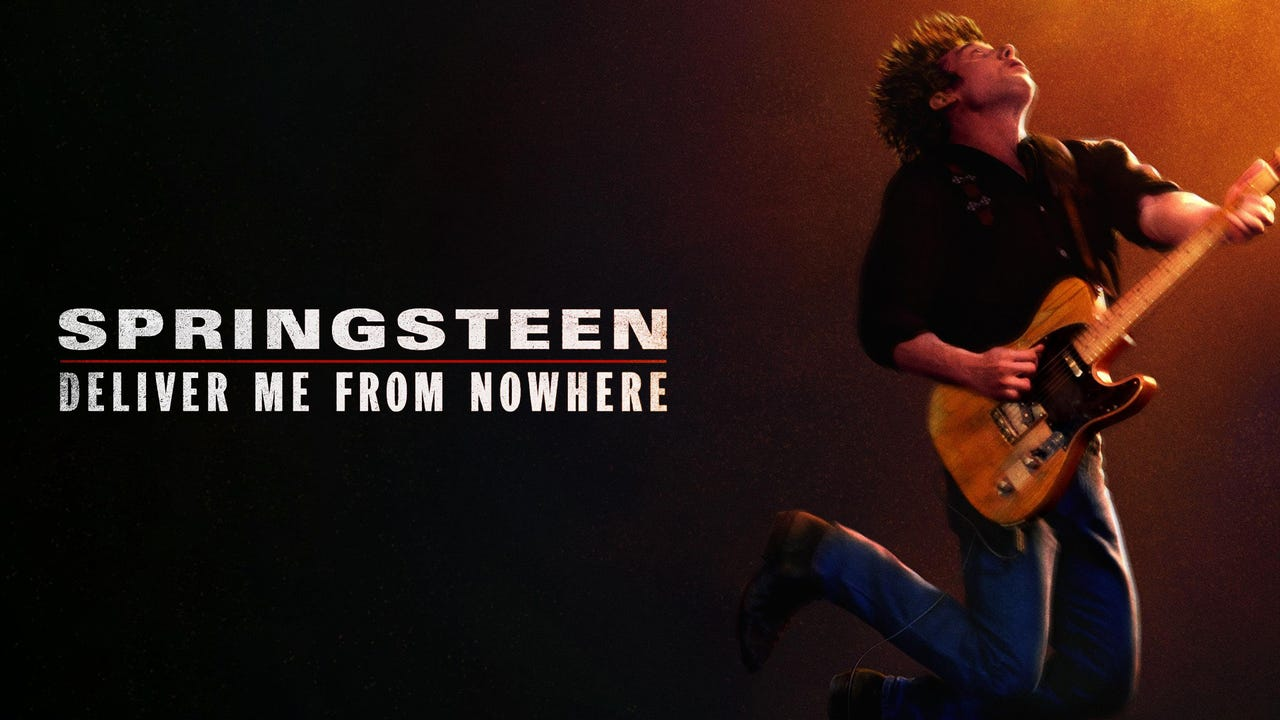
Luckily for Bob Dylan, the director of the latter, James Mangold, took this picture on.

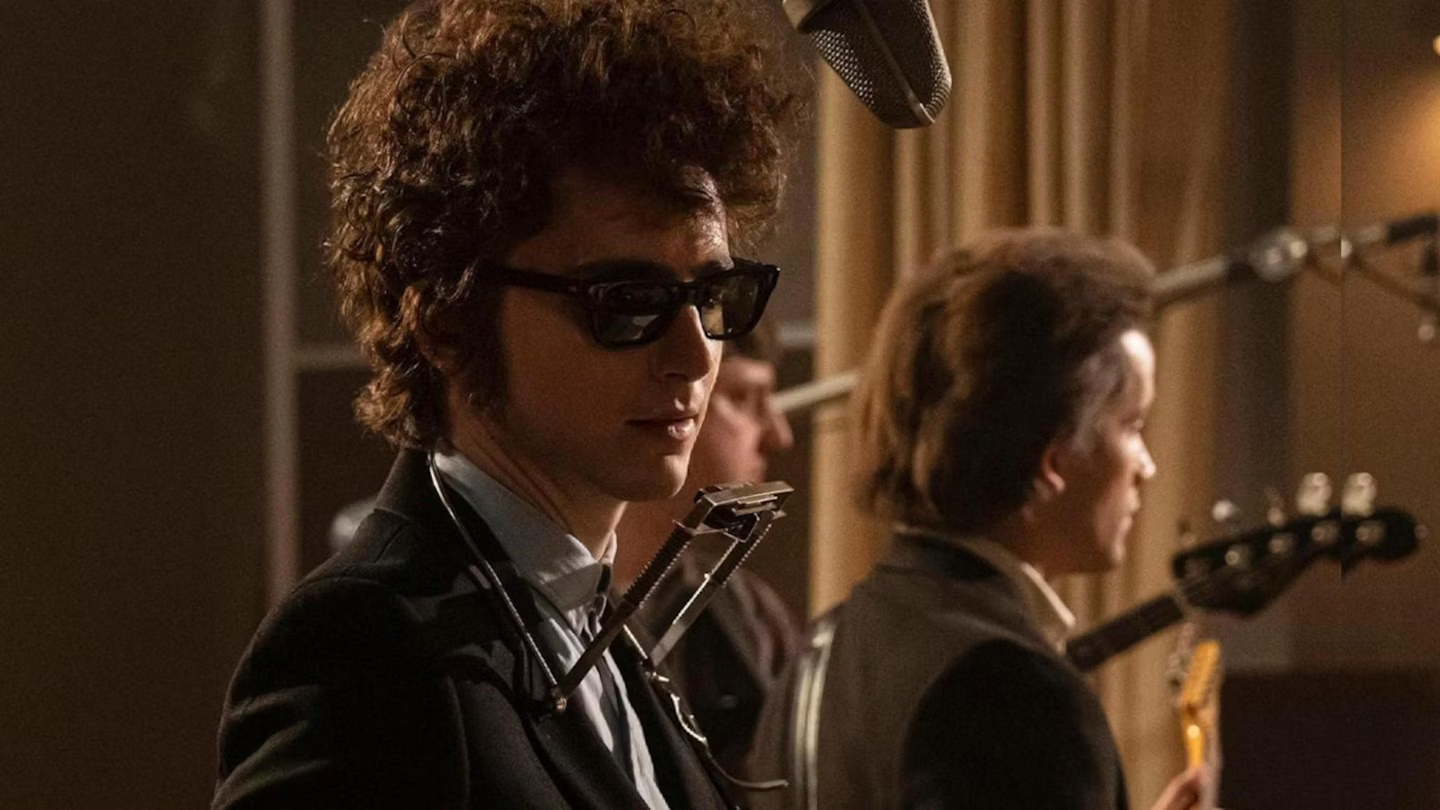
We meet Dylan as he is deposited in NYC to meet his idol, Woody Guthrie (Scoot McNairy) who, robbed of his voice, is tended to in a New Jersey hospital by Pete Seeger (Edward Norton). Seeger and Guthrie see greatness, Seeger takes Dylan under his wing and we are off to the races, from aspiring folkie in 1961 to superstar in 1965, as Dylan weighs the dilemma of a lifetime:

Willeth I go electric?

“Will he go electric?” is actually a big deal in Dylan’s world, one fleshed out by Mangold and screenwriter Jay Cocks (Silence, Gangs of New York), as the genesis and essence of the folk milieu is revealed to us.

Of course, we want electric, but Cocks makes us understand the instincts of the standard bearers. They are curmudgeons, maybe, but they are earnest. The folk movement is something they built, sure, a lot of it on Dylan’s back, but their protective nature is not ridiculed. Quite the opposite. Cocks gives Seeger a great speech wherein he urges Dylan to stay acoustic in the service of a larger musical aim.

Still, the film doesn’t make the tug larger than that, and Dylan’s switch does not stand in ostentatiously for “bigger” themes.

Similarly, the pressure of going from lauded unknown folkie to superstar is not treated as an excuse for bad behavior or a major unfairness. It’s an annoyance that informs Dylan’s desires, and while we get the pressure he is under, as played by Chalamet, Dylan is made kind of dick because of it, equal parts sympathetic and petulant.

Mangold also has fun with the times. The look is spot-on, particularly of early 60s Greenwich Village, and we get the fun interdiction of Johnny Cash (Boyd Holbrook), a Dylan supporter and pen pal. And Al Kooper just jumping in a studio to hit the organ for the start of “Like A Rolling Stone” because he could not play guitar on the track?

Goosebumps.

Ultimately, as with Walk the Line, the music is the star. Chalamet sinks smartly into the role, traversing the road from wise but sweet neophyte to badgered superstar, but he sings great and quite a lot. All the performances crackle but he really nails it.

Mangold also does a great job with Dylan and his first girlfriend (they have an exchange about the plate-spinners on variety shows that is touchingly smart and Elle Fanning really resonates as the gal who took Dylan in only to see him grow beyond her attentions).

The Joan Baez relationship is more ragged. She just seems like a bitch, angry that Dylan criticized her songwriting (“’Sunsets and seagulls.’ ‘The smell of buttercups…’ Your songs are like an oil painting at the dentist’s office”). Mind you, that would piss most anyone off, but they continue as a couple with no discernible attraction, and the why seems thin.

A minor nit.  Great fun, moving, and impressive. Top 5 of 2024.            


The other day, my son bemoaned people who couldn’t just enjoy the silly movies from their childhood, like Star Wars or Indiana Jones, because they had to find a reason to justify the continuation of their early filmic love into adulthood. So, they create a form of criticism that makes their adoration of juvenilia acceptable, even erudite, elevating simple, fun movies to high art or of great social import (which then naturally leads to a concomitant acceptability of their living at home in the basement amongst their toys well into their 30s).

To be fair, I added the parenthetical.

I thought about what he said when I was watching Barbie. Of course, it will be the subject of Gender Studies papers for the next 20 years, and has already spawned reviews of great seriousness (“a searing social critique”; “An earnest feminist manifesto inside a barbed social satire”; an “existential exegesis on what it means to be a woman, and a human”).

There are indeed very smart things in Greta Gerwig and Noah Baumbach’s script, including some clever, contemporary touches and social observations. Some land and some elicit a groan.

However, the movie works best as a series of jokes and physical humor encased in a startlingly resonant set design and an energetic commitment to unbridled fun.

That it lightly lampoons patriarchy, consumerism, wokeness, feminism, bro’ culture, capitalism, and much more is undeniable. But that is icing. The cake is the yuks, and Gerwig offers an endless parade of laugh-out-loud lines and sight gags and rousing musical dance numbers, almost all of which land and charm.

A few nits.

I am sick of Will Ferrell. He’s the same schtick, every single time, and he is lazy and boring.

Also, there’s an inspiring speech that screeches the flow to a halt. A rousing feminist speech. To dolls. It’s a bit like watching a character in Star Wars give a soliloquy about colonialism. To Wookies.

The picture is also a bit repetitive and long in its syrupy, maudlin end (though it lands on a great crack to close out).

But these are annoyances. The film opens wondrously, as we are introduced to Barbieland, where everything is perfect; what is not perfect is plainly identified as such (aka, “Weird Barbie” and “Pregnant Barbie”); girls rule; and the Kens serve and bicker amongst themselves, vying for the attention of their masters. But the perfect world of one Barbie (Margot Robbie) begins to crack (her arches fall, she thinks of death), the real world beckons, and she answers the call with a besotted Ken (Ryan Gosling) as a stowaway. There, she finds sadness, men in power, and her own obsolescence. When she is gone, an empowered Gosling returns to Barbieland, and the Kens rise, in hilarious fashion.

After checking its social responsibility box with indelible ink, the picture ramps up as the Barbies use their superior intellects and, interestingly, their feminine wiles, to overthrow the dum dum Kens during their short-lived reign.

This allows for Gosling’s musical numbers, which are worth the entire movie. There is no way around it. He steals this picture. It crackles in every frame in which he appears, and his resume’ as a strong comedic actor (The Nice Guys, Crazy Stupid Love) has expanded.

And “I’m Just Ken” is undeniably the best musical number EVER!

Tick, Tick...Boom | Official Website | November 19 2021

Let’s first start with Jonathan Larson’s Rent, which was at its very best, catchy and urgent, and at its worst, cheezy, inbred, bombastic and cloying.  Its’ influence, the greater rock/popification of Broadway, is undeniable, if not universally acclaimed.  But it is what it is, and I always found it to be meh.  

As did the South Park guys.

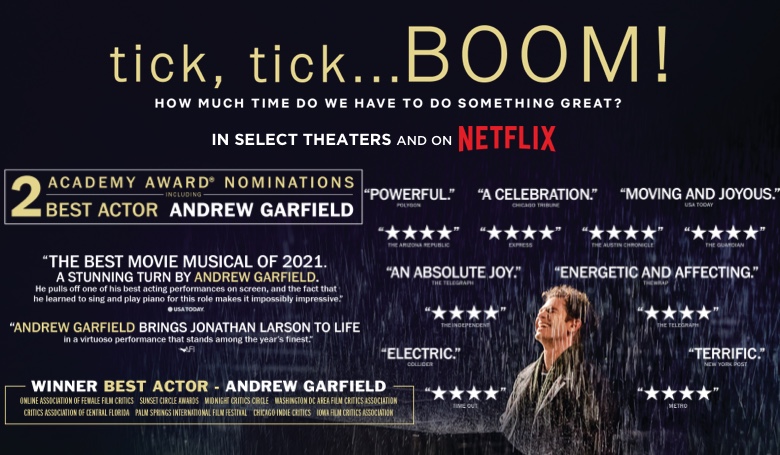
tick tick  . . . BOOM! is Larson’s solo work just before Rent, as directed by Lin-Manuel Miranda, and tells Larson’s story as he tries to get a musical off-the-ground.

The picture is a love letter to theater and theater kids. It is populated by scads of Broadway regulars and icons, in what comes off as a tribute to Larson, who tragically passed away from an aortic aneurysm before his triumph Rent opened.  

The film’s exuberance is near-irresistible. As Larson, Andrew Garfield is so winning, so all-encompassing in his love and enthusiasm for the character and the numbers, that even without Miranda’s clever and engaging staging, he would have carried this thing on his back and across the goal line.      

Of greater moment is the dawning that his one-man musical before Rent was better, in total. The numbers are strong, less gloppy and a little more introspective, and Larson has a better handle on communicating his own artistic struggle than in conveying the plight of the East Village bohemians. For example, this clever, Sondheim-esque ditty is better than most of Rent.

The film suffers from some of the same moral simplicity and noxious casualness that Rent evinced at its worst (who can stand La Vie Boheme when all the self-satisfied, insular riff-raff take up an entire table and “never buy” – Fuck you, waiter! We’re artists!) but it is brief and unobtrusive. In tick tick . . . BOOM!, Larson writes a funny, fantasy piece about escaping the miseries of the City and all of its indignities. In Rent, he has a bunch of pretty, smug faces ennoble the crud.

Great fun. On Netflix.

West Side Story' Is Not for Puerto Ricans Like Me

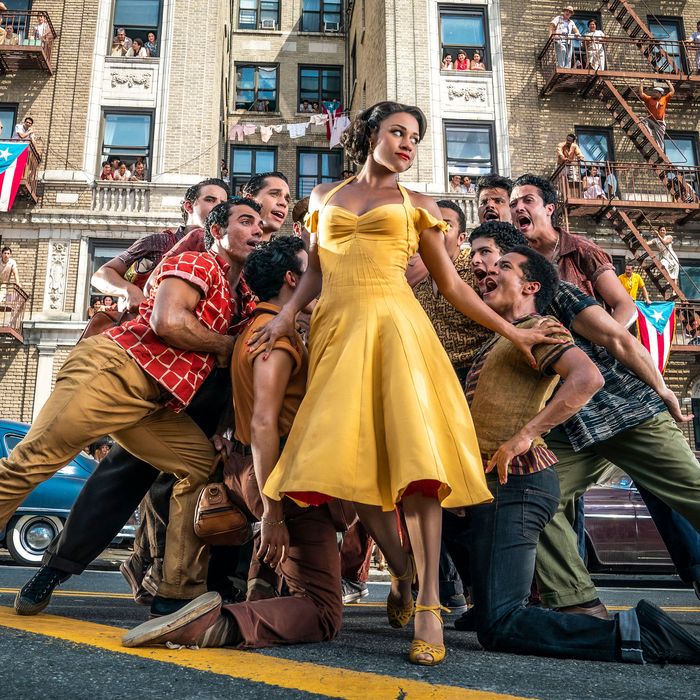
Steven Spielberg‘s vibrant, fluid update subtly modernizes but stays traditional to the original in all the right places.  The “daddy-o” is largely excised but the film still feels like a night at the most expansive Broadway theater.

To be fair, it’s hard to miss the mark too wide with such rich source material. Unlike most musicals, in West Side Story, no number is unmemorable. There isn’t even one that is weak.

The dance at the gym and “America” are particularly good. In the first, Tony and Maria do not melt into the frantic gyrations of the Jets and Sharks, but rather are drawn beneath the bleachers, where, smitten, they have a charming conversation. Before the scene becomes too standard, a snap of Maria’s fingers beautifully cements their attraction and we are returned to the fantasy of dance. In the latter, the call and refrain of the Sharks as to the merits and drawbacks of their new home starts small in an apartment and blossoms in a wondrous, joyful romp culminating in the intersection of a city street.

Screenwriter Tony Kushner (Angels in America) makes several changes to the original, placing the gangs in the peril of urban renewal, beefing up the role of Chino, humanizing Officer Krupke, and providing a critical backstory for Tony which tempers his infatuation with an internal struggle that explodes at the rumble. While more talky, none of the updating is balky or detracts from the music and choreography, which remains front and center.

Three nits. First, Tony (Ansel Elgort) takes a while to imprint. His first number (“Something’s Coming”) doesn’t help. It is geographically limited, stuck as he is in the basement of the drugstore, and Tony just feels a bit muted. It is only until he meets Maria that he starts to connect with the audience.

Second, Spielberg gives us a sparse “Cool”, and moves the song back to before the rumble. It feels like a missed opportunity.  The 1961 film placed the number after the killings, smartly delaying it from the stage play so the Jets could exercise their frustration and hate after the murders in a bravura ensemble dance. Here, the song is a little bit lackluster, and you pine for the highly stylized original, Worse, it’s Tony and Riff, a couple of Jets relegated to onlookers, gymnastically squaring off over a gun. 

Finally, the placement of “I Feel Pretty” is awkward, falling right after the rumble. It’s a delicate, ingenious number, but you are jarred to be placed into such a moment of hope and beauty given where Spielberg has taken you tonally just seconds before. 

Everyone is good and despite my fears, Rita Moreno as Doc’s widow never nears gimmick (she’s a lock for best supporting actress ). The picture is perhaps not doing as well as it would with a marquee name (Elgort is the best known of the young troupe and that ain’t saying much). But one can hope it makes stars, in particular, Rachel Zegler as Maria and Ariana DeBose as Anita. It is difficult to take your eyes off of either. Zegler was selected from over 30,000 applicants for the role and invests Maria’s innocence with a blossoming independence and steel that pays off ten-fold in “A Boy Like That.” DeBose is never less than commanding. And, unlike the original, they, like all the actors, expertly do their own singing.

190D5A0E-F567-4FE3-ABF0-126B8A846388

I always thought Queen was camp, a goof, and their primary contribution was “We are the Champions” and “We Will Rock You” which you sang in the bleachers during CYO basketball games. When I realized some people thought they were a great band, I was surprised. So, I walked into this as if it were a biopic of Emerson Lake & Palmer. Or Kansas.

Still, a great movie does not have to be about a great band. This, however, is not a great movie. It is cookie cutter, inoffensive, as risk-averse a biopic as you’ll find (it’s clear why Sacha Baron Cohen was jettisoned from the project), but well-paced and energized by the erstwhile Bryan Singer and made a little more interesting by Rami Malek’s weird, lizard-like performance (he’s just this side of Bela Lugosi, you never know if he’s just about to bite someone on the neck).  To be fair, Malek is also very moving towards the end.

The scenes of the band playing live and in studio are silly. The scenes of the band talking about the music and themselves are like a slightly more serious episode of the Monkees.  The rendition of the creative process is hilarious.

The primary feeling you’re left with is foreordained watching any story sanctioned by its subjects (the band had script approval) – it’s pleasant.  Rock and roll, drugs, cats and AIDS, brought to you by Disney.  It’s formulaic, harmless and overlong at two hours and fifteen (ending with an extended scene of their set at Live Aid, which is dull in that Malek is lip-synching), but not unentertaining.

Mary Poppins Returns (2018) - Trivia - IMDb

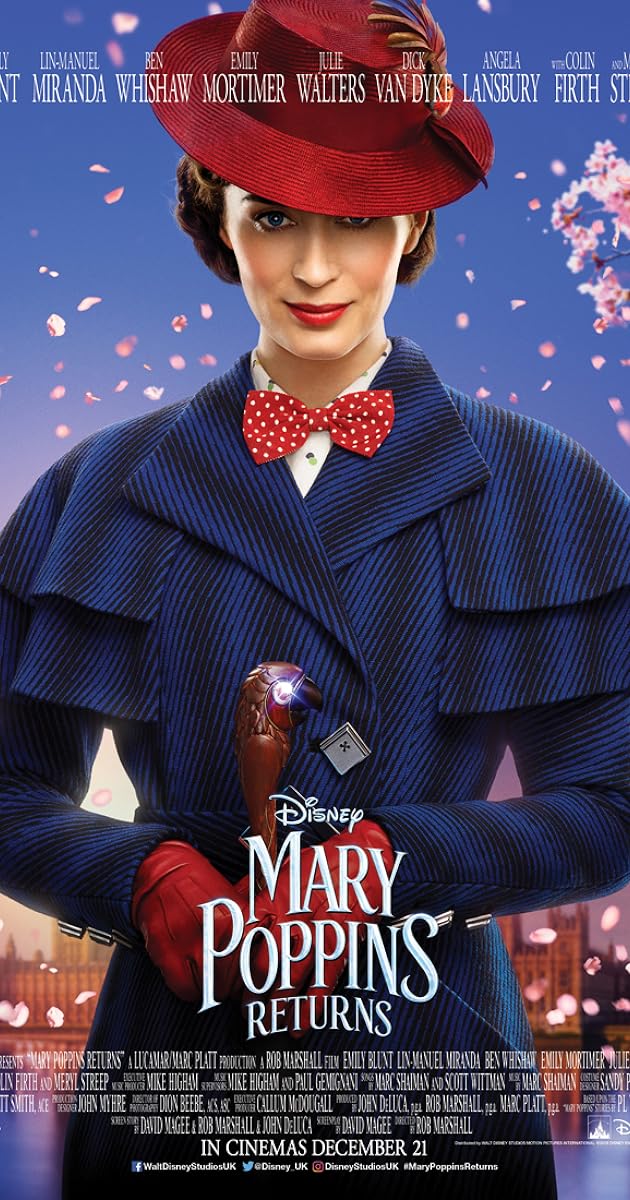
What is good:  the song-and-dance numbers are assured and fun, the melding of animation and reality is deft, and it is for the most part very pleasant.

What is bad:  you don’t remember one of the tunes upon exiting the theater; it is very long and the plot, such as it is, is ragged; Mary Poppins (Emily Blunt) comes off as kind of bitchy, with no real affection for the family; the father (Ben Whishaw) is a pitiful whiner; Lin Manuel-Miranda would have been better off writing the musical numbers rather than offering his version of the cockney lamplighter (that version has said lamplighter on MDMA with an accent rivaling that of Kevin Costner in Robin Hood for authenticity); and Meryl Streep is shoehorned into the picture as a gypsy, replete with her own hammy, endless, obnoxious number.

image

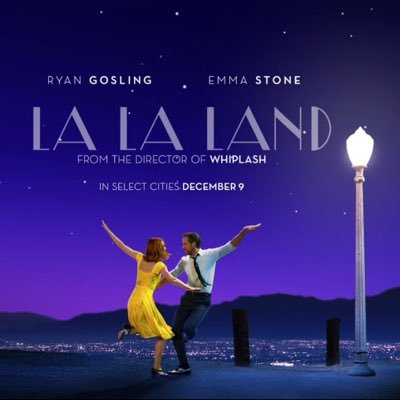
The opening scene of this love letter to Hollywood – a song and dance number on a jam packed LA freeway – is so audacious and expertly rendered that you almost regret its placement, fearing the rest of the film will never be able to match such perfection. When it is followed by another number that takes us from our heroine’s (Emma Stone) apartment to an industry pool party, your fears are alleviated. Thereafter,  the film becomes more personal, relying heavily on the chemistry between Stone and Ryan Gosling (chemistry that was established in a prior film, Crazy Stupid Love) while telling a standard tale of reaching for fame, compromising dreams for money and security, and the wages of those endeavors on true love.

I thought director Damien Chazelle’s Whiplash was the best film of 2014, and others clearly trust his judgment, because his second effort is as risky a gamble as you can make – a modern musical. It works on almost every level. As stated, the romantic leads are compelling and it is clear they connect. Stone is notable, near heartbreaking, as the aspiring actress.  The musical numbers are intricate and dazzling. The quieter moments, including several standard taps and waltzes, are beautifully done, and serve not only as support for their love, but as homage to the musicals that came before. And Los Angeles, as a fantastical costar, is charmingly rendered.

Chazelle showed a competency with music and movement in Whiplash but nothing in that film necessarily suggested the ability to stage the intricate, edit-free song and dance numbers that serve as the heart of this film.  Filming a stationary jazz drummer is elemental stuff compared to the sequences in this picture.

It really is a joy. If I have a criticism, it is simply one of imbalance. The first two numbers are so bravura, you end up waiting for one or two more of the same. When they do not appear, it is not a knock on what replaced them. But the tone is quieter, and the story pretty unoriginal. So I found myself waiting for the knockout punch that never comes. That is on me, not Chazelle, as he opted for a more muted, bittersweet conclusion which is affecting in its own right.

Gosling and Stone do all of their own singing; what is on the screen is all the more impressive given the film’s relatively meager $30 million budget; and the movie is shot in Cinemascope, which broadens its impact (unlike Quentin Tarantino’s 70mm The Hateful Eight, Cinemascope is actually suited to this film’s movement and locale). One of the best films of the year.

image

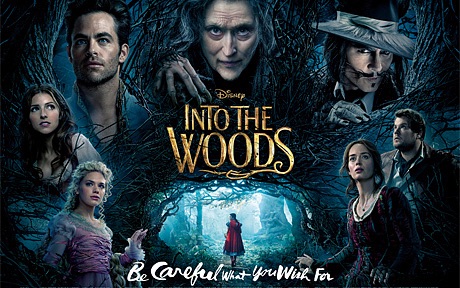
It can be clever, and the intersection of several fairy tales is occasionaly ingenious.  But there are no standout numbers (indeed, the movie appears to have cut the best song), and a musical rises or falls on its music.  The “Into the Woods” riff that snakes through the movie becomes tiresome, there are too few interesting exchanges between the characters, there is an entirely unnecessary and intrusive narration and the entire thing feels small.  It’s also not very funny, and from what I can see from the stage play, it’s supposed to be.

Though he’s been off his game of late, this project would have been better in the hands of Tim Burton.

Jersey Boys, the movie, directed by Clint Eastwood, reviewed.
Having re-watched Walk the Line, I then took my son to go see Clint Eastwood’s Jersey Boys, the film version of the “smash!” Broadway hit chronicling the rise and fall of Frankie Valli and The Four Seasons. He liked the picture. I did not. Let me count the ways.

1)      You couldn’t pick a worse director for this project than Eastwood. Music needs to be shot with energy and verve. Clint’s camera work is fixed and unimaginative. Basically, he shot Frankie Valli much like he shot J. Edgar Hoover. Close up. Then farther away. Then a shot to an admiring audience.

2)      The performances mostly run from pedestrian to dreadful. In the latter category, John Lloyd Young as Valli sports a Broadway pedigree and little else. His “go to” move seems to be consternation, be it at the loss of a gig, $1 million or a daughter. Vincent Piazza (Boardwalk Empire) is so goombah you half expect him to hawk Ragu sauce.

3)      The film can’t decide on being a whimsical tribute to the Broadway show or a dark, cautionary tale on the perils of stardom. Tonally, it’s schizophrenic.

4)      One theme in particular – the omerta of tough Jersey guys – is severely undercut by the fact that these tough Jersey guys are about as scary as The Sharks and The Jets.   In West Side Story, no one was asking you to be scared of ballet dancing toughs; it was a fantasy, delivered in dance, where even the violence was poetic. Here, their bond and hardscrabble roots are important, yet the whole existence seems comedic and pleasant.

5)      134 minutes!!!

6)      The makeup here was worse, if that’s possible, than in J. Edgar, and I didn’t think that could be possible.

My son countered that I didn’t like the music and that queered the film for me. But I didn’t like the music in Dreamgirls, and that was a perfectly fine film.

If you want to see the antithesis of this picture, rent Tom Hanks’ That Thing You Do, which captures the excitement, fun and then, the letdown, of a one-hit wonder band.

So, why one star?  Filial loyalty and the very funny turn by Mike Doyle as producer Bob Crewe.