Archive

Historical

While the story draws you in immediately, and the performances are uniformly solid, this film is really two virtuoso battle scenes bookending Steven Spielberg’s obvious story-telling, which is not helped by some leaden dialogue and a platoon of stock characters (sensitive medic, clueless bookworm, Italian tough, Jewish wisecracker, Irish tough, Southern Bible-Belt sharpshooter).

However, some films transcend criticism. Saving Private Ryan’s roundly lauded re-creation of D-Day is jarring and innovative. Spielberg brilliantly changes the vantage point of the viewer, and the speed and unearthly horror of mass battle is depicted in frightening detail. He tracks the advance on the beach, then moves to a hand-held camera, then to the view of a German gun nest, then back to the beach, with such swiftness that you lose your breath at times. The effect of the opening scene leaves you lost for the next ten minutes. In the theater, I was stunned that everyone was hunkered down in their seats.

When you do reorient, the film becomes a more conventional war film/morality play. Spielberg, as usual, has his characters pound away at his message for fear we won’t “get it.” His foreshadowing is also clumsy.

Still, the battle scenes that ensue after the landing remain true to history. The ingenuity of the GI’s – which might otherwise strike a viewer as contrived – is conveyed by Spielberg. The crucial role of firepower, the slap-dash organization of discombobulated soldiers, the treatment of German prisoners, and the heroic level of unit cohesion – all receive effective dramatization in the film.

In the end, however, Saving Private Ryan works as a particularly American film. Neither a rah rah polemic or a cynical anti-war tract, the movie communicates the basic truth that the loyalties of combat soldiers start (and often end) with fellow soldiers. Spielberg’s platoon is cleaved together as a unit, but the unit is not only threatened by the enemy, but by what seems a questionable endeavor – to save one private because all of his brothers have been killed. The grisly reality of slaughter of many for the saving of more, and the slaughter of more for the saving of one, is juxtaposed, creating the crisis for Hanks, the unit leader, and the audience.

Saving Private Ryan works on a different level as well. The movie transports the viewer to a time when the costs of everyday life were greater, and for higher purpose. In this manner, Ryan can be criticized for engaging in too much “greatest generation” nostalgia, but it is useful to compare the film to contemporaries.

The best film from the year before Ryan’s release was the comedy As Good As It Gets. It was about a spoiled, rich romance writer with OCD, which meant he could not refrain from gay-bashing his neighbor. His heroism was in learning to love while simultaneously not being cruel to anyone in proximity. I liked that movie. Nicholson was a crack-up. But I wonder how his character would have fared on Omaha Beach.

Postscript: in the wake of this film, Hanks and Spielberg partnered to produce Band of Brothers for HBO, a beautifully shot and much better written miniseries covering one unit from D-Day to Hitler’s Eagle’s Nest.

Overlong. Could have been trimmed by lopping off the unnecessary first third. Thereafter, you’d have an elegant two hour insight into the machinery of creating and presenting a musical in 1880s England (specifically, Gilbert and Sullivan’s “The Mikado”). As it is, the film is larded down by wholly unnecessary scenes, including a lengthy exposition of a rift between Gilbert and Sullivan; introduction of Gilbert’s parents, who have nothing to do with the plot or, it seems, Gilbert; and detailed coverage of the business side of the duo’s arrangment with the Savoy Theatre.

By the time you get to the stride of the film, you are impatient and exhausted, and the musical production of “The Mikado” itself is tiring (Director Mike Leigh insists on putting the audience not only through several interesting “Mikado” numbers, but through a few duller numbers from prior Gilbert and Sullivan productions), and the characterization of the crafts of playmaking, writing, scoring and rehearsing is more tedious than it should be.

The Emperor’s New Clothes. A real find with a great concept. Napolean (Ian Holm) sits on St. Helena, but makes his escape to reclaim his Empire by use of the services of a look-alike. The plan: Napolean gets to France, the double declares himself a fake, and Napolean stirs the national passions to his rise once again. Needless to say, things don’t work out that way, and Napolean has to get himself a real job. Holm is pitch perfect. The picture is well-paced and a lot of fun.

Image result for From Hell

A stylish revamp of the Jack the Ripper saga.   It has many things wrong with it.  Here are a few:

1) Johnny Depp, the lead Ripper investigator, is a psychic, which comes in handy;

2) The Ripper entices prostitutes with grapes, a neat fact the investigators choose to withhold from potential victims (as well as the fact that the Ripper is an educated man);

3) Heather Graham is about as convincing as a Whitechapel prostitute as I might be as the lead in “The Clint Eastwood Story.”

4) Every murder (and every autopsy/crime scene) is shown.  Each more bloody than the next.  Exhausting.

The crime of it is not the gore, tedium and heavy hand, but the fact that this Hughes Brothers picture (the Hughes Brothers of the classic Menace II Society) was the end for them until 9 years later, when they helmed The Book of Eli

It is bad enough that Hollywood would hand a period piece to a couple of young directors who made their bones on the verisimilitude of modern South Central LA.  But after they botch it, nine years later, they’re given The Book of Eli?

Not fair.

Sean Penn notwithstanding (it’s a genuine and moving performance), I don’t think it is a good sign when you begin to hope for the assassination just to break the monotony of The Life of Christ in the Castro.  Harvey Milk was a much more fascinating and human figure.  He deserved better than this gauzy, hackneyed, preachy tribute.  And why they gave a best supporting actor nod to Josh Brolin for his portrayal of assassin Dan White is a mystery.  Brolin was very brief on screen and when he appeared, he essentially played like a man with a migraine.

The Duchess.  A lush period piece marred by further establishment of the fact that Keira Knightley, as beautiful as she is, has two stock acting moves – radiantly proud and quiveringly proud (the latter is an indication that she is in some manner of emotional upset).  That said, Ralph Fiennes, as her abusive husband, the Duke of Devonshire, steals this movie as the nuanced tormentor of the duchess.  The more annoying she becomes, the more you sympathize with her husband.

Frost/Nixon.  Expertly acted, well-paced, and ultimately, pat and unsatisfying.  Screenwriter Peter Morgan takes the characters of Frost (Michael Sheen) and Nixon (Frank Langella) in a manner that mirrors his treatment of Tony Blair and Queen Elizabeth in The Queen — the upstart versus the titan, with a quest for moral concession at the end of the saga.  For Queen Elizabeth, she had to change with the times and accept the sorrow of the British people over the death of Diana, and Blair helps her achieve this trek into modernity, in the process, gaining great respect for her.  In Frost/Nixon, Nixon has to accept responsibility for his crimes and thus, help the American people heal, and Frost has to trap him in interview to wrangle the confession, which, of course, ultimately lessens the psychic burden both Nixon and the nation carry.  For dummies in the audience, this theme is explicated by a drunken call from Nixon to Frost on the eve of their last interview (set up as an interview version of a heavyweight bout, The Thrilla’ in the Villa), a wholesale fabrication.

But Nixon had a 20% stake in the sales of the interviews.  And Nixon knew as well as Frost that they couldn’t be a love letter to himself, that there had to be a draw, a teaser, a hook.  So, in the interview on Watergate, he apologizes, though in dramatic, stubborn style.  But he does not, as the film depicts, concede.  And in the end, through their own conspiracy, Frost is lionized, Nixon starts a second comeback (as opposed to the laughable postscript of the film’s closing lines — “[Nixon] never achieved the rehabilitation he so desperately craved.  His most lasting legacy is that, today, any political wrongdoing is immediately given the suffix ‘-gate'”), they both make buckets of dough, and television wins!  A much better story, but also much harder.  Much easier and more crowd-pleasing for Howard and Morgan to revise the impact of the interviews themselves, to make them a definitive win in a titanic battle of wits that finally earned Nixon the calumny he so richly deserved. 

Which is nonsense.

This is not a terrible film.  It’s fine.  It is at about the level of a solid TV movie and about as ambitious.  Moreover, the interviews themselves as depicted curiously lack the crackle of some of the better moments of the real ones, and unfortunately, offer a somber, sonorous Nixon.

I don’t want to come off as some sort of niggling prig.  My discomfort with Frost/Nixon is not predicated on the fact that it is historically inaccurate. My concern is in the manner in which the writer and director chose to be historically inaccurate.  For example, the fabricated drunken phone call from Nixon to Frost seems to fall within the reasonable artistic license.  But the problem is that the movie created a pat, simplistic morality tale, distorting history so egregiously in service of that dramatic aim that it exceeded the admittedly blurry lines in place.

It would be akin to a writer of Bobby/Lyndon penning a script geared toward Bobby being the driver of the civil rights movement, finally impressing upon Lyndon (also drunk on a call – it’s always the old man who is drunk) the importance of completing his brother’s legacy.  It could play well, it could be beautifully acted, but the historical point it serves is not only false, but utterly contradicted by the actual facts.

Indeed, a great interview with Frank Langella shows that he gets the problem:

Q. The movie does make you sympathetic to Nixon, this monster. It really makes you feel sorry for the bastard.

FL: Well, in one sentence you’ve called him a monster and a bastard. You see how totally and completely prejudiced you are?

Q: Well, you said “these two epic monsters.”

FL: Well, I meant monster in the larger sense. But that’s ingrained in you to think that way, and you don’t have any right to judge him that way. You’re not walking in his shoes. If you think Nixon is a monster and a bastard, what do you think of the presidents we’ve had since? That’s the thing: it’s very easy to use these words about this man, and very facile, because we live in a time where it’s sound-byte time.  Let’s see… Richard Nixon? Monster, bastard. Anna Nicole Smith? Dumb, blonde. We just do it. We just narrow everybody down to a tiny little spectrum, and you really can’t and you really shouldn’t. I do it too, though, because it’s really fast, and it’s really quick. It would’ve been totally uninteresting of me to play him as a drunk, or as a crook. Those were two facets of a very, very complicated man, and we mustn’t forget that he was a brilliant statesman.  [Nixon] was an extraordinarily intelligent man. I spent hours and hours of reading his books. His hopes and dreams for this country in foreign policy were extraordinary, and what he did in China and other places was wonderful. It would be a shame to let all that [go to waste] — history has done it, and he brought it on himself. Nixon was not destroyed by anything or anyone but himself.

The Damned United is a movie about a soccer coach in Britian during the 1970s.  The coach, who is a very good coach, holds his slights and grudges dearly, which becomes his undoing.  Scripted by Peter Morgan (The Queen), it’s a fine film, but not really exceptional.  Michael Sheen is excellent as the coach, who burns himself up through ego, but the character he plays is a bit thin and one-note to justify an entire movie.  That said, one cannot sustain a career solely playing Tony Blair.

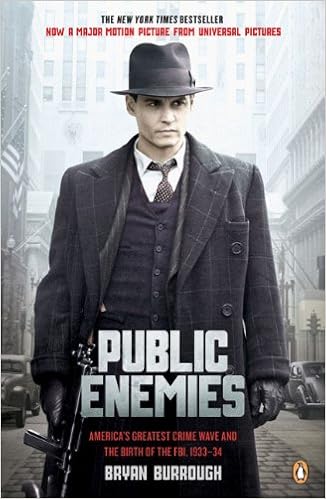
Public Enemies: America's Greatest Crime Wave and the Birth of the ...

I watched 40 minutes, which was 40 minutes too much.  Michael Mann’s last picture – Miami Vice – was bad in exactly the same way Public Enemies is bad – all mood and cool, beautifully photographed, and as interesting as a super model on a talk show.  Within 20 minutes, we learn all we would ever learn about our lead, John Dillinger (Johnny Depp).  He is cooly attractive, wear a suit well, lives for the moment and . . . he is cooly attractive.

Moll: What do you want?

John Dillinger: Everything. Right now.

Blech.