All the visual gifts in the world, and those of director Robert Eggars (The Witch) are prodigious, can’t make this Viking tale of filial vengeance any less stupid. There are a few joys - massive overacting (well played, Ethan Hawke, but Nicole Kidman wins by a nose), a few impressive scenes of sackings, the beautiful Northern Ireland topography standing in for Iceland - but boredom wins out, and by the end, it isn’t much of a fight.
High and mindless, the picture could have used Game of Thrones’ intelligence or the John Boorman Excalibur’s fun. Instead, we get gory drug trips and silly moments when the film feels closer to RenFest than Valhalla. More hamburger than Hamlet.
I do like how many of the actors try to do Norse and come off Transylvanian.
“Well, that was quite a thing” – my wife, at the end of the movie. Spoiler. Animals die.
About my wife. When that occurs, consider all your slack given.
It is indeed, however, quite a film, one that works as a fable, a meditation, and a beautiful, conflicted, messy tale of the shackles, joys and miseries of isolation, friendship and love.
I have a deep frustration with people who have the kind of depression that blots out the sun and cripples those who love them so much that they become collateral damage. The narcissism. The “I don’t take drugs because they change the essence of meeeeeeeeeeee!” The voracious appetite for the steadfastness of the simpletons who take the kicks and keep coming back for more. Blech. I’m not always proud of it but it is genuine and fixed in my marrow.
Here, a depressed, artistic man in despair (Brendan Gleeson) cuts off his simple, dull pal (Colin Farrell) even though they are lifelong friends on a barren Irish Island. The disassociation is brutal and final and nothing less than an assault from the intellectually superior and more sophisticated of the union. Every instinct I had was to decry Gleeson and champion Farrell, even as I grudgingly respected Gleeson’s stand, cruel and self-abasing as it was. I’m more gravitated to the simple and the banal, the loyal, Particularly when the artist’s excesses, in all their Van Gogh glory, start taking hostages. Taken at face value, it was no contest.
But as the picture progressed, my sympathies for both men equalized. Somewhat. Against all of my internal instincts. And in the struggle, the picture opens up and draws you into a much deeper analysis.
Fecking hell.
Interspersed in this tug-of-war is Martin McDonagh’s (In Bruges,Seven Psychopaths, Three Billboards) alternatively hilarious and mournful dialogue, deeply rooted in the Irish experience, with its strange and compelling fixation on conflict, routine, simplicity, and the Church.
Gritty New York City 70s films hold a special place in my heart because my father took me to the theater to see them when I was very, maybe too, young. He had a great way of asking what movie you wanted to see, and then when you picked something age-appropriate like Herbie The Love Bug, he would just say, “No. We’re going to see this.” And off to The Seven Ups or The Laughing Policeman you went. I suspect he just went through the motions of giving you a choice hoping he could get a twofer, seeing a movie he wanted to see and having you actually hit upon the same thing.
If nothing good was out, we watched a lot of these pictures at his apartment, sharing a bowl of candy corn.
I was never very disappointed to have a Disney film vetoed by my Dad. I was nine or ten years old and I was drinking in the likes of Serpico, Death Wish, and The French Connection, which introduced me to the hellscape of New York City, so different from my own suburban enclave. Throw in some other New York City pictures that offered more complicated themes, like Klute, and the Big Apple seemed even more foreign and forbidding.
The experience could be disorienting. After all, I was watching Jane Fonda fake an orgasm but didn’t know what a call girl was or what exactly she was faking. But it was such a rush and a privilege, something we shared that really wasn’t transferable to anybody else. I mean, I couldn’t really tell kids in my fifth grade class about Dog Day Afternoon.
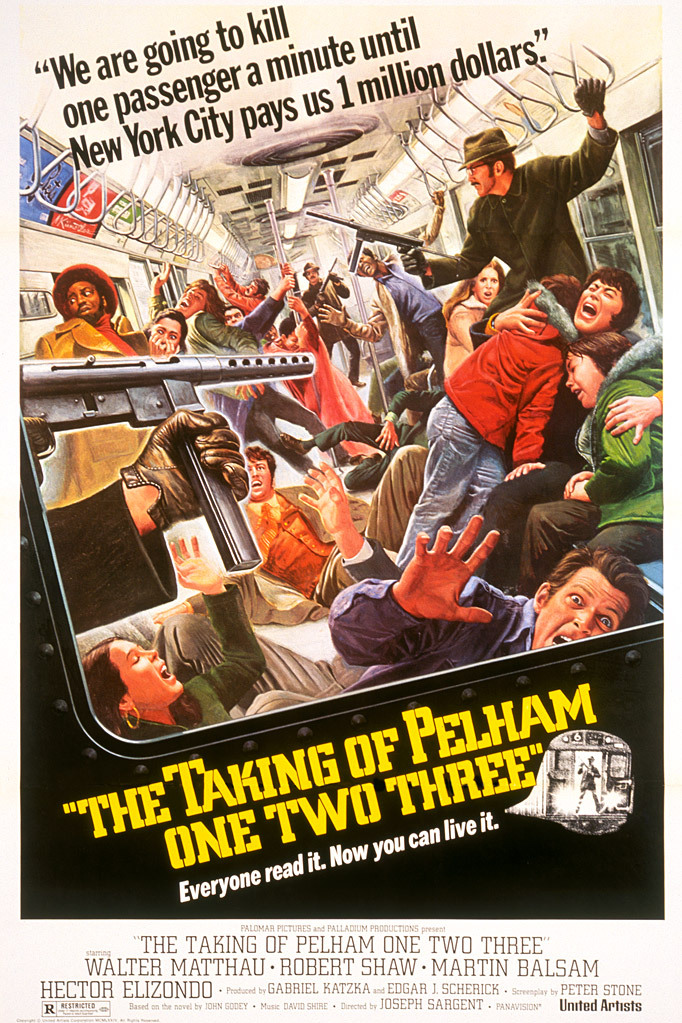
For me, the best and most accessible of these pictures was The Taking of Pelham One Two Three. I think my father agreed. From the beginning notes, a frenetic, jazzy David Shire score, the city translates musically as a haphazard mess of a place where anything can happen. In the space of 15 minutes, you’re introduced to four hijackers of, of all things, a New York City subway train, their hostages, and every sort of New York City bureaucrat, from the mayor all the way down to the weathered Transit Authority Inspector Garber (Walter Matthau). To a person, every politician, cop, administrator, dispatcher, and train driver is cynical, a little bit “Not my department” lazy, obnoxious, and yet, grudgingly heroic in their ability to work in such a fucked up place. They constantly deride, yell at, and ride each other, but there is a fundamental professionalism in their banter, and when they are put to the test by an exacting master criminal with a plan (Robert Shaw), there is something noble about their efforts. Unlike the feeble and mincing bureaucrats of Dirty Harry’s San Francisco, these folks are simply too harried and put-upon to bother with any kind of agenda, be it liberal, conservative, or something in between. They’re just working stiffs doing the best they can and to a character, they are shockingly well fleshed out even with little dialogue. Add an entire subway car filled with all the denizens of New York City – the pimp, the prostitute, an old Jewish man, non-English speaking immigrants, a mother and her two bratty boys, early feminists, a drunk, a hippie – and the picture becomes a model in drawing characters both strongly and economically.
An example: Shaw has asked for $1 million to be assembled in 60 minutes. He tells Matthau that for every minute he is late with the dough, he’ll kill a hostage. You watch the entire city machinery lurch into action to meet the deadline, including two cops who are tasked with driving the money from the bank to the subway station. They are given a few lines as they wait for the payoff funds, and yet, I became so interested in them, when they crashed their police car trying to make time, I fretted about their fate even though the story couldn’t allow for any resolution.
And as a caper film, you’re not gonna get much better than this. I remember gripping my seat, but I can’t remember whether we were in the theater or at home on the couch. Joseph Sargent, a workmanlike director who fought in the Battle of the Bulge, keeps everything moving while the picture remains funny yet taut, and then dizzying, almost as if patterned on the runaway subway train that closes the film. When you get comfortable, he snaps you back to attention with shocking violence and the expressed terror of the hostages.
I don’t know a lot about Elvis Presley, but I’ve read enough to know that most of Baz Luhrmann’s film is distorted, if not outright fictional. It doesn’t matter, because Elvis is a near-inconsequential figure, perhaps proven by the fact that this movie is more about Colonel Tom Parker (Tom Hanks in a fat suit) than poor, boring Elvis. Maybe Luhrmann got bored as well. I can’t say I blame him.
Watching this picture, strangely, I was reminded of Ronald Reagan. He too was a mythic, iconic figure with worshipping acolytes. And as his career wound down and he lapsed into senility, a writer, Edmund Morris, sought to pen the definitive Reagan biography. Morris, however, was stymied by what he perceived as Reagan’s banality, his simplicity, and so, for the book, was forced to invent an American-born Edmund Morris, who as Reagan’s contemporary followed “Dutch” from his near-poverty childhood to Hollywood to the presidency. Here, it feels like Luhrmann realized that Elvis is a dud, so he re-created Parker as Elvis’ dark half, the grotesque sidekick who can provide insight into a wisp. It’s a game effort, but it fails.
While the picture is admittedly visually arresting, you soon realize several things.
It’s not so much a movie as a series of trailers stitched together. Eye-popping vignettes that, for a time, divert you from the tropes and the utter lack of any character development.
The picture is about 45 minutes too long and repeats the same scene, over and over again. Elvis is an impossibly beautiful, mesmerizing near-wax doll with swiveling hips. He is wooed by wily carnival barker Parker. Elvis gets famous. Then Parker reminds Elvis that it’s all about the money. Elvis occasionally strays out of his lane. Parker reminds him, again, that it’s all about the money. Elvis quickly gets back in line to keep the money flowing in. Then he strays again, modestly. Parker reminds him that it’s all about the money. And then Elvis does the financially sound thing, but soon, he’s bucking just a bit. Parker reels his boy back in, time after time, and when things are at their most dicey, the Colonel says, “we are the same, Elvis, you and I” (an actual awful line). And Elvis gets back to doing what he does best, making and spending fat stacks of cash.
Luhrmann tries to sell Elvis as a tragic figure who was killed by his overwhelming love for his fans, rather than his affinity for the cash to keep him in deep fried hollowed out loaves of Italian bread stuffed with bananas, bacon and peanut butter.
Just as Austin Powers buried the super-campy version of James Bond, I thought Dewey Cox buried this kind of hackneyed testament. Not so.
Biopics often fall into the same traps. Hagiography, over-dramatization of mundane events, ridiculous suggestion of significant social impact.
But rarely do they present dullards as their subjects. Here, when you strip away all the glitz, all the quick cuts, all the visual tricks in Luhrmann’s bag, you’re left with the inescapable conclusion that Elvis Presley was a dummy, and that he was manipulated by no Svengali, but rather, someone just a little bit smarter than The King.
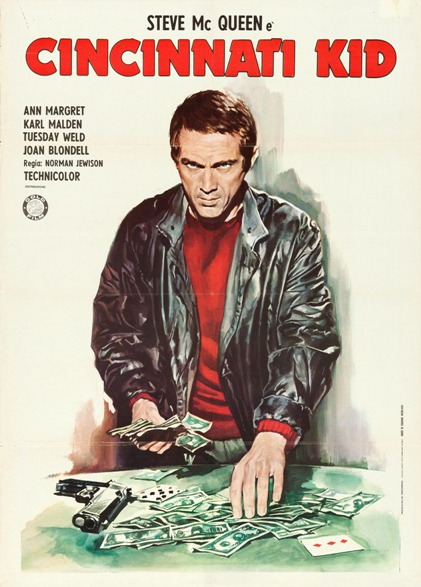
The lure of Steve McQueen is a steely resolve that doesn’t need a lot of explanation. McQueen is the Cooler King, driven by an unarticulated obsession with escape. Or Frank Bullitt, even-tempered yet resolute as he doggedly figures out a conspiracy while courting Jackie Bissett (who, of course, wants to know what’s ticking . . . . up there). The Sand Pebbles, Papillon, The Getaway, The Magnificent Seven, Nevada Smith . . . all pretty much the same guy, with some slight moderation on the irony-to-darkness meter. Always something hidden, a mix of detached bemusement, determination and code.
In The Cincinnati Kid, that’s who we are promised, but the film is so bare bones and uninvolving, it only succeeds in exhibiting how skeletal McQueen can actually be.
He’s a hot shit stud poker player who gets his chance at the top man (Edward G. Robinson) and there is a little skullduggery afoot before and during their epic showdown on the felt. Some of it is business (Rip Torn and Karl Malden vie for his loyalty), some of the heart (child-like Tuesday Weld offers love, voluptuous Ann Margret her vixen’s hips), and none of it is interesting. The Weld-McQueen union is hollow, the Margret-McQueen coupling inexplicable (she oozes, McQueen snoozes), and the shenanigans between Torn and Malden are pedestrian.
Only Robinson, as an aging card player tiring of every young buck who wants to take him on, offers some shading and intellect.
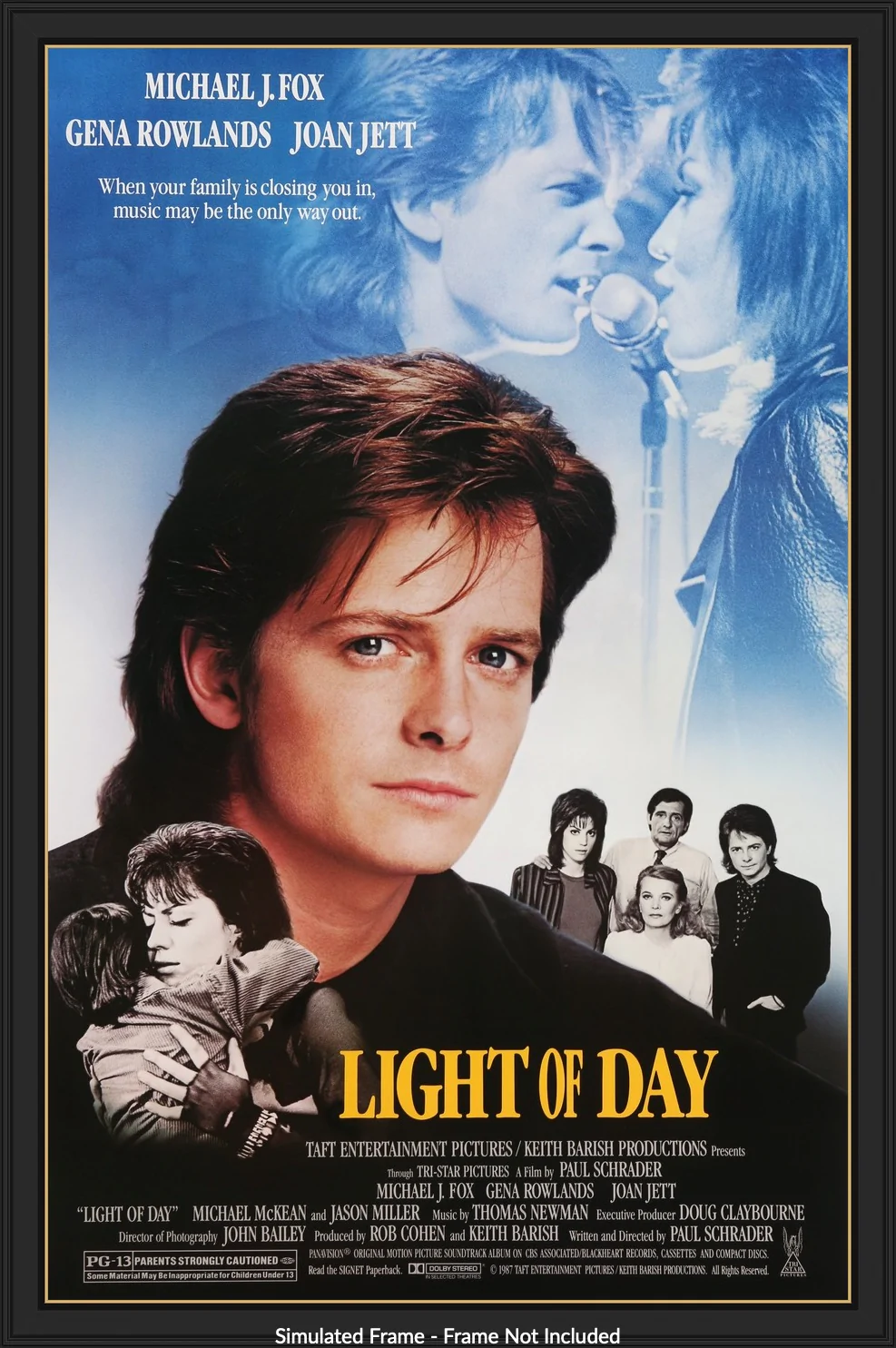
Paul Schrader’s second screenplay, Taxi Driver, was his masterpiece. Robert DeNiro’s ticking time bomb Vietnam vet then gave way to William Devane’s ticking time bomb Vietnam vet in the underrated Rolling Thunder. Spare, steely scripts followed, including Blue Collar, Hardcore, Raging Bull, The Mosquito Coast, The Last Temptation of Christ, Affliction and Bringing Out the Dead, good quality, but all sharing the same character – loners, tortured souls, beleaguered by their pasts and/or alienation in their presents. If you put Schrader at the helm, even of material he didn’t write (Autofocus, The Comfort of Strangers) still bears his solitary strain.
Though I really can’t explain this one:
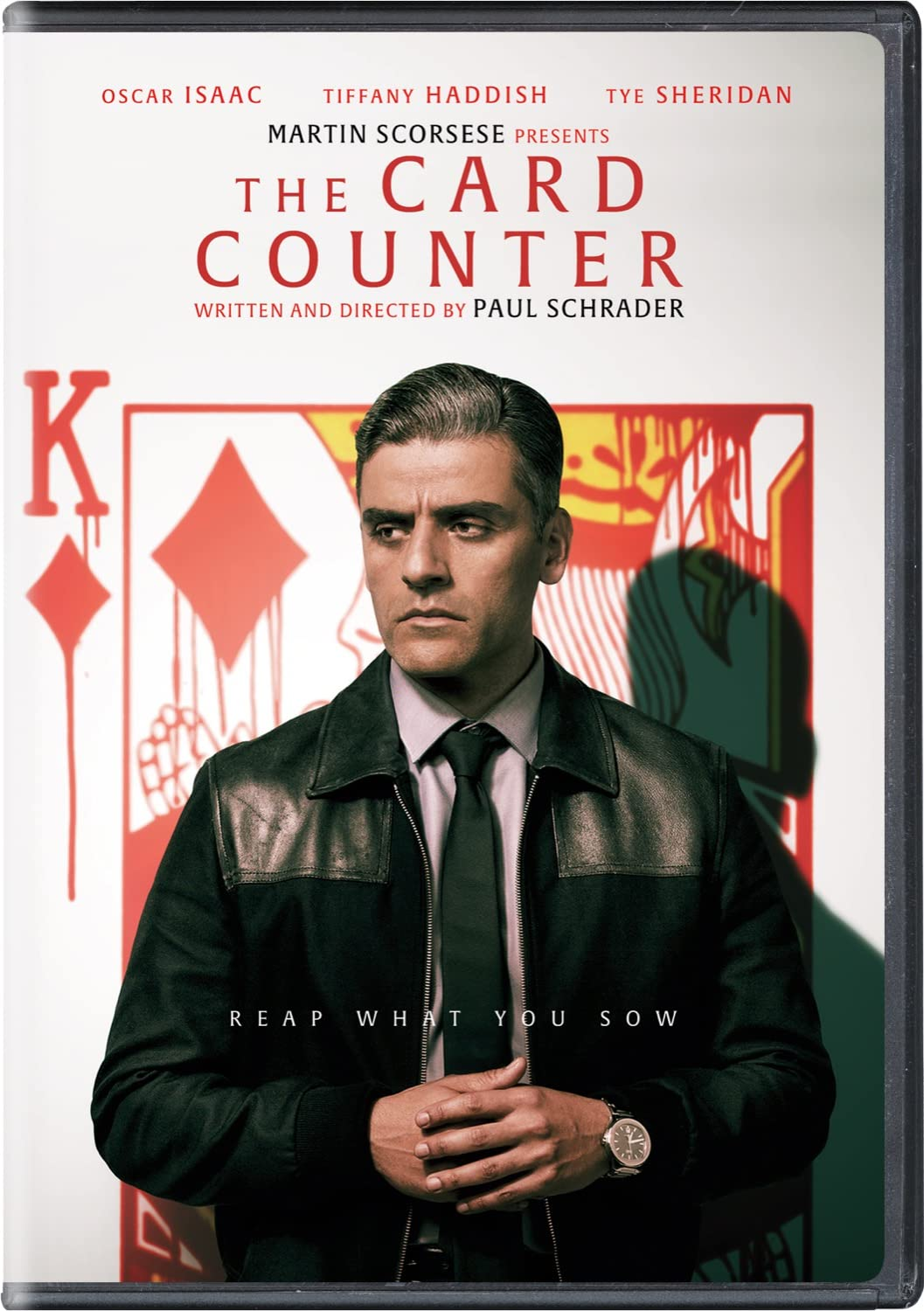
Regardless, The Card Counter is very subpar Schrader. Oscar Isaac is an Iraq War veteran who has a deep dark secret. Upon his release from military prison, he becomes a card counter and poker player, traveling from casino to casino. He is confronted with an opportunity for redemption (offered by the listless Tye Sheridan) and love (in the form of Tiffany Haddish, who seems a little confused as to what she is doing here), and it all goes rather poorly.
Isaac is the best thing about this pretentious, pointless, somnolent, uneven mess, but he is given the near-impossible task of voicing over such pearls as the essence of card counting:
It was in prison I learned to count cards . . . The count is based on a high low system. High cards, ten, jack, queen, king have a value of minus one. If they are depleted, player’s advantage goes down. The low cards, two, three, four, five, six have a value of plus one. The seven, eight and nine have no count value. The player keeps track of every card and calculates the running count. Then the player arrives at the true count, which is the running count divided by the decks remaining. For example, if the running count is plus nine and there are four and a half decks remaining, nine over four and a half gives you a true count of plus two. As true count increases, the player’s advantage increases. The idea is to bet little when you don’t have the advantage and proportionately more when you do.
Thank God Schrader didn’t have Isaac work on carburetors in prison.
The end makes no sense, but if you make it there, you won’t be better for it.
Hardworking scout and would-be NBA assistant coach Adam Sandler (Stanley Sugarman) finds himself on the outs with his employer, the Philadelphia 76ers, after the owner (Robert Duvall) dies and Sugarman becomes enamored with an unknown street hoops player in Spain. Duvall’s son, Ben Foster, who always resented Sugarman’s relationship with his Pop, revokes Sugarman’s elevation to assistant coach and shuns the unicorn Spaniard (real NBA player Juancho Hernangomez) Sugarman has discovered.
What follows is an unoriginal but entertaining sports drama. Nothing trailblazing, but filled with enough good things to elevate the material, such as–.
1. Scads of NBA stars, with speaking and/or playing cameos. If you’re an NBA fan, this is right in your wheelhouse.
3. An acceptance of sports tropes that borders on reverential immersion. Stanley has a deep dark secret about his playing days, Hernangomez needs a daddy, and daddy gets his hijo in shape with consistent runs up a Philly hill (to be fair, they do reference Rocky, but still) and the longest workout montage in film history (it practically has an intermission). Damned if it doesn’t work.
4. Hernangomez, who has some acting chops, and is surprisingly affecting as a young fish-out-of-water.
There are problems. Sugarman’s secret is insufficiently recapitulated, his family dynamic is too cute by half, and Hernangomez is tarnished and his stock devalued because he had an assault conviction in Spain (a fight with his daughter’s mother’s boyfriend).
The Mona Lisa of Stupid, a film so generic and irrepressibly cliche’ the never-fail motor of Tom Cruise almost fails to drive it.
Almost.
I liked it but I’m not proud of it. It is not the peak of genre nor does it defy it. It’s as insipid as elevator music, as banal as a modern country song, as predictable as pollen every spring.
I liked it because Tom Cruise willed it to be so.
I liked it in spite of the following
1) Bavaria appears to be the next potentially lethal nuclear power (again, homogenization and studied inoffensiveness to such a degree that the closest we get to “bad guys” live in Von Trapp territory)
2) The portrait at Val Kilmer at his funeral appears to have been made at Spencer Gifts
3) Every scene with Cruise and Jennifer Connelly is shot-for-shot a Kay Jeweler’s commercial.
4) The strafing run that serves as the centerpiece of the movie is the same strafing run in Star Wars and yes, a version of “the force” is used.
5) Cruise has many gifts. Chemistry with the opposite sex is not one of them. His post-coital moment with Connelly suggests they just engaged in a perfunctory bout of Wordle (K-I-S-S-Y).
Also, one might ask, if Val Kilmer, who cannot speak, was invited to reprise his role as Iceman, whither Kelly McGillis? She explains–
“I mean, I’m old and I’m fat, and I look age-appropriate for what my age is, and that is not what that whole scene is about.”
Per usual, Olivia Coleman is transfixing, and the film is almost a master class on how to construct a psychological thriller. It is hard to believe it is Maggie Gyllenhaal’s first feature.
Sadly, the film is not a psychological thriller. Rather, it’s a psychological character study of a middle aged woman and the choices she made as a young mother and professional. Coleman is a college professor on holiday in Greece, and during her stay, we cover the source of her disaffection from her two adult daughters, her kinship with a young woman (Dakota Johnson) who is clearly in maternal and familial crisis, and her inner turmoil at her own pathological selfishness and insecurity. It is the latter issue upon which the film turns. It is also its undoing, for while each flashback gives us greater insight as to her personality and her current state, it does not quite articulate why she does a particularly loony thing, a looniness made loonier by how she resolves the lunacy. Spoilers follow.
In her twenties, Coleman was driven mad by her own demanding daughters, so much so she abandoned them for several years, for the arms of an adoring colleague and a passionate affair. She eventually returned, but the coldness in her manner and guilt over her actions is evident years later, on holiday, when she encounters Johnson in similar conflict.
Gyllenhaal stacks the deck. The entirety of what we see of Coleman’s children in flashback and Johnson’s daughter in the present is wildly unflattering. The girls are not only obnoxious, but incessant, obtrusive and maddening. I may be having a generational problem here, because I cannot imagine such behavior being countenanced for a second, either growing up or when my daughter was that age, but perhaps Gyllenhaal was making a statement on the tyranny of children.
Regardless, Coleman becomes a confidante to Johnson but she also rather cruelly forces her into kinship by hiding the child’s beloved doll. In doing so, she takes a demanding child, who is already on the last nerve of the harried Johnson, and makes her a devil. Coleman can see this and either she wants to punish the child or she is leveraging the heightened distress of the brat to wheedle her way into Johnson’s trust. Either way, loony tunes.
The film pretty much ends with Coleman admitting to the crime, and Johnson, naturally, looking past any connection the two had established to conclude that Coleman is, indeed, a kook.
Which is undeniable and renders the layered and patient build-up pointless, a shame, because the film was meticulously crafted to go somewhere better.
This is one of those pictures where the 98% Rottentomatoes.com score from the critics and the 48% score from the audience makes great sense. Fix me in the latter camp. I kept waiting for the murder to happen.
Which reminds me of when I saw Monster’s Ball in the theater and an unimpressed man behind me was getting get shushed by his wife until finally, he declared he was leaving “unless there was motherfuckin’ monsters coming soon.” Then Billy Bob Thornton and Halle Berry had their steamy love scene and he was temporarily assuaged.
In 2016, Mike Mills’ 20th Century Women seemed wildly overlooked, even though he was nominated for an Oscar for best original screenplay. Here, his follow up has indeed been wildly overlooked. It’s one of the best films of the year.
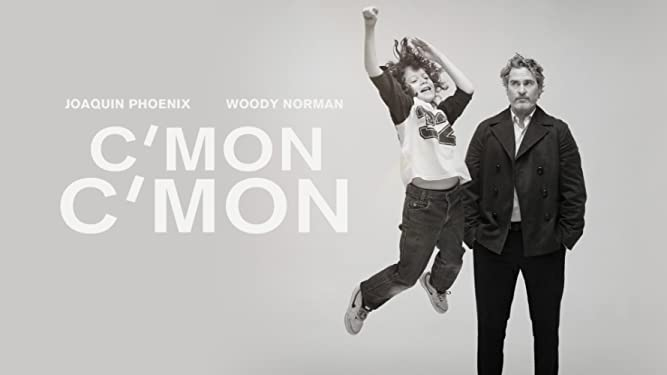
Joaquin Phoenix is a chronicler of children’s stories, working on a project where he interviews kids in different US cities about their hopes and dreams and fears, the kind of endeavor that would likely end up on NPR. His work is interrupted by a crisis. His sister (Gabby Hoffman) has to take care of her bipolar husband (Scoot McNairy), who is off his meds and spiraling, so Phoenix shows up in LA to watch their 9 year old boy (Woody Norman). Phoenix’s duty extends beyond the few days, and soon he is taking the boy with him to various cities for his project. A crash course in parenting, with all its trial and error, misstep and occasional triumph, ensues. Phoenix and Norman establish a relationship from near-scratch, sometimes terrifying, often insightful and ultimately enduring (it is piercing when Norman asks Phoenix if he is going to be like his father), and the bond never comes close to cloying or sentimental. Their union is authentic and fraught with peril. You simultaneously feel for Phoenix, who you can envision just shaking the boy in utter frustration, and Norman, who has his own demons to confront and is forced to confront them away from the natural comfort of his mother, home and routine.
Interspersed in the story are Phoenix’s interviews with the children, snippets of which range from heartbreaking to hopeful, and his phone calls and texts with Hoffman, with whom we quickly realize he has a difficult relationship, stemming from both the death of their mother and his rigid stance on the wisdom of her relationship with McNairy.
But the film is primarily about Phoenix and the boy.
As with most children, there is exhaustion and exasperation, doubly so here given Norman’s issues, and Mills starkly portrays how much fun children are and how much fun they are not. We live in a society that idolizes children. As presented to us, they are mirrors to our better selves, somehow wiser, nearly always charming or charmed, almost as if America has at times become enraptured by tiny Svengalis who made “but what about the children?” our inner Gregorian chant. Listen to an adult speak to their child at the grocery store when they sense you may be in earshot. It often borders on performance, like C.O.P.S. when the fuzz know the camera is running. The parent knows they are being judged via their child and interaction with same and they have put on their best act for the judging.
Mills knows the kid is more than a handful, particularly given the precarious genetic hand given to him, and he allows for the moments where Phoenix, like you, can’t stand Norman because he is a kid. An unformed, insistent, repetitive child.
Our parents knew what the hell they were doing when they sent us to bed at the inception of the party and out of their hair to roam the streets for 12 hour stretches, and you can see Phoenix wordlessly pine for these simpler times only to analyze his reaction in a monologue to his tape recorder.
Mills also makes Norman’s self-awareness a curse and a blessing. A good friend nailed it in a text exchange. “His performance was actually great, and I like that he didn’t try to kill with cuteness. More of a personal reaction…just can’t imagine caring for a kid so annoyingly fluent in therapeutic language.”
The film is graceful, multi-faceted and subtly moving and the performances are adept and grounded across the board. In particular, Hoffman and Phoenix establish a patter that any sibling will recognize as true.
Put the phone down and really take it in. Easy top 5 for 2021 and currently streaming for less than $5.







 filmvetter
