In a year when Andrew Dominik thudded with a Hollywood fable, Blonde, Damian Chazelle, who was on a three picture heater for the ages (Whiplash, La La Land, First Man – yes, people, that’s three 5 star pictures), also crashed and burned, bigly and badly. But where you can see that Dominik’s failure was easier to hide in the making, Chazelle’s epic expanse of shit seems so obviously terrible in its awful construction that you hold everyone involved responsible, for any of them could and should have struck Chazelle hard across his face and said, “What the fuck are you thinking!”
The film, set in Hollywood in the silent to sound era, mistakes bloat as grandeur, Looney Tunes-level excess as glory, and crassness as knowing cynicism. Chazelle’s monstrosity has nothing to say or offer though what the picture does provide is a lot, and loudly. Then, unforgivably, it closes with paeans to the magic of the movies, gaudy testaments as they live in the hearts and hearths of the little people. Chazelle has the audacity to attempt to transform two sybaritic simps (up and coming ingenue from the wrong side of the tracks Margot Robbie and drunken leading wreck Brad Pitt, who fared poorly from the silent to the talkie) into the nostalgic wreckage of TinselTown. And if that wasn’t enough, a racial parable is tacked on in the story of a jazz trumpeter who crosses over to the screen (Jovan Adepo). He is given just enough of a story to feel both insufficient and patronizing.
The movie is not a takedown of old Hollywood or an homage or even a madcap celebration of the hedonistic heyday. It’s just a boring, overlong freight train that supplants story and motivation for one spectacle after another, mainly in distractingly dizzying and ostentatious tracking shots. Then, after treating the characters as little more than CGI, they are destroyed amidst an ill-considered lecture about the perils of fame, the fakeness of it all, and the fact that Hollywood, as a Hedda Hopper type (Jean Smart) relays to Pitt, “is bigger than you.” But, she promises, you will … live on … forevah, on celluloid, “with angels and ghosts.”
Retch.
The performances are necessarily cartoons. Robbie, in particular, is obscenely over-the-top and nearly abused. As I said, you don’t care about her, you don’t care about anyone. Unless you care about Wile E. Coyote.
So bad you feel a little sick at the end, following a grotesque foray into the truly seamy underbelly of the town (think Freaks-meets-Carnival of Souls).
This was all done better by the Coens inBarton Fink and a heckuva lot better in Hail, Caesar!
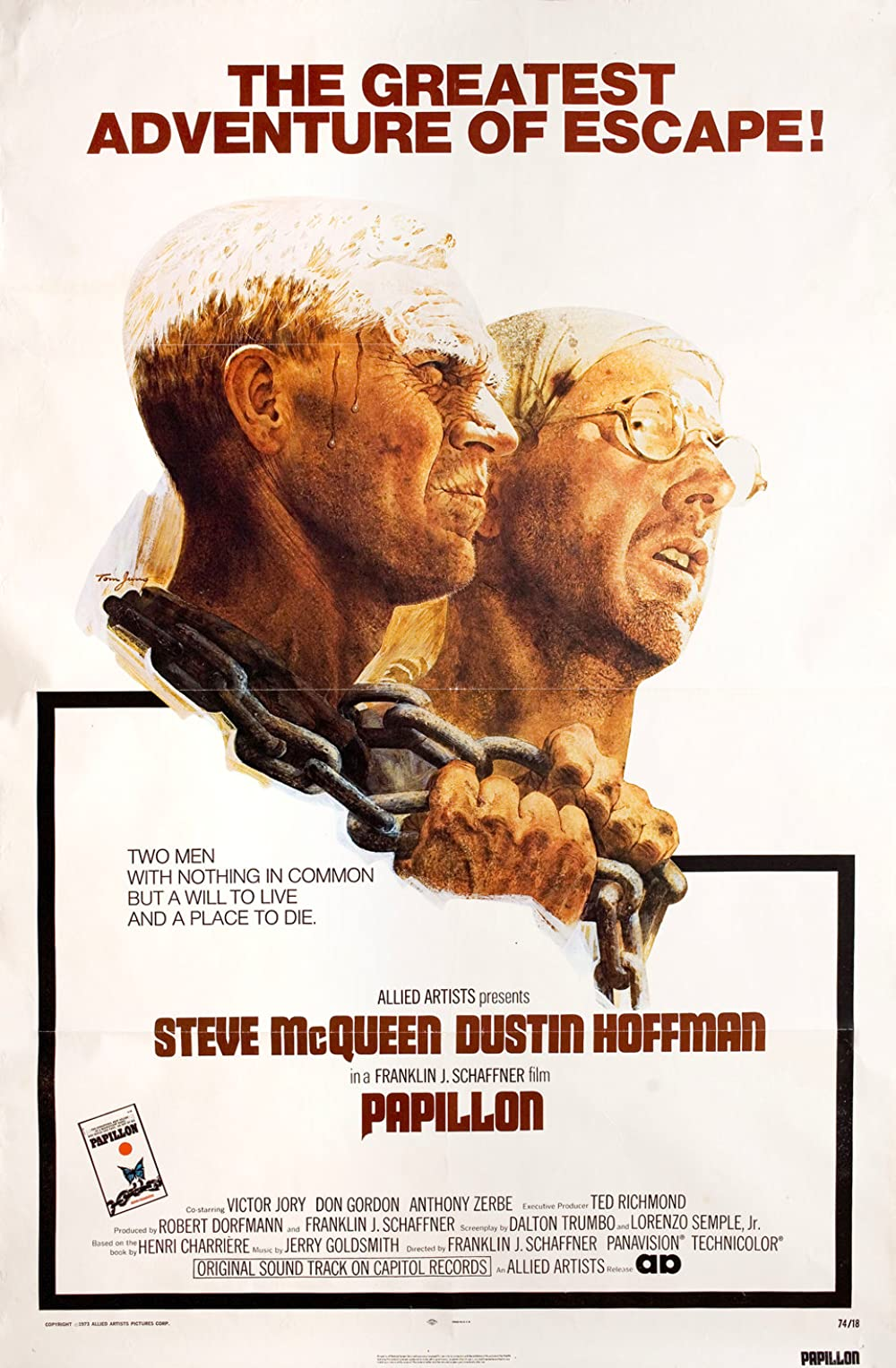
Franklin Schaffner’s (Patton) big-budget adventure/escape flick is competent, professional, well-acted (even if Steve McQueen and Dustin Hoffman have no interest in playing French people) and occasionally imaginative, particularly McQueen’s dream sequences as he fights solitary confinement and near-starvation. McQueen is the title character, sent to French Guiana for killing a pimp, where he meets the bespectacled Hoffman, a forger whose only protection is the ability to bribe officials. Their relationship deepens as McQueen, the Cooler King of The Great Escape, naturally attempts escape again and again here.
You may like the flick or not, but it is noteworthy for one scene, below. That crocodile has its snout wired shut and sure, it is drugged to the gills, but those are two massively bankable stars messing with a real crocodile. Nuts!
Perfectly pleasant, adept, and without a moment of originality, a very nice 2 hours delving into Michael Jordan and his first sneaker contract. You will likely enjoy the movie, and then you’ll never think about it again.
Of note is the easy charm of Ben Affleck as Nike founder Phil Knight, the dogged everyman turn by Matt Damon playing Nike basketball scout Sonny Vaccaro, the wry Jason Bateman (Nike Marketing manager Rob Strasser), and the steely resolve of Viola Davis playing Michael Jordan’s mother. All give superb, professional, wholly unchallenging turns that complement both each other and Alex Converey’s tight, predictable script. Marlon Wayans playing Jordan coach and confidante George Raveling also contributes in a poignant scene where he advises Vaccaro on how to approach the budding star.
On the minus side, this is a movie about signing a basketball player to a shoe deal, and the film doesn’t really find anything particularly insightful about this mundane negotiation, other than Damon’s dawning that Jordan will be a God amongst men. So godly is His Airness that while he is present, inexplicably, we only see the back of his head. Jordan never speaks, which both reinforces the picture’s theme that he is near-deity and serves as a tremendous cop-out and missed opportunity.
I mean, don’t we all want to know what God thinks when negotiating a shoe deal?
Mind you, the script is larded with b.s. Nike’s underdog status in the competition to sign Jordan is poppycock, as is the fact that his agent David Falk (a hilariously entertaining Chris Messina) was hostile to the deal. The dollar amount the young upstart company was allotted to go after Jordan is also understated by half. And Vaccaro never made the decision to breach negotiating etiquette by going over Falk’s head to visit Jordan’s parents in North Carolina, a fiction seminal to the movie.
The mushy camaraderie of this band of Nike visionaries may also have been a bit much. Worse, the truth may have made for a more interesting picture. Per Slate, “Vaccaro, as might be expected, disputes all these other versions of events robustly, saying “Phil Knight’s lying, Michael’s lying more than Phil, and Raveling is insane. All three of them need to destroy me to live happily ever after. Everyone’s trying to rewrite history. It goes beyond Jordan. I am the savior of Nike.’ It seems that Vaccaro, far from being the easygoing, collegial guy the film depicts, had a tendency to burn bridges. He fell out with Raveling in 1991 and was fired by Nike without explanation that same year.’” Now, that’s a guy I want to see a movie about, not the milk-and-cookies, faux cynical but really schmaltzo character Damon cooks up.
Okay. It’s not a documentary – enough of my curmudgeonly nitpicking. There is certainly greater appeal here for others. When I watched Winning Time on HBO – the laughably ridiculous rendition of the Lakers ascent in the late 70s/early 80s at the advent of Magic Johnson – it was hard to stifle a laugh throughout, and my wife and daughter joined in. But they also liked the series more than me. It was set in a milieu and about a subject they knew nothing about and they were more than happy to enjoy it without worrying about accuracy or any hackneyed presentations. Here too, though she found if “Hallmarky,” my daughter dug Air and noted that she didn’t really know much about any of it before seeing the movie.
Also, if you pine for all things 80s, from Cyndi Lauper to Tecmo Bowl to skateboards, run, don’t moonwalk, to Amazon Prime, because this thing is loaded with “Let’s Get Physical” Reagan-era montages.
Treacle and cornpone to its very core, an exercise in nostalgic tedium. Reese Witherspoon loved the book, a story of murder and mystery and coming of age in the swamps of a North Carolina small town. So the movie got made, in exactly the vein and manner of this vacuous and generic interview with the producer.
Daisy Edgar-Jones (Normal People, Under the Banner of Heaven) is Kaya, one of a kabillion kids living in the marsh with her abusive father and helpless mother. Soon, the mother ups and leaves (Kaya yells “Mommy, Mommy” but as is the style in this type of Southern gothic turdpile, Mom sleepwalks down the misty driveway, never looking back). Kaya’s siblings soon follow (one of whom basically tells 9 year old Kaya “stay low” to survive just before he abandons her). Then her father splits, and Kaya is consigned to a life alone as the spooky swamp girl. Mind you, for the rest of her life (and when we leave her, she is in her mid-twenties), not one of her siblings circles back to see if, maybe, their little sister is ok. Her serviceman brother does a perfunctory drop-in later, when she is on trial for murder, meaning he was an adult for 12 or so years and couldn’t be bothered.
The film’s version of 1960s rural poverty is to the real McCoy what the Disney ride is to actual pirates in the Caribbean. You soon suspect the swamp girl is derided by the locals not for her foreign and mysterious ways, or any class condescension, but rather, for her stunning cheekbones, luminous skin, and pearly white teeth.
The entire feel is inauthentic, as if brought to you by Loew’s or Home Depot. The swamp feels more like a fern bar, the town like Smallville, the characters every single archetype you’ve seen before.
We even get Kaya’s ponderous voiceover telling us things we can plainly see, half Marlin Perkins, half Judy Blume.
Kaya grows up and is caught in a tepid love triangle between two disinteresting homogenous actors with the mien of reality tv star brothers who macrame.
Could this be a double murder? Oh to dream!
Sadly, no. Kaya goes on trial for the murder of only Siegfried, not Roy, and perhaps the most boring legal drama in filmic history ensues. The case is so weak, you expect the actor playing the prosecutor to turn to the camera and shrug in apology. Kaya’s defense attorney (David Strathairn) shreds all witnesses with easy politeness, stopping just short of patting them on the head at the conclusion of his cross examination.
With the verdict a foregone conclusion, the reveal (she did/did not do it!) is anticlimactic in the extreme, made worse by the filmmakers’ decision to withhold “how” she did or did not do it.
It’s all clearly too much for director Olivia Newman, who had some TV episodes on her resume’, to handle. She can’t settle in on any one aspect of the story (the disconnect between town and swamp, the thriller, the abandonment and solitude, the love stories) with any depth so we get a steamed, soggy pu pu platter of platitudinous porridge. The fact that the dull screenplay was written by Beasts of the Southern Wild co-writer Lucy Alibar is both confounding and depressing.
In the end, Kaya becomes a big star. Music swells. Crawdads sing. Cursing of Reese Witherspoon’s reading habits follows.
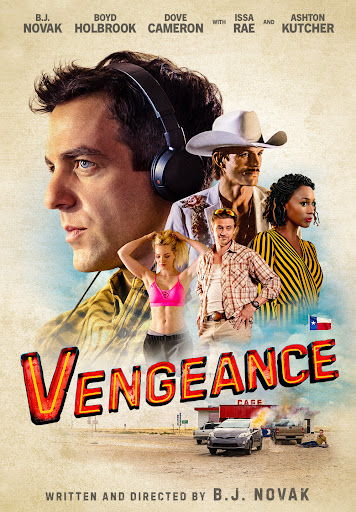
BJ Novak‘s black comedy nicely straddles the line between laugh-out loud funny and acerbically insightful. Ultimately, a culture class vehicle, the film also hits every one of its marks in blue and red America.
Ben Manalowitz (Novak) is a NYC writer who longs to host a hot transformative podcast, a vessel for his views of America. When we meet him, he is so hiply ironic and up his own butt, there’s not a lot to root for. But we do, because he seems adrift and in struggle for meaning. Once you get past all his posturing, he also seems decent, if weak.
Novak’s Ben reminds me of Lena Dunham’s Hannah Horvath in Girls, a clearly unsympathetic protagonist shown in an unflattering light who still manages to elicit empathy. Novak skewers himself mercilessly (shout out to John Mayer, whose one scene with Novak is a hilarious, ostentatious riff between two “bro’s” that introduces Ben and what he is about with economical precision), but stops short of the cartoonish, offering a balanced portrayal of a narcissistic guy with bite-sized intellectual pretensions who also wants to be a good dude.
When Ben gets a call from a distraught man in Texas telling him that his sister and Ben’s girlfriend Abilene is dead, it takes Ben a minute to realize that she was just one of his many occasional hookups, one who must have told her family that he was her steady boyfriend back in the city. Ben takes an extra beat to see a trip to Texas for Abilene’s funeral as an opportunity to immerse himself in some of the America he waxes so philosophically about. Upon arrival, a hot podcast is born.
Ben is the quintessential fish-out-of-water, and in lesser hands, the film would have had little to say about the cultural divide while maximizing the pratfalls and faux pas of a NYC Jew in shitkicker county. Or, the picture would have jettisoned the funny for deep intonement about the state of our current national fracture, such as it is.
Novak smartly balances both elements while crafting a genuine connection he makes with Abilene’s family. A scene where Ben attends a rodeo is gut-busting, another where he interviews Abilene’s record producer (an impressively soulful Ashton Kutcher) is thought-provoking and intelligent, and the deeper his dive into fly-over country, the funnier and more meaningful the picture becomes. Novak takes hard, amusing, and accurate shots at everyone’s station with a humility that elevates the movie.
The picture suffers just a bit at the end from repetition (a little Ashton Kutcher goes a long way) and a discordant, implausible cherry on the top, but no matter. Very sharp, very tight, highly recommended.
Andrew Dominik’s The Assassination of Jesse James by the Coward Robert Ford is one of the best films of the last 25 years and would rank in my own top 25 of all time. So, no matter the negative notices, any of his pictures merit a look.
Blonde received scads of poor notices. Justifiably so.
The picture has much in common with Elvis, and you get the sense that Dominik, like Baz Luhrmann, was behind the eight-ball from the outset. Both biopics are devoted to broad pop icons with fixed public personas that, when pierced, reveal soft, dull goo. So, the directors make up for the deficit by untethering the stories from fact, gussying up the visuals, and stretching for a larger point. As with Elvis, we quickly learn a good-looking picture can only get you so far.
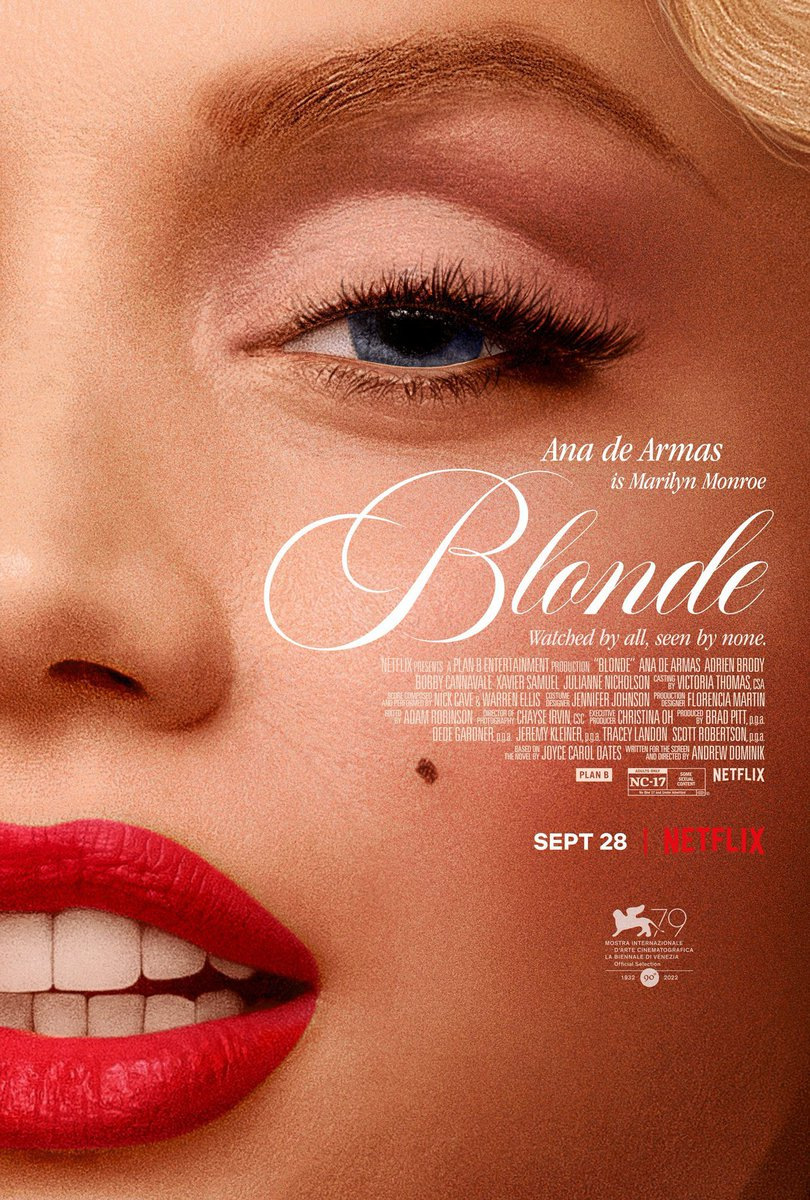
Make no mistake. Blonde is a visual feast. But it has no real narrative. We meet poor Norma Jean as a child brutalized by her mentally ill mother, and then she’s brutalized via casting couch, and then she seeks shelter in a “throuple” with two men, who take advantage of her sexually and financially. Soon, Joe DiMaggio (Bobby Cannavale) shows up out of nowhere, and then Arthur Miller (Adrien Brody), and then JFK, and soon, drugs and death. One calamity after another, one torment replacing another. None of her relationships are developed. Rather, her romantic entanglements just appear, are thunderstruck, and then we move to the next victim/victimizer.
It is all very sad, but watching a film is transactional, and you soon wonder, “Why am I supposed to care?”
Ana de Armas as Marilyn is occasionally effective (in particular, during a riveting audition), but for the most part, she’s a cartoon, cooing “Daddy” (to her own, unknown father and every man she has chosen to replace him) in a breathy, childlike manner at such a rate that you can almost see DiMaggio and Miller thinking, “Yikes! I thought the ditzy bombshell thing was an act? How do I get myself out of this?”
de Armas was nominated for best actress, and much like Natalie Portman in Jackie, the rendition is an over-the-top caricature of a public figure, where their peculiar tics are amplified. When her Cuban accent makes one of many appearances, it doesn’t really bother. There’s just too much else wrong with the performance, as if someone told de Armas to play Marilyn as a perpetual thirteen year old girl. With a concussion.
Not that de Armas was given much to work with. In one scene, she is with the none-too-impressed DiMaggio women, who are making spaghetti, and she lilts, “ooooh … real spaghetti? Like . . . not from a store?”
There’s plenty more where that came from in this ridiculous script. At the premiere of her first big film, as the crowd erupts in thunderous applause for the town’s new star, Marilyn breathily says, out loud, “For this, I killed my baby.”
Hoo boy.
Dominik’s missteps can also be traced to his misunderstanding of Monroe in the American consciousness: “If you spent 70 years enjoying a fantasy of a person; then a movie comes along that says she was not complicit in your enjoyment, it puts you in an uncomfortable position for having enjoyed it. People don’t want to be put in that position; they want her to be the one that created their enjoyment, and was along for the ride, then had a bad year and killed herself. That’s not the way it works. There’s no redemption in suicide. Americans don’t like you to monkey with their mitts too much. They very often want to jump to the solution without looking at any of the trauma.”
I am not unreceptive to some of these observations, but as applied to Monroe, Dominik is just wrong, He is talking about the Monroe of Elton John’s “Candle in the Wind” which was so long ago (1973, only 11 years after Monroe’s death) the song has been repurposed for Lady Diana (and will eventually be repurposed again when the next pop starlet dies before her time). Americans are not so protective of Monroe that Dominik’s pedestal tipping would elicit a reflexive defense. Rather, in modern memory, she was a sexy, mentally disturbed, marginal actress who sang a sultry “Happy Birthday, Mr. President!” publicly and privately and then overdosed. Side note: has anyone been taken down further in filmic history than JFK? When I grew up, he was the cool, collected president who saved his mates in PT 109 and stared down the Russians in The Missiles of October. Recently, in The Crown, he was a pill-popping whirling dervish. Here, he’s a #MeToo emblem, forcefully cajoling Monroe to perform oral sex on him in what has to be the worst scene in the picture.
I suspect Dominik knows the film fails, but credit him for a stout defense: ”Blonde is a very well worked-out film. Those who don’t think that aren’t watching it. If you sit back and trust that the movie knows what it’s doing, it’ll work.”
It does not. But if you are hot for a visually impressive, near 3-hour movie about a glamorous, vapid punching bag, Blonde is streaming on Netflix.
Filmvetter has gaps. Many gaps. Truffaut, Godard, and Bergman come to mind.
And, until now, John Cassavetes.
I knew that Cassavetes was an influential filmmaker. Martin Scorsese credits two films that most informed his career: Orson Welles’ Citizen Kane and Cassavetes’ Shadows. Quentin Tarantino also cites Cassavetes, which is strange, for, as one writer observed, Tarantino makes films “in which almost no element comes from life,” whereas Cassavetes’ work is infused with realism. Others who refer to his work include Jim Jarmusch, Hal Hartley, and the aforementioned Godard.
But to me, Cassavetes was the nasty, cynical guy in The Dirty Dozen and the husband in Rosemary’s Baby.
Until I saw this picture, currently available as part of the Criterion Collection on HBO Max.
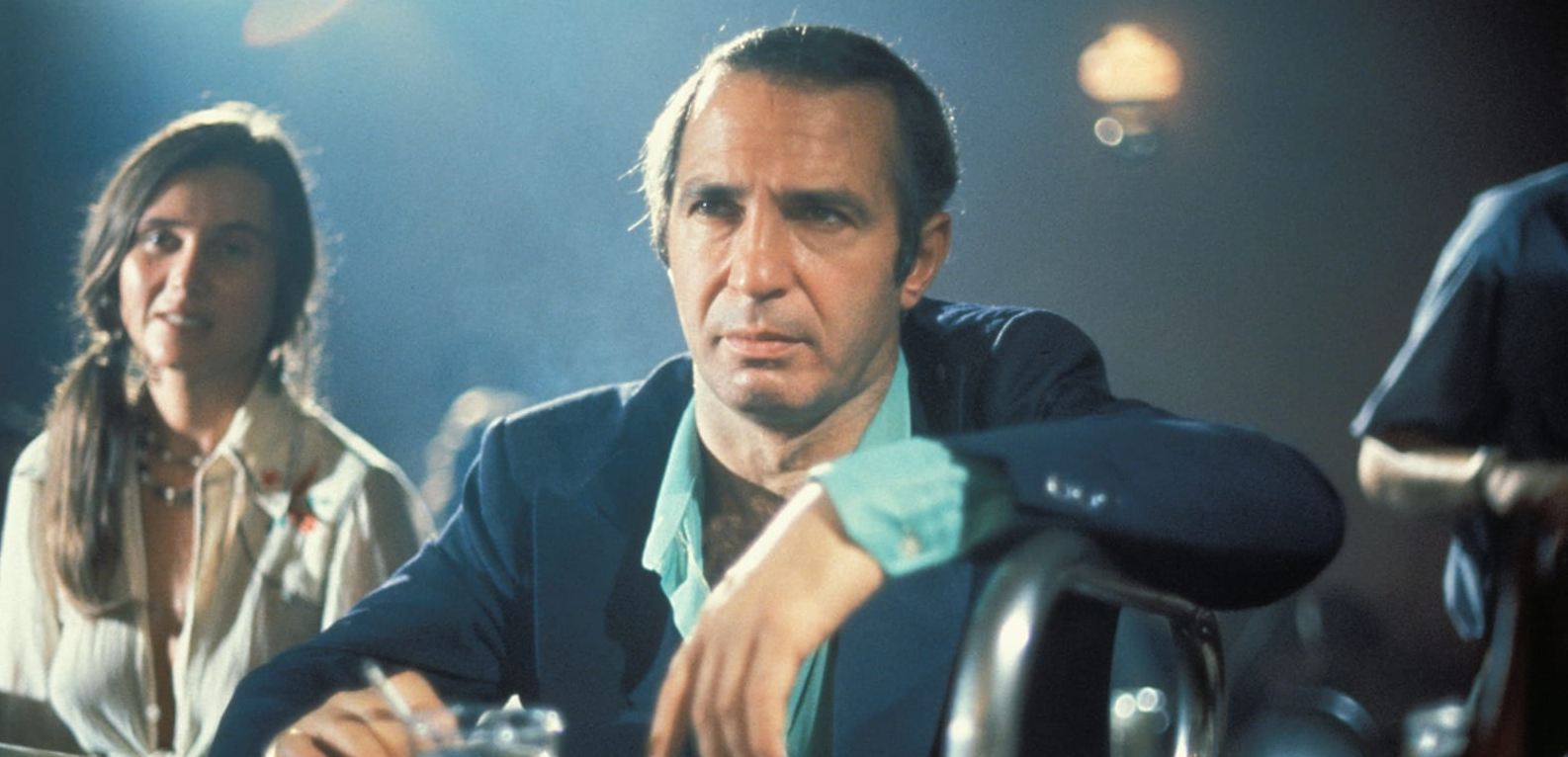
Ben Gazzara (“Cosmo”) plays a strip club/cabaret owner in Los Angeles, when showing some thigh and breast still required the trappings of a “show”. His stage girls are his children, and he is a small fish in a big pond. He just doesn’t know it. Until his big shot routine results in a sizable gambling debt to the local mob, who decide to absolve him of the “loan” in exchange for lethal services.
The film is visceral and immediate yet leisurely. Cassavetes brings you right in on the actors, often letting the dialogue of others register on the one. I was reminded of Boogie Nights and the long take on Mark Wahlberg right before the drug heist, but while that was showy, if effective, Cassavetes’ style is anything but. Instead, it feels natural, almost a controlled improv. Cassavetes gave his actors maximum room, eschewing the Strasberg Method as tired and narcissistic. Per Matt Zoller Seitz, reviewing Ray Carney’s Cassavetes on Cassavetes: “Among other things, Cassavetes hoped to offer young actors an alternative to the Method, a sensory- and memory-centered approach that was taught, in personalized form, by Actors Studio founder Lee Strasberg (whose students included James Dean, Robert Duvall, Robert De Niro, Elia Kazan, Shelley Winters and many others). Variants of the Method encouraged actors to draw heavily on their own experiences and feelings, and to treat hesitancy and inarticulateness as gateways to truth rather than obstacles to clear expression. A number of Method actors personalized this approach and had great success. But Cassavetes felt that the Method, and Strasberg’s Studio in particular, had become a different sort of factory, and he was ‘…resentful about the power the Studio exerted over casting directors, which he felt was what had held him back early in his career,’ Carney writes. ‘He was scornful of what he called the guru aspects of the Studio and pointedly described his and Lane’s school as anti-guru. He felt that the Method was more a form of psychotherapy than acting, and believed that although figures like (Montgomery) Clift, (Marlon) Brando and Dean had had a salutary effect on acting in the late ’40s and early ’50s, by the mid-’50s the Method had hardened into a received style that was as rigid, unimaginative and boring as the styles it had replaced ten years earlier. The slouch, shuffle, furrow and stammer had been turned into recipes for profundity. The actor filled the character up with his own self-indulgent emotions and narcissistic fantasies…Normal, healthy, extroverted social and sexual expression between men and women dropped out of drama. Inward-turning neuroticism became equated with truth. The result was lazy, sentimental acting.’”
There is none of that in this film, which feels so authentic as to be revolutionary. The picture is riveting, grounded, and wholly personal, with an L.A. devoid of the well-know landmarks, not purposefully omitted but rather, naturalistically absent. Cassavetes sets up a noir-ish crime pic, but perhaps bored with the endeavor, detours repeatedly into Cosmo’s crisis of identity.
Gazzara is captivating. Cassavetes trains in on Cosmo’s every conceit when playing the big man. Cosmo’s descendant is none other than Burt Reynolds’ Jack Horner in Boogie Nights, a semi-proficient pornographer who makes himself father to the talent and creates his own world, one where he is Fellini. Similarly, Cosmo treats his girls like perpetual prom dates and tells the patrons in his seedy club, “I’m the owner of this joint. I choose the numbers, I direct them, I arrange them. You have any complaints you just come to me and I’ll throw you right out on your ass.”
When his powerlessness is revealed, Cassavetes lingers on Cosmo’s doubt and his insistence on maintaining the veneer of control and aplomb reveals a hollowness that progressively evinces during the film. But there is also decency and honor, one that becomes difficult for even the mobsters to ignore.
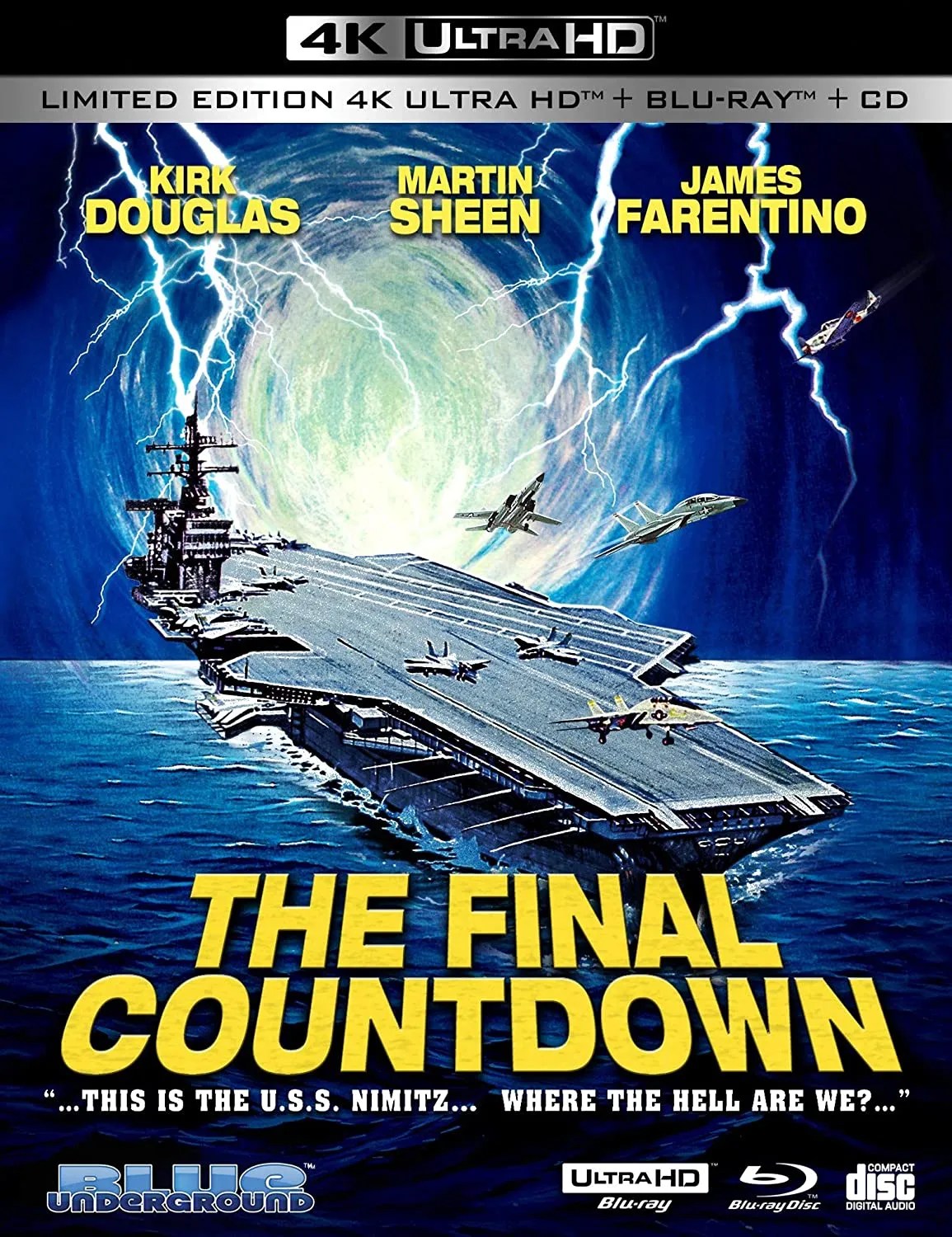
An old Twilight Zone episode depicted three soldiers on National Guard duty in Montana who went back in time and found themselves spectators to the Battle of the Little Big Horn. They struggled with the implications of intervention, essentially foreshadowing Star Trek and violation of the “prime directive” (i.e., never mess with history when time traveling lest you step on a bug and forever alter what is meant to be). They eventually jumped into the fray. This flick is essentially the same concept, but with a modern aircraft carrier being time-portaled back to the day before Pearl Harbor. Kirk Douglas, Martin Sheen, and James Farentino have to contend with the same conundrum.
It’s fun. A little discordant, alternating between whimsy (the commander of the modern USS Nimitz, Douglas, has a certain Disney movie mien to him, but then there are very bloody scenes that punctuate the film). But solid.
It is also clearly a joint effort with the Navy. There is so much aerial footage and extended scenes of flying and taking off that it feels like a recruiting ad, Top Gun sans the volleyball. Curious sidenote. The Department of Defense actually sued the producers for reimbursement, alleging fraud on the reporting of actual flying time. My father’s law firm represented the producers, including Kirk Douglas’ son.
On Amazon.
P.S. There was a big to do in the last several years over a Reddit discussion: “Could I destroy the entire Roman Empire during the reign of Augustus if I traveled back in time with a modern U.S. Marine infantry battalion or MEU?”
A short story followed. Hollywood then bought the short story. Good rundown below. Stay tuned.
For a film about the investigative reporting of a very big story, this picture is about as interesting as assembly line work.
Some may say, “but Filmvetter, this is the reality of the job.” Alas, so is banging out fenders and they don’t make movies about that.
$34 million brought in $5 million domestic, justifiably so. The film is a didactic, repetitive, undramatic, boring 2+ hours of drudgery acted by rote with a sprinkle of washed out dread.
I presumed the picture was a financial flop because of #MeToo fatigue, the lack of a present villain (in the movie, Harvey Weinstein is just a voice on boring phone calls and the back of a head – the most riveting part of the film by miles is the short clip of the actual vicious brute threatening a woman), a lack of stars, and the fact that a movie about reporters, especially in the digital age, would be static. But its problems go deeper. This is less a picture than homework. The great reportorial films (All The President’s Men, Spotlight) place their journalist protagonists in the areas of doubt, indecision and lack of assuredness. Even if they think they have the story cold, they are intrepid, skeptical, tough on each other. They make mistakes. They catch breaks. They are drawn in.
Here, the reporters are emotionally invested in a matter that is a foregone conclusion from the outset. Beyond the sympathy they communicate is a barely contained outrage. Therapeutic enabling takes the place of inquiry, skepticism and the remove of professionalism. They just get a name, make a call or visit, sit down with an emotional, reluctant, and/or scared victim and report back to editors (Patricia Clarkson, Andre Braugher) who support them unreservedly, listening intently as the duo relay facts so elemental you weep for the descent of The New York Times. The newsroom is thus reduced to church and rally (“Let’s interrogate the whole system”). Thank you, oh thank you, the reporters hug and cry when a source confirms. They do this three times.
The two leads (Carrie Mulligan, Zoe Kazan) are as flat as both the material and the portentous strings and piano score. Kazan overlays her dullness with sophomoric earnestness. It also doesn’t help anyone that the film regularly proclaims it is about women at the expense of its female cardboard characters.
The picture is also brutally unsubtle. On numerous occasions, the film has a woman clunkily just pop in and do a solid for women writ large or a creepy man being an oaf or a pig. Discussions between Kazan and her young daughter on the nature of her work and “rape” are so forced and artificial as to be embarrassing. A character actually looks into the mirror to search his soul.
Finally, for what aspires to be a brave expose’, the movie pulls a few punches, ignoring or soft-pedaling some of the great institutional protectors of Weinstein (NBC, scores of Hollywood folk who knew for sure Weinstein was sexually abusive) while highlighting easier targets. Weinstein was Jeffrey Epstein and everyone wanted to be at his party, but we don’t get much on the partygoers.
The film can be moving on occasion. A few of the interviews of Weinstein’s victims have the crackle of the scenes of abuse survivors in Spotlight. But the genuine moments are few and far between in this long, edifying slog, where post-partum depression is the most compelling aspect.
The least sentimental coming of age film I’ve ever seen, James Gray’s (Ad Astra) autobiographical reflection of a middle-class Queens family at the advent of Reagan is evocative, unstinting and spare. Paul (Repeta Banks) is an artistic, unfocused, silly, and obnoxious sixth grader, doted on by his mother Esther (Anne Hathaway), cherished by his wise grandfather Aaron (Anthony Hopkins) and in terror of his father Irving (Jeremy Strong), who can be silly too, but who also sports a volcanic temper.
Paul is a dreamer. He falls in with rebellious black kid Johnny (Jaylin Webb) at the public-school they attend and soon, he is in with this wrong crowd of one. Paul’s rebellion runs smack dab into the instincts and hopes of his extended family, which include elderly immigrant grandparents and an uncle and an aunt.
This is a film about many things, but family is paramount. When Irving beats Paul for getting in trouble at school, the scene is disturbing, but when Paul mutters, “I hate you… [I] hate this family…”, Irving returns and in Strong’s face, registers that there is no greater calumny (I thought for a split second an already brutal strapping was going to escalate). The family is the vehicle for all success and support. They changed their distinct name of “Greizerstein” to “Graff,” and they want Paul out of public school, Esther being the last resistance. Per the aunt, “The class sizes are out of control, and the kids that they have coming in from the neighborhoods from all over. The Blacks, coming in…” eliciting a gasp and rebuke from Esther. These are, after all, traditional liberals (early on, Irving watches Reagan being interviewed, and comments “Sounds like a Class-A schmuck” and the film near-closes with the glum family watching Reagan’s victory and predicting nuclear war). But the facial response to Esther’s objection is a weary capitulation, an “it is what it is.”
They reminisce about their familial, generational struggles and focus on their shared goal of success. Sure, art is great, but an “artist”?
Paul’s behavior lands him in the private school attended by his older brother. The school’s most influential patron is none other than Fred Trump, and soon, Paul is in a new world. When Johnny visits, he is on the other side of the playground fence, as we see Paul awkwardly shying away from his former partner in crime.
Went I went to private Catholic school in ’78, I came with a crew of over a dozen boys from grade school, every one of them white, into a feeder for Catholic parishes all over D.C., Maryland, and Virginia. Until that time, the black kids I knew were the children of diplomats, literally and figuratively, from another country. All of a sudden, there were a lot of black compatriots, kids probably just as scared as I was, but seemingly, not. And in those years, there was casual racism where I (and many others, I am sure) was Paul, keeping my head low, negotiating the moment with assuredly too much regard for my own skin, smirking an endorsement or pretending I didn’t hear. For every decent moment or objection, there were three of cowardice.
Gray does a wonderful job of depicting just how mundane and routinized these negotiations really are. As Irving tells Paul, “When you get older you can change the world. Right now, you just need to get past this and become a mensch. Your friend got the shaft, you feel bad. I understand that.” Modern dramatizations take such vignettes and make them seminal, even momentous. As Gray shows, they are more often than not pedestrian and disposable (“You just need to get past this”) or, in Gray’s most optimistic declaration, per Aaron:
GRANDPA AARON RABINOWITZ
It’s hard to fight. Isn’t it.
PAUL GRAFF (beat)
I tried.
GRANDPA AARON RABINOWITZ
How do you think you did?
TEARS FORM in PAUL’S EYES. He starts to shake his head.
GRANDPA AARON RABINOWITZ (CONT’D)
You’ll have a lot more chances. And it will happen, again and again. It won’t be easy.
It’s hard to overstate Gray’s deftness and restraint (another reviewer nailed it with, “At its most muted, it leaves a respectful distance for the audience to think”). An example. In the hands of a lesser writer, Paul’s matriculation at the Trump school would have been an ordeal through and through. And it is not without its blots. The casually racist kid, the strictures, the cliques. But there is also attention to Paul, the kind that money brings, that every parent wants for their child, the kind where a troublesome kid isn’t immediately discarded as “slow” (the determination of Paul’s public-school principal). At public school, Paul’s “art” is doodling, dummy stuff. At his new private school, it is encouraged, even celebrated.
And the Trumps, in the form of Fred (John Diehl) and Maryanne (cameo by Jessica Chastain), could have been lampooned. In Gray’s hands, they are utilized. Both characters, in talks to the students, revere America in the vein of a zealot. As Fred Trump tells the kids, “Because we have a new president, a new beginning, a return to America’s rightful place in the world. I know speaking for myself personally I couldn’t have more hope than I do at this very moment in our future. So. When I look out, and I see all these beautiful, handsome kids, clean-cut… You’re ready to face the world–you’re being taught all the right things. And you’ll be the leaders. Leaders in business, finance, politics, all aiming to keep our country good and strong.”
Take the reference to “Class-A schmuck” Reagan out, and you can see Paul’s family nodding in reverential assent.
Similarly, Hopkins, as Paul’s soulmate, exhibits the lessons of his past, lovingly supporting Paul’s artistic ambitions while shocking Paul by admitting he was the key vote for the school change (“Because the game is rigged. And we have to do everything we can for you and your brother”).
The rigging of the game and the fate of Johnny coalesce to end the picture, and like everything that came before, there’s no easy lesson or dawning.
The performances are pitch perfect. As Irving, Strong is noteworthy, a man who doesn’t really have control of his house or the respect he thinks he should be afforded, alternating between explosion and understanding. The child actors are natural and Webb in particular evinces an affecting blend of the cynical, the world-weary, and the aspirational.






 filmvetter