Archive

Drama

True Grit is really near-flawless, hewing very closely to the structure of the prior film.  Some folks may feel that John Wayne’s larger-than-life persona is a bit of a blot in the original, but I always liked his performance, as well as that of a novice actor, Glen Campbell.  For those folks, this film is an upgrade – Jeff Bridges and Matt Damon deliver deft performances that don’t suck the air out of a scene or distract.  This version also replaces many of the laughs for the “grit,” though, thankfully, it is not a dour, bloody replacement (the scenes of the 14 year old Mattie Ross negotiating her father’s affairs are very funny, as is the cross-examination of Rooster Cogburn).  It is also beautifully shot by the Coen brothers.

Finally, I always found Kim Darby annoyingly showy in the original, even though the film was good enough to minimize her excess.  A newcomer (Haley Stanfield) plays her role in the re-make, and she’s just the right mix of earnest, savvy and bitchy, a perfect companion for Bridges and Damon as they search for her father’s killer (Josh Brolin, who has a mere two scenes and almost steals the film).

Amazon.com: Greenberg: Ben Stiller, Rhys Ifans, Greta Gerwig, Noah  Baumbach: Movies & TV

Cyrus (2010 film) - Wikipedia

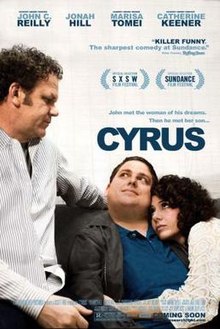
Similar films about dysfunctional and barely interesting people.  In Cyrus, poor John C. Reilly has the good fortune to start dating Marisa Tomei.  Unfortunately, Jonah Hill (Cyrus) is Tomei’s babied adult boy and what ensues is a muted power struggle played a little too seriously when there were more laughs to be had.

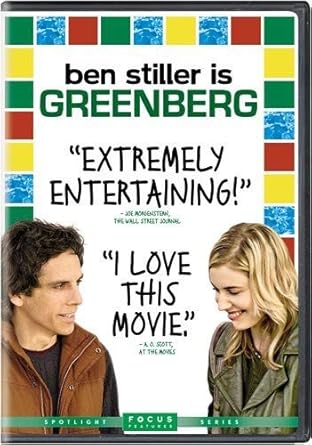
Greenberg is another filmic form of torture from Noah Baumbach, who has made quite a career of making movies about unpleasant, self-centered wretches (Jeff Daniels and Laura Linney in The Squid and the Whale; Nicole Kidman in Margot at the Wedding).  The sad center of Greenberg is Ben Stiller, a just-out-of-the asylum condescending dick who is house-sitting for his brother in L.A. Thankfully, unlike the prior films, Baumbach doesn’t put children front and center for the abuse he finds so illuminating.

To give credit where it is due, both Hill and Stiller do well with their appointed tasks, which is to squeeze a little humanity out of such creepy, crappy characters.  And while Cyrus ends up unconvincingly sweet, Greenberg is coyly ambivalent.

But really, do we care whether an ass like Stiller may find love at the end of the day?

We do not.

Image result for 50/50 Movies

Joseph Gordon Levitt gets a grim cancer diagnosis and is supported by Seth Rogen, who plays the standard best friend role (much as he did in Funny People), only now, he’s a stoner trying to get his friend to use the cancer to get women.  Rogen can be funny but he better branch out.  He’s got one persona and it is wearing very thin.

There is also a love connection with his cancer support therapist Anna Kendrick that is all too paint-by-numbers with its concerns about the ethics of falling in love with a patient and the inevitable breakthrough.  And there is an overbearing mom played with little imagination by Angelica Huston.

What is memorable about the picture is Gordon Levitt, who manages to convey the loneliness, confusion and other-worldliness of a possible premature death sentence with force and subtlety.  He’s almost worth the watch alone.

J.C. Chandor (A Most Violent Year) gives us a taut, intelligent, crisp story of one NY investment house which realizes (credibly, at least for movie purposes) that the economic crash/conflagration of 2008 is not only going to happen, but it is happening, however subtly.  As a result, we get to see the reaction of and impact upon the firm’s silky Gordon Gekko-like chairman (Jeremy Irons); the executives who sold him on the mortgage-based investment policy that brought the firm to the brink of ruin (a harsh looking Demi Moore, made all the more brittle by her counterpart, the Dorian Grayish Simon Baker); the traders (Kevin Spacey, who I would say steals this movie except for the fact that Paul Bettany as his no. 2 is every bit as good); and the lower-level young risk analysts (Zachary Quinto and Penn Badgley) who reveal the threat and then serve as wide-eyed witnesses to the first rumblings of the financial earthquake.  The film never misses a beat as it propels the story (which unfolds in a 24 hour period) while offering great characters in an ensemble piece loaded with dialogue that is thoughtfully cynical but never showy.

Chandor’s byzantine world of finance is neither sexy or diabolical, and the cogs are just performing their jobs in a system whose caprice they often fail to understand.   As the trading floor manager, and the closest thing the film comes to a moral voice, Spacey sees the inevitability of the resolution but he cannot resist it; the system won’t let him.  There are no villains, and thankfully, no simplistic Oliver Stone-esque sermons.  The characters are the audience, and they, like us, do not lash themselves to the wheel as the ship goes down.  They survive, take stock and move on.

By far the best film of 2011.

Image result for Young Adult theron
A departure for Diablo Cody, who wrote JunoWhile Juno was whipsmart and clever, it was often too much so, veering into the Aaron Sorkinland of “oh, what I would have liked to have said.”

Young Adult is more grounded and real.  While the protagonist (Charlize Theron) is a prom queen frozen in the time of her glory, Cody does not use her for a series of comebacks and big rhetorical finishes or for being taken down a peg.  Theron is as she was, returning to her home town to reign once more, and in the process, reclaim her high school sweetheart (Patrick Wilson).  But there are no grudges to be fixed or comeuppances to be delivered.  The queen is home, but her prior reign is largely in her mind, and the kingdom did not miss her.

In Jason Reitman’s hands, as always, the film is assured, alternately somber (Theron’s life in Minneapolis and her return to her strip mall dotted home town differ mainly in the fact that in the big city, she lives in a high rise, away from the masses) and awkward (the small town does not welcome Theron’s glamour; sports bars do not accommodate slinky and seductive).  Theron and Patton Oswalt (as a crippled high school nerd who runs into Theron during her quest) shine, and their earnest interactions reveal Cody’s maturity as a writer.

One scene in particular comes to mind — they are drinking at a bar, and Oswalt sees some guys playing pool and he moans.  I immediately figured, here we go. Old high school tormentors. But now he has the queen in his corner.  But instead, a guy wheels over in his wheelchair, a cheery and upbeat disabled townie who Oswalt dislikes for being cheery and upbeat.

.

The Descendants Movie Review for Parents

Another Alexander Payne gem.  I’m always heartened by a picture about family and relationships that is neither pat, cute and unreal, or so raw and uncompromising that you’re driven to awkward discomfort.  George Clooney is more than believable as a father whose wife has an accident and is in a coma, having to deal with establishing relationships with his two daughters while also learning that his wife was having an affair. On top of these woes, Clooney is the trustee of a pristine piece of Hawaii, and his family naturally wants to sell to the highest bidder. So, no stress there.

All the characters ring true, from the wife’s grief-stricken and angry father (Robert Forster) to the rebellious daughter (Shailene Woodley) to his wife’s scared lover (Matthew Lillard) to his shattered wife (Judy Greer).  Particularly strong is Nick Krause as Woodley’s boyfriend, who accompanies Woodley as she comes back from college to deal with the tragedy. He could have been ill-used as the clueless stoner/comedic relief, and while he is funny at moments, he’s also poignant, another burden Clooney has to carry, but perhaps the only one who can actually assist.

The film meanders a little, and it tests Clooney’s depth (plus audience credulity – what wife cheats on George Clooney?), but those are nits.  This is a rich portrait.

Image result for ides of march movie

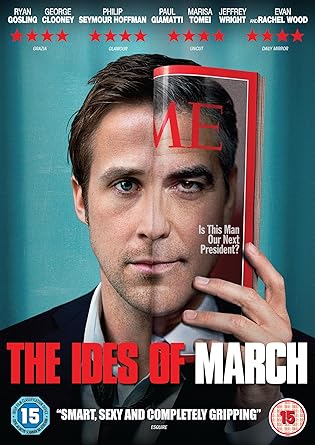
An earnest political tale, not as serpentine as Advise and Consent  and lacking the sense of humor of Primary Colors.  It’s closer to The Best Man.  That said, it could have used Gore Vidal’s involvement because the picture is dull, with dutiful performances by George Clooney as the flawed and dark presidential candidate; Phillip Seymour Hoffman as his “loyalty first” campaign manager; Paul Giamatti as the conniving rival campaign manager; and Jeffrey Wright as the oily senator who holds the key to the nomination. Based on a stage play, it feels stagey, but the biggest flaw is Ryan Gosling as the number two in Clooney’s camp who becomes embroiled in a web of intrigue.

Gosling is poorly written.  On the one hand, he’s presented as whip-smart and an up-and-comer, but some of his missteps are so glaring as to be ridiculous.  Note to self:  when having to pay off the massive fee of $900 to take care of a problem, DO NOT USE PETTY CASH!

The plot is also a little too tidy (why is meeting with the rival campaign manager presented as the equivalent of a paid sexual tryst with a transvestite?) and sometimes, the perfect rebuttal is foregone for the weight of the message.

There’s also a political imbalance that is a little distracting.  Christopher Orr nails it:

Alas, The Ides of March wears its ever-bleeding heart on its sleeve. As frontrunner Morris, Clooney is to Barack Obama as Martin Sheen was to Bill Clinton, an uncompromising embodiment of the liberal id. He waves his irreligiosity like a banner, vows that with a greener energy policy, “you don’t have to bomb anyone, you don’t have to invade anyone,” and publicly derides the gay-marriage debate as a “silly argument.” (He even gives the right answer—with the benefit of 23 years’ hindsight—to the historic Michael Dukakis death-penalty gotcha.) A war hero turned antiwar, Morris is Wesley Clarke crossed with Dennis Kucinich crossed with Robert Redford in The Candidate. It’s little wonder that from the film’s vantage point on the ideological rim, moderate Democrats are Machiavellian devils, and Republicans—I may be mistaken, but I don’t believe a single one appears onscreen throughout the entire course of the film—are an inconceivable evil looming on a distant horizon, like the White Walkers in Game of Thrones.