Archive

Drama

No matter the gravity of the historical event, be it the assassination of JFK or the Cuban Missile Crisis, Kevin Costner raises the hard question.

“What the hell kind of accent is that? Did Jim Garrison and Kenny O’Donnell have speech impediments?”

As to the movie, Thirteen Days is the historically inaccurate drama of the Cuban Missile Crisis told through the eyes of former JFK advisor Kenny O’Donnell, who most historians agree was more of a gofer and pal than a policy force. While it is not unreasonable to inflate the involvement of a tertiary character in historical drama, if you’re going to make stuff up, then do it smart. Make O’Donnell from Delaware, so Costner doesn’t have to butcher an accent. And make him interesting. As written here and played by Costner, O’Donnell is dull as dishwater, has poor political instincts and the temperament of a teen. Indeed, his primary motivation seems to be to have the Kennedys (as played by Bruce Greenwood and Stephen Culp) really, really like him (upon reflection, given the sycophancy surrounding the Kennedys, that motivation may be more in line with actual history than I surmised).

Blocky, uniform, anti-climactic, and predictable (it even uses black-and-white reverence to Camelot), you’d do much better with the classic teleplay The Missiles of October, which had William Devane as Jack and Martin Sheen as an angry, blustering Bobby.

Thirteen Days (2000) - IMDb

Cub-er, Cub-er, Cub -ah – er”

The only thing that recommends the film is Greenwood, who does a fine job conveying President Kennedy’s angst and his sense of isolation. Conversely, Culp’s Bobby Kennedy is portrayed as borderline stupid with impulse control issues (again, on reflection, maybe they got the history right there as well).

Even when the film does pick up a little speed (after all, it is the story of the nation on the brink of nuclear holocaust), Costner’s O’Donnell re-enters with his domestic issues and bizarre elocution, to grind it to a halt.

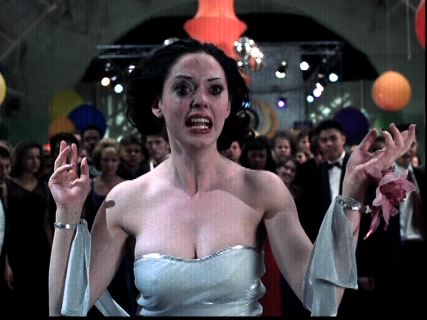
Jawbreaker. The hot chicks run the high school. The top hot chick is kidnapped by her three cohorts as a prank. She is accidentally killed in the process. The murder must be covered up. The veneer of high school politics is exposed in the process. And the queen bee (Rose McGowan) –

<

well, things go poorly for her.

This is a retread of the Winona Ryder-Christian Slater satire Heathers. Heathers, however, was funny. Jawbreaker is merely nasty, which is not all bad, but close. The film has a self-satisfied manner, constantly congratulating itself on its advanced perceptions of popularity and social standing, but never veering to far from the titillating trash it pretends to mock. I prefer the titillating trash without the condescension.

It does have a young Judy Greer who turned in a great performance as the cheated-upon wife in the Oscar-nominated The Descendants.

Matt Damon is a candidate for Senate in New York, pretty much a carbon copy of George Clooney’s presidential candidate in The Ides of March – smart, iconoclastic, liberal, not the kind of guy to admit he wouldn’t support the death penalty for the murderer of his wife. He finds his true love (Emily Blunt) before a big speech and then on a bus, and there is a real connection. But his path leads to higher things than true love. Sooooooooo . . . .

A bunch of angels (Anthony Mackie, John Slattery and eventually, ponderously, Terence Stamp) in ridiculous fedoras do all in their power to keep Damon away from Blunt and “on his plan.” And their power is impressive, except when it is not. So, they can freeze time and inject an idea into the mind of Damon’s campaign manager, but when Damon and Blunt are close, the best they can do is jam land lines and ensure that a cab won’t stop for Damon.

A decent premise (true love conquers all, even angels who have us on a predestined course) is destroyed by failure to let us in on the rules of what angels can do and cannot do (apparently, their powers are weakened near water, ala’ the aliens in Signs). Worse, the “Mad Men” hats the angels wear are actually powerful. They can open doors. Not in the “a well dressed man can get the right doors opened” way but in a “wearing this hat can get doors of teleportation to open.” And before you can say Ben Braddock, Damon is interrupting Blunt’s wedding.

Image result for Matt Damon The Adjustment Bureau hat

“How do I look in this? Really.”

Avoid.

Denzel Washington plays a high school football coach in 1970s Alexandria, Virginia. Washington is given the head coaching job in the middle of the integration wars. Making matters worse, he replaces Will Patton, the soft-spoken former coach, who responds with a bruised ego but a determination to stay on as an assistant coach for “his boys.” There are racial tensions between Washington and Patton and between the now integrated high school football team.

No worries, though. All those tensions are erased by group sings, group hugs, group showers, the iron-fist of the strict Washington, and the velvet touch of the gentle Patton.


“THIS IS A VALUABLE TEACHING MOMENT, SON.”

The lessons are fired into your brain with the subtlety of a nail gun, and the cliches pile up quicker than you can say After School Special.

The black players can sing and dance, and they soon turn those slow-footed white boys into singers and dancers.

The black defensive captain is angry and he lacks the concept of team, so the white defensive captain shows him what teamwork really means.

Washington is a “My way or the highway” kind of guy, yet Patton shows him that improvising and being receptive to new ideas can make him a better coach.

Patton is too gentle on the black players, a repressed form of condescension, so Washington points this out, and dag gummit, Patton learns to be tough.

Oh, and for the most part, the story is a concoction churned out by the Hollywood folks who gave you the slow clap, “don’t you die on me!” and racial healing via dancing to Ain’t No Mountain High Enough.

As for what one would hope could be a saving grace in a sports picture, the football is laughably inauthentic. Altman filmed better sports footage in M*A*S*H.

If your intelligence isn’t insulted, as the screenwriter might observe, “Houston, we have a problem.”

Reese Witherspoon had to come from somewhere, so why not a high school socialite world remake of Dangerous Liaisons, with monied prep school Manhattanites in the roles of French courtesans?

The picture is neither adept enough to be engaging or camp enough to be funny. It also includes a cringe-inducing courtship between Ryan Phillipe (as Valmont) and Witherspoon. Phillipe, tasked to deflower the chaste Witherspoon (she is the daughter of the headmaster), becomes “totally infatuated” with her. Why? Because she makes him laugh. How? Because during a car ride, she made faces at him by sticking her tongue out and screwing her nose up and using her fingers on the top of her head to simulate the look of a lunatic/horned beast.

Oof.

Summer

Summer of Sam. Spike Lee’s disjointed pastiche of the summer of ’77 in NYC fails on just about every level. Still, because of the nature of Lee’s failures (they tend to be interesting and sometimes spectacular failures), there are worse bad films you could go rent.

NYC in the summer of the Son of Sam is a hot, violent, steamy, stupid place, populated by an unfaithful, disco hairdresser (John Leguizamo), his confused and sexually unsatisfied wife (Mira Sorvino), loose trash from the Queens neighborhood that serves as our setting (Jennifer Esposito), an Italian kid getting into the punk scene (Adrian Brody), a mob boss (irascible Ben Gazarra, who just died, RIP), a local cop who came from the streets (Anthony LaPaglia), Leguizamo’s sharp tongued paramour and boss (Bebe Neuwirth), a bunch of Lee’s standard Italian thugs, and of course, David Berkowitz (Daniel Badalucco from TV’s “The Practice”) who is going stark raving mad and taking it out on everyone else by shooting them.

Lee’s first mistake is his attempt to capture the milieu of too many totems of ’77 NYC. So we get the Queens disco, punk haven CBGB, Plato’s Retreat, Studio 54, Yankee Stadium, the looting. It’s all too much, too scattershot, and in trying to depict so many hallmarks of the time, it feels rushed and inauthentic. (Boogie Nights stands in sharp contrast in that it conveyed a convincing feel of late 70s, early 80s LA without having to take you on a Map of the Stars – Burt Reynolds’ backyard pool party was quite enough).

It’s a minor problem, as it turns out, because Lee’s characters – to a person – are uninteresting morons. Leguizamo is a conflicted Lothario with a bad case of the madonna-whore complex – he can nail anything in heels but his wife, with whom he must couple both quickly and without fanfare. That we have to suffer this semi-believable inadequacy in the late swingin’ 70s (repeatedly, as Lee cannot get enough of long, boring arguments between Sorvino and Leguizamo) is unfortunate. That Leguizamo is the main character, and emotes his fu**in’ love for his wife, his fu**in’ confusion, and his fuc**n’ fear of that fu**in’ Son of fu**in’ Sam, is excruciating. Worse, Leguizamo’s character lapses into drug abuse. The actor takes the opportunity to vomit all over his shoes in expressing his confusion and angst.

No one else is much better. Sorvino is dull and whiny as a wife who tries to please her husband and then gets fed up – no, make that fuc**n’ fed up. Brody, who was just another Italian goombah in the neighborhood, now sports a dog collar and spiked hair. He is forgettable, mainly because Lee never gives him a chance to explain why he changed, what about punk rock has transformed him in both spirit and style. He is bisexual, gets cash for having sex with men, dances at a gay strip house and does porno. And if he’s angry, he’ll smash a glass against his own forehead. Why? No real reasons are given for Brody’s anger. It seems that he does these things merely because it is hot in NYC.

Naturally, the Italian toughs – looking to keep the streets safe from Sam – decide that Brody is the killer. And that is the story.

There are cultural false notes as well. For example, Brody digs punk and articulates that The Who are his discovery. Anyone into punk rock in ’77, however, would have found The Who much too radio and establishment. You can tell that Lee just wanted to use the band’s anthems (he does so twice) in the movie, so presto, The Who become a punk icon. Additionally, when Brody’s band plays at CBGB, they are much too polished and pop to be a convincing 1977 punk act. Finally, Lee casts himself as a television reporter, which makes for painful watching (let’s just say Lee’s elocution is closer to Gerry Cooney than Max Robinson – he could not have gotten job announcing winners at a race track, much less being the “man on the street” for a local NYC station).

Other problems: Lee clumsily injects race into the mix in a street interview with black residents of Bed-Sty. Specifically, Lee allows the rant of one woman, who screams that the greatest race war ever would have ensued had the Son of Sam been black. She then chides Lee’s reporter character for acting white. The effect is unintentionally laugh out loud, because no matter the film, you feel Lee’s childish compulsion to sacrifice story for slogan.

In the end, Summer of Sam struck me as oddly subversive. You get the sense that Lee is most sympathetic to Berkowitz, who spends his days screaming at a neighbor to muzzle a barking dog (this same dog was the one who told him to kill, kill, and kill again). But the sum of Lee’s picture is creepy: given all the characters of NYC in that muggy summer of ’77, no wonder Berkowitz started shooting people. You loathe them, and Lee makes you complicit in empathy for Berkowitz (at least, you figure, I can get a break from these dimwits if he gets back to the killer).

So why see it? Lee is a gifted director who is crippled mainly because he has no real feel for story. Of his films, only two stand out – Crooklyn and Clockers – the latter because the reminisces of childhood in Brooklyn lend themselves to film by disconnected vignette, and the former because it was built solidly on the work of Richard Price. Like He Got Game, Summer of Sam is a mess, but interspersed in the carnage (and there is plenty of that, by the way, because Lee chooses to lovingly film almost every grisly shooting) are well-realized visions. Included are a montage of the characters’ summers to The Who’s “Teenage Wasteland” a smart dance scene between Sorvino and Leguizamo, and the recurrent pan shot of a tormented Berkowitz who spells his maniacal rants on his walls, with children’s blocks, and in conversation with a barking dog. Lee captures these, and many other moments, with ingenious motion (his strong suit) and smart editing.

Unfortunately, as usual, his skill cannot overcome an inane script, a corral of overactors and his own excesses.

Hollywood conceits come in many forms. In the Denzel Washington/John Lithgow film Ricochet, the screenwriter presumes he can replicate the idiom of the inner city. There is a scene with Washington, as the good black man who “made it out” and Ice T, as the bad drug lord who is still “in.” Their exchange is gussied up Shaft. The screenwriter even concluded the film with Washington saying “You can kiss my black ass!”

The screenwriter of Ricochet?

Steven E. de Souza (@StevenEdeSouza) / X

So, Hollywood’s sense of urban culture is lacking. But you’d think it would have a better handle on places closer to its heart, like suburbia. Think again. Hollywood sees the suburbs as a vast wasteland, a place for vacuity and the spawning of disgruntled screenwriters. Hollywood’s grasp on Maple and Main is no more firm than its grasp on “the ‘hood.”

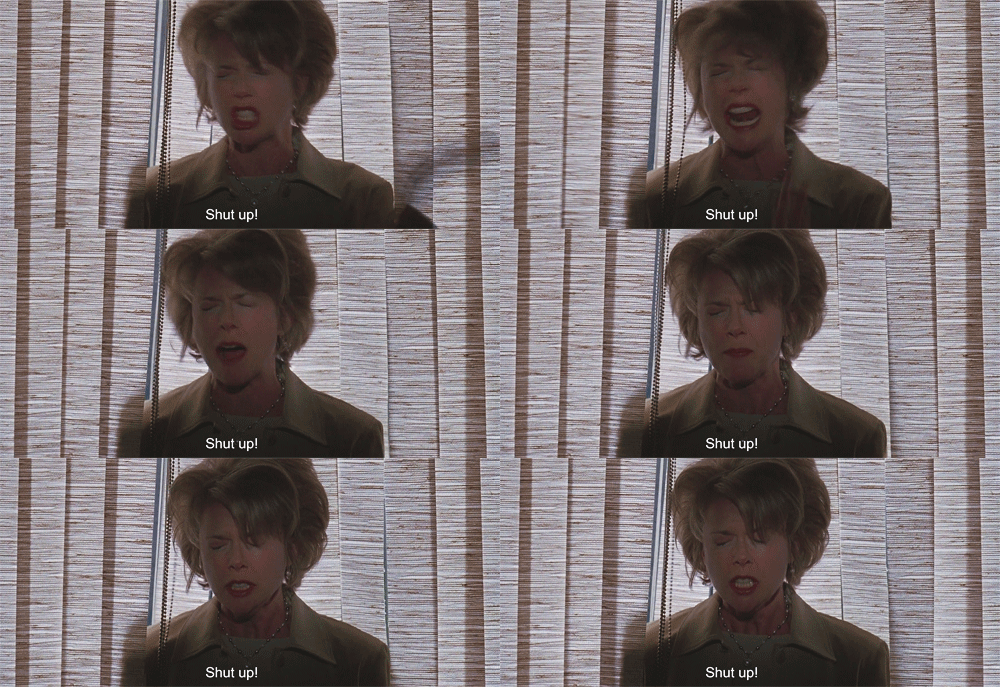
Which brings me to American Beauty, a false film of suburban decay. Kevin Spacey has a midlife crisis, though it really isn’t a true midlife crisis, because he is married to Annette Bening, and she is so cartoonishly gruesome that Spacey’s crisis seems less a subject of introspection than one of survival. Bening approaches her character as Martha Stewart on methampehtamine (and that’s the joke – get it? – because Martha Stewart is so insidious). She is so outlandish that any acting out on the part of her husband and daughter seems ho hum. And then there is the tranquilized housewife neighbor, and the homophobic (or is he?) Marine neighbor, and the disaffected, let-down teens. You’ve seen it all too many times to be touched.

What is good about the film? A few things. It ends tidy. Spacey plays decidedly above the material (though, being the only empathetic character, he is difficult to judge because you beg for his return during every one of his absences).

But what is bad is really quite awful. The characters are abused rather than drawn. The use of Bening as Mothra the Suburban Scene Eating Hydra not only minimizes most character reaction, but it seems cruel.

image

Bening is so demonized and dehumanized – all for the illumination of Spacey – that you pity her.

Image result for Boorman The general

John Boorman’s film is the story of Martin Cahill, a Dublin gangster of the 1970s, 80s and 90s. Cahill’s story is fairly interesting. He was a small time thief whose gang rose up to become a crime wave so big that – after an art heist which included the swiping of a Vermeer – the police followed him everywhere (not stake-out following, but standing at his front door and walking 3 feet behind him following). His attempts to shake his tails, his planning and execution of robberies, his avoidance of conviction on an earlier heist, and his constant obscuring of his own face from public view are stuff of crime legend. Brendan Gleeson has great fun with a simple character in ridiculous circumstances.

Boorman writes good patter between the crooks, and he paces his heist scenes well, all with a comic touch. Boorman also has a keen insight into the economic and political pressures in everyday Irish life, and he presents his observations without any great speechifying.

There are two glaring problems with the film. First, Jon Voight plays the Inspector who hounds Cahill. Voight is a glutton for scenery, and his brogue is something you see in an Irish Spring commercial. I understand Boorman and Voight go way back to Deliverance days, but Voight’s presence here is very disconcerting.

Second, Boorman shows Cahill doing something so brutal about 3/5 through the film thatyou withdraw emotional investment in Cahill. While Boorman tries to make it all part of the lore of Cahill, in fact, tonally, the film seemed off-kilter from that point forward.

Therein lies the rub with real-life crook pictures. Cahill is portrayed as man of vision, and a good guy, one in a line of devil-may-care thieves in a corrupt system. His associates are all twinkle-in-the-eye goodfellas just trying to get by. This is old hat, from the Jesse James just being a misunderstood man of honor file. In fact, Cahill was a vicious thug, as is necessary if you are going to net 40 million pounds over a 20 year career. He attempted to blow up a forensic scientist who was to testify against him. His gang was not just band of merry robbers, but they participated in extortion, heroin dealing, and rape. Indeed, Cahill once nailed a victim to a snooker table, and in 1993, one of Cahill’s associates was arrested and charged with raping his own 14-year-old daughter (Cahill personally intimidated the young girl giving evidence).

Top o’ the morning!


The Winslow Boy. David Mamet’s period piece about an Edwardian scandal is sharp and deep. A proper, emotionally serene English family strives to clear the name of a family member from what they perceive as a slander (the youngest son is accused of the theft of 5 shillings and expelled from navy school). The father (Nigel Hawthorne of The Madness of King George) is an eccentric banker who sacrifices the family’s position (financial and otherwise) to clear his son’s name. His daughter (Rebecca Pidgeon) is a suffragette engaged to a military man. As the scandal envelops the family, her social life is shattered.

The family engages the services of Sir Robert Morton (Jeremy Northam), a leading barrister and politician who opposes women’s suffrage but finds himself inexorably drawn to the case and Pidgeon. What follows is a psychological study of the ties of family and the limits of honor as well as a satisfying courtroom drama.

The dialogue is understated, which is rare for Mamet, but it is still rhythmic. Mamet treats each character, major and minor, with dignity. There are no fops or fools. Everyone is multi-faceted and thus, interesting.

Tom Ripley's “Talent” Explained in Psychological Terms | by Martine Nyx |  Cinemania | Medium

Anthony Minghella’s The English Patient did not have the beauty (such is Italy versus the Middle East), the narrative strength or the strong characterizations of The Talented Mr. Ripley. While it won best picture, it can comfortably be catalogued in that big picture-big bore compendium of Gandhi, The Last Emperor, and Out of Africa. The somnambulate performances of Ralph Fiennes and Kristin Scott Thomas sealed the deal.

Not so in Minghella’s follow-up. Matt Damon plays, in his own words, a “nobody” named Tom Ripley who by chance and minor deception is hired to retrieve the wayward son (Jude Law) of a shipping magnate (James Rebhorn) in Italy. When he gets there, Damon insinuates himself into Law’s life, as well as the life of his fiance (Gwyneth Paltrow) through a mix of artifice and honest friendship. Damon immediately becomes entranced by Law and by Law’s life. His love-affair with both gives us entree into the mind of a malformed ego undergoing slavish adoration.

And Law is worthy of adoration. He is the energy of this picture, alternately charming, impetuous and cruel. As Damon keeps sidling up to Law, you feel for both if them. Damon is voracious but because Law is so captivating, Damon’s need to be near him and eventually to be him elicits understanding. This is a crucial component, for while the sexual undertones are strong, what Minghella does is make you a partner to Damon’s mental, rather than physical lust for Law.

This is the film’s triumph, as most psychological thrillers suffice to center on the madness within the sociopath, rather than lay a sympathetic base for why the sociopath becomes sociopathic.

Here, Minghella allows us to see the Damon-Law relationship through courtship, their bad moments, Damon at his most fawning and pathetic, Law at his most generous and spiteful. All with the backdrop of beautiful Italy, a locale Minghella makes almost dreamlike, the better to underscore Damon’s dizzying descent.

Damon manages the role very well, though he overrelies on a few tics (the weird, self-effacing grin, the penetrating stare). Still, his is a measured and affecting performance, certainly a worthy contrition for his “aw shuckism” of Saving Private Ryan. Everyone else is quite good, with special mention to Philip Seymour Hoffman as Law’s monied playboy friend from Princeton. His time on screen is limited, but he dominates every moment he has with a dry, smart rendering.