Archive

Drama

The opening scene, where our beleaguered protagonist Duncan (Liam James) has to endure a numeric assessment from his mother’s new boyfriend (Steve Carell, who deems Duncan a “3” on a 1 to 10 scale for his layabout ways) reveals a great strength and a great weakness of the film.  James, as an awkward, inward 14 year old dragooned to Carell’s beach house with his mother (Toni Collette) for the summer, exhibits all the hideous hallmarks of the age. He’s ungainly, goofy and paralyzingly shy.  Carell also keenly occupies his type – an exact, sly bully who masks his menace in the cause of trying to be a father figure.  Everyone time he says “hey, buddy”, it presages a cut, an attack, and therein lies the problem with this coming of age tale.  With Carell identified as a villain from the get go, little that occurs next is unexpected or fresh.

That said, the script, from the Oscar winning writers of The Descendants (Nat Faxon and Jim Rash, who also co-direct) is assured.  The story of Duncan’s growth under the tutelage of Sam Rockwell, a comic guru who runs the local water park, takes pity on Duncan, and gives him a job, is the heart of the picture, and their banter is really very funny and often surprisingly touching.  As Duncan’s mother loses herself in Carell’s world, we know  Carell must be slayed.  While we wait for that inevitability, however, Faxon and Rash have a blast with the water park and all of its quirky characters (including both Faxon and Rash, who are both very funny as well).  Carell’s coterie at the beach are also well written, if not fully developed, with Allison Janney delivering the lion’s share of the killer lines, most of which are directed at her own son, who has a wandering eye she insists be covered up by a patch.

There is triumph and happiness at the end of the picture, as you knew there must be, but with a little more care and guts, the writers could have made a great film.  Instead, in the middle, they so vilify Carell that they do lasting damage to the story.  Duncan goes on a boat trip and Carell forces him to wear a ridiculous life vest while the much younger kid with the wandering eye is unburdened.  The cruelty is too much.  It robs Carell of any chance of being anything but a caricature, demeans Collette, and is so humiliating to Duncan that you start to lose sympathy for the kid.  I don’t think Faxon and Rash wanted Carell’s numeric assignment to find purchase with the audience, but that’s what they risked.

This film is a similar to, but not as good as Adventureland.

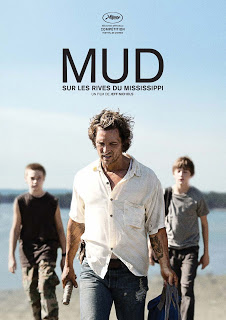
The excellence of writer/director Jeff Nichols’ Mud lies in its authenticity, confidence and reserve. As I watched this coming-of-age story about two boys, Ellis (Tye Sheridan) and Neckbone (Jacob Loffland), both of poorer Arkansas stock, and their involvement with a fugitive (Matthew McConaughey), I couldn’t shake what the film wasn’t – maudlin, simplistic or heavy-handed (i.e., like the template for so many “coming-of-age” stories about young boys, Stand by Me). While those two films have the Huck Finn story in their DNA, that’s where the comparison ends. Stand by Me needed a narrator to tell you what was of import and what was not in the adventures of their young male characters, and by the end of it, you felt thoroughly manipulated. Mud, however, requires no such crutch. The symbol of what is a man and father, what the divorce of his parents means to a boy, what young love is, and the heart of friendship, is depicted in a lifelike, piercing way. There is a wonderful scene where Loffland’s uncle, played by Michael Shannon, tries to impart some wisdom to Ellis, explaining in a deft but allegorical manner how Ellis needed to stay out of trouble and the nature of his responsibility to Neckbone, who is both a rock and a natural born follower. When Neckbone asks Ellis what they were talking about, Ellis shrugs and replies, “I don’t know.”

The performances are almost completely spot on, and Sheridan and Loffland should be shoo-ins for best actor and best supporting actor, but I’m certain they will be overlooked. That’s a shame, because they are at the ages where pure naturalism (for example, Quvenzhane Wallis in last year’s Beasts of the Southern Wild) cannot carry the day. These boys are making intuitive choices. Their interplay alone is mature and steady, and Sheridan’s scenes with a would-be girlfriend are heart wrenching. They will evoke your best friend from childhood, and you won’t need Richard Dreyfus intoning, “he was my best friend from childhood.”

McConaughey, who has bouts of phoning in roles with a quick smirk and a lazy drawl, delivers a much deeper performance here as the outlaw, desperate not only to escape the law but to reconnect with his true love (Reese Witherspoon). Nearly every other supporting character – from the rigid, recluse Sam Shepard to Ellis’s parents (Ray McKinnon and Sarah Paulsen), to Shannon (whose three scenes damn near steal the movie) – contributes in an effective, understated manner. If there is a weakness, it is Witherspoon, and she was not bad, she was just a little outclassed.

Nichols (Take Shelter) shoots the Mississippi River as a dream, and when the boys are on or traveling to and from the island where McConaughey is holed up, the feel is very Terence Malick. But when the boys are back home or amongst the townies, the look is bleached and tacky, further emphasizing the juice they get from their adventure.

Another kudo – when Hollywood deals with the non-urban, at its worst, you get a grotesque caricature, and at best, you merely get a sort of condescending ennobling, the hick version of “the magical negro” (usually wrapped up in a “you’re better than this place, Willie!”). There is none of that here. Instead, Nichols has written rounded, grounded, real characters.

It is perhaps unfair to use this picture as a club against Stand by Me. To the positive, it ranks up there with the equally excellent Sling Blade and One False Move and is thus far the best film of 2013.


This biopic of Alfred Hitchcock’s making of Psycho attempts to juggle three stories:  the strain on the relationship between the director (Anthony Hopkins) and his wife (Helen Mirren), Hitchcock’s own perverse infatuations with his leading ladies, present and former (Scarlett Johannson as Janet Leigh and Jessica Biel as Vera Miles), and the actual making of the movie, with its unsettling, revolutionary ties to the Ed Gein murders.  Each of these threads is presented in a tepid and/or listless manner.

Hopkins and Mirren are quite good, but the script gives Hitch little to do but mope about his wife’s inattention, and Mirren’s near-dalliance with another writer (Danny Huston) is a bit uncomfortable.  Either the 68 year old Mirren, or Alma Hitchcock (she was 60 at the time of the making of Psycho) are too old for the communication of unquenched sexual urges necessary for the role.

As for Hitchcock’s own urges, the film cops out.  The director is shown as a peeping tom, and any darker heart is reflected only by his silly imagined conversations with Gein.  Leigh and Miles commiserate a bit on the director’s peculiarities, but nothing particularly upsetting is revealed, and neither actress is capable of delivering some deeper psychic injury or fear.  At best, they cluck, “oh, be careful.  You know old Hitch.” Given the director’s very disturbing behavior prior to, during and after Psycho, the wispy treatment seems cowardly. But even if the filmmakers were reluctant to travel that dark path, they missed many other opportunities to illuminate the eccentricities of the director. The lore has it that Leigh and Hitchcock were both unhappy with John Gavin’s work in his love scene with the former, and that Hitchcock instructed her to “take matters in her own hands” to amp up the passion. Yet this gem of a vignette is left out?

Finally, there is the risky making of Psycho, a film Hitchcock bankrolled himself when the studio became leery over the subject matter.  Hitchcock is ostensibly based on Alfred Hitchcock and the Making of Psycho by Stephen Rebello. which I have not read but hope is more interesting than was portrayed in the film.  The making of the film is characterized as worrisome at times. The director’s financial stress is shown, and he pouts when his wife is away, but that’s about it. Nothing of Hitchcock’s craft is developed, and some of the hurdles, such as the fight with the censors over the shower scene, are played mainly for laughs. So much is missed.

Take Rebello in a 2010 interview:

But she is killed in the shower in the novel. In fact, Hitchcock told many people that he was most attracted by Bloch’s notion of a murder coming out of the blue in an everyday, confined setting—the shower, where we feel relaxed and complacent but where we’re utterly vulnerable.  Hitchcock was thrilled with the idea of shocking audiences by casting a major star as the heroine and killing her off so early in the picture. That violated every Hollywood rule. Bloch’s heroine has her head cut off in the shower, not exactly the kind of thing that even Hitchcock could have gotten away with, even if he had been tempted. Bates in the novel is middle-aged, pudgy, alcoholic, brooding, unattractive, repugnant. He also has extensive conversations with his mother, which would have been fatal and a cheat on film. Casting Anthony Perkins was a lucky masterstroke; he’s as charming, attractive, sad, perverse, and lethal as earlier Hitchcock killers like the one Joseph Cotten played in Shadow of a Doubt and Robert Walker played in Strangers on a Train. Perkins had already worked with top directors like William Wyler, Anthony Mann, and Stanley Kramer, and Paramount had spent lots of money promoting him as a successor to the late James Dean or comparing him to the young James Stewart or Henry Fonda. Although he had become a teen idol and even made some hit records, things hadn’t quite clicked and, at the time, Perkins felt typecast and owed Paramount a movie. Hitchcock could hire him inexpensively. It was a perfect storm.”

There is so much here, but the film merely gives us Hitchcock cackling at killing Leigh early and the tut-tutting over the ghastly plot, with Alma disapproving, the powers that be huffing “You can’t do that!” and Hitch gleeful as the bad little boy.

One added point.  As noted, Johannson and Biel are pedestrian, but they aren’t the only ones.  The bullying studio head is played in embarrassingly broad fashion by Richard Portnoy, James D’Arcy’s Anthony Perkins is an impression rather than an embodiment, and Ralph Macchio is unfortunately unearthed for a short scene as the writer, Joseph Stefano.  The Karate Kid is not missed.  And I can watch Robocop only so often to remove the taste of yet another Kurtwood Smith uptight authority figure performance.

At the end, you’re left with a damning question – why make this picture?  It does little to communicate Hitchcock’s demons or his genius, it meanders and plays it safe, an unfortunate testament for a cinematic trailblazer. One that should not have been delegated to director Sacha Gervasi, whose resume’ is anchored by his 2008 documentary of a Canadian metal band, Anvil: the Story of Anvil.

Search Results for gangs of new york GIFs on GIPHY | Gangs of new york,  Leonardo dicaprio, Gang

Martin Scorsese’s sprawling, excessive period piece, set in The Five Points of Civil War era New York City, is almost punishing in its immoderation. A directionless Leonardo DiCaprio works his way up the ladder of nativist gang chieftain Bill “the Butcher” Cutting (Daniel Day Lewis) to avenge the death of his father, Liam Neeson, who died at Cutting’s hand when DiCaprio was a boy. Scorsese sought to offer a steamy, vibrant and bloody portrait of the slum that was lower central Manhattan, but the feel is inauthentic and verisimilitude is overcome by the garish. The opening scene – the gang fight resulting in Neeson’s death – plays as a mash up of Walter Hill’s The Warriors and a really violent version of West Side Story. You almost expect Neeson to sing, “The Dead Rabbits are gonna’ get their way, toniiiiiight!” as he brings his crew to battle.

If only. The story is deathly dull, duller even than the featured Cameron Diaz, horribly miscast as an Irish lassie/grifter (her accent comes and goes like the viewer’s interest).

Day Lewis’s performance is widely lauded and he was nominated for a best actor Oscar, but he is so over-the-top as to appear foolish. Still, scene-chewing is bound to garner easy accolades, and Day Lewis is voracious. More surprising are the nominations of the phlegmatic script and Scorsese’s aimless helming. The film meanders, half-heartedly committing to DiCaprio’s vengeance but then veering into historical re-creation, such as the machinations of Boss Tweed and the draft riots. The former plot line is marred by DiCaprio’s sullen, disinterested performance, the latter by pat conclusions (including a pretentious morphing of old and new Manhattan that closes the film and nearly induces the gag reflex).

By the time Gangs of New York was released, Scorsese had suffered the indignities of having his classic Raging Bull lose to the tepid Ordinary People and Goodfellas go down to the overpraised and politically acceptable Dances with Wolves and certainly, the Academy felt bad about that. But guilt is a bad adviser, and this is Scorsese’s worst film (though the dull and similarly overpraised Hugo and the bruising Shutter Island are close seconds).

Behind the Candelabra (2013) - Rotten Tomatoes

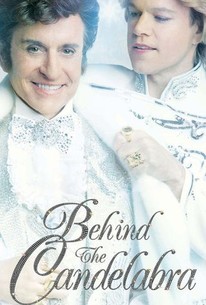
This is Steven Soderbergh’s last picture? A flimsy, small biopic about a kitschy figure (Michael Douglas as Liberace) and his boy toy (Matt Damon as Scott Thorson), arguing over dog poop in the mansion, plastic surgery and the fact that Thorson won’t agree to be on the receiving end in sex? There is no insight, Liberace’s fear of being outed is without nuance, and Soderbergh doesn’t have any fun with the Vegas excess, so the film fails as a character study and as a mindless guilty pleasure, ala’ Mommy Dearest. At its best, it is a decent VH1 “Behind the Music” as Thorson’s descent progresses. Mainly, it is clumsy and pedestrian and really disappointing when we realize this is Thorson’s story (Liberace is the reasonable one pretty much throughout).

Douglas has some strong moments, especially during his last visit with Thorson as he lay dying of AIDS, but Damon is way past “boy” much less “toy” (Thorson met Liberace when has was 17 and stayed with him until he was in his mid 20s) and he is unconvincing.

This is the filmic equivalent of Bjorn Borg’s comeback and the subject matter is Soderbergh’s wooden racket.

David Chase’s The Sopranos was a titanic television achievement, a violent, rich soap opera centered on a New Jersey crime family, adroitly crossing into the areas of everyday life of “civilians” and finding common cause in the political, familial, and cultural. But Chase was more an organizer of talent than a creator – he wrote very few of the episodes and only directed two. This is not a knock, but it may be relevant in evaluating Chase’s first underwhelming feature length film, Not Fade Away.

The picture opens with the chance first meeting of Keith Richards and Mick Jagger but quickly swings back to 1960s New Jersey, where another band is forming. Chase captures the awkwardness of the early house show; the various personalities (the guitarist who always needs more time for the band to be “ready” and the jealous former frontman, sidelined to back-up because of a weaker voice); and the juice of a well-played song.

But just when you think the story might go somewhere, Chase reverts back to the lead singer’s (James Magaro) depressing home life, where his dying father (James Gandolfini) harangues him for his long hair and his mother kvetches in full Livia Soprano mode. When we get back to the incremental steps of the band, we are again diverted to the domestic woes of Magaro’s girlfriend (Bella Heathcoate) and her own miserable homelife (her Dad is a scotch-swilling GOP square and her sister is a free spirit soon to be forcibly institutionalized).

The leads are weak. As the band’s budding lead singer, Magaro provides no more than smarm and edge, though he performs a convincing transformation from dork to Dylanesque cool. His mercurial girlfriend Heathcoate is leaden and charmless.

Worse, very little happens in this dark (and by dark, I mean inexplicably dimly lit, as if the 60s is best evoked by dingy exposition), moody, mostly joyless picture. We get some affecting vignettes and then what feels like filler after there is no follow up. The end is a preposterous paen to the power of rock n’ roll that is more peculiar than poignant.*

That said, had this been the first two episodes of a miniseries, who knows? I certainly would have continued to watch.

*. Having just read this sentence, I am forced to add “so put that in your pipe and puff on it, Pancho.”

Image result for Anna Karenina film

Beautiful, sumptuous and deservedly nominated for production design, costume design, and cinematography Oscars, the film is also leaden and dull. There is no burning desire detectable in the icy, mannered Keira Knightley, and her illicit romance with the fey Aaron Taylor-Johnson (Kick-Ass, Nowhere Boy) is unconvincing. The lush production is soulless and a bit gimmicky, replete with a dance sequence that recalls Tony and Maria in West Side Story (minus the passion), and a distracting movie-within-a-play depiction. Very pretty and little else. Knightley is preeternaturally girlish. She cannot convey having lived long and rich enough to put it all on the line for an adulterous love, so she opts for Anna as bipolar.

Frank Langella lives alone in the country a few hours from New York City.  He is slowly succumbing to Alzheimer’s, functional but slipping, and at first, appears to be little more than a forgetful, petty thief of decorative soaps sold in the town’s gift shop.  When his son (James Marsden) brings him a robot for company and guidance, we learn that Langella was once a second story burglar who did two stints in prison.  He loathes the robot until he learns it has no conscience.  A friendship develops, and soon, the robot is acting as his accomplice in a jewel heist.

The movie is clever, often touching, and a bit subversive.  There is a hilarious section where Langella’s anti-robot daughter (Liv Tyler) visits.  Horrified at her father’s reliance on the robot, she turns it off, only to surreptitiously turn it on when she wants the house cleaned.

Though the film is set in the not too distant future, the credits are accompanied by clips of the work robots are currently doing (or being designed to do) for humans, and the future is now.

Paul Thomas Anderson’s attempt to chronicle the rise of an L. Ron Hubbard type, Lancaster Dodd (Phillip Seymour Hoffman), is crippled by what the director probably deems a necessary evil. Dodd finds the damaged and cruel WWII veteran Joaquin Phoenix, and through his character (a brutish Of Mice and Menesque Lennie), we see how the weak can be co-opted and conscripted by a charismatic charlatan. But to dramatize that point, we have to spend an inordinate amount of time with a vicious, unsympathetic thug. Phoenix’s rendition is jarring, but unpleasant, as his character is mentally unstable and ape-like.

Amy Adams plays Dodd’s fanatical wife and observes of Phoenix, “He’s a drunk and he’s dangerous and he will be our undoing if we have him here.”

And that’s what happens to the movie. Phoenix progresses, but from feral animal to a more controllable and controlled beast. Not a particularly interesting or illuminating journey.

The film is also repetitive. The scenes of Phoenix’s “processing” feel interminable, Phoenix skulks and broods and then attacks critics of Hoffman, and Hoffman charmingly explains his cobbled together philosophy, until he is questioned, and then he explodes.

The performances of Hoffman, Phoenix and Adams are all excellent (all three received deserved Oscar nominations), but this is a very long, awful dull, hard slog and the ending is ridiculous.

The Master is a marathon of well shot tedium. It’s also a bit of a cop out. If you’re going to take on the genesis of Scientology, why be so oblique? Why choose to focus so tightly on the relationship between the Hubbard character and a baboon like Phoenix?


Flight – review | Denzel Washington | The Guardian

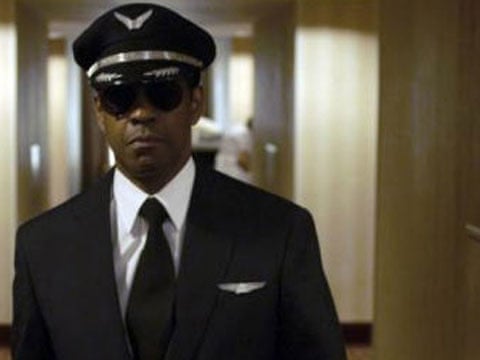
Denzel Washington has earned his best actor nomination. His performance as an addict pilot who saves a plummeting passenger jet while it and he are loaded is riveting. His character covers the gamut, from stoned to heroic, solemn to terrified, brash to impotent, but unlike other aging, iconic actors, Washington is toning down his idiosyncrasies. The scene where he learns that 6 of the 102 passengers did not make it, including a flight attendant with whom he was intimate, is a study in restraint. One shudders to think what Pacino would have done with such a role. While Tony Montana scarred that actor permanently, Washington was able to accept his best actor Oscar for Training Day without making excess his trademark.

Washington’s multi-faceted and powerful performance takes us through what is otherwise a confused film by Robert Zemeckis. The opening scene is a skillful, harrowing recreation of an incredible crash and what follows looks to be somewhat of a procedural, as the defense lawyer (Don Cheadle) is introduced and the airlines, the union and the government take their positions. Before you can settle in, however, Zemeckis pivots, and you’re watching a film about addiction, replete with a whore (well, a heroin addict) with a heart of gold (a wan Kelly Reilly). Okay. Fine. Will Washington’s valor be sullied by revelation of his intoxication? Will his heroism be overridden by his own self destructive tendencies?

As the film’s day of reckoning approaches, the picture reaches for the spiritual, and the final trials become ludicrous. Will he drink? Will he lie? Has he hit rock bottom? Before we find out, enter John Goodman, as the drug dealer who must get Washington straight via cocaine after an all night bender, in a wacky, comic turn.

What the hell is going on here?

In parts, the film is moving. In others, it is muddled or plain awkward, but Washington pulls you through what eventually morphs into a redemptive weepie.