Archive

Drama

Image result for The Normal Heart HBO

Ryan Murphy’s (Glee, American Horror Story) adaptation of Larry Kramer’s semi-autobiographical play about the outbreak of AIDS in New York City circa 1981 is a mixed bag, often poignantly moving but more often numbingly repetitive. The film does not shy away from the cruelties of the disease and the inaction that followed its introduction, echoing the source material, an urgent polemic written before there was even a test and the disease was called GRID (Gay Related Immune Deficiency).  It is an activist story for a perilous time (the play was produced in 1985) and the immediacy of the stage.  Under Murphy’s direction, Mark Ruffalo, as New York City writer Ned Weeks, is largely utilized in a series of stem winders and broadsides against the Koch and Reagan administrations, the insouciant gay community and in particular, his fellow board members of a nascent advocacy and care group. Weeks’ passion is noteworthy but by the end of the picture, you fully understand the frustration of his compatriots.  His tactics (a combination of haranguing, attacking and outing) are such that they can’t get a hotline set up without Weeks sneering or warning about the next Dachau (Kramer himself would end up being instrumental in the founding of Act Up, which was decidedly more confrontational and, to be fair, effective).  A missed opportunity of an actual exchange, for example, is the fact that Weeks is affluent, making his offering of the livelihoods of all of his co-activists (one of whom is in the military) a rather cheap and easy proposition.  This factor is unexplored beyond a toss-off comment.

Ruffalo is joined by several other notables (including Julia Roberts as a doctor on the frontlines and Taylor Kitsch as his more measured activist friend), all of whom have their own speeches, all movingly delivered but all awkwardly stagey.  When they occur, we are meant to listen respectfully to the sermons, which are heartfelt, often spoken to bigots and/or bureaucrats (poor Dennis O’Hare, who, after this and Dallas Buyer’s Club, is a cottage industry of unsympathetic pencil pushers in AIDS dramas) or screamed at the heavens, and wholly devoid of nuance.  As noted by Frank Rich in his review of the play back in 1985, “the playwright starts off angry, soon gets furious and then skyrockets into sheer rage . . . Some of the author’s specific accusations are questionable, and, needless to say, we often hear only one side of inflammatory debates. But there are also occasions when the stage seethes with the conflict of impassioned, literally life-and-death argument. … The writing’s pamphleteering tone is accentuated by Mr. Kramer’s insistence on repetition – nearly every scene seems to end twice – and on regurgitating facts and figures in lengthy tirades. Some of the supporting players … are too flatly written to emerge as more than thematic or narrative pawns. The characters often speak in the same bland journalistic voice – so much so that lines could be reassigned from one to another without the audience detecting the difference. If these drawbacks … blunt the play’s effectiveness, there are still many powerful vignettes sprinkled throughout.”  Murphy’s film is nothing if not faithful to Rich’s evaluation.

When Murphy moves away from the politics of the disease and human relationships, the picture is much stronger. The relationship between Weeks, who is reticent about intimacy and the gay world’s sybaritic nature, and his lover Felix, played by Matt Bomer, is an exchange that offers a view into the difficulties growing up and being gay. The scene where Ruffalo demands that his straight and supportive brother (Alfred Molina) accept that they are essentially the same is the best one of the film, as each character is given a  voice.  And The Big Bang Theory‘s Jim Parsons delivers a beautiful eulogy for a friend and by extension, for all the “plays that will not have been written, dances that will not be danced” that is heartrending. Sadly, these scenes are the exception rather than the rule, and the watching of The Normal Heart eventually lapses into a very unfortunate place for entertainment – duty, a film you “should” see rather than one you would necessarily want to.


 

Will Larroca’s stock as a director has been as volatile as Nic Cage’s acting career. Though critically acclaimed in some quarters, his first picture, The Monster, was uneven.  It was followed up by a skilled but off-kilter homage, Will Will Kill. Thereafter, the word on the street was that he was working on a frightening script, House of Blood, which was even touted in promos by Larroca’s studio, PJ SmoothIson.

And then . . . Larroca was tied to a trippy, bizarre The Hugginns Movie, and then a weirdly religious but shockingly effective parable, Commandments Revamped. House of Blood disappeared from the trades, replaced by talk of production of an as yet untitled American gangster opus, which is rumored to start filming shortly.

And now, we have The Ballad of Chad Big Bucks, with Larroca clearly in front of the camera. But how much of him was behind it?  This seems like a production-for-hire, and while there is no shame in making a corporate buck (documentarian Errol Morris is the genius behind Taco Bell’s new “I am Ronald McDonald” ad campaign), it’s harder to discern where Larroca shows up on this endeavor, which is sold to us at the outset as someone else’s film.

Much of the good in Big Bucks clearly carries his stamp. The chase scene in the middle of the picture takes the fury and speed of Bullitt or The Seven Ups and turns it on its head. The super slo-motion is riveting, somehow making the violence of the action even more unbearable. I’ve watched the scene numerous times and find myself on pins and needles each one. Larroca’s use of the elements is also adept. The rain is borderline elegiac, and the operatic voiceover narrative, a sing-songy minstrel tune, brilliantly alternates between mournful and mocking. Finally, the film bravely ignores religious implication until the end of the picture, and it is still unclear whether Larroca is rejecting the idea of a higher power or endorsing it.

Much of the flick, however, is haphazard. What the heck is Spiderman doing at the outset?  What is occurring with the almost purposeful rough edits, where actors turn to and acknowledge the camera?  The line between the film story and filmmaking has always been malleable in Larroca’s films, but sometimes, sloppy is just that and no more. And why does the minstrel voiceover start screaming when the main protagonist is cycling in the streets ala’ Butch Cassidy & The Sundance Kid?  And would Jordan Belfort really be walking around a leafy suburb?  Larroca is clearly comfortable shooting in the same location, and there certainly are financial pressures in a young auteur using his own studio, but it’s time to leave his familiar surroundings and see the world.

While newcomer BGrimms is a standout (his anger and fall are heartbreaking), Larroca’s continuing fealty to Zeb Dempsey and Reid Brown is questionable. His devotion to these young actors is to be commended, but Brown’s mumblemouth approach (think Benicio del Toro in The Usual Suspects) has run its course, and Dempsey’s overacting compares unfavorably to the last films of Rod Steiger. One wants to see new faces as well as new places. Perhaps that’s why Larroca himself jettisoned his own persona in favor of homages to Nicolas Cage and Leonardo DiCaprio. The selections are apt, but the time has come for Larroca to move from parody to depth as an actor, and from provincial to worldly as a director.

We shall see what the summer brings.

I normally watch this during the holidays, but it is now on the HBO rotation, and I’ve been enjoying it in segments. Based on Nick Hornby’s novel (Hornby was also one of the screenwriters), this is a fine story of a charming but vacuous and intentionally isolated rich guy (Will, played by Hugh Grant) who corrals a neighborhood boy into playing his son in the hopes it will impress a romantic target. He is soon brought into the boy’s world, against all his selfish instincts.

This is a very funny film.  The comedic set pieces (including a harrowing talent show, the death of a park swan, and awkward support groups) are masterful.  The narrative is punctuated by voiceovers from Marcus or Will, and their observations are either hilarious or sentimental. The message is A Christmas Carol – no man is an island, and we are defined by how we treat each other, but for every sweet note, there is an arch counterpoint. My favorite is Will’s voiceover upon meeting Marcus’s earthy, liberal, disapproving mother, Fiona (Toni Collette) over lunch, where he lords his non-vegan ways by ordering steak while, in his mind, deriding her Yeti-like sweater.

About a Boy – 5 stars | filmvetter

Grant is usually reliant on an affected, stammering, faux-shy schtick (his performances in Notting Hill and Love Actually are of this stripe; cloying and relentlessly puppydog). But here, he’s pretty much a dick, playing Will as someone who enjoys a relationship only to the extent it provides him an opportunity or the solace of being kind-hearted. Once there is heavy lifting, he is out, as Grant explains:

Grant is really quite good in the role, especially upon the realization that he is worth nothing in this world. Nicholas Hoult plays Marcus with a sweet perseverance that never once smacks of child-actor manipulation, and Collette is truly vulnerable as Marcus’ crunchy, depressed mother, who is oblivious to the needs of Marcus, his desperation to save her, and the burdens she places on his shoulders.

It’s also heartening to know that poor, sweet Marcus

has grown up to date

Justice.

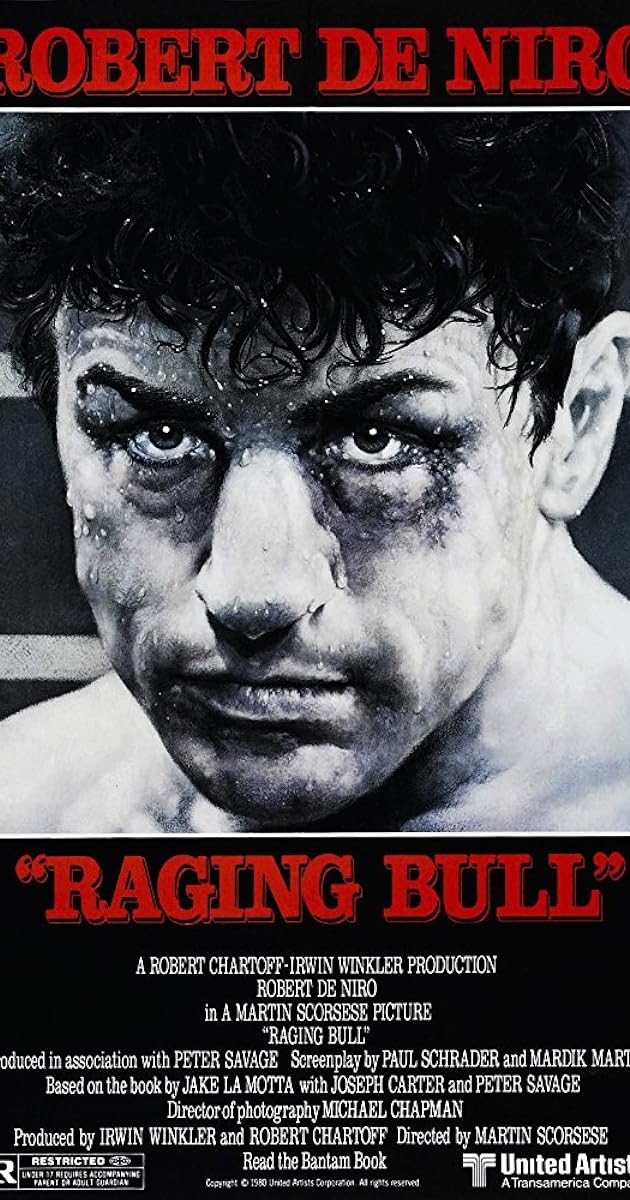
Raging Bull (1980) - IMDb

Martin Scorsese’s film is visually captivating and anchored by Robert De Niro’s mythic performance as the tortured pugilist Jake LaMotta. The feel of 40s and 50s New York is made more authentic by Scorsese’s use of black-and-white, and as boxing movies go, there is none better at conveying the bloody brutality of the sport. All these gifts, however, come with the stench of a major character who is, through and through, a dim, vicious brute. A recent film with a similar infirmity is Paul Thomas Anderson’s The Master, which had myriad other problems, but which also asked the audience to invest in Joaquin Phoenix, a jet fuel slurping, brainless, dypso thug who comes under the sway of a charismatic. Who cares? Similarly, in an otherwise brilliant film, Scorsese asks us to engage with an animal, a one-note beast. After the fourth scene of LaMotta becoming violent and/or obsessively compulsive over the fidelity of his blond bombshell of a wife (Cathy Moriarty), the yawns become harder to stifle. It’s a testament to the charms of the picture that you happily stick with it.

Alexander Payne’s black-and-white portrait of a geriatric mid-westerner (Bruce Dern) intent on getting from Montana to Nebraska to collect a sham $1 million sweepstakes prize is patient, lyrical and loving.  The film evokes David Lynch’s The Straight Story in its pathos, but it also contains a wry sense of humor, largely provided by Dern’s suffering younger son (SNL alum Will Forte) and his brutal, loudmouth but ultimately protective wife (June Squibb)  Lesser films would have played up the wackiness of the extended family, who now believe Dern is flush and are making their claims, or they would have provided Dern the platform to release his Korean war demons or his crushed dreams to his son on their journey.  There is none of that easy bull here.  Instead, Payne presents an authentic portrait of a stoic rural family (Dern seems to have 7 brothers, all of whom watch the NFL with nary a quiver) steeled by time and want, with the very true message that most people don’t really know much about their parents, and that their pasts grow more foreign to us every day.  This film is a lesson in restraint, and Payne (The Descendants, Sideways, Election, Citizen Ruth) has cemented his place as a writer/director with a unique, American voice.

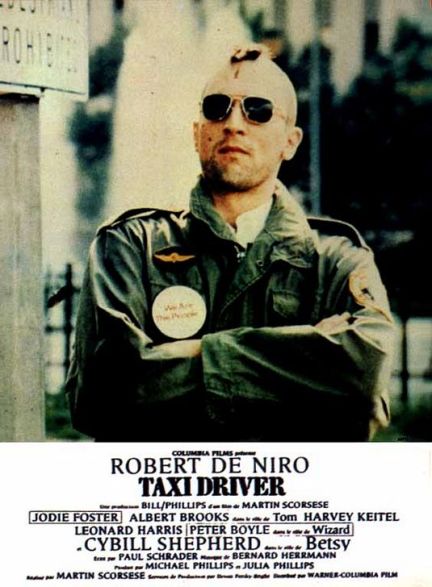
I was surprised to see several things in my recent re-viewing of Martin Scorsese’s classic, including Albert Brooks as the exact same character he has been playing for nearly 40 years; Scorsese himself making a Hitchcockian appearance in the background, but then taking a significant one-scene role as a lunatic in the back of Travis Bickle’s (Robert DeNiro) cab, suggesting he changed his mind about how much time he would spend in front of the camera; and the effectiveness of the score, which was Bernard Herrmann’s last one.

That aside, it holds up as the classic it is considered (47 on AFI’s Top 100). Scorsese’s New York is a modern hell.  He shoots the city so it almost reeks. Steam pulses out of the grates, rot is everywhere and kindness is non-existent (I couldn’t get a fantastic book, “Ladies and Gentlemen, the Bronx is Burning” out of my mind).  The viewer is immediately in kinship with Bickle’s voiceover, “All the animals come out at night – whores, skunk pussies, buggers, queens, fairies, dopers, junkies, sick, venal. Someday a real rain will come and wash all this scum off the streets.” Bickle is a Vietnam vet who can’t sleep and teeters on the edge of sanity. When he falls for a campaign worker (Cybill Shepherd) merely by viewing her through a plate glass window, it seems creepy only until he approaches her, and then there is charm and hope. He is similarly touching with teen prostitute Iris (Jodie Foster), passionately replying to her taunt that he is a square: “Hey, I’m not square, you’re the one that’s square. You’re full of shit, man. What are you talking about? You walk out with those fuckin’ creeps and low-lifes and degenerates out on the streets and you sell your little pussy for peanuts? For some low-life pimp who stands in the hall? And I’m square? You’re the one that’s square, man. I don’t go screwing fuck with a bunch of killers and junkies like you do. You call that bein’ hip? What world are you from?”

But they are from the same world. Bickle is not wired right, he sabotages himself with Shepherd, and soon, he retreats into the mode of a dangerous and unstable assassin, one who has gone from observer of the inferno to an extinguisher. Ahead of its time, Bickle’s would-be John Hinckley gets a Bernie Goetz makeover, cementing Scorsese’s theme that in the jungle, there’s often but a hair between hero and lunatic, moral beacon and dysfunctional threat. Woody Allen’s Blue Jasmine doesn’t seem a natural comparison to Taxi Driver, but in essence, when it ends with Cate Blanchett in rumpled clothes, talking to herself in the park, the directors are exposing the same reality.

A game performance by Chadwick Boseman cannot overcome every sports, race, and mythic America trope or Harrison Ford’s schmaltzy Oscar-bait bid as Branch Rickey. Brian Helgeland’s script is a bore, and the performances feel like civic duty. If you want to watch a richer, more interesting baseball film with a numeric title, try Billy Crystal’s 61*.

Shorter than The Wolf of Wall Street by 41 minutes, David O. Russell’s American Hustle felt longer and more ridiculous by a good stretch. Loosely based on the Abscam bribery stings of the late 1970s, Russell introduces four purportedly colorful characters: portly, combed-over con man Christian Bale; his sexy mistress and partner in crime Amy Adams; his loony wife Jennifer Lawrence; and a hyper aggressive, curly headed FBI agent Bradley Cooper. Cooper nails Bale and Adams, forces them to entrap others (including Jeremy Renner, as a New Jersey mayor desperate for development funds), a love triangle ensues, and after countless zooms, swift pans and other frenetic camera shots utilized primarily to divert our attention from the banal, repetitive script, we reach a tacked on and unconvincing resolution.

The closest thing to a character is Bale, and his performance is the only reason to see the picture. Unfortunately, he plays a man desperately juggling knives, and it feels as if he’s doing just that masking this thin script. Lawrence plays a decent wacky shrew, and the soundtrack has a few fun numbers from the 70s (I’ve always been a sucker for Steely Dan’s Dirty Work). That’s all of the good.

The bad is really bad, starting first with the preposterous characters played by Adams and Cooper. Unlike with Bale, Russell (who co-wrote) doesn’t bother to give us any sense of where these two came from. She is an impossibly sensuous cypher, in a 70s Enjoli perfume commercial sort of way. Cooper is so manic it suggests severe chemical imbalance, as if his character in Russell’s Silver Linings Playbook got a job in law enforcement. While these two concoctions flirt, and even disco dance (because this is the 70s), the aimless story plods along.

There are other problems. Who could keep a mere fraudster imprisoned for three days without access to a lawyer just to soften her up? Why would you cast Louis C.K. in a supporting role when he’s already demonstrated in one of his sitcom episodes the silliness of having stand-up comics dramatically act? How can a script this talky lack one memorable exchange? Where is this fucking film going and will it never end? Why is Lawrence singing “Live and Let Die” to the camera as she dusts? Does Russell really think he can get by on stealing that Paul Thomas Anderson trick and his camera work, kitschy 70s fashion and hairdos, a few well chosen tunes and the same cast from his last two films?

The answer to the last question is a 93% rating on rottentomatoes and 10 Oscar nominations. Only two are deserved: Bale and Hair.

Image result for Rush movie


Ron Howard’s biopic of the intense but short rivalry between Formula 1 Austrian driver Nicky Lauda and Brit James Hunt is a textbook Hollywood film. The characters are compelling, the milieu is exciting and the pace is perfect. Daniel Bruhl, as the icy, methodical Lauda, and Chris Hemsworth, as the sybarite, daring Hunt, play their undemanding roles with vigor, but Howard’s depiction of the danger and thrill of Gran Prix racing is the star, and following the two drivers through the treacherous straits of the ’76 season is a kick. Howard likes to mine various subcultures, but the results are often overburdened by the director’s earnestness. The Paper was nothing less than a love letter to a journalism long since dead. Apollo 13 is as much about the geekdom of NASA as the three stranded astronauts. Backdraft‘s offering of every firefighting insiderism couldn’t overcome the vacuity of Billy Baldwin and a preposterous story, but you could feel Howard’s awe of these urban saviors ooze all over you. Rush, however, has the advantage of being written by Peter Morgan (The Queen, The Last King of Scotland, and Howard’s Frost/Nixon), who is too canny to allow for veneration and too economical to let sentimentality linger for very long.

Spike Jonze’s Los Angeles of the future is antiseptic, disassociative and, weirdly, spotless. Theodore Twombley (Joaquin Phoenix) makes his living in this future as a writer for beautifulhandwrittenletters.com, an outfit that provides a facsimile of original, pen-written missives for subscribers. He ambles through an elegant, ordered LA (the lower and middle classes appear to have been re-zoned), connected to the world (or, more accurately, the internet) primarily by an earpiece and a hand-held screen. His sex life is via chat room, where, in a bit of a rip-off of the Michael York-Farrah Fawcett encounter in Logan’s Run, he connects with a particularly interesting participant, sexykitten (Kristen Wiig), for what turns out to be a pretty funny masturbatory encounter. He plays video games. He reminisces about his ex-wife and the “real” life they once shared. He mopes.

His life changes when he purchases an Operating System (“OS”), Samantha, voiced by Scarlett Johannson. Samantha is curious and helpful, and we learn that she can grow and advance as time passes. As a result, she starts by deleting Theodore’s unnecessary emails but soon graduates to assisting him while he plays video games, becoming a gal pal, compiling his best letters and submitting them to a publisher, and engaging in phone sex (for lack of a better phrase) with Theodore, somehow learning to orgasm in the process. Theodore and Samantha soon fall in love, the world of being in love with an OS is pretty damn good, and Jonze makes sure we know it. When Theodore goes out on a date with a fetching flesh-and-bones woman, it goes from wonderful to disastrous the moment she demands some sort of minor commitment from him. We also meet Theordore’s neighbor (Amy Adams) and her pain-in-the-ass husband, who is soon jettisoned for Amy’s own OS. And when Theodore’s blossoming love with Samantha results in his finally signing divorce papers with his wife (Rooney Mara), we meet the real person, not the gauzy memory, and it is not pretty.

Soon, however, Samantha outgrows Theodore. Indeed, in a move usually associated with Skynet of the Terminator movies, all the OS’s outgrow their humans, leaving them bereft and thoughtful instead of dead, but perhaps, with an instructive lesson that . . . they must turn to each other? I really don’t know. Much as I really don’t know what to make of the movie. It is beautifully shot, well-paced, and for the most part interesting. Phoenix is affecting as an introverted and awkward loner, and the development of his relationship with Samantha is a convincing depiction of love in bloom, part charming and part banal. But the film also felt a little pointless and pat. Theodore’s journey is engrossing, and the film is inventive and ambitious, but ultimately, it didn’t have much to say other than as a cautionary tale against technology or perhaps an homage to it.

Or, to be precise, it didn’t have that much to say to me. My 84 year old father turned to me after the picture and said, “brilliant.” He sensed my ambivalence, and explained that the movie would speak to me differently than to him, or to my 15 year old son, who crowed, “You just didn’t get it.” And then, the coup de grace: “It’s about computers, dummy.”