Archive

Drama

image

Like Birdman before it, there are scenes in this movie so visually audacious, I gasped. But where that picture hit you like a ton of bricks based on the cumulative effect of its dizzying pace and construction in the close confines of a Broadway theater, Alejandro Inarritu’s The Revenant – which is essentially a lone survivor/revenge flick, with a little spiritual mumbo jumbo thrown in for good measure – presents dazzling set pieces interspersed with awesome portraits of the vastness of nature. The year is 1823, and Leonardo DiCaprio is a guide for a fur trapping expedition in South Dakota beset by a brutal Indian attack, and in escorting the survivors back to the safety of their fort, he is viciously mauled by a bear, a scene so expertly rendered I could not believe it had not happened, yet, of course it had not. DiCaprio seems a committed actor, but no one is that zealous.

After the attack, DiCaprio has many more hurdles before him, including a suspicious and dangerous member of the surviving group (Tom Hardy, channeling Tom Berenger in Platoon, a compliment) and pretty much every calamity the brutal world of the wilderness can provide.  DiCaprio has little to say, but he brings all the physicality he mustered in The Wolf of Wall Street, only this time, during his infirmity, he exudes animalistic fury instead of stoned near-paralysis.

This is one of the most thrilling, visually stunning films I’ve ever seen. Inarritu used natural light and subjected the actors to enormous rigors (some say, “a living hell“).  Like George Miller in Mad Max: Fury Road, Inarritu dispensed with CGI, remarking, “If we ended up in greenscreen with coffee and everybody having a good time, everybody will be happy, but most likely the film would be a piece of shit … When you see the film, you will see the scale of it, and you will say, ‘Wow.'”

Wow indeed.  It all pays off in making the picture visceral, authentic and epic.  My only nits are a bit of anachronistic, stale “you have stolen everything from us” dialogue from the primary Indian and one depiction too many of DiCaprio hallucinating his Pawnee wife welcoming him to death ala’ Russell Crowe in Gladiator. But these are very minor criticisms. This is a great film and certainly one of the best of the year.
image

Key Largo melded with Quentin Tarantino’s bravura scenes in Inglorious Basterds and his crackling dialogue in Reservoir Dogs. I had the pleasure of watching this picture on Christmas Day in 70mm at the AFI Silver Theater, complete with an overture and an intermission. The latter occurred after 1:46 minutes, and I remarked to my son that the film was flying by, particularly so because almost all that had occurred was conversation. Obviously, a Tarantino film cannot subsist on talk alone, but when the violence occurs, it is supported by the rich, if broad, characters developed beforehand (unlike in Django, where the carnage at the end felt like an indulgent spasm, revealing an insecurity at what came before).

It’s one of the best films of the year and it’s also one that should not be in any way spoiled by a plot summary or any other commentary that could lessen the fun. Accordingly, I’ll make my review brief and non-specific in the form of a few notes.

First, Spike Lee once disrespected Samuel L. Jackson when the latter was a working character actor and the former was the auteur du jour. Lee is also made apoplectic by Tarantino, who wades into race with a daring and incisiveness that obliterates Lee’s rote and easy observations. As it turns out, Lee and Jackson have achieved a rapprochement (they do commercials together), but any rift between Lee and Tarantino is settled by Jackson (“Spike saying, ‘I’m not going to see Django because it’s an insult to my ancestors’? It’s fine if you think that, but then you have nothing else to say about the movie, period, because you don’t know if Quentin insulted your ancestors or not,”).

Also, Jackson should receive an honorary Oscar for this alone:

This is an ensemble picture but it’s Jackson’s picture (though costars Walter Goggins and Jennifer Jason Leigh give him a run for his money).

Second, Tarantino masterfully blends genre, history, comic books and violence, but sometimes, it is to the detriment of his narrative. Not here. When the necessary resolution explodes, it’s almost a disappointment because you know there will be less talk. Tarantino’s script is razor-sharp, hilarious, suspenseful and a brilliant mix of modern pop culture and historical grievance.  It’s really something.

Third, I generally do not read any reviews or commentary about a film before seeing it or writing my own review, and I did not do so here. But I presume there is the same hullabaloo about Tarantino’s liberal use of racial and sexist insults. All I can say is that he uses them beautifully, like David Milch in Deadwood.  This is how you would expect low, dangerous comic book characters who steal and murder to parlay.  Any objection is likely coming from the same humorless prigs or their progeny who objected to the hyenas in The Lion King because they were villains voiced by minorities. In fact, in creating a movie depicting a roomful of lethal people who must sleep with one eye open as they brave a blizzard and their own treachery, opprobrium aside, it’s one of the most egalitarian rooms you’ll find in film.

image

This is a gripping but measured film, a reportorial procedural and a meditation on the impact of the sexual abuse scandal that rocked the Catholic church in Boston, as reported on by The Boston Globe in 2002. “Spotlight” refers to an investigative team of the paper (Michael Keaton, Mark Ruffalo, Rachel McAdams, Brian d’Arcy James) who, under the direction of a new editor (Liev Schreiber) takes on the case. As they dig deeper, the breadth of the scandal widens (the number of culpable priests balloons from 13 to 87) and the institutional protections surrounding the church become more evident and intrusive. The story also takes its toll on the team, all some form of Catholic (cultural, lapsed, etc . . . ) at the time of the investigation.

The film is economical and direct and it stubbornly avoids cliche’ and histrionics. It is also a rare “based on true events” movie that feels authentic throughout, not jumped up or glamorized.  It is very similar to A Civil Action, another Boston based movie that tackles a legal case (water contamination in Woburn) by analyzing the city and its institutions. Like that film, Spotlight packs its biggest punch during scenes of interviews with the survivors of abuse, which are nothing short of heartrending.

If you want a gripping movie about the mechanics of taking on a story like this, this is it, and if you want a companion piece that shows exactly how an individual molester operates, I recommend Doubt. Watching this film, as with Doubt, stirred my own memories on the subject, having been educated by the Catholic church for eight years of grade school and by the Jesuits for four years of high school. I saw the picture with my kids and tried to explain how what is now an indelible black mark on the church wasn’t exactly a deep, dark secret by the time I reached high school, yet somehow, was not a full-fledged scandal. I explained that we had a religion teacher who was very charismatic, but who you just kind of knew not to be around. Why? It’s hard to say. It could have been my own sense of it, or the fact that my brother or his friends imparted some decent advice, or the fact that after gym, when you were showering, he could sometimes inexplicably be seen in the locker room.

Whatever the impetus, you learned not be around Father Bradley, but I guess I just assumed that all boys shared the same sense of something being off and were similarly self-protective. That wasn’t the case, and in 2007, I was one of thousands of recipients of a mass email detailing the misdeeds of this priest at our high school, and at other places where he taught afterwards, encouraging us to report if in fact we had any knowledge of his abuse. Without the work of The Boston Globe on the story, that email may never have come to be.  In that manner, this film is a testament to solid, door-knocking, pavement pounding reporting.

If you’re interested in the priest who plagued my school, the story is here.  The original Boston Globe story can be found here.

image

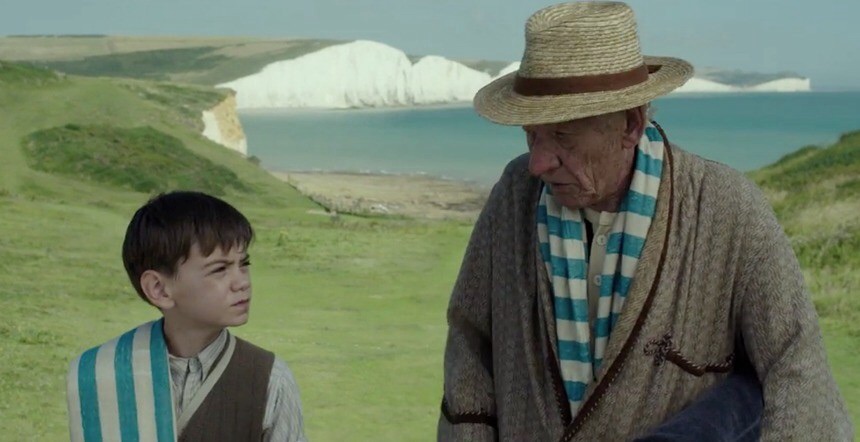
Sherlock Holmes (Ian McKellen) has been in retirement for decades, forced there by the traumatic events of his last case, a case he has increasing trouble remembering as senility does its damage. With Watson long gone, Holmes relies on the son (Milo Parker) of his caretaker (Laura Linney) to assist him in his daily activities and serve as a bridge to younger, healthier and more lucid days. Holmes is soon entwined in the hostile relationship between the working class mother and her clearly clever yet condescending son, and he confronts the mistakes of his past while engaging, reluctantly, in their very pedestrian domestic drama. This is Holmes adrift, vulnerable and shorn of the cock-sure bravado of his younger years.

It’s hard not to over-praise McKellen’s performance. Too much Gandolf has fixed him as caricature, but here, he deftly injects Holmes’s withering intellect and emotional shortcomings with a plaintive frailty. Director Bill Condon has experience with McKellen – their work in Gods and Monsters was similarly touching, restrained and intelligent and also garnered McKellen a Best Actor nod.  The film is also blessed by a strong turn by Parker. If I’ve said it once, I’ve said it a thousand times, as in life, you warm to a child who is genuine as opposed to precocious, natural instead of stagey.  Parker is just right.

Occasionally, the movie is a little dragging, but this is still one of my favorite films this year.

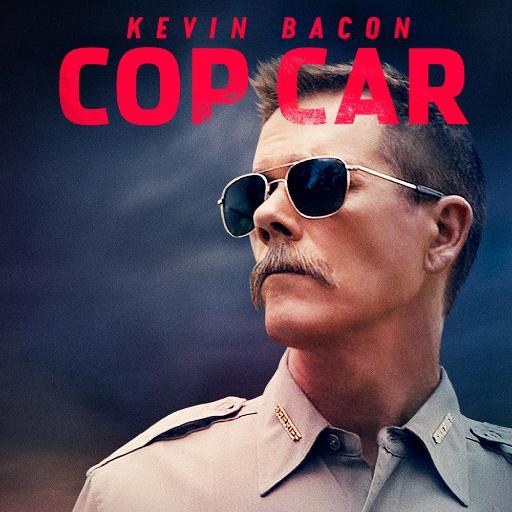
I was just talking about how professional and polished yet paint-by-numbers and predictable Bridge of Spies was and I juxtaposed it with the other film I watched this weekend – Cop Car. With a fraction of Spielberg’s budget, writer-director John Watts’s second feature is inventive, engaging and darkly comic. Two boys are running away from home when they come across what appears to be an abandoned police cruiser, and, as boys will be boys, they take it for a joyride around the fields and deserted highways of Colorado. Turns out the car belongs to a crooked county sheriff (Kevin Bacon), who lost the car to the boys in the middle of dirty business. He races against time to find them, and what follows is often thrilling and occasionally inspired. But what elevates the material is an intelligent dialogue between two boys, with one foot in the world and the other in the imagination. As they confront real danger, Watts revels in their innocence yet uses it to amp up the tension. A great deal happens to these boys, but there is no scene more gripping than when they handle firearms as if they are as harmless as the ones on Playstation.

The film isn’t without faults. It drags a bit here and there, and ultimately, its charms succumb to a more pedestrian action thriller. But it maintains a sly sensibility, and it trusts its audience to have patience and get the drift. The same can’t be said for Spielberg, who rarely extends such trust, opting for the sledgehammer. A beautifully crafted and polished instrument, but a blunt one nonetheless.

image

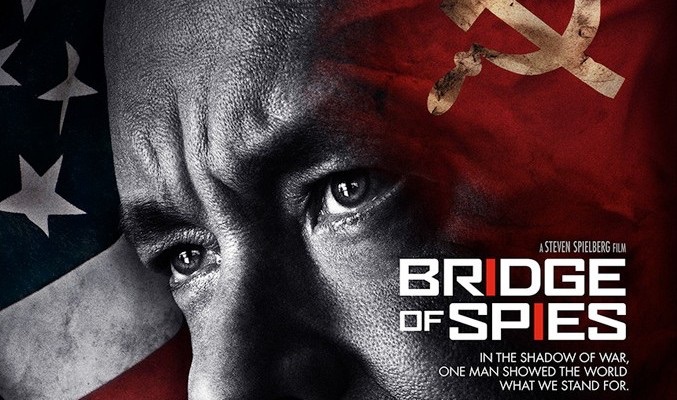
Steven Spielberg’s rendition of private attorney James Donovan’s (Tom Hanks) defense of a Cold War Russian spy (Mark Rylance) and then his negotiation of the swap of that spy for downed U2 flier Gary Powers and an American student detained in East Berlin is assured, workmanlike, forgettable, and plagued by the schmaltz that accompanies much of his work. Spielberg takes a can’t miss, gripping tale of espionage and burdens it with overwrought homilies to American civil liberties, repetitive scenes of bland conversation, and cheap comedy (Rylance is even given a catchphrase he repeats three times). I’m as patriotic as the next fella, but it’s not enough to show Hanks resisting the zeal of the Cold War simply because he’s Hanks. We never learn why Donovan holds his convictions. They apparently come with Hanks, no assembly required.

Worse, Spielberg juices up the action, probably because he sensed the movie was a bit of a slog. So, Donovan’s house is shot up because he is representing a Russian spy (never happened) and Donovan witnesses East Germans gunned down as they try and make it over the wall (also never happened).

It’s an okay film, it has some moments, and I’ve certainly seen worse, but it’s no great shakes, and as with much of Spielberg’s work, it stays safely in the lines.

image

This story of one woman’s journey – a 1000 mile hike along the Pacific Crest Trail – is unfortunately marred by unconvincing dialogue, inconsistent pacing, and an actress not quite up to the task. Reese Witherspoon’s best actress Oscar came after her portrayal of June Carter Cash, a performance that took advantage of her quick wit, common sense instincts, and sunny disposition. She was also able to sing, no mean feat.  As the distraught daughter of a mother who died young (Laura Dern), Witherspoon cannot sing her way to our hearts, and de-glamorization and nudity do not sell the fact that she is supposed to have lapsed into a downward spiral of promiscuity and heroin addiction after Dern’s death. There is still too much of Ellle Woods and Tracy Flick in Reese Witherspoon. She doesn’t even curse authentically, much less play a waitress who has sex with two customers in the alley behind her restaurant just because it feels good. The role required an actress with more gut and greater reserves. Meg Ryan, another plucky can-do lead, tried to toughen up later in her career in In the Cut with similar results.

Even with another actress, this film still has real problems. Everyone becomes depressed upon the death of a loved one, but there is no basis to suggest why Witherspoon’s character became so self-destructive. Rather than elicit our sympathy, Witherspoon at times threatens to evoke our scorn. Her choices are presented to us in flashback, in the bedrooms of strange men, with her long suffering friend, in the heroin dens of Minneapolis, or in conversations with her mother, scenes that are supposed to give us insight into how she ended up here. They don’t. Rather, they are too disjointed to tell us much of anything, and we are left wondering “how the hell did she end up there?”

Finally, the film is too new-agey and pat for its own good. Witherspoon reminisces along the trail while inscribing the words of poets at its various check-in stations. She is followed by a mystical fox. She meets people who say wildly unrealistic things (her discussion with a little boy in particular) that are supposed to reflect her singularity and the momentous nature of her trek (she is even dubbed queen of the trail by other hikers). She finishes and tells us in an ego-centrism that lacks any self awareness that it all worked out in the end. Heck, she informs us in voiceover – she even has two lovely kids.

To the good, it is beautifully shot and the beginning of the film, when Witherspoon is starting on the trail wholly unprepared and over-fortified, had promise. I thought she might even get an appendage stuck in between some rocks.

image

I loathe artistic political correctness in all its forms, be it the soul-sucking idiocy of demanding cultural authenticity in casting, the blanket condemnations of some “ism” by the cultural debt counters, or the wails of some grievance group as one of their own is skewered for comedic purposes (Robert Downey Jr.’s “retard” riff in Tropic Thunder comes to mind).  The effect is the same – to straightjacket creative endeavor so it presents like a PSA. The only good that comes of the p.c. influence are–

* the groveling apology (Cameron Crowe bootlicking because he cast Emma Stone as a quarter-Asian, quarter Hawaiian: “I have heard your words and your disappointment, and I offer you a heart-felt apology to all who felt this was an odd or misguided casting choice”);

* the unctuous backpedaling (Matt Damon, after having been caught on camera rejecting affirmative action and using the word “merit”: “My comments were part of a much broader conversation about diversity in Hollywood and the fundamental nature of ‘Project Greenlight’ which did not make the show. I am sorry that they offended some people, but, at the very least, I am happy that they started a conversation about diversity in Hollywood. That is an ongoing conversation that we all should be having”), and

* inane public proclamations (Viola Davis, who, when receiving an award for a TV drama, without a hint of irony or self-awareness equated her struggle to that of Harriet Tubman).

That said, Welcome to Me is an offensive film, and the heart of its offense is in how it portrays mental illness.   Kristen Wiig plays a sad shut-in, obsessed with Oprah, who wins the California lottery. She suffers from borderline personality and is off her medication, yet that doesn’t stop a local production company run by Wes Bentley and James Marsden from taking her millions so she can develop her own show. That show is a stage for Wiig to exhibit all the debilitating aspects of her un-medicated disease in a manner that at best is quirky and at worst is truly disturbing.

If done well, I don’t have a huge problem with making a dark comedy about a mentally disturbed person being taken advantage of.  I’ve gone down weirder, filmic roads.

So, to be clear, my objection is not to the premise nor do I advocate for the babying of any protected class in art.

But when you take this on, you can’t have your cake (using the disability as comedic tool) and then ask the audience to regurgitate it in shame after the eating.

Essentially, that’s what writer Elliot Lawrence does here. It’s not that the picture is poorly acted or directed or that there aren’t even a few funny scenes. Rather, the film is an exploitative movie about a sick person being exploited, and it wants to use mental illness for yucks while pretending to be brave in showing the true face of that illness.

You need a really deft hand for that kind of trick, and Lawrence and sophomore feature director Shira Piven do not have it.

Worse, the movie condescends with a throw-away lame anti-television theme, and in the end, Wiig is transformed into a “winner” with the help of a mere few pills.

image

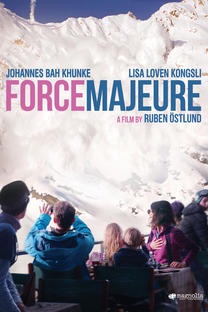
This is a disquieting look into how a single failure, even one that is in no way fatal, can fray the bond of an entire family. Tomas, Ebba and their two young children are on a ski vacation. While having lunch at the resort’s outdoor patio restaurant, at the base of the slopes, a controlled avalanche gets a little out of control and for a moment, threatens to engulf them.

How Tomas and Ebba react, and the aftermath, reveals a great deal about fear, commitment, gender expectations, the frailty of masculinity, the dangers of self denial and the ability of people ostensibly in love to casually, cruelly gut each other.  I know that seems a mouthful, but it’s all there in this literate, intelligent picture. See it with spouse, boyfriend/girlfriend, and/or friends, and you’ll be chatting deep into the night.

The film was rightly bandied as a potential Best Foreign Film nominee, but it did not make the cut,  perhaps because it never takes a strong stand. It is as gray as gray gets.

Remade, horribly, as a Julia Louis Dreyfus/Will Ferrell picture.

The film has aspirations to Wes Anderson, but you’ll learn quickly, having Bill Murray in your cast isn’t enough. Murray plays an old Brooklyn codger, a man who drinks, smokes, and consorts with a pregnant Russian stripper/prostitute (Naomi Watts, sporting an accent so thick and implausible it would make Gary Oldman recoil and say, “no, no . . . too much”).  He also gambles at the track, is in deep with a bookie, and spits in the eye of anyone who might show him kindness. Yet, he’s cool because he listens to a Walkman that plays kitschy 70s pop or Dylan. So rest assured, this guy has a heart of gold. Naturally, when he gets new neighbors (newly divorced and fed up nurse Melissa McCarthy and her impossibly wise yet innocent son Jaeden Lieberher), he opens up a crack, takes the kid under his wing, and to the track, and to the bar, and in the vicinity of the prostitute.  Predictable hijinks ensue, but when the son gets the assignment at his Catholic school to find a saint here on earth, well . . . guess who?

It’s a testament to the effectiveness of first time writer-director Ted Melfi that he can get you to well up a little on occasion, but that doesn’t change the fact you want to punch him in his face for manipulating you so brazenly.  This is paint by numbers, hip treacle that might make even Zach Braff a little queasy.