Archive

Documentary

Image result for Red Army movie

This a great time capsule documentary, providing insight into the post WW II Soviet Union cult of supremacy as manifested in its hockey program. The Soviet military actually ran the tryouts at the Red Army school, winnowing out of the weak and fusing sport with propaganda. The result was a juggernaut that came of age right at the moment it ran into the American team in 1980 at Lake Placid. After that ignominy (the Russians had just beaten the Americans in an exhibition 10-3), the team did not lose a game for the two years prior to Sarajevo, where they won gold, and again, in 1988.

However, the toll on the players was brutal. They spent their time in hockey camps 11 months of the year, and the coach, Viktor Tikhonov, would not even allow a player see his dying father. Perestroika loosened some of the restrictions, but still, Tikhonov, would not permit his best defenseman, Slava Fedisov, to go to the NHL.   Fedisov quit over the prohibition, made his displeasure public, and was ostracized for his impunity.  On the light side, he was denied training facilities. On the harsher, the police in Kiev picked him up, beat him, and then called Tikhonov to pick him up. Eventually, the Soviets allowed the players to play in the NHL, but they took half their salaries (Fetisov said no and was the first Soviet hockey player to get his full check) .

The footage – especially of the fluidity of the Soviet team – is dazzling, and the interviews of any number of direct but impatient Russians are sharp and revealing. The documentarian, Gabe Polsky, is to be commended for including footage of his broad questions, where he stretches to get a response on larger geopolitical issues, only to get a “stupid question” from the “suffer no fools” Fedisov. In fact, it was a stupid question, but we learn more in Fedisov’s curt comment than had he answered the stupid question.

This is a charming documentary about the first fan club president of The Beatles – Freda Kelly – who started out in a typing pool, sneaking off work to see the band at The Cavern Club, and worked her way in to become the assistant to Beatles manager Brian Epstein.  Kelly provides nothing really new about “the lads” (Paul was always nice, John could be a handful), but her remembrances are touching and frankly, impressive.  She took her job as correspondent for the band very seriously, and while in their employ, authored thousands of responses to fan mail, even going so far as to fire an employee for sending non-Beatle hair to a fan who had requested a strand.  She even used her home address as the fan club address for a time, until her father complained that he couldn’t find his utility bills in the sacks of mail that arrived every day.

Kelly worked faithfully for the group until its demise, and then just moved on with her life.  As the documentarian finds her now, she is a working secretary.  The surviving Beatles and the estates of John and George must have given the filmmakers rights to the music, because Beatles tunes litter the film, and Ringo even gives a video goodbye to Freda during the credits.  I will say, however, there’s a bit of a bad taste at the end.  Freda is presented as a true gem, someone who tended to the band’s needs, kept their confidences, never once traded in on their fame for her own aggrandizement, and even became a companion to many of their parents.  I don’t expect the Beatles to shower attention on all of the “little people” who helped their rise, but Freda seems a cut above, and so . . . what the fu**, Paul!

image

Rory Kennedy’s Academy Award nominated documentary opens with American Captain Stuart Herrington asking, “The burning question. Who goes and who stays?” When it went bad, Herrington took his South Vietnamese friends out surreptitiously (Americans were not allowed to bring South Vietnamese out without authorization), but the move was not expected nor planned for.  As Herrington explains, as do others, after the Paris Accords, the presumption of most in-country Americans was that peace was at hand, and the Americans would be in South Vietnam for a long time.

This film shows the feel on the ground for the last denizens of Saigon, while adding insight on a geopolitical level. For example, the North Vietnamese took very seriously the threat of Nixon bringing back American air power after execution of the accords – as one interviewee states, the North Vietnamese thought Nixon was a madman – but after Watergate and the “madman’s” self-inflicted wound, they were naturally emboldened. “Overnight, everything changed. Hanoi suddenly saw the road to Saigon as being open.”

With 16 divisions bearing down on Saigon, Herrington recounts how Ambassador Graham Martin wouldn’t countenance plans for evacuation because it was defeatist and he feared a panic (Martin is a tragic figure who lost his only son in combat in Vietnam, and while he is criticized for his intransigence, he also saved hundreds of South Vietnamese by refusing to leave the embassy until more civilians were evacuated).

At the end, there were 6,000 Americans still in country, and Martin held firm even after he returned to the United States to watch President Ford’s $722 million request for an evacuation voted down.  At this juncture, embassy staff began to risk their careers to get South Vietnamese compatriots out in makeshift airlifts to the Philippines, and at the very end, in any other way they could find.  Their stories are harrowing.

There is no political agenda here.  Kennedy’s documentary is about people, not policy, and their stories are engrossing.  One Vietnamese evacuee recalls his father, a pilot in the South Vietnamese, picking his family in a Chinook and heading out to sea (“when I heard the Chinook, I knew my Dad was coming to get me”).  When it couldn’t land on an American vessel, the occupants jumped out to be fished from the water.

Much of the footage is simply jaw-dropping. A scene of a modern World Airways passenger jet taking off with its on-board stairs lowered, hustling panicked South Vietnamese on as it hurtles down the runway, is indelible.  Another is footage of the pick-up points (Americans knew when to go to them; the code was the playing of “White Christmas” on the radio”) as South Vietnamese press the buses for entry to helicopter evacuations, one of the last options available after the North Vietnamese closed down the airport with artillery fire.  Or the American naval vessels that became deposit points for South Vietnamese helicopter pilots, who had flown from their air bases to pick up their families and then headed to sea hoping for the best.  The ships could only accommodate one helicopter at a time, so when one landed, and its passengers disembarked, the crewmen pushed it over the side to make room for the next.

A must see.

I re-watched and reviewed Apocalypse Now a few weeks ago and followed it up with the documentary of its making, Hearts of Darkness: A Filmmaker’s Apocalypse. Directed by Francis Ford Coppola’s wife Eleanor and two others, the documentary intersperses Eleanor’s “home movies” of the extended shoot in the Philippines with participant interviews and actual film footage. The result is a gripping, informational remembrance from start to finish.  The story is incredible.  Coppola put up his own money against the profits and endured a host of calamities:  a change in lead actor (Coppola brought in Martin Sheen to replace Harvey Keitel after reviewing a few weeks of footage); a typhoon that destroyed many of his sets; a Philippine air force (standing in for American Vietnam-era air cavalry) whose helicopters would often have to leave in the middle of his shoots to fight rebels; Sheen’s heart attack, which delayed filming further; and finally, the bewildered behemoth that is Marlon Brando, who came to the shoot fat, unprepared, and mercurial, insisting on spending days talking about character motivation rather than shooting scenes. On this last fiasco, Coppola realized Brando had not read the book Heart of Darkness as instructed nor was he in any shape to adhere to the script, Unfortunately, Coppola had given $1 million to Brando to show up, and it was non-refundable. In a particularly tragicomic part of the documentary, Coppola explains that he made a decision to have Brando just walk around and improvise during his time on set, and some of the rushes are painfully funny, as Coppola tries to prompt some sort of usable dialogue from Brando, and Brando rejoins with pomposity and ultimately, a certain “can I just cash my check and get out of here?” weariness.

This is just one of many brilliant nuggets exploring the process of filming this audacious movie.

image

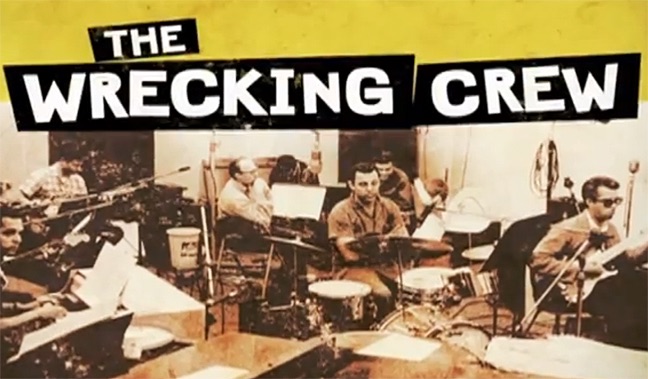
A significant portion of Love & Mercy is devoted to Brian Wilson’s production of The Beach Boys record “Pet Sounds.” Wilson enlists a room full of session musicians rather than the Beach Boys, who are utilized solely for vocals. The studio players were known as The Wrecking Crew, and it was from this group that the band found its replacement for Wilson on the road, Glen Campbell.

Denny Tedesco, the son of session guitarist Tommy Tedesco, has written and directed a fascinating documentary that chronicles the heyday of The Wrecking Crew, who played the music on a seemingly exhaustive list of pop records in the the 60s and 70s. Working from interviews of the players and the acts they backed, as well as home movies of his father, Tedesco provides great insight into the times as well as the life of a working musician.

The interviews are particularly fun. Roger McGuinn of The Byrds, who had been a session player himself, had to break it to the band that the rest of them wouldn’t be playing on their hit single “Mr. Tambourine Man” which didn’t go over well. As McGuinn recalls, The Byrds produced two tracks in three hours during the “Mr. Tambourine Man” session, while it took 77 takes to produce “Turn, Turn, Turn” which the band insisted on playing.

Tommy Tedesco tells the story of The Gary Lewis and the Playboys guitarist who confessed he could never play what Tedesco had played in studio on tour and always felt embarrassed when fans complimented his playing on the records.  Peter Tork of The Monkees tells a poignant story of the disappointment he felt when he was invited to come to the studio for the production of a Monkees tune only to learn that the invitation was solely as an observer.  On an up note, Mickey Dolenz reveals that the studio musicians taught him how to play the drums in preparation for his Monkees tour.

Obviously, the days of a small crew of players backing most of the pop radio play (and film and televisions tracks and radio and TV commercials) coming out of LA couldn’t last, but this is a blast of a documentary that also serves as a loving remembrance of the filmmaker for his father.

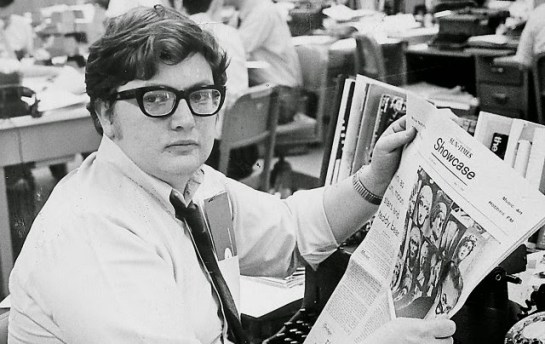
What stands out in Steve James’ engrossing documentary on Roger Ebert is not so much Ebert’s skill and status as a movie reviewer, but his absolute love of life.  It appears Ebert almost fell into his craft, found he had a knack for it (so much so he was awarded a Pulitzer), and thereafter, became a cultural icon, along with “frienemy” Gene Siskel, changing the way film criticism was perceived both by the public and Hollywood.  But when we are introduced to Ebert, he is in the midst of yet another of his trying medical travails near the end. Cancer has robbed him of his jaw (and, cruelly, his ability to speak), but he types ferociously and utilizes a voice-activated program to communicate.  And the prominent feature of his personality is not intellectual or esoteric; it is a lust for people and ideas.

We learn Ebert was a wunderkind college editor, then a hard-drinking Chicago newspaperman who swore off booze after one-too-many benders in his 30s, finding love in his 50s with a woman who already had children.  Ebert is also revealed as a know-it-all and, at times, petulant and self-important.  As James’s demonstrates, he was also a caring man, one whose passion was broad enough to encompass not only cinema but simple discussion and engagement.

Ebert has never been my favorite reviewer simply because I found him so mercurial, one moment intolerant of the offbeat, another celebrating it; I was looking for standards and signposts, and he wouldn’t oblige. But his best reviews were such a mix of accessible, earthy and honest, my expectations were unrealistic. Ebert could also smell a rat, and he had no problem going against the grain. Take, for example, his review of the highly touted anti-Vietnam War documentary Hearts and Minds, a celebrated work that greatly influenced documentary filmmaking. Ebert grants the film its due, but his caution, in 1974, is prescient:

My problem in writing about “Hearts and Minds” is how to go about separating the film’s images — which are sometimes heartbreakingly tragic, sometimes cruelly revealing — from the craft of the film itself. Here is a documentary about Vietnam that doesn’t really level with us on a simple technical level. If we know something about how footage is obtained and how editing can make points, it sometimes looks like propaganda, using such standard tricks as the juxtaposition of carefully selected but unrelated material to create a desired effect. And yet, in scene after scene, the raw material itself is so devastating that it brushes the tricks aside. . . The problem is that the film is at such pains to make its points that it doesn’t trust us to find our own connections. We see a tearful graveside scene in North Vietnam, for example, with a widow trying to throw herself onto her husband’s coffin, and then we get Westmoreland soberly explaining that Orientals don’t place a high value on life. In this and his other comments about what he calls “the Oriental philosophy,” Westmoreland comes over as not only racist and stupid, but incredibly lacking in awareness of how his remarks will sound. This man ran a war for years in a country he didn’t begin to understand. And yet placing these two pieces of film together — and the editing in “Hearts and Minds” consistently makes similar matches — finally only undermines the film’s effectiveness. It’s too heavy-handed. We’re bludgeoned by the point of view, we don’t like the feeling of manipulation we get. Yet there are scenes here of incredible power, even for a nation which watched this war on television every evening.

James’ documentary also shows Ebert to be the kindest and most giving of mentors and friends, which reminds me of Will Leitch’s piece on Ebert upon his death.  Leitch had edited the same college newspaper as Ebert, and Ebert’s generosity to him was astounding:

Because I was 19, I took this as an invitation to keep bothering Ebert, and over the next two years, I emailed him regularly, with questions about my career, with movie reviews I’d written and hoped he would offer tips on, with requests for advice on writing, on life, on the tough job market that awaited me upon graduation. Ebert wrote back to every single one, with lengthy and heartfelt missives that were far more than a snot-nosed kid clearly getting off on Knowing Roger Ebert deserved. I have no idea why he did it. He told me “that this is important to you as it is, that’s a very large percentage of what you need, really.” He emphasized that such ephemera like “career” and “success” were mostly beside the point. “Just write, get better, keep writing, keep getting better. It’s the only thing you can control.”

Ebert even recommended me for a job stringing movie reviews for the suburban Daily Southtown newspaper. For the first one — the Robert Downey Jr. movie Restoration — I borrowed my friend Mike’s car and drove up to a Chicago screening room. I didn’t know Chicago well and of course got lost, just sneaking into the theater right as the lights were going down. After the movie, I walked out to the elevator, and standing there, was Ebert.

“Sir,” I said, talking very fast. “I’m Will Leitch, from the DI. I wanted to thank you and say what an honor it is to me. I can’t thank you enough for what you’ve done. I promise not to abuse it.”

Ebert was bigger then, and his hand was meaty and sweaty.

“Of course, Will, I’m happy to help you in any way. You have talent, and anyone from the DI is a friend of mine,” he said. “Actually, I’m going to be in Champaign in a few weeks for a screening at the New Art, and I’d love to meet with you and some of the staff beforehand. Is Papa Del’s still open?”

Two weeks later, Ebert was entertaining me, my friend Mike and a few select editors — the fight to be included at the dinner was fierce and still angers some today — at Papa Del’s. (We had four pizzas, and Ebert ate 1 1/2 of them.) He took our questions, we talked about journalism and movies (he and I had a fierce debate as to whether or not Harry Connick Jr. was in the Holly Hunter movie Copycat: I was right, though nobody had an iPhone to prove it at the time), and he told us stories about the old days without ever romanticizing his good old days at the expense of ours. He was not Roger Ebert, the guy on television. He was just the fun guy eating pizza, dishing about Gene Siskel — he absolutely could not understand how that man could care so much about the Chicago Bulls, a stupid sports team — and having a grand time. We sat there for three hours. None of us wanted to leave, including him.

At the end of the night, Ebert took me aside. “I understand it’s your birthday tomorrow, Will,” he said. (It was. I was turning 20.) “Well, I have a gift for you. It’s a scoop. You can run it in the paper tomorrow. I received a print of a movie that’s not out yet to show at the theater tomorrow. You can have the exclusive: It’s Mighty Aphrodite, the new Woody Allen film.”

Yet, as Leitch shamefully admits, with the web exploding, “we [were] young turks . . . ready to kill our idols . . . we all thought we were hot shit.” In that vein, Leitch later wrote a piece for the web magazine Ironminds entitled, “I Am Sick Of Roger Ebert’s Fat F—-ing Face”, the thesis of the piece being that Ebert’s TV work was hurting his writing (with a few fat jibes included).

Ebert’s response, and his later correspondence with Leitch, is an epitaph to which we all should aspire:

Will —

I have always tried to help you, and you know that. I am not sure what you were trying to do with your piece — if you object to me being on television, there is a dial to the right that will take care of that problem for you — what issues you might be dealing with, but I am certain you will grow to regret writing it someday. If you were trying to make a point, I fear you are not in control of your instrument. I wonder if you feel shitty this morning, now that that piece is out there. I know that I do.

RE

Leitch wrote him back, completely backing down, apologizing, but the damage obviously had been done. I did feel shitty, instantly, and have ever since. A year later, I was working for Brill’s Content’s All-Star Newspaper . . . where I ran an early incarnation of a blog, linking to the best newspaper writers in the country every morning. As the job required me to do with all the writers we selected, I sheepishly emailed Ebert to tell him he was on the roster. He wrote back:

Does this mean you’re no longer sick of my fat fucking face? 🙂

It’s an honor. I hope you’re well.

RE

(Available on Netflix streaming)

Nick Broomfield’s (Kurt and Courtney, Battle for Haditha) documentary for HBO is a must-see for several reasons. First and foremost, I had no idea we had a modern serial killer of historical proportions in South Central Los Angeles, a killer of dozens and possibly over a hundred women over a 20 year period beginning in the 1980s. That, of course, is a large point of the story. Broomfield does an effective job of demonstrating that the dispossession of the citizens in that part of LA, coupled with the carnage occurring with the rise of crack cocaine, rendered the murders and disappearances of “crack whores” a rather low priority. After all, a majority of the women killed by local stolen car fixer and semi-strong man Lonnie David Franklin were likely lured to their deaths by the offer of drugs-for-sex, most meeting their ignominious ends in a camper parked at the back of his house.  I couldn’t shake wondering as to the numbers Jack the Ripper could have amassed if he’d kept to his Spitalfields hunting grounds and refrained from corresponding with the police.

The documentary is less an indictment of the police and government officials, who, when in “no comment” mode, always seem guiltier, than a singularly brave exploration of the urban condition in a rotted corner of the city. Broomfield, a Brit, is one of at least two white men poking their cameras in an area where white men generally fear to tread, and his endeavor results in incredibly revelatory footage. Franklin’s pals at first proclaim his innocence (he was set up by the cops, they swear), but as Broomfield spends more time with them, two open up, explaining that Franklin was indeed a suspicious character and that they were even involved in his kinks, so much so that they traded pictures of the naked street girls they photographed, almost as if in a local snapshot club. They were happy to party with the man, even if he was a brutal beast who preyed upon the addictions of so many street walkers. In this, Broomfield reveals that the neighborhood itself could be as blasé’ about the women as the authorities.  But he also captures the pain and regret of one friend, for whom the “hey, I didn’t know he was killing them after I left” explanation no longer fully suffices.

Broomfield also hits documentarian gold when he hooks up with a former crack addict/prostitute – Pam – who shepherds him through the dangerous streets, always introducing the crew to the locals as her “friends from England.” Her efforts actually lead the crew to women deemed “missing” by the LAPD after Franklin’s arrest (Franklin’s penchant for photography resulted in a 200+ picture sheet):

Pam’s tour of the neighborhood shows the depths of its depravity at its worst, but she has survived, now clean and out of the game, and there is fundamental decency about her, though encased in the hardest of shells, that is riveting.

Franklin goes to trial this summer.  Definitely catch this before you start reading about the case.

Currently available on Netflix streaming, this almost 3 hour documentary essay presents as both art exhibit and graduate course (it is written and narrated by the sleepy-voiced Thom Anderson, a filmmaker and film theory and history teacher at the California Institute of the Arts).  Los Angeles Plays Itself is textually interesting, the visuals of the city’s depiction in film are always entertaining, and accompanied by Anderson’s incisive narration, often illuminating.

Anderson can also be very funny, in a dry “this is Carlton, your doorman” way. On a scene from Michael Mann’s Heat:  

 [In Heat, Neil McCauley (Robert DeNiro) is briefing two members of his gang. He tells them, “Saint Vincent Thomas Bridge, that’s escape route number one.“]  Vincent Thomas was San Pedro’s representative in the state assembly for many years, but he hasn’t been canonized yet, not even in Pedro.

And on the perpetual destruction of LA in the movies:

Mike Davis has claimed that Hollywood takes a special pleasure in destroying Los Angeles, a guilty pleasure shared by most of its audience. The entire world seems to be rooting for Los Angeles to slide into the Pacific or be swallowed by the San Andreas fault. …In Independence Day, who could identify with the caricatured mob…dancing in idiot ecstasy…to greet the extraterrestrials? There is a comic undertone of ‘good riddance’ when kooks like these are vaporized by the earth’s latest ill-mannered guests.  But to me the casual sacrifice of Paris in Armageddon seems even crasser. Are the French being singled out for punishment because they admire Jerry Lewis too much? Or because they have resisted Hollywood’s cultural imperialism too fervently?

Of course, if you let an academic talk long enough without interruption or query, he’ll eventually meander into overstatement and grandiosity, and as Anderson moves from LA’s history, architecture, sprawl and patterns in film to politics, race and class, we get poetic broadsides, against the cops and the modern Noah Crosses and skyscrapers. This is all part of the condescension of most any “true” city dweller who presumes to know the authentic heart that beats in his city, and for the most part, that’s part of Anderson’s charm.  Anderson has a grievance, as he concedes at the outset:  That’s another presumption of the movies: that everyone in Los Angeles is part of their industry or wants to be. Actually, only one in forty residents of Los Angeles County works in the entertainment industry. But the rest of us simply don’t exist.  We might wonder if the movies have ever really depicted Los Angeles.

But doleful mouthfuls like “White America had declared a crisis of the black family as a cover for its campaign of incremental genocide against its expendable ex-slave population, rendered superfluous by immigrant labor power, so black film-makers responded by emphasizing families and children” are waiting at the end, so you have been warned.

Though it limps a little at the finish, I really dug this movie, and it is a must-see for any film buff.


image

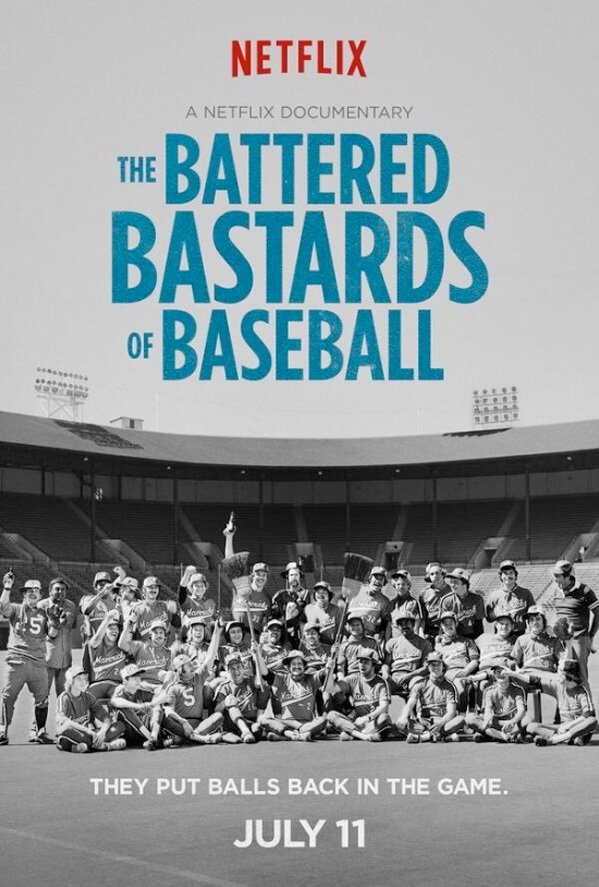
I’m not sure what is more surprising, this fascinating, Netflix-produced documentary chronicling the Portland Mavericks, an independent minor league baseball club run by baseball enthusiast and actor Bing Russell in the 1970s, or the fact that this story has not been made into a major motion picture. Russell capped off a lucrative career as a Hollywood “plumber actor” (according to his son, actor Kurt Russell, who also played on the Mavericks) by going to Portland and starting the only independent minor league baseball club in the country. The team is loaded with characters (including New York Yankee great and then baseball pariah Jim Bouton, who played for the Mavericks en route to a short MLB comeback), the story is utterly fascinating, and it has sweep, color, tragedy and vindication. Jesus, the damn thing writes itself.

This is available streaming on Netflix and I can’t recommend it enough, not only for the undiscovered gem of a story, but for the documentarians skillful restraint in reliance on interviewed remembrances and poignant found footage (a lot of which is 8mm). Not even close to schmaltzy, this output is yet another reason to get Netflix.

Ken Burns’ eerie documentary about the crime of the century (at least, according to former NYC Mayor Ed Koch) – the 1989 rape of a jogger in Central Park – is an uneven effort, but the story is so compelling and the good parts so strong, the work as a whole is commendable.

On the night of the rape, the subjects were part of a larger crowd of kids who were trolling Central Park, “wilding” (harassing and attacking bikers and joggers, beating a homeless man, throwing rocks, etc.)  The five boys, ranging in ages 14 to 16, were picked up and interrogated for a long period of time and at intervals, very forcefully. As adults, they are credible in explaining why, eventually, they implicated each other as well as themselves in the form of written statements and videotaped confessions. They just wanted to go home and accepted the proffer from the police that if they gave in, they would do just that. None of the statements, however, matched up, and the only DNA evidence found matched none of boys. But the power of a confession is unparalleled in the criminal law and all five were convicted, in two trials by two juries.

Their journey through arrest, trial, incarceration and exoneration is harrowing. With at least 3 of the 5 boys interviewed as adults (one would not go on camera), you can see the damage done in their eyes.

Burns, however, makes an introductory error, revealing at the beginning of the documentary that the boys are innocent via the taped confession of the true assailant. The effect of this choice is to make the actions of the police and the prosecution seem more than egregious, but sinister. There is no question the authorities may have fixed the facts to the confessions (the confessions were haphazard even in the aftermath of coaching by zealous cops), but the structure of the documentary suggests malice on the part of the authorities. It also does not help that no one from the police or prosecution would sit for interviews, especially given the conclusion of an internal review of the case by the D.A.:

Comparison of the statements reveals troubling discrepancies. … The accounts given by the five defendants differed from one another on the specific details of virtually every major aspect of the crime—who initiated the attack, who knocked the victim down, who undressed her, who struck her, who held her, who raped her, what weapons were used in the course of the assault, and when in the sequence of events the attack took place. … In many other respects the defendants’ statements were not corroborated by, consistent with, or explanatory of objective, independent evidence. And some of what they said was simply contrary to established fact.

But perhaps this is a choice rather than lack of access. Mike Sheehan, one of the investigating detectives, told New York Magazine, “All this stuff about coercion really pisses me off,” Sheehan says. “Do you honestly think that we — detectives with more than twenty years in, family men with pensions — would risk all of that so we could put words in the mouth of a 15-year-old kid? Absolutely not.” More Sheehan: “I used to lie awake at night thinking about cases we had over the years: I hope to God we have the right guy,” he says. “That’s your biggest fear: You never want to put an innocent person in jail. Mother of God! I didn’t worry much on this one. Because they’re telling us where they were. They are telling us — the sequence may be off, but they’re essentially telling us the same stuff. They remember a guy they beat and took his food, they remember hitting this guy running around the reservoir. They went through all of these things, each kid. And they also tell you about the jogger. And they place people, so you have a mental picture of where they were around this woman’s body. And their parents are with them, not only in the interviews but in the videotape, for the record. That’s enough for me. I’m satisfied.”

We don’t get Sheehan. Instead, we get what becomes the second major problem for the documentary – the people Burns actually interviewed. With the exception of a social scientist and family members, the commentators who did sit down for Burns are desperate to contextualize the case. So, we have it fixed into the standard racial tropes of the time, and we are provided nuggets along the lines of “if this was a black girl . . .” and “we are all at fault, we are all bad” and “they would have been lynched like Emmitt Till.” These sentiments may be true and/or heartfelt, but they are pedestrian and they have the effect of cheapening the raw, chilling story being presented. Worse, the interviewer never questions the interviewees, a tactic that makes their observations come off as studied pronouncement.  To see how to do it, re-watch OJ: Made in America.