
Archive

Crime/Mystery

The Last Stand is as formulaic as they come and is strangely populated by 5 characters sporting near-incomprehensible accents: Arnold Schwarzenegger (born in Thal, Styria, Austria), as a retired LA narcotics detective who is the sheriff of a small town on the Mexican border; Forest Whittaker (born in Longview, Texas), as the out-of-breath, over-salivating, beleaguered FBI agent who has lost a major cartel figure in an attempt to transfer him from Las Vegas to a super max prison; Eduardo Noriega (born in Santander, Cantabria, Spain), as that cartel figure, who is hurtling at 200 MPH in a tricked-out sports car, hoping to make the border; Peter Stormare (born in Arbrå, Gävleborgs län, Sweden), Noriega’s henchman, who is clearing the path for Noriega’s arrival by trying to kill Schwarzenegger and his motley crew of small town defenders (Stormare’s southern accent is hilarious, half ABBA, half Foghorn Leghorn); and Rodrigo Santoro (born in Rio de Janeiro, Brazil), one of those defenders, an Iraq and Afghanistan war veteran locked up on a drunk and disorderly, deputized to assist Schwarzenegger.

Since you can’t understand what most of the people are saying, the pedestrian script is mooted, leaving you free to enjoy director Kim Jee-Woon’s (born in Seoul, South Korea) impressive chase scenes and shoot ’em ups.

I’ve seen worse, and Schwarzegger maintains an irrepressible likeability that makes for an enjoyable ride.
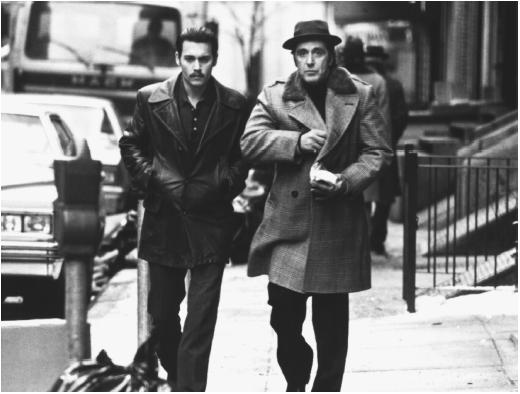
A year or so before The Sopranos, Mike Newell’s Donnie Brasco offered a glimpse of the series with this sharp, “deep cover” mob flick, alternatively brutal and funny, and at the end, touching. Donnie Brasco (Johnny Depp) is actually FBI agent Joe Pistone, who goes undercover to break a mob crew led by Michael Madsen. His entree is provided by a lower-level made guy, Lefty (Al Pacino), who vouches for Donnie, shows him the ropes, and, as Donnie loses his moorings and allegiances (to both the FBI and his suffering wife, Anne Heche), becomes a father figure.

Paul Attanasio’s (Quiz Show, Disclosure, and several episodes of Homicide: Life on the Street) script is tight and playful. We get harrowing scenes where Donnie is conscripted to dispose of a body via hacksaw or merely nearly found out:

These scenes are followed by amusing vignettes of what mobsters do on vacation in Miami (water slides, burying colleagues in sand, bad tennis) or the everyday humdrum of the criminal life, stealing boxes of steak knives or parking meters.  Attanasio even includes a wry stab at marriage counseling between Depp and Heche. David Chase would do the same thing for Tony and Carmella Soprano a few years latter, to similar tragicomic effect.

As Donnie becomes enmeshed in his crew, the audience becomes invested in their survival, if not from the FBI, from rival mob crews. Depp sells this kinship very effectively. This was one of his first major dramatic roles and he shows a depth and darkness that is highlighted by Heche’s increasing frustration and anger. Tempering both performances is a rare restrained turn by Pacino, who becomes Donnie’s family. It is always a treat to see an older Pacino performance that shelves histrionics.

There are a few weaknesses. The Heche-Depp marriage, rocky as it is, seems too indomitable for reality, and Depp’s introduction into the crew seems a tad effortless. But this is a picture every bit as strong as the best of The Sopranos episodes.

1993's "True Romance" | Films complets, Film, Affiche film

Quentin Tarantino’s bona fides, established by the success of Reservoir Dogs, led to production of his script for Tony Scott’s overpraised and over-copied True Romance, a deafening whiz-bang, shoot ’em up.  A comic book store clerk in Detroit, Clarence (Christian Slater) happens upon a whore named Alabama (Patricia Arquette) in a movie theater during a triple feature of kung fu flicks.  Alabama likes kung fu flicks, a true romance is born, and Slater is driven to confront her pimp (Gary Oldman, playing black), in the process unknowingly stealing a million dollars worth of cocaine from the mob. He and Alabama are soon off to L.A. to sell the coke, and bloodshed ensues.

Tarantino’s voice is dominant, and we get a steady dose of racial epithets, tough guy jargon borrowed from previous genres, movie references (two on Steve McQueen) and the like. On the plus side, we also get a few taut and funny exchanges, the best being the fencing between Slater’s father (Dennis Hopper) and the mob underboss (Christopher Walken).

Unfortunately, the actors all appear to be vying for the Best Supporting Actor in a Quirky Scene of Tarantinoesque Patter, and many are not up to the task. Hyped-up cops Tom Sizemore and Chris Penn are particularly awful, but Gary Oldman’s excess nears embarrassing and Saul Rubinek’s Hollywood producer is a tiresome cliche’ of every oily movie mogul you’ve ever seen in film. While Walken and Hopper can do something with Tarantino’s writing, they are aided by their set piece scene, which is essentially two monologues. Those who are asked to act have a rougher go.

Which bring me to the leads. Slater handles the tough-guy patois but there’s no heart. He’s a loser but doesn’t feel like one. He’s a tough guy but doesn’t project. Mainly, he’s a nasally Nicholson wannabe who becomes increasingly grating. Arquette is better, but she’s not good, nor is she much more convincing. Her “whore with a heart of gold” is trite and cloying, and it isn’t until a later scene, where she fights for her life with the psychotic hit man James Gandolfini (in prep for Tony Soprano), that she communicates any depth.

Recently deceased director Scott (Top Gun, Crimson Tide, Enemy of the State and numerous other flashy, soulless action pictures) papers over the dull leads with a brisk pace, but his super shootout clusterfu** of a finale is laughable. It’s hard to identify what is worse – the implausibility, the slo-mo explosions, or the fluttering feathers from shot up pillows – but coupled with Tarantino’s by now played out macho dialogue (before an execution, Penn actually says, “this is for Cody”), this is as bad as it gets. Sadly, this kind of thing spawned a generation of allegedly hip, super violent copycat films.

Unbreakable (2000) - IMDb
It is a testament to M. Night Shyamalan’s clout after The Sixth Sense that he could get such a deliberate and meditative film made. Bruce Willis is a Philadelphia security guard, an ex-jock in a crumbling marriage with Robin Wright. His son is overly attached to him, sensing in his father something special and perhaps dangerous. After Willis emerges from a horrific train wreck as the sole survivor, with nary a scratch, the son’s suspicions are confirmed by the appearance of a comic book aficionado (Samuel L. Jackson) who leads Willis to a great revelation. It’s an old movie, but to discuss it further substantively would be an injustice. Before Shyamalan became a slave to big twists and reveals that became increasingly ridiculous, from aliens who invade earth but for whom water is acid (Signs) to an eco-counterattack where trees make people commit suicide (The Happening), he could deliver some truly effective codas, and Unbreakable contains my favorite.

Great ending aside, the story is original and sophisticated, Shyamalan’s Philly locales are lovingly chosen and spooky, Willis is the perfect choice for a regular Joe who soon learns he is anything but, and Jackson projects brilliant obsession. The penultimate scene, where Willis tests his new incarnation, is one of the more frightening I’ve ever seen.

The studio and Shyamalan had to have been disappointed by the latter’s sophomore effort. While it did very well overseas, its domestic gross exceeded budget by only $15 million compared to The Sixth Sense‘s $250 million. But Shyamalan had to know that such a painstaking, personal film would not garner an expanding mass audience, even if the studio didn’t.

Image result for End of Watch

This is the film cops might make about themselves if they were in the business of recruiting like the military and they had a big budget. Jake Gyllenhaal and Michael Pena are LA cops, and they work a beat every bit as tough as that of Sean Penn and Robert Duvall in Colors and Denzel Washington and Ethan Hawke in Training Day. Unlike those duos, however, these guys love each other. Brothers in blue, these two are damn near bunk mates. But they happen upon the stashes of a drug cartel, twice in between stunts of great derring do, and bad things happen. And that’s it. We see the camaraderie, the daily toll, the unbreakable bond, the heroism and some kick-ass gunplay.

There is no story to speak of, the movie doesn’t really work as a “slice of the life” exercise, the villainous Hispanic gang members are wildly cartoonish (they don’t say, “ess-Ayyyyyyy” but they come close), and director-writer David Ayer (who wrote Training Day) utilizes a distracting, ridiculous camera technique (Gyllenhaal is filming his daily activities for a class he is taking). The different vantage points juice up the action, but the technique also evokes The Office and the Paranormal Activity movies. On the plus side, the movie is occasionally thrilling and Pena and Gyllenhaal are very good.

The exploration of the Tarantino oeuvre ended last night as me and the boy watched Tarantino’s opus (I will not subject my son to Death Proof from Grindhouse or Tarantino’s contribution to Four Rooms unless he’s really bad). Pulp Fiction is audacious in its break with continuity and vibrant in dialogue.  The film is essentially a series of riffs (and nobody riffs better than Samuel Jackson and Christopher Walken) or two person sketches. A stunning follow-up to Reservoir Dogs, the movie is a pop culture totem, demonstrating Tarantino’s love for kitsch as well as his sharp ear for a modern, urban, tough guy patter, Spillane-meets-Quisp.

Almost all of the performances are brilliant.  I’ve criticized Tarantino’s reclamation projects, but his insistence on JohnTravolta (over Daniel Day Lewis) was exactly right.  In the words of Tarantino’s agent, at the time, “John Travolta was at that time as cold as they get.  He was less than zero.” But Tarantino would not budge, and as hit man/enforcer Vincent Vega, Travolta is just the right amount of cool and introspection to Jackson’s ferocity. When the boss’s wife (Uma Thurman) mistakes his heroin for coke and overdoses, Travolta snaps out of his own drug-induced laze and, in one of many comic but harrowing scenes, becomes electric. The performance is artful, it resulted in an Academy Award nomination, and it resurrected his career.

If there is a criticism, it is of one vignette, after Jackson and Travolta accidentally shoot a man’s head off in their car. They need to get off the street, and end up at the home of one . . . Quentin Tarantino. Even the introduction of “The Wolf” (Harvey Keitel), a Mr. Fix-It who arrives to assist the stranded duo, cannot save this halting sequence or Tarantino’s amateurish acting. Rank has its privileges, but this particular hubris was detrimental.

But that’s a minor bump in the road in this highly engaging and original flick.  Related — The Pulp Fiction Oral History:  Uma Thurman, Quentin Tarantino, and John Travolta Retrace the Movie’s Making.

Hitman Joseph Gordon-Levitt seemingly has the simplest job in the world.  A crime syndicate in the future sends bound targets back in time to a field, where “loopers” like Gordon-Levitt kill and dispose of them.  The loopers get paid in silver until one day, an older version of a looper is sent back to be killed by his younger self.  Strapped to that older version is a pile of gold, the final reward.  When the older Gordon-Levitt is sent back, he is Bruce Willis, and not unexpectedly, Willis thwarts his own execution, and the fun begins.

A blast of a movie, and upon scrutiny, for a time travel film, it does pretty well from a logic standpoint (though some disagree). What matters, however, is that the logic holds up well enough to allow you to be carried away by writer/director Rian Johnson’s fresh and intricate script and his nifty vision of two futures.  The Terminator, for example, was so riveting, you didn’t have the chance to think, “Hey.  Why didn’t Skynet send the Terminator back in time to the hospital where John Connor was born?  Aren’t babies easier to track down and execute?”

Gordon-Levitt is uncanny as a young Willis (they’ve even altered the contours of his face to cement paternity), Willis is gruff Willis, and Emily Blunt (the Brit fashionista assistant in The Devil Wears Prada) is surprisingly convincing in a tough gal role.  Jeff Daniels is a good choice as an off-beat heavy, and Noah Seegan and Garret Dillahunt impress in small roles as the men tasked to hunt Gordon-Levitt and Willis down.  The standout performance, however, belongs to child actor Pierce Gagnon, who manages to be terrifying and then sympathetic.

Johnson’s 2005 noir high California school flick – Brick – was similarly inventive.  Johnson is not exactly prolifiic, but if Looper is the norm, I can wait.

This is the most un-Tarantinoesque of Quentin Tarantino’s pictures, faithfully adapted by the director from an Elmore Leonard book. A flight attendant (Pam Grier) gets caught shuttling money and drugs for a gun seller (Samuel L. Jackson) and caught in between the ATF (represented by Michael Keaton) and Jackson, she devises her own scheme to steal all of the latter’s funds while extricating herself from prosecution, enlisting the help of a bail bondsman (Robert Forster) in the process.

Tarantino’s pace is languid, his body count minimal, and the film features long stretches of sharp dialogue and silent character reflection. As Jackson’s scheming girlfriend and dim accomplice, Bridget Fonda and Robert DeNiro shine in a cast of apt, funny secondary characters. This is a clever and straightforward crime story.

Like the two Tarantino pictures that preceded it, Jackie Brown utlizes the seedy environs of Los Angeles to great effect (the bar and nightclub locales are particularly well-chosen). In an interview, Tarantino explained his changing of the locale from Miami to LA:

I don’t really know anything about Miami. I had never been to Miami before. One of the things Elmore Leonard has to offer in his novels, is an expert sense of both Miami and Detroit. He has got his Detroit novels and he has got his Miami novels. I can’t compete with that, and Miami is very hot! You don’t want to got there to shoot! One of the things I do have to offer is that same kind of knowledge about Los Angeles; partly in the area that the area is shot in, in the South Bay. It is not used that often. Tequila Sunrise used it a little bit, and a few other movies have touched on it a little bit. I am very familiar with that area because I grew up around that area. It is one of the things I could bring to the piece; an expert knowledge of that area, the way he brings an expert knowledge to Miami.

While Jackson uses the “n” word with his usual vigor, the script is refreshingly shorn of the showy pop culture references found in Reservoir Dogs and Pulp Fiction. It’s also a lot moodier than those pictures.

The plot, however, is not wildly intricate and certainly doesn’t justify a 2 and a half hour running time. Also, while Tarantino loves reclamation projects like John Travolta and David Carradine, Pam Grier and Robert Forster are bridges too far. Neither are particularly good actors, and while Forster’s wooden approach isn’t terrible given his role, Grier is key, and she cannot convey the emotions necessary to really bring the character home.

She was a B picture star in the 70s for a reason other than acting.

Lawless (film) - Wikipedia

I wonder how a movie like this gets made these days.  Tom Hardy, Jessica Chastain, and Shia LeBeouf can’t open it, the milieu (1930s backwoods of Virginia) doesn’t relate, it can’t be cross-marketed with a soundtrack, and the script, which could override all of the above if it were really good, is not.  In fact, there is not a memorable exchange in it. Hardy is colorless (he resonated stronger with a mask in The Dark Knight Rises), Chastain a stock dancer with a heart of gold, and LeBeouf showy, always “acting!”

The Bondurants are bootleggers in Franklin County, Virginia.  On principle, they won’t pay off the authorities, which smacks of stupidity more than honor or savvy business sense.  The authorities hire Guy Pearce to shut them down. Pearce must have sensed what a dreary endeavor this was to be, so he took on the affectation of a sexually dysfunctional dandy/germaphobe.

And he hates hillbillies.

Character developed!

Pearce goes too far, Hardy brings hell and damnation with him, and it ends with an underwhelming shoot-out and an interminable voice-over coda by LeBeouf.

Writer/director Martin McDonagh’s first feature is assured, intelligent, and deviously funny.  Two Brit hitmen, Ken and Ray (Brendan Gleeson and Colin Farrell) are exiled to Bruges in Belgium by their crime boss Harry (Ralph Fiennes) after Farrell cocks up his first job (a priest) and accidentally kills an altar boy.  What starts as a languorous wait, with Gleeson fascinated by the history of the town and Farrell bored to tears, becomes tense and edgy after Gleeson is given his next assignment (guess who?) and Farrell becomes more and more despondent over what he has done.  The duo sightsee, drink, do drugs and discuss morality, fate, death, religion, Americans, beer and various and sundry other topics until Fiennes comes to town to force the action.

The three leads are all very good.  Fiennes is a brutal yet charming Cockney, and Gleeson is a stoic solider on the brink of a moral epiphany.  But Farrell’s frenetic, comic-yet-tortured turn is the engine.  He’s barely a man, he’s killed a child, and he is denied any peace, having been placed in “bloody Bruges.”

A taste —