Archive

Comedy

Hollywood Ending (2002) |

My how the semi-mighty have fallen.  The Woody Allen stable of Diane Keaton, Diane Wiest, and Mia Farrow are replaced by Tea Leone, Debra Messing and . . . wait for it . . . Tiffany-Amber-Thiessen.  Worse, the 67 year old Allen still insists on casting himself as a love interest (this time, with 36 year old Leoni).  The courtship is ridiculous and the images revolting.

Worse, the film lacks one funny premise, line or sketch.  Allen plays Allen, arms waving and neuroses on all cylinders. But oh does he have some subversive things to say about filmmaking.

Allen is directing a $60 million picture.  He he he.  And he’s stricken by psychosomatic blindness. Te he he.  But he makes the film anyway, and in the process, reunites with his ex-wife.  And again, they kiss (just vile – you’re praying his teeth do not fall out).  And guess what?  In the end, the French love the film.

Har har har.

Nyuk nyuk nyuk.

It is the worst film of 2002, certainly one of Allen’s most terrible and perhaps the shittiest film of the millennium.  In the face of Hollywood Ending, saying “Well, Allen directed Annie Hall and Hannah and Her Sisters,” is like saying “Well, Hitler built the Autobahn.”

Borat - Wikipedia

Funny to the point of tears, but a testament to the generous nature of Americans.  My fear was that Sacha Baron Cohen would be cruel to his subjects, but the film is, perhaps unintentionally, quite the opposite.  Yes, the rubes and dudes and New York toughs can be less than politically correct, but what they lack in modern manners they make up for in their easy acceptance of this bizarre, crude faux immigrant who tests the limits of all patience. As Christopher Hitchens noted:

Americans are almost pedantic in their hospitality and politesse. At a formal dinner in Birmingham, Ala., the guests discuss Borat while he’s out of the room… agree what a nice young American he might make. And this is after he has called one guest a retard and grossly insulted the wife of another… The arrival of a mountainous black hooker does admittedly put an end to the evening, but if a swarthy stranger had pulled any of the foregoing at a liberal dinner party in England, I wouldn’t give much for his chances. 


A Serious Man.  I consider Fargo and No Country for Old Men to be two of the best films ever made.  The only resemblance the Coen brothers’ Oscar-nominated film, A Serious Man, bears to those films is attention to detail and the potential evocation of outrage from a distinct group (in Fargo, Minnesotans took umbrage at their farcical portrayal; here, it should be Minnesotan Jews circa 1967).  A Serious Man beats up on its protagonist, a Jewish professor with cretins for children, a disloyal shrew for a wife, cartoonishly unhelpful religious guidance, and various other unpleasant people who vex him, including a disgusting uncle with a cebacious cyst he must drain on a regular basis.  Apparently, the protagonist is cursed, a curse handed down from his Polish ancestors, but the curse appears to be the fact that he’s Jewish.  The moment it appears he can get out from under, the curse strikes again, and the film ends abruptly.

This is an unpleasant, frustratingly tedious film that may have served as some sort of the therapy for the Coen brothers (they grew up in St. Louis Park, Minnesota, a suburb of Minneapolis, in the 60s).  It has few other attributes and they shouldn’t have worked out their issues on us.

500 Days of Summer.  A romantic comedy that takes another whack at the rom-com dreck machine (1567 Dresses, He’s Just Not That Into You, Maid of Honor, etc . . . ).  Great chemistry between an earnest Joseph Gordon-Levitt and an aloof Zooey Deschanel, who at times tests your ability to stomach the quirky, bohemian modern girl but still captivates.  Still, it is hard to dislike a film that can carry a Hall and Oates dance number in the middle of an L.A. park.  Also, I did notice that the office where Gordon-Levitt is interviewing in the last scene is Jack Nicholson’s office in Wolf.  Great office.

Image result for Kids are alright Moore
Julianne Moore and Annette Bening are two middle-aged lesbians with two teenage children in the midst of a mid-life crisis.  The kids decide they want to meet their father (Mark Ruffalo, who is actually just their sperm donor).  Very funny, occasionally poignant, and refreshingly devoid of the kind of politics you might fear from such an endeavor.  Bening is particularly good as the controlling, more responsible member of couple, the uncool drudge, trying to keep it all together in competition with cool “new” and fun, breezy Moore.

The Other Guys - Wikipedia

Will Ferrell’s antics have a shelf life.  There were a few good gags, but Mark Wahlberg steps on a lot of them with his clod-like turn as straight man (he substitutes volume for timing). But we do get a political tract on Ponzi schemes from director Adam McKay during the credits, so, there’s that.

Amazon.com: Greenberg: Ben Stiller, Rhys Ifans, Greta Gerwig, Noah  Baumbach: Movies & TV

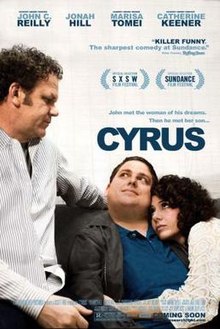
Cyrus (2010 film) - Wikipedia

Similar films about dysfunctional and barely interesting people.  In Cyrus, poor John C. Reilly has the good fortune to start dating Marisa Tomei.  Unfortunately, Jonah Hill (Cyrus) is Tomei’s babied adult boy and what ensues is a muted power struggle played a little too seriously when there were more laughs to be had.

Greenberg is another filmic form of torture from Noah Baumbach, who has made quite a career of making movies about unpleasant, self-centered wretches (Jeff Daniels and Laura Linney in The Squid and the Whale; Nicole Kidman in Margot at the Wedding).  The sad center of Greenberg is Ben Stiller, a just-out-of-the asylum condescending dick who is house-sitting for his brother in L.A. Thankfully, unlike the prior films, Baumbach doesn’t put children front and center for the abuse he finds so illuminating.

To give credit where it is due, both Hill and Stiller do well with their appointed tasks, which is to squeeze a little humanity out of such creepy, crappy characters.  And while Cyrus ends up unconvincingly sweet, Greenberg is coyly ambivalent.

But really, do we care whether an ass like Stiller may find love at the end of the day?

We do not.

Image result for Hot Tub Time

A bro-mance that is actually a menage-a-trois.  John Cusack, Craig Robinson and Rob Corddry go back to the ski lodge of their youth, are transported to 1986, and proceed to do unfunny and boring stuff (often involving their bodily fluids) in the hopes of getting back to the future.  Cusack looks like a hostage.

Image result for 50/50 Movies

Joseph Gordon Levitt gets a grim cancer diagnosis and is supported by Seth Rogen, who plays the standard best friend role (much as he did in Funny People), only now, he’s a stoner trying to get his friend to use the cancer to get women.  Rogen can be funny but he better branch out.  He’s got one persona and it is wearing very thin.

There is also a love connection with his cancer support therapist Anna Kendrick that is all too paint-by-numbers with its concerns about the ethics of falling in love with a patient and the inevitable breakthrough.  And there is an overbearing mom played with little imagination by Angelica Huston.

What is memorable about the picture is Gordon Levitt, who manages to convey the loneliness, confusion and other-worldliness of a possible premature death sentence with force and subtlety.  He’s almost worth the watch alone.