Archive

Comedy

A soldier in Iraq (David Anders) is gunned down and dragged away into the desert. He comes home to LA for a full military funeral, but after being put in the ground, he rises. And goes straight to the apartment of his wastrel friend (Chris Wilde, who looks like David Spade but acts funnier). There, he realizes he cannot eat. Soon, he craves blood. He robs a blood bank but realizes he is better served appearing vulnerable and then feeding off of criminals (a mix of Charles Bronson in Death Wish and Dexter).

The first half of the film is fresh and clever.  The “what the fu**!” reaction of Anders to his plight is gut-busting and the aplomb with which Wylde greets his pal is the perfect pitch. The picture has a wicked sense of humor, harkening back to American Werewolf in London and Reanimator. This could easily have been a bigger budget, Paul Rudd/Seth Rogen project. Indeed, feeding your back-from-the-dead pal is the ultimate validation of a bromance.

Alas, two thirds in, and it runs out of gas. The plot shifts to the woes of Anders’s girlfriend, who still unconvincingly loves him with all her heart, even if he actually rots and stinks when unfed. It gets more and more absurdist, and after we dispense (in gruesome fashion) with the girlfriend, the movie doesn’t know what to do with itself.  So it opts for over-the-top excess and a high concept finale. The former is numbing. The latter comes off cheezy. The film’s low budget, hidden nicely by well-chosen LA locales and unambitious special effects, becomes an issue when we get into police chases, an overlong massive shoot-out in and outside of the subway, and sci fi nonsense that cries out “Student film.”

Still, promise from director D. Kerry Prior and a noble failure.

A vehicle for the skills of a host of accomplished Brit actors, this movie starts out swift and charming, as we watch our leads end up in India at a run-down retirement hotel that looked a helluva lot better in the brocuhure.  Judi Dench is recently widowed; Tom Wilkinson, fed up, abruptly resigns his judgeship; Bill Nighy and Penelope Wilton have had to scale down their retirement plans after an investment in their daughter’s internet company went bad;  Maggie Smith needs a hip replacement and can get it quicker in India; and Celia imrie and Ronald Pickup are fighting aging and simply along for the ride.  Directed ably by John Madden (Shakespeare in Love), the set up is deft and the upcoming culture clash looks to be fun.  Okay.  Love Actually for old people, right?

Instead, the film takes itself way too seriously.  The Nighy-Wilton union is crumbling.  Dench is regretful of her long-term marriage.  Wilkinson has a deeper secret underlying his removal to India.  Smith’s tale is even more woeful.  What seeemed a light comedy turns into a morose trek.  Even the comic relief (Slumdog Millionaire’s Dev Patel, who runs the hotel) has his own crucible – he must stand up to his mother and choose the one he loves (all with the help of some sound Brit advice).

The actors are really all very good, and they are elevating pedestrian material (not a thing happens that you haven’t guessed).  The resolutions are absurdly convenient and it ends sickeningly cloying.  Unlike Slumdog, the India portrayed here is all sweetness and dazzle, if a little crowded, and the Indian actors are given that child-like nobility that always comes off as condescending.   

The last 15 minutes is so rushed in its effort to provide a tidy, happy ending, it feels damn near like the entire endeavor was trying to make a flight.

It is in vogue to denigrate Will Ferrell, whose excess has long outlived its freshness. He’s slogged into one tiresome, repetitive project after another. Land of the Lost? A one-man show portrayal of George W Bush, The Other Guys, Casa di mi Padre, The Campaign, and soon, a repeat, Anchorman: The Legend Continues. His forays into a successful Jim Carrey-like branch-off started with promise (Stranger than Fiction) but his dramatic weaknesses were apparent in Everything Must Go. His last goofy semi-triumph was Step Brothers, which owed as much to the supporting efforts of the scene-stealing, diabolical Adam Scott and the inspired premise as to Ferrell’s adolescent sincerity as the arrested man-child, Brennan Huff.

Let us not forget, however, that when Ferrell was on a roll, it was an impressive one – Old School, Elf, Anchorman, Wedding Crashers . . . all a variation on the man-child theme, but classics nonetheless.

At the end of Ferrell’s run is Talladega Nights, the last hurrah, but what a hurrah.  Ferrell plays Ricky Bobby, an ignorant, flashy, uber-American NASCAR driver with a hot blonde wife (Leslie Bibb), a loyal race car compadre (John C. Reilly) who loves Ricky so much he happily takes second in every race, two horrific kids (Walker and Texas Ranger) and a gay French nemesis on the track (Sacha Baron Cohen). When Ricky is on top, it looks something like this:

When it all goes to crap after a brutal wreck, Ricky must re-connect with the itinerant father who abandoned him as a child (Gary Cole) and his old-school mother (Jane Lynch). With their help, and the help of a loyal, starstruck flunky (Amy Adams), Ricky regains his mojo and lives the VH1 comeback before our eyes.

The gags are inspired, the back-and-forth (much of which has to be improv, as evidenced by the bloopers in the credits) crackles, almost every supporting character delivers well (Molly Shannon as the boozehound wife of a corporate slime is particularly prime), and the chemistry between Ferrell and Reilly, which was very good in Step Brothers, is undeniable. After Ricky loses his nerve and then all, Cal replaces him, setting up in Ricky’s house and with his wife. But they do miss each other:

It’s uproarious, loaded with gem slogans (“If you ain’t first, you’re last”) and has as much fun as you can have with American excess. Even as silly an endeavor as this could have come off condescending and mean to “those NASCAR types” but Talladega Nights feels wholly respectful even as it goes to town on its target.

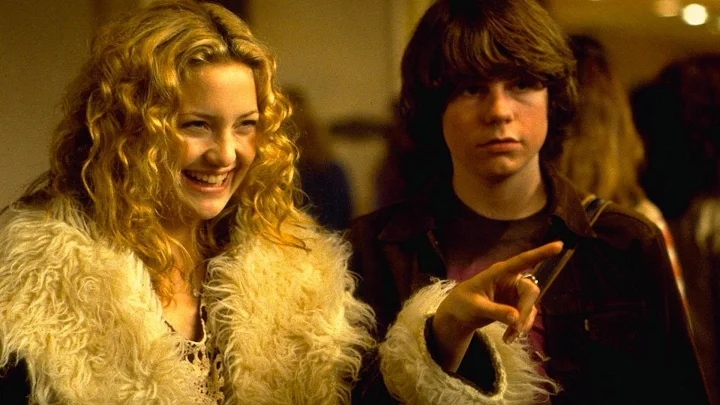
Almost Famous - Movies on Google Play
Based on writer/ director Cameron Crowe’s experiences touring with rock bands like Poco, The Allman Brothers and Led Zeppelin,
Almost Famous gives us Crowe stand-in Patrick Fugit, a 15 year old rock fan who writes for his school newspaper and a San Diego alternative mag.  His work garners the attention of Creem magazine and its famed rock critic Lester Bangs (Phillip Seymour Hoffman).  Bangs tutors Fugit, who gets an assignment from Rolling Stone to cover rising band Stillwater, fronted by the suspicious and bloviating Jason Lee and the more talented and enigmatic guitarist Billy Crudup.  As Fugit is ensonced with the band on the road, he is charmed by groupie (or, Bandaid) Kate Hudson while his mother (Frances McDormand) monitors his trip via regular phone calls.  Fugit falls in love with Hudson, who is in love with Crudup and considers herself a muse to both.

The film is unabashedly nostalgiac, particularly the scenes of McDormand allowing and then regretting letting her son go on the road with the band.  McDormand is a conflicted personality, half free spirit, half overbearing “DON’T DO DRUGS” nag.  But her affection for her child is undeniable and as she sees him grow up, their distance becomes more painful.  Worse, she intuits he has found a new family (all of whom assure her when she calls that she has raised a wonderful boy while raising the specter that he is being plied with sex, drugs and rock and roll).

This is a fan’s movie, interspersing great 70s rock with a coming of age tale.  Fugit evokes the awkward, sweet nature of a 15 year old lovestruck boy and his performance is beautifully sentimental.  Crowe shows no fear of the maudlin which is for the most part to the film’s advantage.  When the band and its coterie, breaking apart due to various strains on the road, spontaneously sing Tiny Dancer on the tour bus, you can imagine eyes rolling after reading the scene.  But it works perfectly, all part of Crowe’s love letter to rock.

This is not to say that the film never missteps.  It is occasionally too cute, a Crowe weakness.  At one point, Hudson tells Fugit, “You’re too sweet for rock and roll” as if it needed to be said.  Crowe then makes him prove it.  Hudson, despondent over Crudup’s rejection of her, overdoses on Quaaludes.  Fugit saves her and as she gets her stomach pumped before his eyes, he remains starstruck, mooning as she vomits (Stevie Wonder’s “My Cherie Amour” plays in the background).   In another scene, the band plane appears to be going down, and the members all trade simmering accusations and long held secrets, which feels pat and forced.

But by and large, the film’s tone is just right, evoking the memories of your first LP and the moments when your mother actually read the lyrics on a record sleeve and took it away.

There are also laugh out loud moments, my favorite being Lee’s first interview with Fugit, where he waxes poetic on rock:  “Some people have a hard time explaining rock ‘n’ roll. I don’t think anyone can really explain rock ‘n’ roll. Maybe Pete Townshend, but that’s okay. Rock ‘n’ roll is a lifestyle and a way of thinking… and it’s not about money and popularity. Although, some money would be nice. But it’s a voice that says, ‘Here I am… and fuck you if you can’t understand me.’ And one of these people is gonna save the world. And that means that rock ‘n’ roll can save the world… all of us together. And the chicks are great. But what it all comes down to is that thing. The indefinable thing when people catch something in your music.”

When the quote makes the article, his response is priceless:  “Rock ‘n’ roll can save the world”? “The chicks are great”? I sound like a dick!”

There are precious few good movies about making movies  Tropic Thunder is uproariously funny, a brutal send up of dozens of Hollywood tropes, which get a less raucous going over in Get ShortyThe Player reveals a Hollywood machinery that routinizes art, creating a war of sorts between the suits (Tim Robbins) and the creativity.  A Cock and Bull Story and Adaptation are examples closer to Seven Psychopaths, in that you don’t necessarily know where the movie and the “movie in a movie” begins and ends.

Writer/director Martin McDonagh’s In Bruges was a surprising dark comedy about the philosophical doubts of hitmen as they tracked each other in the beautiful Belgian city.  In  Bruges marked McDonagh as a Quentin Taranatino disciple, but his dialogue was meatier, more complex and less reliant on pop culture diversions.

In Seven Psychopaths, the setting is LA, where McDonagh veers deeper into Tarantino-country.  His characters, however, retain the penchant for discussing deep moral and meditative matters as they negotiate an increasingly circuitous plot.  An actor (Sam Rockwell) tries to motivate his screenwriter friend (Colin Farrell) who is listlessly working on a script entitled “Seven Psychopaths.”  Farrell, despondent over the exploitative, repetive crap of violent pictures, has taken to drink at the thought of writing another.  Rockwell, however, is a proponent of the genre Ferrell seeks to escape, creatively urging a shoot ’em up with a blazing guns finale.  To that end, he puts out an ad in the “LA Weekly” inviting real psycopaths to come see Farrell and provide their stories.  Concurrently, Rockwell and an older gentleman (Christopher Walken) run a scam where they steal dogs and return them for rewards.  When they steal the beloved shih tzu of a real psycopath (Woody Harrelson). the script and reality meld.

I first took note of Sam Rockwell in Galaxy Quest, a very funny ensemble comedy which he completely stole.  He has the face of a supporting player, not quite Steve Buscemi odd, but one is often reminded of a rat gnawing on cheese.  Looks aside, which probably deny him leading status, Rockwell is a kinetic yet soulful actor, either riffing or expressing a heartfelt need to be understood.  Walken brings his trademark quirkiness, Harrelson his jovial menace, and Farrell, playing the straight man, his increasing frustration.  But the movie belongs to Rockwell, who blends psychoses with the LA surface cool of an aspiring actor/writer.  His performance is hilarious.

The preview portrays  the film as zanier than it really is.  There are a bunch of funny set-ups and coincidences, but McDonagh provides a sharp commentary on movies and contemporary LA.  He has also written some clever scenes where the characters toss around their screenplay ideas and in the process, write the movie before our eyes.  It’s a neat, meticulous trick.

If there is a weakness, it is the part of the film where the characters appear to suffer writer’s block, and in response, run off to Joshua Tree National Park to reflect (Walken takes peyote). The movie drags a bit at this point, but not for long.


image

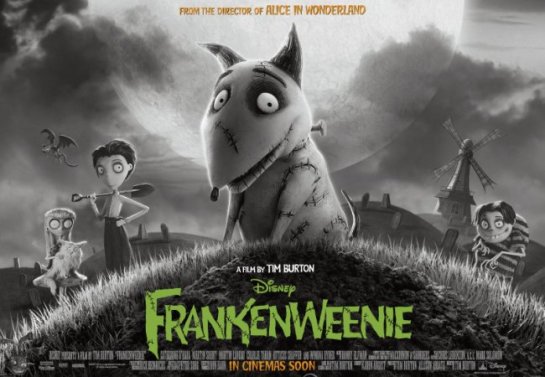
Tim Burton goes back to his roots (this is a remake of  Burton short film from 1984) with this clever and sweet story of a boy whose beloved dog is killed by a car.  Inspired by his science teacher, the boy brings the dog back to life, but does so in the midst of a heated science fair competition.  His classmates use his same scientific methods, and soon, the town is overrun by monsters brought back to life by the irresponsible kids.

Burton uses stop action animation, the same technique used for Coraline, and Burton’s own Corpse Bride and The Nightmare Before Christmas.  The process is well tailored to the macabre, old-timey haunting and rich in texture, especially in black-and-white, which evokes classic horror films.

I have two minor criticisms.  First, there is a subplot where the science teacher is run out of town because of his influence on the children. It’s a little too contemporary and feels a bit like an unfair shot in the culture wars, especially off putting when, in fact, the neanderthal townsfolk who feared the teacher are seemingly vindicated – the kids damn near destroyed the town.

Second, the ending feels forced, as if the test audiences couldn’t bear the downer of a dead pet.  So, the dog lives, which is pleasing, but contrary to what I thought was a well-developed theme about love and loss and the limits of science. In that way, I suppose Frankenweenie is hopelessly, sadly modern.

image

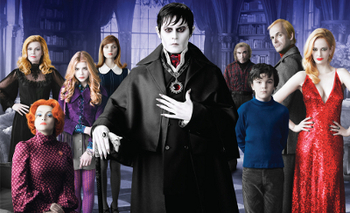
Tim Burton’s Dark Shadows starts out with a crisp recap covering how Barnabas Collins (Johnny Depp), the scion of a Maine fishery and lord of the manor at Collinsport, was laid low by a spurned scullery maid witch (Eva Green) and cursed to a life buried in the ground as a vampire. 200 years later, he is unearthed by a construction crew building a McDonalds.  Very thirsty, he slaughters them all, and heads on down the road to his manor to reestablish the family’s supremacy.  So far, so good.  Burton’s economical use of flashback harkens to Coppola’s Bram Stoker’s Dracula, and this looks to be a lot of fun.

It is not.  Barnabas in 1972 is rather a bore, and Burton does just about everything you’d expect Dennis Dugan to do as a director.  Barnabas marvels at electricity, commands the demons in the TV to show themselves, reads and quotes from Eric Segal’s Love Story and watches Scooby Doo and observes that it is a very bad play.  None of it is funny.

Nor is any of it engrossing.  Green now runs the town as the executive of a lead cannery, low ambition indeed for such a powerful woman, and Barnabas challenges her – by opening a competing cannery.   In the meantime, Barnabas has a series of lame encounters with the surviving Collins’s, who include a droll Michelle Pfeiffer as the matriarch, a wasted Jonny Lee Miller as her brother, a couple of pointless kids (Chloe Grace Moretz and Gulliver McGrath), Burton’s wife Helena Bonham Carter as a live-in psychiatrist, and Jackie Earle Haley as groundskeeper Willie.

There is also a love interest (Bella Heathcote), the boy’s nanny, for whom we have to suffer a second, less interesting flashback showing that she was institutionalized when she was a child because she commiserated with ghosts.

One gets the sense Burton knew this was a hopeless mess and found himself desperately piling on more and more visual wonder and absurdity in the hopes of saving the picture.  Hence, Barnabas has a ball for the town and arranges for Alice Cooper to perform (allowing him to say that she is the ugliest woman he has ever seen); Carter tries to transfuse the vampire blood out of Barnabas and then just decides to give him a blowjob; Barnabas and Green have a hate mating and fly about the room and up and down the walls, destroying everything, but at least breaking the tedium; and inexplicably, Moretz turns out to be werewolf.  There are also two musical sequences, the tactic of the lazy.

We eventually limp to a lengthy showdown between Collins and Green that is all Robert Zemeckis.  Statues come to life, ghosts intercede, and millions are spent wowing us with spectral visions.  All wasted, making you nostalgiac for the one-take, live-to-tape format of the original soap opera.

There is a hint at the end a sequel may be forthcoming, though with a production budget of $150 million and a domestic take of about half that, we may be spared.

Th signature achievement of the reign of John Hughes.  During his run, Hughes wrote and/or directed the following teen dramedies– Pretty in Pink, Sixteen Candles, The Breakfast Club, Weird Science, Ferris Bueller’s Day Off, Some Kind of Wonderful, Uncle Buck and Career Opportunities.

Hughes offered a certain corporatized schmaltz and sentiment, and there are worse Hollywood epitaphs.  Hughes also provided a silly, devil-may-care ethos for affluent suburban high schoolers (Hughes grew up middle class in tony Grosse Pointe, Michigan) and he could deliver a bravura screwball scene, such as Ferris Bueller’s rock out during a Chicago parade or John Candy crashing a teen party in Uncle Buck. At the end of his films, a trite lesson was always learned, and opposites always came together for a hug of understanding.

Nestled in this treacle, however, was a bit of nastiness fully realized in The Breakfast Club.  A group of kids – the geek (Anthony Michael Hall), the jock (Emilio Estevez), the weirdo (Ally Sheedy), the hood (Judd Nelson), and the “it” girl (Molly Ringwald) – all must spend a Saturday in detention together.  It becomes a group therapy session, and the archetypes – initially hostile to each other – soon find solidarity in their hatred of the school administrator (Paul Gleason) and the fact that it appears they each have something in common – an oppression at the hands of their cretinous parents.  Nelson is burned by cigarettes (given the school, one presumes Dunhills); Hall is so pushed to succeed academically he has contemplated suicide; Estevez is also driven by his overbearing father, and his torture is so great he actually starts to punch himself ; and Ringwald explains her homelife thusly when asked if she can go to a party:

                            CLAIRE
I don’t know, my mom said I was [grounded] but my dad told me to just blow her off.
                           ANDREW
Big party at Stubbies, parents are in Europe.  Should be pretty wild…
                           CLAIRE
Yeah?
                          ANDREW
Yeah, can you go?
                           CLAIRE
I doubt it…
                         ANDREW
How come?
                           CLAIRE
Well ’cause if I do what my mother tells me not to do, it’s because because my father says it’s okay.  There’s like this whole big monster deal, it’s endless and it’s a total drag.  It’s like any minute… divorce…
                            BENDER
Who do you like better?
                            CLAIRE
What?
                            BENDER
You like your old man better than your mom?
                            CLAIRE
They’re both strict.
                            BENDER
No, I mean, if you had to choose between them.
                            CLAIRE
I dunno, I’d probably go live with my brother.  I mean, I don’t think either one of them gives a shit about me…it’s like they use me just to get back at each other.


Hall adds: “…I don’t like my parents either, I don’t…I don’t get along with them…their idea of parental compassion is just, you know, wacko!”

Then it is the jock’s turn:  “Um, I’m here today…because uh, because my coach and my father don’t want me to blow my ride.  See I get treated differently because uh, Coach thinks I’m a winner.  So does my old man.  I’m not a winner because I wanna be one… I’m a winner because I got strength and speed.  Kinda like a race horse.  That’s about how involved I am in what’s happening to me.”

Cue the tough, doing his own impression of his house:  “(as his father) Stupid, worthless, no good, God damned, freeloading, son of a bitch, retarded, bigmouth, know it all, asshole, jerk!  (as his mother) You forgot ugly, lazy and disrespectful.”

The jock rejoins, explaining that he taped a classmate’s ass together.  Why?  “I did it for my old man…I tortured this poor kid, because I wanted him to think that I was cool. He’s always going off about, you know, when he was in school… the wild things he used to do . . . it’s all because of me and my old man.  Oh God, I fucking hate him!  He’s like this…he’s like this mindless machine that I can’t even relate to anymore…’Andrew, you’ve got to be number one!  I won’t tolerate any losers in this family…Your intensity is for shit!  Win.  Win!  WIN!!!’  You son of a bitch!  You know, sometimes, I wish my knee would give…and I wouldn’t be able to wrestle anymore.  And he could forget all about me…”

Just to make sure we get the message, Gleason is the biggest prick in the world, an amalgamation of every insecure, bullying teacher in the continental United States.

There’s not a genuine moment in the picture nor a hint of deviation from its blame-shifting orthodoxy.

Hughes has always included some of this foolishness – the parents in Uncle Buck are too committed to their jobs, Alan Ruck’s father in Ferris Bueller’s Day Off cares more for his sports car than his son.

But The Breakfast Club’s attack on the cruel, neglectful parents is the primary theme of the picture and Hughes uses it to portray these five kids (three of whom do appear to be sh**heads of the highest order) as victims.

Look, children can be obnoxious, and teens doubly so, but there is perhaps nothing more unpleasant than encountering a self-pitying teen who bemoans his vaunted station just as he nears the age when lesser forebears were jumping into a hot LZ in Vietnam.

Hughes died recently of a heart attack.  He was a bit of a recluse in his later years.  I wonder if the stereotype of the suffering, whining rich kid he presented in The Breakfast Club contributed to his distress, either because he was prescient and had to live with it or he felt he had a hand in cementing the mold.

In a Vanity Fair piece after Hughes’s’ death, David Kamp wrote “As hoary as it sounds, The Breakfast Club spoke to a generation.”

Unfortunately, it appears they were listening.

All good things . . . Whit Stillman lost his patience and made a lazy film. Rather than allowing us to cozy up to his affluent young characters, understand their milieu, and then enjoy their erudite yet innocent banter, he dispensed with development and jammed the quirky kids right down our gullet.

A transfer student to a tony private liberal arts college is identified by a trio of society girls who decide she needs their counsel and guidance. All four negotiate a lampoon of a Seven Sisters campus replete with neanderthalic frat boys, sneering campus journalists, and neurotic coeds.

There is no subtlety to this picture. The characters aimlessly drift into various Stillman exchanges, waiting their respective turns to say something Stillmanesque, like, “Do you know what’s the major problem in contemporary social life? The tendency to always seek someone cooler than yourself.”

There is more cleverness than that, but little intelligence, warmth or draw. Like Kubrick’s Eyes Wide Shut, which proved Kubrick probably had not had a sexual relationship in decades, Stillman seems too far removed from youth to master even a very broad comedy about young people.

And broad it can be. When one of the girls runs away to sort out her feelings after she finds her boyfriend has cheated on her, she goes to a low-rent motel. “Were you at a Motel 6?” her friends ask. “The Motel 4 – it’s even cheaper.”

Stillman has achieved bad Woody Allen. Not much fun, especially when he takes us out of Manhattan.

The film is often amusing, but the characters, never particularly realistic in Stillman pictures, are cartoons. Worse, every actor knows Stillman, and they’ve brought their Stillman A Game. The dialogue is stilted and even charmless. Oh for Chris Eigeman, who last I saw, stole a scene in HBO’s “Girls.”

The movie borders on a Whit Stillman spoof, though that really can’t be, at least until we get a proper David Mamet spoof.

He also cribs from his own work. A character has a fascination with a dance craze as social movement, just like a character in The Last Days of Disco. When you’ve only made 4 films, this is bad news.

It is no recommendation that it ends with two dance numbers.