Archive

Comedy

The exploration of the Tarantino oeuvre ended last night as me and the boy watched Tarantino’s opus (I will not subject my son to Death Proof from Grindhouse or Tarantino’s contribution to Four Rooms unless he’s really bad). Pulp Fiction is audacious in its break with continuity and vibrant in dialogue.  The film is essentially a series of riffs (and nobody riffs better than Samuel Jackson and Christopher Walken) or two person sketches. A stunning follow-up to Reservoir Dogs, the movie is a pop culture totem, demonstrating Tarantino’s love for kitsch as well as his sharp ear for a modern, urban, tough guy patter, Spillane-meets-Quisp.

Almost all of the performances are brilliant.  I’ve criticized Tarantino’s reclamation projects, but his insistence on JohnTravolta (over Daniel Day Lewis) was exactly right.  In the words of Tarantino’s agent, at the time, “John Travolta was at that time as cold as they get.  He was less than zero.” But Tarantino would not budge, and as hit man/enforcer Vincent Vega, Travolta is just the right amount of cool and introspection to Jackson’s ferocity. When the boss’s wife (Uma Thurman) mistakes his heroin for coke and overdoses, Travolta snaps out of his own drug-induced laze and, in one of many comic but harrowing scenes, becomes electric. The performance is artful, it resulted in an Academy Award nomination, and it resurrected his career.

If there is a criticism, it is of one vignette, after Jackson and Travolta accidentally shoot a man’s head off in their car. They need to get off the street, and end up at the home of one . . . Quentin Tarantino. Even the introduction of “The Wolf” (Harvey Keitel), a Mr. Fix-It who arrives to assist the stranded duo, cannot save this halting sequence or Tarantino’s amateurish acting. Rank has its privileges, but this particular hubris was detrimental.

But that’s a minor bump in the road in this highly engaging and original flick.  Related — The Pulp Fiction Oral History:  Uma Thurman, Quentin Tarantino, and John Travolta Retrace the Movie’s Making.
Ted Movie Review – New Bedford Guide

For better or worse, Seth MacFarlane is our Academy Award host this year. It almost has to be better given Billy Crystal’s snooze-inducing Borscht Belt performance last year and the train wreck that was stoner James Franco and clueless ingenue Anne Hathaway the year before. MacFarlane is the force behind numerous animated television shows, the best of which is the occasionally funny but mainly awful Family Guy, an outlet for easy shots and pro forma crudity still outclassed by the tired old Simpsons and never, ever near the same class as the brilliant South Park. So, I’m no fan. But I am hopeful. MacFarlane is a gifted mimic and I watched him on a recent Saturday Night Live. He was surprisingly deft and his impression of swimmer Ryan Lochte was nothing short of brilliant.

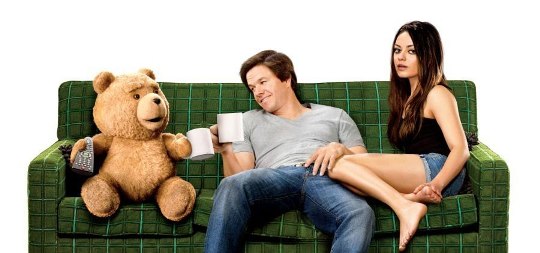
Ted is MacFarlane’s creation, a live teddy bear wished for by a young Mark Wahlberg. Wahlberg is all grown up and he and Ted remain roomies, even as Wahlberg hits year four with his luminous girlfriend, Mila Kunis. Kunis wants commitment and maturity, Ted and Wahlberg smoke dope all day and watch TV, and things come to a head when, after an anniversary dinner, the live couple come home to find Ted with a passel of hookers.

There are a few clunker lines, but for the most part, this is a very funny, very crude (Ted’s come-on to a grocery store checker is waaaaay over the top) and surprisingly sweet story of a boy and his childhood pal. I say “surprisingly” because I would have expected MacFarlane to be a little more daring. He comes close, such as a scene in the end where, after Ted has gone through a harrowing ordeal and appears to have died, he wakes up but appears to be impaired. Is Ted going to come back as a mentally disabled stuffed bear?

That’s MacFarlane – and Ted – in a nutshell.


I could only bear 20 or so minutes of this student picture.  Written and directed by Mark and Jay Duplass, this is a movie that represents the dark side of “independent” film.  Jason Segal plays a 30 year old stoner who . . . lives at home. Ed Helms plays his brother in exactly the same style as his Andy character on The Office. Their mother, Susan Sarandon, suffers them both as they are tasked to buy her wood glue.

Alas, she suffered them longer than I. The script is pretentious, the set-up uninviting, the direction (the Duplasses are addicted to an ostentatious jump zoom) self-indulgent and the plot random, all sins that cannot be expiated by deeming it “quirky.”

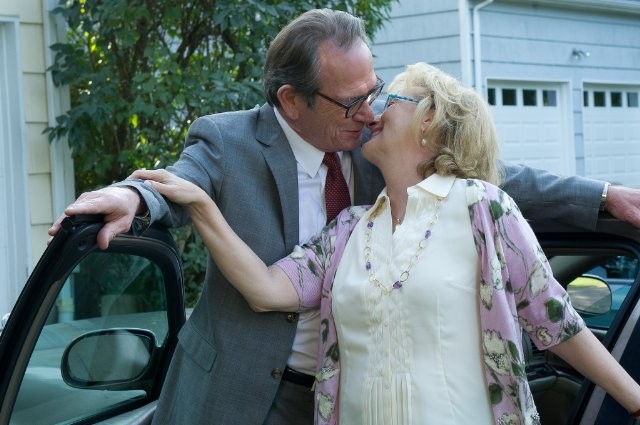
Meryl Streep is incredible, as always, flawlessly and effortlessly inhabiting the character of a repressed, unhappy Nebraska housewife, married to a removed, cantankerous Tommy Lee Jones.  She signs the couple up for a week of couples counseling in Maine under the tutelage of Steve Carell, during which their marriage is analyzed in order to fix it.

Most of their problems stem from intimacy issues.  They haven’t had sex for 4 years.  So that’s where Carell focuses.

The performances are uniformly good and the interplay between Streep and Jones is often genuinely affecting.  The film, however, becomes repetitive and ends in a cloying renewal of vows that is much too much.  The movie also features some of the worst, most intrusive and blaring pop songs to accompany emotional stretches.

Be prepared.  As I said, the central problem for Jones and Streep is sexual.  Which means frank talk about and between people I’d prefer not to think about in sexual situations.  It also has a scene of Streep trying to give Jones a blowjob in a theater, a failed endeavor. Sure, there is some humor in Streep purchasing “Sex Tips for Straight Women by Gay Men.” But watching her put those tips into practice?  Sorry, kemosabe.  Deal me out.

image

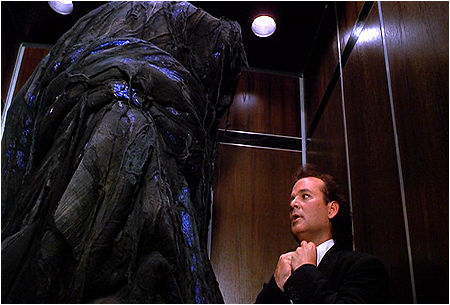
Bill Murray plays the Scrooge character, Frank Cross.  Cross, however, is not in finance, but television.   A child abandoned to the TV by uncaring parents, Cross has become a holy terror as the head of programming for a major network.  His newest achievement is a live broadcast of “A Christmas Carol” on Christmas Eve, with Buddy Hackett as Scrooge.  Cross is so cynical and mean he’s ordered the stapling of tiny antlers on to the heads of mice.  Soon, the ghosts appear.

This is a zany, funny version of the Dickens tale co-written by SNL alum Michael O’Donoghue (he communicated his loathing of the theatrical version before his death at 54) and directed by Richard Donner (who helmed all the Lethal Weapons and various and assorted dreck).  Donner has little skill save for making movies move, and this movie moves.  O’ Donoghue’s complaints aside, it’s also often very clever, propelled by Murray’s manic and humorous descent into madness and his joyous redemption.  It’s big, messy, all-over-the place, and excessive (which is kind of the point) but great fun.

Writer/director Martin McDonagh’s first feature is assured, intelligent, and deviously funny.  Two Brit hitmen, Ken and Ray (Brendan Gleeson and Colin Farrell) are exiled to Bruges in Belgium by their crime boss Harry (Ralph Fiennes) after Farrell cocks up his first job (a priest) and accidentally kills an altar boy.  What starts as a languorous wait, with Gleeson fascinated by the history of the town and Farrell bored to tears, becomes tense and edgy after Gleeson is given his next assignment (guess who?) and Farrell becomes more and more despondent over what he has done.  The duo sightsee, drink, do drugs and discuss morality, fate, death, religion, Americans, beer and various and sundry other topics until Fiennes comes to town to force the action.

The three leads are all very good.  Fiennes is a brutal yet charming Cockney, and Gleeson is a stoic solider on the brink of a moral epiphany.  But Farrell’s frenetic, comic-yet-tortured turn is the engine.  He’s barely a man, he’s killed a child, and he is denied any peace, having been placed in “bloody Bruges.”

A taste —

Wes Anderson’s breakout picture centers on Max Fischer (Jason Schwartzman), a sort-of prodigy, son of a barber on scholarship at the tony Rushmore Academy. Rushmore is Fischer’s domain. Not academically but in every extracurricular activity (he is President, Model UN; Founder, Bombardment
Society; Founder, Rushmore Beekeepers; Founder, Max Fischer Players; and Director, Piper Cub Club – 4.5 hours logged, to name a few).

It is natural that Max would claim the winning new teacher (Olivia Williams) as his first love. Fischer, however, finds himself in competition for her affections, first with the rich, dissolute father of
two bratty classmates, Herman Blume (Bill Murray) and then with the ghost of Wiiliams’s dead husband. Max can defeat neither, finds himself expelled, and must rise anew to atone for his selfishness and stupidity.

Following up on the promise of his debut (Bottle Rocket), Anderson made a picture quite unlike anything before it, a blend of the fables of boyhood, the adult cynicism that follows, a beautiful romance, and the tragedy of loss (Williams’ has lost a husband, Fischer his mother), all scored by
British invasion B sides. As with this year’s Moonrise Kingdom, Anderson revels in the adult as child and vice versa. The result is charming and wistful, but also heartfelt. There is something both clever and moving in exchanges where Max is earnest and Blume dry:

Max Fischer: So you were in Vietnam?

Herman Blume: Yeah.

Max Fischer: Were you in the shit?

Herman Blume: Yeah, I was in the shit.

There are numerous bravura scenes, all sharply written (the screenplay was the work of Anderson and Owen Wilson).  Fischer’s first “date” with Williams (he invites Murray as cover and Williams actually brings a real date, Luke Wilson) is an exemplar of Anderson’s melding of the comic and pathos.

Murray’s brief speech to the students of Rushmore is also noteworthy.

You guys have it real easy. I never had it like this where I grew up. But I send my kids here because the fact is you go to one of the best schools in the country: Rushmore. Now, for some of you it doesn’t matter. You were born rich and you’re going to stay rich. But here’s my advice to the rest of you: Take dead aim on the rich boys. Get them in the crosshairs and take them down. Just remember, they can buy anything but they can’t buy backbone. Don’t let them forget it. Thank you.

I also don’t think I’ve ever seen a better-scored film (Scorsese’s Casino, with the extended “Can’t You Hear Me Knocking” is close). Anderson originally wanted the entire soundtrack comprised of Kinks songs, but Mark Mothersbaugh of Devo chose a variety of classic-sounding, if not classic,
tunes. The effect is nostalgiac but a little unfamiliar, which tracks nicely with the whimsical, sometime sad story. “I Am Waiting” by The Rolling Stones is an example of an early, lesser know track where Jagger’s vocals are not confrontational and modern, but almost earlier century chamber music ala’ “Lady Jane.”  Anderson uses this track in a brilliant changing of seasons montage.  “A Summer Song” by Chad & Jeremy, “The Wind” by Cat Stevens, and “Oh Yoko!” by John Lennon are used in similar, successful fashion.

It’s may seem strange to call this an important film, but it really is.  With it, Anderson emerged on the scene as a unique storyteller.  When he showed the film to Pauline Kael, she loved it but told him, “I genuinely don’t know what to make of this movie” which strikes me as the highest of praise.  It is one of my favorite films.

https://i0.wp.com/ecx.images-amazon.com/images/I/51bfR0ArmlL._SL500_SS500_.jpg

A group of friends gets together to mourn the suicide of a contemporary. What is really being mourned, however, is their youth, which occurred during the 1960’s when they matriculated at college together.  What follows is a miasma of nostalgia, sound-tracked ironically by Motown (there is not a black, brown of tan face among them), as a group of super-successful people (even the drug dealer has a Porsche!) lament their transformation from their fantasy selves of the past (idealistic, war protesting, caring, would-be world changers) to what they have become (affluent, whiny, navel-gazing malcontents who rue their upper-tax brackets, nice homes and cars, and cushy lives).

Some offerings on their current state:

“Wise up folks. We’re all alone out there and tomorrow we’re going out there again.”

“It’s a cold world out there. Sometimes I feel like I’m getting a little frosty myself.”

“I’m sure we all think there’s a lot of good left in us.”

Only one character resonates, and then, but for a moment.  The drug dealer, William Hurt, eventually succumbs to the feel-good ooze and affirmation, but early on, as the unctuous Kevin Kline tries to connect, Hurt says one of the few adult things in the movie:

a long time ago we knew each other for a short period of time; you don’t know anything about me. It was easy back then. No one had a cushier berth than we did. It’s not surprising our friendship could survive that.”

This moment of lucidity is soon overwhelmed by gloppy, poofty, self-congratulatory schmaltz, forever to be prefaced by “the soundtrack for a generation.”

Peace and love is easy to dispense in a gorgeous, multi-million dollar mansion, owned by Kline and his angelic wife Glenn Close.  So, in the ultimate sacrifice of a suburban queen, she offers Kline’s sperm to her college buddy, Mary Kay Place, who is desperate to get pregnant.  Said sperm is to be delivered by Kline in the natural act, who is dispatched in Dick Van Dyke’s pajamas to inseminate.

Close even stands in the hallway after delivering her gift, so proud of her selflessness she positively beams.

Throwback: 'The Big Chill' | Decider

My kingdom for sounds of hard, headboard pounding sex emanating from the bedroom (“You like that?” followed by “Oh daddy, give it to me”).  Or Kline coming out into the hallway and saying to Close, “Do you mind?  We’re fu*&ing in here.”

And then Close the Good becomes the Glenn Close from Fatal Attraction, killing everyone in the house.

Alas, it was not to be.

The movie makes a virtue of overt explication of what every character is thinking.  The audience cannot be trusted to intuit their banal, narcissistic whining masquerading as some kind of higher truth.  They must be told!

The Big Chill is made worse by the fact that it isn’t even original, but rather, Lawrence Kasdan’s big-budget version of John Sayles’s The Return of the Secaucus Seven.  The picture spawned a worse copycat, even more cloying and self-satisfied, Peter’s Friends.  If you wondered what The Big Chill would be like with Brits, wonder no longer.


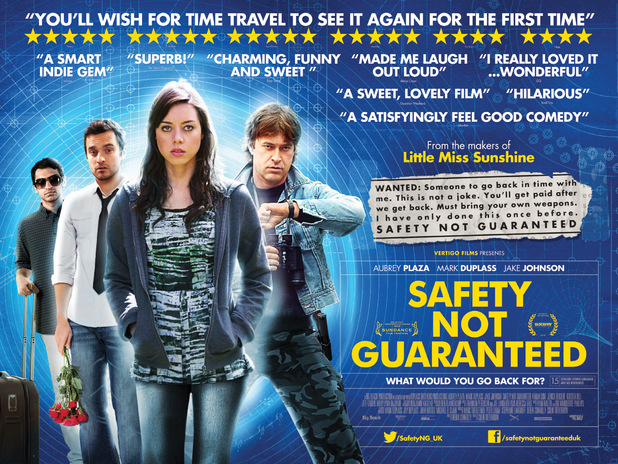
What are the chances I’d see two Mark Duplass movies back-to-back much less one I’d rate a 0 and one I’d rate a 5?  This is a sweet, whipsmart picture about three Seattle magazine employees – two interns (Aubrey Plaza and Karan Soni) and a writer (Jake Johnson) – who go to Northern California to do a piece on a guy (Duplass) who put out an ad to go back in time, looking for a companion.  The writer took the job solely to nail an old high school girlfriend he found on Facebook (Jeneca Bergere).  Plaza is along for the ride and Soni, a geeky Indian techie, only took the internship to round out his resume’.  Plaza becomes intrigued by Duplass, Johnson falls for his target, and it turns out time travel may be possible.

This is a dual story between four people looking to connect.  Duplass bonds with Plaza while Johnson and Soni engage in a mentor-mentee dance.  Best, what seems a goof assignment to write an ironic, hip piece on a quirky dude masks a couple of crises of conscience, place and purpose.

Everybody is excellent, but Johnson is particularly strong as an urban scammer who uses the story as a cover to hook up with a high school flame and realizes how empty he feels in the arms of a real woman.  She asks what he’s doing, he responds that he has an Escalade, she clarifies “no, I meant with your life” and he responds “I just told you.”

When she puts up her guard, points out the error of his idealization, and his fairy tale collapses, he runs to Soni and screams in the geek’s face to get off the Internet, away from his safety bubble and live a life.  Johnson’s character is emblematic of the maturity of the writing.  Normally, he’s the dick, the full-of-himself comic relief.  As a character, it’s an honorable job, ala’ Bradley Cooper in Wedding Crashers.  But Johnson (and really, all the characters) are given more depth in an economical fashion, making a very funny movie poignant and multi-layered.  One of the best films of the year.

Your Sister's Sister (2011) - Rotten Tomatoes

Mark Duplass (Humpday, Safety Not Guaranteed) is the brother of a recently deceased.  We meet him at the one year anniversary of his sibling’s death.  After a gentle eulogy by his brother’s friend, Duplass offers his own, explaining that his brother was a bully who only changed for the better after watching Revenge of the Nerds and realizing that the bully doesn’t get laid.  His brother’s ex (Emily Blunt) intervenes, let’s Duplass know he’s in a bad place and offers her remote family house so he can sort it out.  When Duplass arrives, he finds Blunt’s sister (Rosemary DeWitt) sorting her own issues out, having just left a 7 year relationship with another woman.

With a promisingly caustic first scene and the idea of a romantic angle perhaps immediately removed from the equation, the possibilities are momentarily intriguing.  But Duplass and DeWitt share a bottle of tequila, they have sex (she actually says “I’m game if you’re game”), and the movie craps out.   Duplass achieves orgasm in less than a minute to establish his bona fides as a regular schlub and to ensure that no connection was achieved.  Blunt, in love with Duplass, shows up.  It gets weird.

The film tries desperately to be cool, but the dialogue is stilted and humorless.  Duplass is presented as a bit of a crack-up, but he is unfunny (a sample bon mot is his observation that they go to an IHOP but will need passports), superficial, and self-involved.  Both women are crashing bores and for a romantic triangle of sorts, it is surprising how sterile and sexless they seem.

Though Duplass is desperate to keep the fact he had sex with DeWitt from Blunt, you know and hope it will out.  Anything to break the monotony, which is quite something for a 90 minute film.  These are the three most boring people in the world, characters created by the writers who pen quips traded by couples in Ikea commercials, if an Ikea commercial was sound-tracked by acoustic guitarists who play at contemporary Christian services.

The film is also amateurishly acted (Duplass is the poor man’s Ron Livingston, DeWitt is dishwater dull and Blunt one-note dewy eyed).  Is there depth under those still waters?  Most likely, just brackish, gloomy ennui.

Another criticism.  There is no lazier writing tic than the use of “fucking” before every noun, a regular staple in this film.

How I Met Your Mother is better paced and funnier and that show sucks.  This is hipster drivel without a single genuine moment.  Avoid.