Archive

Decade

Writer/director Martin McDonagh’s first feature is assured, intelligent, and deviously funny.  Two Brit hitmen, Ken and Ray (Brendan Gleeson and Colin Farrell) are exiled to Bruges in Belgium by their crime boss Harry (Ralph Fiennes) after Farrell cocks up his first job (a priest) and accidentally kills an altar boy.  What starts as a languorous wait, with Gleeson fascinated by the history of the town and Farrell bored to tears, becomes tense and edgy after Gleeson is given his next assignment (guess who?) and Farrell becomes more and more despondent over what he has done.  The duo sightsee, drink, do drugs and discuss morality, fate, death, religion, Americans, beer and various and sundry other topics until Fiennes comes to town to force the action.

The three leads are all very good.  Fiennes is a brutal yet charming Cockney, and Gleeson is a stoic solider on the brink of a moral epiphany.  But Farrell’s frenetic, comic-yet-tortured turn is the engine.  He’s barely a man, he’s killed a child, and he is denied any peace, having been placed in “bloody Bruges.”

A taste —

Wes Anderson’s breakout picture centers on Max Fischer (Jason Schwartzman), a sort-of prodigy, son of a barber on scholarship at the tony Rushmore Academy. Rushmore is Fischer’s domain. Not academically but in every extracurricular activity (he is President, Model UN; Founder, Bombardment
Society; Founder, Rushmore Beekeepers; Founder, Max Fischer Players; and Director, Piper Cub Club – 4.5 hours logged, to name a few).

It is natural that Max would claim the winning new teacher (Olivia Williams) as his first love. Fischer, however, finds himself in competition for her affections, first with the rich, dissolute father of
two bratty classmates, Herman Blume (Bill Murray) and then with the ghost of Wiiliams’s dead husband. Max can defeat neither, finds himself expelled, and must rise anew to atone for his selfishness and stupidity.

Following up on the promise of his debut (Bottle Rocket), Anderson made a picture quite unlike anything before it, a blend of the fables of boyhood, the adult cynicism that follows, a beautiful romance, and the tragedy of loss (Williams’ has lost a husband, Fischer his mother), all scored by
British invasion B sides. As with this year’s Moonrise Kingdom, Anderson revels in the adult as child and vice versa. The result is charming and wistful, but also heartfelt. There is something both clever and moving in exchanges where Max is earnest and Blume dry:

Max Fischer: So you were in Vietnam?

Herman Blume: Yeah.

Max Fischer: Were you in the shit?

Herman Blume: Yeah, I was in the shit.

There are numerous bravura scenes, all sharply written (the screenplay was the work of Anderson and Owen Wilson).  Fischer’s first “date” with Williams (he invites Murray as cover and Williams actually brings a real date, Luke Wilson) is an exemplar of Anderson’s melding of the comic and pathos.

Murray’s brief speech to the students of Rushmore is also noteworthy.

You guys have it real easy. I never had it like this where I grew up. But I send my kids here because the fact is you go to one of the best schools in the country: Rushmore. Now, for some of you it doesn’t matter. You were born rich and you’re going to stay rich. But here’s my advice to the rest of you: Take dead aim on the rich boys. Get them in the crosshairs and take them down. Just remember, they can buy anything but they can’t buy backbone. Don’t let them forget it. Thank you.

I also don’t think I’ve ever seen a better-scored film (Scorsese’s Casino, with the extended “Can’t You Hear Me Knocking” is close). Anderson originally wanted the entire soundtrack comprised of Kinks songs, but Mark Mothersbaugh of Devo chose a variety of classic-sounding, if not classic,
tunes. The effect is nostalgiac but a little unfamiliar, which tracks nicely with the whimsical, sometime sad story. “I Am Waiting” by The Rolling Stones is an example of an early, lesser know track where Jagger’s vocals are not confrontational and modern, but almost earlier century chamber music ala’ “Lady Jane.”  Anderson uses this track in a brilliant changing of seasons montage.  “A Summer Song” by Chad & Jeremy, “The Wind” by Cat Stevens, and “Oh Yoko!” by John Lennon are used in similar, successful fashion.

It’s may seem strange to call this an important film, but it really is.  With it, Anderson emerged on the scene as a unique storyteller.  When he showed the film to Pauline Kael, she loved it but told him, “I genuinely don’t know what to make of this movie” which strikes me as the highest of praise.  It is one of my favorite films.

https://i0.wp.com/ecx.images-amazon.com/images/I/51bfR0ArmlL._SL500_SS500_.jpg

A group of friends gets together to mourn the suicide of a contemporary. What is really being mourned, however, is their youth, which occurred during the 1960’s when they matriculated at college together.  What follows is a miasma of nostalgia, sound-tracked ironically by Motown (there is not a black, brown of tan face among them), as a group of super-successful people (even the drug dealer has a Porsche!) lament their transformation from their fantasy selves of the past (idealistic, war protesting, caring, would-be world changers) to what they have become (affluent, whiny, navel-gazing malcontents who rue their upper-tax brackets, nice homes and cars, and cushy lives).

Some offerings on their current state:

“Wise up folks. We’re all alone out there and tomorrow we’re going out there again.”

“It’s a cold world out there. Sometimes I feel like I’m getting a little frosty myself.”

“I’m sure we all think there’s a lot of good left in us.”

Only one character resonates, and then, but for a moment.  The drug dealer, William Hurt, eventually succumbs to the feel-good ooze and affirmation, but early on, as the unctuous Kevin Kline tries to connect, Hurt says one of the few adult things in the movie:

a long time ago we knew each other for a short period of time; you don’t know anything about me. It was easy back then. No one had a cushier berth than we did. It’s not surprising our friendship could survive that.”

This moment of lucidity is soon overwhelmed by gloppy, poofty, self-congratulatory schmaltz, forever to be prefaced by “the soundtrack for a generation.”

Peace and love is easy to dispense in a gorgeous, multi-million dollar mansion, owned by Kline and his angelic wife Glenn Close.  So, in the ultimate sacrifice of a suburban queen, she offers Kline’s sperm to her college buddy, Mary Kay Place, who is desperate to get pregnant.  Said sperm is to be delivered by Kline in the natural act, who is dispatched in Dick Van Dyke’s pajamas to inseminate.

Close even stands in the hallway after delivering her gift, so proud of her selflessness she positively beams.

Throwback: 'The Big Chill' | Decider

My kingdom for sounds of hard, headboard pounding sex emanating from the bedroom (“You like that?” followed by “Oh daddy, give it to me”).  Or Kline coming out into the hallway and saying to Close, “Do you mind?  We’re fu*&ing in here.”

And then Close the Good becomes the Glenn Close from Fatal Attraction, killing everyone in the house.

Alas, it was not to be.

The movie makes a virtue of overt explication of what every character is thinking.  The audience cannot be trusted to intuit their banal, narcissistic whining masquerading as some kind of higher truth.  They must be told!

The Big Chill is made worse by the fact that it isn’t even original, but rather, Lawrence Kasdan’s big-budget version of John Sayles’s The Return of the Secaucus Seven.  The picture spawned a worse copycat, even more cloying and self-satisfied, Peter’s Friends.  If you wondered what The Big Chill would be like with Brits, wonder no longer.


A vehicle for the skills of a host of accomplished Brit actors, this movie starts out swift and charming, as we watch our leads end up in India at a run-down retirement hotel that looked a helluva lot better in the brocuhure.  Judi Dench is recently widowed; Tom Wilkinson, fed up, abruptly resigns his judgeship; Bill Nighy and Penelope Wilton have had to scale down their retirement plans after an investment in their daughter’s internet company went bad;  Maggie Smith needs a hip replacement and can get it quicker in India; and Celia imrie and Ronald Pickup are fighting aging and simply along for the ride.  Directed ably by John Madden (Shakespeare in Love), the set up is deft and the upcoming culture clash looks to be fun.  Okay.  Love Actually for old people, right?

Instead, the film takes itself way too seriously.  The Nighy-Wilton union is crumbling.  Dench is regretful of her long-term marriage.  Wilkinson has a deeper secret underlying his removal to India.  Smith’s tale is even more woeful.  What seeemed a light comedy turns into a morose trek.  Even the comic relief (Slumdog Millionaire’s Dev Patel, who runs the hotel) has his own crucible – he must stand up to his mother and choose the one he loves (all with the help of some sound Brit advice).

The actors are really all very good, and they are elevating pedestrian material (not a thing happens that you haven’t guessed).  The resolutions are absurdly convenient and it ends sickeningly cloying.  Unlike Slumdog, the India portrayed here is all sweetness and dazzle, if a little crowded, and the Indian actors are given that child-like nobility that always comes off as condescending.   

The last 15 minutes is so rushed in its effort to provide a tidy, happy ending, it feels damn near like the entire endeavor was trying to make a flight.

It is in vogue to denigrate Will Ferrell, whose excess has long outlived its freshness. He’s slogged into one tiresome, repetitive project after another. Land of the Lost? A one-man show portrayal of George W Bush, The Other Guys, Casa di mi Padre, The Campaign, and soon, a repeat, Anchorman: The Legend Continues. His forays into a successful Jim Carrey-like branch-off started with promise (Stranger than Fiction) but his dramatic weaknesses were apparent in Everything Must Go. His last goofy semi-triumph was Step Brothers, which owed as much to the supporting efforts of the scene-stealing, diabolical Adam Scott and the inspired premise as to Ferrell’s adolescent sincerity as the arrested man-child, Brennan Huff.

Let us not forget, however, that when Ferrell was on a roll, it was an impressive one – Old School, Elf, Anchorman, Wedding Crashers . . . all a variation on the man-child theme, but classics nonetheless.

At the end of Ferrell’s run is Talladega Nights, the last hurrah, but what a hurrah.  Ferrell plays Ricky Bobby, an ignorant, flashy, uber-American NASCAR driver with a hot blonde wife (Leslie Bibb), a loyal race car compadre (John C. Reilly) who loves Ricky so much he happily takes second in every race, two horrific kids (Walker and Texas Ranger) and a gay French nemesis on the track (Sacha Baron Cohen). When Ricky is on top, it looks something like this:

When it all goes to crap after a brutal wreck, Ricky must re-connect with the itinerant father who abandoned him as a child (Gary Cole) and his old-school mother (Jane Lynch). With their help, and the help of a loyal, starstruck flunky (Amy Adams), Ricky regains his mojo and lives the VH1 comeback before our eyes.

The gags are inspired, the back-and-forth (much of which has to be improv, as evidenced by the bloopers in the credits) crackles, almost every supporting character delivers well (Molly Shannon as the boozehound wife of a corporate slime is particularly prime), and the chemistry between Ferrell and Reilly, which was very good in Step Brothers, is undeniable. After Ricky loses his nerve and then all, Cal replaces him, setting up in Ricky’s house and with his wife. But they do miss each other:

It’s uproarious, loaded with gem slogans (“If you ain’t first, you’re last”) and has as much fun as you can have with American excess. Even as silly an endeavor as this could have come off condescending and mean to “those NASCAR types” but Talladega Nights feels wholly respectful even as it goes to town on its target.

Me and my boy are scheduled to see The Who playing Quadrophenia from beginning to end next week, so we prepared by watching Franc Roddam’s directorial debut, a story of a miserable 1960s London “Mod” (Phil Daniels) eternally at war with his parents, his job, the girl he fancies, rival “Rockers” and all that bourgeois b.s.

Daniels is a punk, through and through, and increasingly, it appears he is mentally disturbed.  He either laughs goofily or snarls, and at no point do we feel empathy for his not particularly difficult plight.  He has a job, a super cool Vespa, a gang of friends who are pleasant and tepid, and a fondness for readily available pills.  His life is also soundtracked to The Who, fer crissakes (poorly, though – it’s clear the director didn’t know how to fit the music into the film and with the exception of the final scene, the musical contribution of band is distracting rather than evocative).

There are some charms to the movie.  It was filmed on location in London and Brighton and the final scene (where Daniels either kills himself or he doesn’t) is a pretty impressive (though overlong) helicopter shot of a precarious ride along the Brighton cliffs.

If you look close, you’ll also see a boatload of very young Brit actors who went on to solid careers, including Tim Spall, Ray Winstone, and Phillip Davis.  It’s a shame one of them didn’t get the lead, because Daniels appears to have been chosen solely for his likeness to Pete Townsend.

Sting is also featured.

Almost Famous - Movies on Google Play
Based on writer/ director Cameron Crowe’s experiences touring with rock bands like Poco, The Allman Brothers and Led Zeppelin,
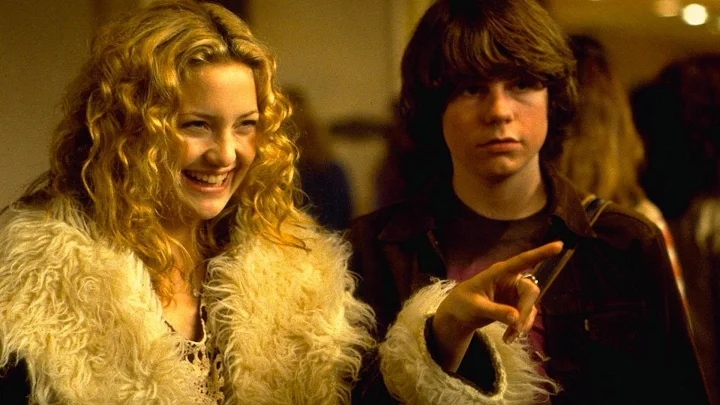
Almost Famous gives us Crowe stand-in Patrick Fugit, a 15 year old rock fan who writes for his school newspaper and a San Diego alternative mag.  His work garners the attention of Creem magazine and its famed rock critic Lester Bangs (Phillip Seymour Hoffman).  Bangs tutors Fugit, who gets an assignment from Rolling Stone to cover rising band Stillwater, fronted by the suspicious and bloviating Jason Lee and the more talented and enigmatic guitarist Billy Crudup.  As Fugit is ensonced with the band on the road, he is charmed by groupie (or, Bandaid) Kate Hudson while his mother (Frances McDormand) monitors his trip via regular phone calls.  Fugit falls in love with Hudson, who is in love with Crudup and considers herself a muse to both.

The film is unabashedly nostalgiac, particularly the scenes of McDormand allowing and then regretting letting her son go on the road with the band.  McDormand is a conflicted personality, half free spirit, half overbearing “DON’T DO DRUGS” nag.  But her affection for her child is undeniable and as she sees him grow up, their distance becomes more painful.  Worse, she intuits he has found a new family (all of whom assure her when she calls that she has raised a wonderful boy while raising the specter that he is being plied with sex, drugs and rock and roll).

This is a fan’s movie, interspersing great 70s rock with a coming of age tale.  Fugit evokes the awkward, sweet nature of a 15 year old lovestruck boy and his performance is beautifully sentimental.  Crowe shows no fear of the maudlin which is for the most part to the film’s advantage.  When the band and its coterie, breaking apart due to various strains on the road, spontaneously sing Tiny Dancer on the tour bus, you can imagine eyes rolling after reading the scene.  But it works perfectly, all part of Crowe’s love letter to rock.

This is not to say that the film never missteps.  It is occasionally too cute, a Crowe weakness.  At one point, Hudson tells Fugit, “You’re too sweet for rock and roll” as if it needed to be said.  Crowe then makes him prove it.  Hudson, despondent over Crudup’s rejection of her, overdoses on Quaaludes.  Fugit saves her and as she gets her stomach pumped before his eyes, he remains starstruck, mooning as she vomits (Stevie Wonder’s “My Cherie Amour” plays in the background).   In another scene, the band plane appears to be going down, and the members all trade simmering accusations and long held secrets, which feels pat and forced.

But by and large, the film’s tone is just right, evoking the memories of your first LP and the moments when your mother actually read the lyrics on a record sleeve and took it away.

There are also laugh out loud moments, my favorite being Lee’s first interview with Fugit, where he waxes poetic on rock:  “Some people have a hard time explaining rock ‘n’ roll. I don’t think anyone can really explain rock ‘n’ roll. Maybe Pete Townshend, but that’s okay. Rock ‘n’ roll is a lifestyle and a way of thinking… and it’s not about money and popularity. Although, some money would be nice. But it’s a voice that says, ‘Here I am… and fuck you if you can’t understand me.’ And one of these people is gonna save the world. And that means that rock ‘n’ roll can save the world… all of us together. And the chicks are great. But what it all comes down to is that thing. The indefinable thing when people catch something in your music.”

When the quote makes the article, his response is priceless:  “Rock ‘n’ roll can save the world”? “The chicks are great”? I sound like a dick!”

Midnight Screaming: Dawn of the Dead (2004) | The Long Take

AMC’s The Walking Dead is successful in part for its visceral presentation of a dystopian United States where calamity has not only brought the dead to life, but those dead have pretty much overrun the country.  Even more disturbing, our cast of characters has learned that all living people carry the virus that will make them zombies hungry for flesh after they die, and that only a post-zombification destruction of the brain can stop their lust for humans.

Still, zombies in The Walking Dead are slow, near catatonic (though, like me passing a Chick-fil-A, they get more animated when near a meal).  If you stay in an open space or avoid them in bunches, you should be fine.  These zombies are like the walking dead in George Romero’s Dawn of the Dead (1978).  Don’t get in an elevator without knowing what’s on the other side of the door and you should be okay.

This is a trial for the show’s writers, who have to continually come up with scenarios where the protagonists and the zombies must come to close quarters (i.e., the group just wrangled with hundreds trying to clear them out from a prison that, if habitable, will be the perfect fortress).

No such problem for Zack Snyder’s (300, Watchmen) unappreciated remake of Romero’s film.  Nurse Sarah Polley and her husband wake up to see a little neighbor child at the foot of their bed.  Awww.  Sally is sleep walking again. Nope.  She’s a zombie and she’s fast and she strikes like lightning.

And away we go.  The zombies are like bullets, carbon copies of the victims of “the rage” in Danny Boyle’s 28 Days Later.  The decision is brilliant, because now, it becomes plausible that zombies actually took over the world (a ridiculous notion if, to become zombies, they had to die, and then get up and move about at the speed of latter years Andy Griffith).  A motley crew of survivors, including Polley, Vingh Rames as a cop, Mekhi Phifer as a hood, Jake Webber as the conscience, and an impressive Michael Kelly as the security guard who traverses from self-interested and greedy to semi-heroic, hole up in the mall.  All is well until they try and help a man they can see from their binoculars and it goes poorly, to say the least.  What follows is a harrowing escape from a their breached fortress.

First time director Snyder makes his mark at the outset with an introduction showing the breakdown of society as scored by Johnny Cash

It’s a helluva a ride and has numerous touches that elevate the material.  I’ll list three.  First, the film has the guts to show us what happens to a baby in the womb if that womb belongs to a zombie.  Second, it can be very funny, one such moment being target practice on the top of the mall that becomes a competition to shoot Burt Reynolds:

Third, it features my favorite zombie ever

Ty Burrell of Modern Family.

EBFDF7B9-9AE9-4195-8CD8-70BF9A2C66AB
Any film where the director kicks the Jesuitical screenwriter off set because the latter wants the film to be unequivocal in its conclusion that God triumphs over Satan is bound to be unique. As that screenwriter William Peter Blatty observed:

Like so many Catholics, I’ve had so many little battles of wavering faith over the course of my life. And I was going through one at that time. And when I heard about this case and read the details, that seemed so compelling. I thought, my God, if someone were to investigate this and authenticate it, what a tremendous boost to faith it would be. I thought, someday I would like to see that happen. You know, I would like to do it . . . the research into it affected me. And the novel, it very much strengthened my faith.

Director William Friedken had other ideas.

The film opens near an archaeological dig in Iraq. There, Friedken depicts a harsh and poverty-stricken world, where the blind are led by starving children, a widow grieves inconsolably, people work in small foundries like toilers in a fiery, oppressive Hell, and Father Merrin (Max Von Sydow) receives a sign that he will soon be meeting Satan.  We are then transported to Washington, D.C., where another priest – Father Karras (Jason Miller) – is in a modern Hell.  He is counselor to unsure and shaken Catholic priests.  He tells one, “There’s not a day in my life when I don’t feel like a fraud.” To another, “I think I’ve lost my faith.”  Karras’ mother is in her own nightmare, 1970s New York City.  She needs care, she lives in a slum, and Karras is wracked with guilt over her abandonment.

Friedken masterfully portrays the connection between a society sick by sin and the infestation of one little girl, Regan McNeil (Linda Blair), the daughter of a Hollywood actress (Ellen Burstyn) filming on location in D.C.  As Regan’s personality changes, she undergoes rigorous medical procedures (an arteriogram and a pneumoenchephalogram, to name two) that are graphic and invasive, as well as psychological probing (way before its time, the film has a doctor extolling the virtues of Ritalin).  Her father forgets to call her on her birthday, pointing up the damage of divorce.  Regan is alone and left to play by herself and eventually, an imaginary friend, in a foreign town and a rented townhouse.  She is the quintessential “modern” child.

Other characters are also on the point of a knife.  Father Karras nears breakdown after the death of his mother yet he continues to counsel other priests sick at heart and doubting of faith. The director of Burstyn’s “film in the film” (Jack MacGowran) is a lonely drunk cursed by memories of the Holocaust who scathingly brands Burstyn’s housekeeper of Germanic descent a closet Nazi.  Everything and everyone seem rife with wrong and discomfort, raw and vulnerable. Von Sydow is nothing less than a condemned man, awaiting his confrontation with Satan and dependent on nitroglycerin pills for his ailing heart. 

As Regan descends into the throes of possession, Friedken and Blatty smartly turn the world on its head: the physicians, once cocky, can offer Burstyn only the Jesuits, but only because a symbol of God might suggest salvation to Regan, the idea of faith, of course, being ridiculous. And when Regan talks to Karras (himself an Ivy League trained psychologist), the priest immediately sends her back to the doctors and recommends the child’s institutionalization. This is what modernity does when confronted by evil – denies it or locks it away. Friedken’s reservations aside, Blatty gets his morality play.

But it’s a morality play encased in a thrill ride. When the nature of Regan’s torment can no longer denied, and her abuse progresses, Friedken uses all means at his disposal to discomfort the viewer, from the foul, such as the vomit and green goo and the masturbation-with-crucifix (Blair had a stunt double who was used in the disturbing sexual scenes, for those who may have been wondering – double or no, it is still quite a shock to see a little girl utter the abomination “Let Jesus fu** you, let him fu** you”) to the subtle (the use of subliminal cuts, as when Father Karras dreams of his mother and sees a death mask and then, the same mask is overlaid on Regan’s face during the exorcism).  Friedken also had the set dropped to below freezing by placing a restaurant air conditioner across the top of the set, which he then ran all night. The effect on the actors is stunning – their fear is enhanced by physical cold and the steam of breath is another frightening component.

Understandably, Blatty fretted over Friedken’s depictions: “A large section of the audience probably came because something that shocking and vulgar could be seen on the American screen. Bill Friedken always said that would be the case; that they would come to see the little girl masturbate with the crucifix . . . At the time I didn’t believe it; I thought he was destroying the film. But when I perceived that he was absolutely right, I thought it was terribly depressing.”

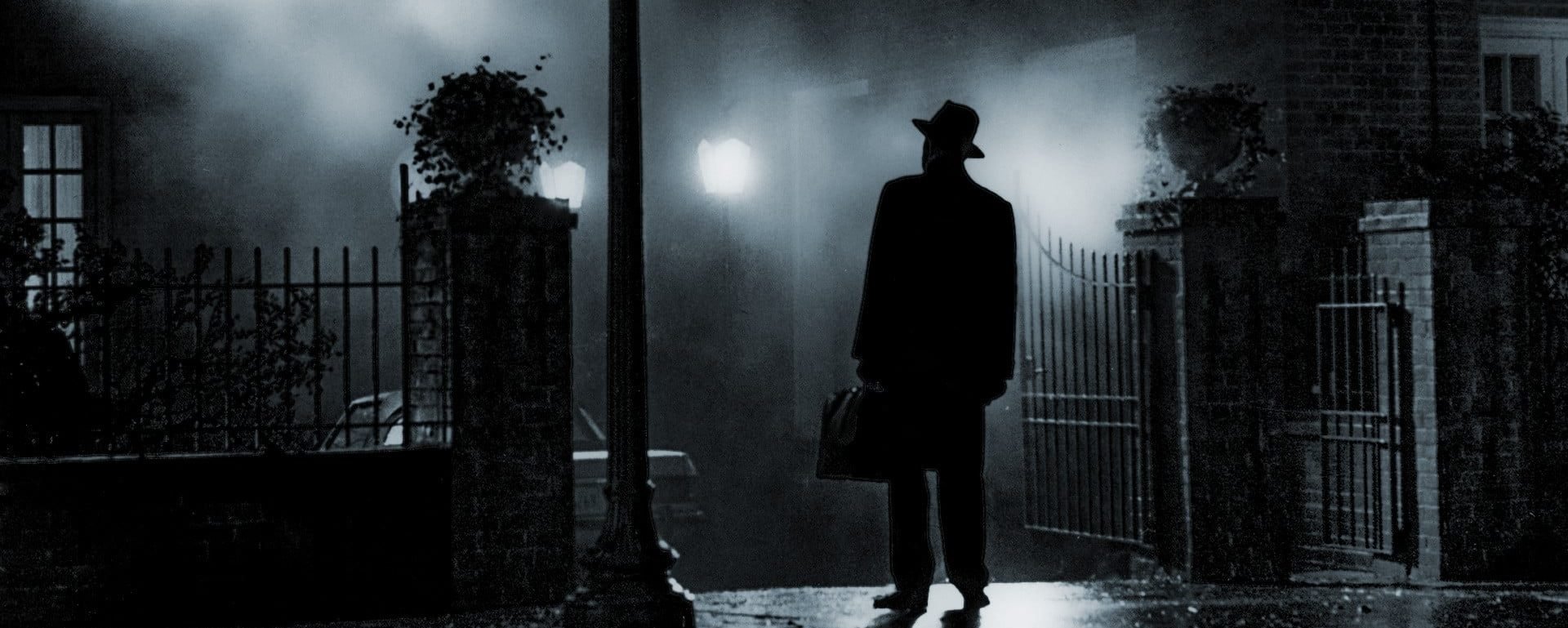
Friedken, however, is not only a showman, he’s a damn good one. He sets one spooky scene after another, constantly tracking his characters slowly in a manner that feels as if they being enveloped … by something. Burstyn’s walk home from a film shoot in Georgetown, where she witnesses Karras furtively counseling one priest and then passes two nuns with the wind whipping their garb, lends an eerie sense of the foreign and the what is to come.  Much of the camera work is elegant tracking and slow zooms, soon to be punctuated by the occasional hand-held jolt (mostly, when characters are rushing to Regan’s room). The effect lulls the viewer, making the terror – when it occurs – all the more shocking.

Friedken understood that the spinning head was important but not as important as verisimilitude: “It’s set in the real world, with characters who are portrayed as humanly possible. So I think that the fact the story is portrayed realistically is what disturbs people about the events in it.”

The performances are poignantly measured, just on the edge of documentary. The film should be a Hollywood treatise on the exposition of minor characters. Blair is sweet and gentle as needs be, until – with the help of a stunt double, the guttural voice of Merecedes MacCambridge and various pulleys – she transforms convincingly into a leering, goading demon. Burstyn presents as a pampered star and mother at the end of her rope, but she grows to a hardened, more simple warrior. Von Sydow is appropriately ghostly as the doomed Father Merrin. McGowran and Lee J. Cobb are memorable as the murder victim and the murder policeman. Cobb’s gentle interrogations of Karras and McNeil are the kind of quiet respites necessary for such a tense film. Cobb also represents the skeptic and a rebuttal to any sense of despair. He is, after all, steeped in the evil that men do.  But he is also kind and supportive, looking for an autograph from Burstyn and a friend in Miller. His supporting performance is one of my favorites in all of film.

 The great turn, however, belongs to Miller (a playwright who succumbed to drink and never really did much as an actor after The Exorcist). His is a tortured existence, filled with doubt. His trepidation shows in his eyes. Physically, Miller plays as a man who fears his weakness is obvious to all, so he shrinks into himself so as not to be noticed. Merrin and Karras act like a men who know Satan is looking for them. The difference is that Merrin knows what is coming and solemnly accepts it. Karras thinks he can hide, and that is why he is so compelling. Friedken almost always films Miller hunched over, or huddled in talk, or sitting down, or crouched, or in a crowd, accentuating his need to be anonymous.

In the end, despite the tension between  Friedken and Blatty, the latter need not have worried. The film is a clear triumph of good over evil.  To save Regan, Karras defies the devil, “Come into me! Come into me!” The devil obliges, and for a moment, it looks as if Satan/Karras will kill Regan. Karras, however, summons his faith and hurls himself out of the window. He is given last rites, and later, a recovered Regan (having no memory or the possession) sees a priest and kisses him.

The Exorcist is a great popcorn flick but also a cinematic declaration that palpable, defined evil exists. It is an ultimate rejection of moral relativism, a harsh check on modern mores and technological advances. It is also, despite its slick sophistication, religious.  After all, you cannot really find “good” or “justification” or “well, sure . . . but” in Satan. There is no bargain, even as Burstyn asks a herd of befuddled doctors “You’re telling me that I should take my daughter to a witch doctor?” The answer is, yes, there is no modern skate or help for you. And Friedken, the carnival barker, effectively shows you just how frightening and insidiously entertaining Satan can be.

A closing note: Blatty wrote The Exorcist many years after attending Georgetown University in Washington, D.C.  One of his inspirations was newspaper reports of a real life exorcism of a boy in Mt. Rainier, Maryland.  That boy went to my high school, and you can read about his story here — http://www.strangemag.com/exorcistpage1.html  Enjoy.

1408 (2007) - Rotten Tomatoes

With Halloween nearing, and my son in eighth grade, the number of scary films appropriate for him to see is increasing, and he is chomping at the bit (he’s already secured a promise from me that I will take him to The Exorcist for its 40th anniversary next year).  I remembered 1408 as having been both scary and appropriate and so we watched it this weekend.  It is scary and appropriate, but on a second viewing, it is pretty weak tea,

The movie is based on a Stephen King short story, so naturally, the protagonist (John Cusack) is a writer, and not just any writer, but that certain writer whose first book was brilliant and serious and moving, but it just didn’t sell (how could “The Long Road Home” not sell?).  Cusack is James Caan in Misery, even down to the sole cigarette.  So now, embittered, Cusack writes a schlocky travelogue based on his visits to haunted hotels, inns and B&Bs.  Cusack is enticed by an anonymous invitation to spend the night in New York City’s The Dolphin Hotel, room 1408.  Despite the best efforts of its manager (Samuel L. Jackson) to dissuade him, Cusack insists, and soon, he is ensconced and psychologically assaulted.

The lead up is good stuff.  Cusack is convincingly cynical in his pooh poohing and Jackson is effectively ominous in his warnings.  Moreover, the plot is equipped with a nifty “in” to the room – Cusack’s agent (Tony Shalhoub) engaged lawyers to find a civl rights statute that prohibits a hotel from refusing to rent an available room.

But there are only so many holes that can be patched.  Cusack learns that there have been 56 deaths, both natural and unnatural, in Room 1408, and Jackson also informs him that recently, a maid went in the room and gouged her own eyes out.  Cusack doesn’t believe it, which is fine, but Jackson knows the room is a meat grinder.  How in the world could the room be made available to anyone under any circumstances?  The civil rights law wouldn’t override gutting the room, or making it a part of the hallway, or simply declaring it off limits to any renter.   And who needs to tidy up this room?

This is a failure of writing.  There are any number of ways around the “we have a haunted room but it is still available” conundrum, but first, you have to cut the body count down by 46 to make its availability to Cusack, even under threat of litigation, reasonable, and its availability to victims 15 and up plausible.

Once Cusack gets in the room, it becomes a decent fright fest, starting with a few slight tricks (chocolates on the pillow appearing magically, a creepy clock radio that only plays The Carpenters).  Ghost jumpers follow, then an unexplained slasher and soon, you name it, it happens.  The room plays on Cusack’s pain, and torments him, inevitably, with the memory of his dead daughter.

Cusack is excellent as a man fighting losing his mind, but without backstory, the movie becomes all about the visuals.  And those remain interesting only for so long.

Still, state senator Clay Davis from The Wire (Isiah Whitlock, Jr.) steals the picture in his one scene as a reluctant air conditioning repairman.  So there’s that.

Sheeeeeeeeeeeeeeeeeeeeeeeit!