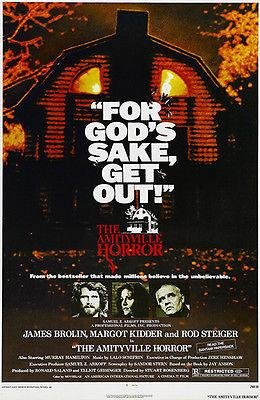
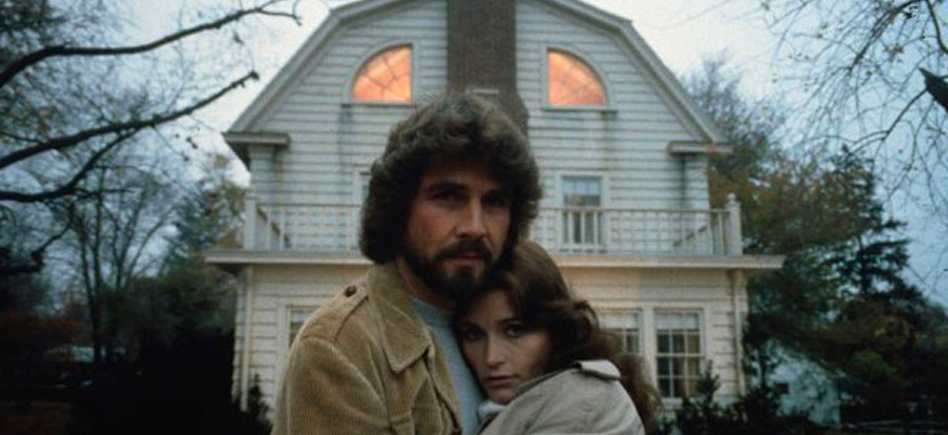
Often listed as a top picture in the horror genre, this 1979 release is rather dull and clunky. Based on a “true” story that is decidedly untrue, the Lutz’s (James Brolin and Margot Kidder) move into a cheap dream house in Long Island knowing full well a 20 year old murdered his entire family there the year before. When their local priest, Rod Steiger, comes to bless the house, the demons therein drive him out and eventually, blind him. The house soon possesses Brolin, and Kidder (and her three children) are endangered.
The house itself is awfully creepy and the score features a chilling sing-songy ghostly whisper of children’s voices. But Brolin is flat and ridiculously coiffed, even for 1979, Kidder is uninvolved, the children may as well have been mannequins, and Steiger overacts the hell out of his role.
Performances aside, the movie just isn’t that scary. Sure, flies congregate, the walls bleed, creepy eyes shine in the window, and there appears to be a guy dressed as the devil behind a wall in the basement, but these features come off about as frightening as a decently prepared house on Halloween. Director Stuart Rosenberg, who helmed some interesting films (Cool Hand Luke, The Drowning Pool) is clearly uncomfortable with the genre, and apart from some disturbing externals of the house, offers very little visually. It’s a blocky, uninteresting picture, and the ending (Brolin goes back for the dog!) is ridiculous, though not as ridiculous as when locals tell Brolin he is the spitting image of the 20 year old killer.
A funny, cynical 80s movie that holds up well, unlike, say Splash. While Dan Aykroyd is obtrusive and over-the-top as the snooty Philadelphia financier who, in the service of a sociological inquiry/$1 bet, is framed as a thief and drug dealer by his financial titan bosses and replaced by the homeless Eddie Murphy, John Landis’ picture overcomes his scene-chewing. Well, Murphy does. He is electric and inventive, Jamie Lee Curtis voluptuous and winning, and as the scheming Wall Street chieftains Duke and Duke, Ralph Bellamy and Don Ameche are having such fun it is infectious.
LANDIS: The most remarkable story, casting wise: I thought, ‘Well, I need someone who was a movie star in the ‘40s, who never has never really played a villain, and I was thinking, ‘Hey, what about Don Ameche?’ And the casting woman said, ‘Don Ameche’s dead.’ And I said, ‘I don’t think so, I would know if Don Ameche is dead.’ And so we called the Screen Actor’s Guild, and his residuals were being sent to his son in Phoenix, Arizona. And I thought, ‘Well that’s not a good sign.’ And he didn’t have an agent, and I thought, ‘Shit, goddamm, who else could we get?’ when one of the secretaries said, ‘I heard you’re looking for Don Ameche.’ We said ‘Ya.’ She said, ‘I see him all the time walking on San Vicente in Santa Monica.’
So I called information, and I said, ‘I there a Don or D Ameche on San Vicente in Santa Monica?’ And there was! So I called him. And you know he has that unmistakable voice, and you realize, Don was a huge star, in the late ’30s, definitely a big star in the ’40s — I mean he was Alexander Graham Bell for chrissakes! — a major star in the ’50s, Broadway star, radio star, movie star, television star.
And I said, ‘Mr. Ameche?’ ‘Yeeessss…?’ ‘My name is John Landis, I’m with Paramount Studios, and I’m making a film and I’d like you to consider a part.’ So I had a script sent over. ‘And could you please read this and can you come in tomorrow?’ And he said, ‘Yes.’ Would you like us to send a car?’ He said, ‘No no, I can drive.’ I said, ‘Great.’
And he came in and was prepared to read for me. I was so shocked. I said ‘You don’t have to read for me.’
He hadn’t made a movie in 14 years, he’d been doing dinner theater.
While we were shooting later in Philadelphia — he was so wonderful — I said, ‘Don, may I ask a question? How come you haven’t worked in 14 years?’ And he said, ‘Well, nobody called!’
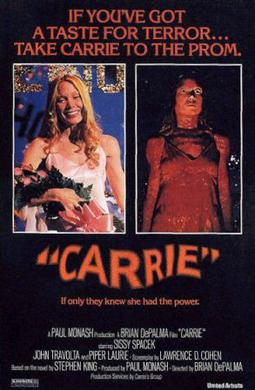
Carrie is often listed as one of the scarier films of all time (untrue) and one of the better adaptations of a Stephen King scary novel (true – in fact, The Shiningand Salem’s Lot are the only rivals). It certainly has a staying power, so much so it has spawned two remakes and a Broadway musical.
The story is simple. Untutored by her religious zealot/lunatic of a mother (Piper Laurie), Carrie gets her period in the shower after gym class, naturally freaks out and is humiliated by her classmates. When one of the more thoughtful ones (Amy Irving) tries to make amends by having Carrie escorted to the prom by her popular boyfriend (William Katt), one of the less thoughtful ones (Karen Allen) doubles down on the humiliation. Carrie, who has become increasingly aware of her telekinesis, responds, er, inappropriately.
Brian DePalma caught a much deserved rap for overly-aping Alfred Hitchcock, especially in his early films, and Carrie, his breakout picture, is Exhibit A. It opens with a shower scene, Pino Donaggio’s score is Bernard Hermann through-and-through (Hermann was supposed to score the picture but died before filming), and when Carrie uses her powers, we hear the 4 note violins of Psycho. The scene leading to Carrie’s ultimate indignity, where a bucket of pig’s blood is spilled on her head, speaks for itself (and much of Hitchcock’s oeuvre). Some mock the picture for this fealty, but there are worse directors to copy.
Hitchcock aside, Carrie stands on its own, even if some of its filler seems cheezy and dated. Laurie is riveting in her fanaticism (and her depressing prescience – they all did laugh at her), Irving and Katt offer an unheralded sweetness to the story, and the prom scene, projected with a gutsy and effective split-screen technique, is loaded with indelible, nightmarish visuals.
But the engine of the picture is Spacek, who DePalma makes downright homely and spooky. We all knew a kid like that in school. A few tormented her. A few were kind. Most ignored her, perhaps tactically, or laughed meekly when she was catching hell. Or, you just looked right through her. Spacek shows her pain and her promise, which is viciously crushed by the bullies.
So, it’s hard to root against her, even in the midst of her wanton slaughter.
Released in 2005, The 40 year Old Virgin is raucous, frank, funny, well-grounded, and fortified by the sweet lead performance of Steve Carell. Carell, a 40 year old technician at an electronics chain, is a lonely man-child, surrounded by mint-condition action figures and video games. His younger co-workers (Paul Rudd, Seth Rogen, Romany Malco) learn he is a virgin and push him out in the world so he can “bust a nut.” They each have their own theories, which are terrible, but Carell does happen upon a young grandma, Catherine Keener, and a romance develops. It all ends well in a joyous finale, a brilliant post-coital rendition of “Aquarius” and one of the finest ends to any film.
This is a roller coaster ride of potential mates (the criminally drunk Leslie Mann, the creepily seductive Jane Lynch, and the sex freak Elizabeth Banks) and inevitably disastrous consequences.
Everyone is funny, including Jonah Hill, David Koechner, Kevin Hart, and Carell’s mate from The Office, Mindy Kaling, even in the briefest of scenes. The milieu – young working stiffs in retail – also lends itself to not only hilarity derived from the vagaries of the job, but communality. The bro’ talk is sharp and true, if occasionally overdone, but is counterbalanced by Carell’s sweet humanity and earnestness.
Fast forward 7 years. Apatow is a film titan, producer of 14 movie comedies and two TV series, but director of only 3 feature films. His fourth is the execrable This is 40. Gone is the working world and the empathetic center of a lost boy. Instead, Rudd reappears in rich California suburbia, a struggling indie record company owner whose financial pressures still allow for nights away with his craven, hissing, shrewish wife (Mann) in what has to be a $1000 night oceanside resort. So much for communality.
Worse, the film is populated by unfortunate and unfunny characters. Rather than finding common cause or sympathizing in their plight, an exalted Apatow mocks them through his condescending leads. And as it all unravels, he amps up the gross-out factor to the point where Rudd is spreading his legs, demanding that Mann inspect his asshole for polyps or fissures.
I recently saw a “filmumentary” on Jaws and realized I had not reviewed the greatest summer movie ever made, an astonishing, deep blend of adventure, terror, and action, communicated by Stephen Spielberg’s great eye, the deft casting of three disparate principal actors, and a John Williams score that evokes fear and exhilaration.
Spielberg at the advent of Jaws was hardly a wunderkind. Like William Friedken before The French Connection, Spielberg had a pedestrian resume’ — a Columbo, a few TV movies and an okay feature (Sugarland Express). With a production plagued by everything from the mechanical failures of the shark to the tax problems of star Robert Shaw (if he spent more than a certain amount of time in the U.S. he would face a tax liability, so he was flown to Canada on his days off), Spielberg took Peter Benchley’s piece of summer pulp and fashioned a moving, ingenious film, evident from the opening scene credits, which give us a shark’s point of view in what is the still and peaceful deep, an image followed by the jarring, horrifying massacre of the shark’s first victim, alone, at night, where none of us ever want to be.
Like Friedken in The Exorcist, who prefaces the introduction of the demon in the child only after an hour of exposition, Spielberg waits quite some time to show us the shark in full, making what is happening beneath the water all the more frightening. Indeed, when we see the second fatality (a little boy on a raft), it is from the vantage point of a beachcomber lazing in his chair, a brief, violent act that immediately makes the viewer question, “what the hell was that?”
After Spielberg stuns the audience, he introduces them to poor Chief Brody (Roy Scheider), a landlubber from New York who marshals for the summer town of Amity, As the bodies pile up, it is Brody who succumbs to the pressure of the townsfolk dependent on summer dollars, only to be shamed by his malleability. Emboldened and in need of reclamation, Brody is assisted by the articulate and passionate wisecracker, oceanographer Matt Hooper (Richard Dreyfus) and old salt Quint (Robert Shaw). The former wants the scientific find of the century, the latter is a modern Ahab, seeking his white whale, as explained in the famous scene written not by screenwriters Benchley and Carl Gottlieb (a comic writer who presumably penned some of the very funny exchanges in the picture) , but John Milius (writer of Dirty Harry, Apocalypse Now and creator of HBO’s fantastic Rome).
The experience of the three men from their separate vantage points, with their different motives and backgrounds, is the fuel of this picture, not the shark. As good as Milius’ Indianapolis speech is, or Shaw’s monologue to the town leaders opened by his nails on a chalkboard, the scene where Shaw’s grit runs up against Dreyfus’s privilege and Scheider’s quiet authority is better:
HOOPER You’re going to need an extra hand…
Quint turns to see this new voice, and starts walking towards him.
BRODY This is Matt Hooper…
QUINT I know who he is…
BRODY He’s from the Oceanographic Institute.
HOOPER I’ve been to sea since I was 12. I’ve crewed three Trans-pacs —
QUINT Transplants?
HOOPER — and an America’s Cup Trials…
QUINT I’m not talking about day sailing or pleasure boating. I’m talking about working for a living. Sharking.
HOOPER And I’m not talking about hooking some poor dogfish or sand shark. I’m talking about a Great White.
QUINT Are you now. I know about porkers in the water — (throws him some rope) Here. Tie me a sheepshank.
Hooper ties the knot effortlessly.
HOOPER I don’t need to pass basic seamanship.
QUINT Let me see your hands…
He takes Hooper’s hands in his own big bloody fists, and feels them as he talks.
QUINT Ha. City hands. You been counting money. If you had a $5000 net and $2000 worth of fish in it, and along comes Mr. White, and makes it look like a kiddy scissors class has gone to work on it and made paper dolls. If you’d ever worked for a living, you’d know what that means.
HOOPER Look, I don’t need to hear any of this working class hero crap. Some party boat skipper who’s killed a few sharks…
BRODY (interrupting) Hey. Knock it off. I don’t want to have to listen to this while we’re out there…
QUINT What do you mean ‘We…?’
BRODY It’s my charter. My party.
QUINT All right, Commissioner. But when we’re on my ship, I am Master, Mate and Pilot. And I want him… (indicates Hooper) …along for ballast.
BRODY You got it.
During shooting, Shaw rode Dreyfus very hard, making fun of everything from his star status, stature and his ethnicity. Any hostility was used to great effect on-screen.
As good as these three actors are, they are more than ably supported by Lorraine Gary (as Brody’s wife), Murray Hamilton (as the oily mayor) and a boatload of locals who lend the film a great air of authenticity. Again, kudos to the script, because it allows dignity for Hamilton in the aftermath of his grave error, when, shaken at the hospital, he says to Brody, “Martin . . . my kids were in that water too.”
Finally, Williams’ score is a mixture of dread and adventure, the simplicity of dark repetition (“duh, nuh . . duh, nuh . . . dun dun dun dun dun dun dun”) followed by a near-swashbuckling romp as the men seek their quarry.
I never tire of this film and always find some new marvel or nuance when I watch it. If only the Hollywood shit that is shoveled in summer these days could sport 1/10 of the chops of Jaws, the town wouldn’t be losing its shirt.
Martin Scorsese’s sprawling, excessive period piece, set in The Five Points of Civil War era New York City, is almost punishing in its immoderation. A directionless Leonardo DiCaprio works his way up the ladder of nativist gang chieftain Bill “the Butcher” Cutting (Daniel Day Lewis) to avenge the death of his father, Liam Neeson, who died at Cutting’s hand when DiCaprio was a boy. Scorsese sought to offer a steamy, vibrant and bloody portrait of the slum that was lower central Manhattan, but the feel is inauthentic and verisimilitude is overcome by the garish. The opening scene – the gang fight resulting in Neeson’s death – plays as a mash up of Walter Hill’s The Warriors and a really violent version of West Side Story. You almost expect Neeson to sing, “The Dead Rabbits are gonna’ get their way, toniiiiiight!” as he brings his crew to battle.
If only. The story is deathly dull, duller even than the featured Cameron Diaz, horribly miscast as an Irish lassie/grifter (her accent comes and goes like the viewer’s interest).
Day Lewis’s performance is widely lauded and he was nominated for a best actor Oscar, but he is so over-the-top as to appear foolish. Still, scene-chewing is bound to garner easy accolades, and Day Lewis is voracious. More surprising are the nominations of the phlegmatic script and Scorsese’s aimless helming. The film meanders, half-heartedly committing to DiCaprio’s vengeance but then veering into historical re-creation, such as the machinations of Boss Tweed and the draft riots. The former plot line is marred by DiCaprio’s sullen, disinterested performance, the latter by pat conclusions (including a pretentious morphing of old and new Manhattan that closes the film and nearly induces the gag reflex).
By the time Gangs of New York was released, Scorsese had suffered the indignities of having his classic Raging Bull lose to the tepid Ordinary People and Goodfellas go down to the overpraised and politically acceptable Dances with Wolves and certainly, the Academy felt bad about that. But guilt is a bad adviser, and this is Scorsese’s worst film (though the dull and similarly overpraisedHugoand the bruising Shutter Island are close seconds).
Was John Wayne being an old Green Beret stick-in-the-mud when, after seeing High Plains Drifter, he wrote to its director and star Clint Eastwood, “This isn’t what the West was all about. That isn’t the American people who settled this country”?
Wayne was never a lover of nuance, and he had little patience for depicting the darker side of the American psyche, as is evident from his evaluation of another film: “High Noon was the most un-American thing I have ever seen in my whole life. The last thing in the picture is ol’ Coop [Gary Cooper] putting the United States marshal’s badge under his foot and stepping on it. I’ll never regret having run [screenwriter Carl Foreman] out of this country.”
Eastwood second directorial effort was released in 1973, and he wasn’t interested in Wayne’s myth. It was a time of callous selfishness and a vicious appraisal of the institutions so revered by Wayne, hardly the environment for an uplifting Western about the strong stock of the frontier.
Eastwood’s story of a drifter returning incognito to the town that ran him out via a brutal whipping is assured (he was clearly taking mental notes when directed by Sergio Leone and Don Siegel with this bizarre, even trippy revenge flick). It is also supremely cynical. Nearly everyone in the town is guilty of either directing the whipping or standing by when it happened, frauds and cowards all, and these villains unwittingly give Eastwood a run of the place so he’ll protect them from the very same thugs (newly released from prison) the town set on Eastwood. Eastwood enjoys the power, as well as sticking it to townsfolk for their hypocrisy, per this exchange with a preacher upbraiding Eastwood for evicting people from the town hotel:
PREACHER You can’t turn all these people out into the night. It is inhuman, brother. Inhuman!
EASTWOOD I’m not your brother.
PREACHER We are all brothers in the eyes of God.
EASTWOOD All these people, are they your sisters and brothers?
PREACHER They most certainly are!
EASTWOOD Then you won’t mind if they stay at your place, will ya?
PREACHER All right, folks, let’s go. Put your bags here. Friends, don’t worry. We shall find haven for you in our own homes… and it won’t cost you one cent more than regular hotel rates.
But let’s not dismiss that old fuddy duddy Wayne out of hand. High Plains Drifter is also groundbreaking in a different, uglier way. Eastwood’s character rapes a woman in the first 15 minutes of the film, yet his status as the anti-hero is none the worse for wear. While she was a complicit bystander in his whipping, even cheering, when she tries to shoot Eastwood (and misses), he asks, “I wonder why it took her so long to get mad?” to which a character replies, “Because maybe you didn’t go back for more.”
Compare and contrast Wayne: “I want to play a real man in all my films, and I define manhood simply: men should be tough, fair, and courageous, never petty, never looking for a fight, but never backing down from one either” and you can better understand his distaste.
This 1974 documentary is devoid of voicever narrative, alternating between footage of the Vietnam War, news footage of the era, anti-communist propaganda documentary clips, movie clips, and interviews with ordinary American citizens, Vietnamese villagers, American soldiers and policymakers. The thrust of the documentary is that the conflict was precipitated by a racist, warrior society (high school football being an engine of the former malady), a hysterical fear of communism, and a hubristic, imperial policy. It is skillful, affecting and pernicious, simplifying a complicated reality with editing that feels deceptively selective. Worse, because it is comprised of raw footage and heartfelt interviews, it presents as an honest portrayal. As Roger Ebert noted, “Here is a documentary about Vietnam that doesn’t really level with us … If we know something about how footage is obtained and how editing can make points, it sometimes looks like propaganda … And yet, in scene after scene, the raw material itself is so devastating that it brushes the tricks aside.”
An example: interviews with American bombers, where we never hear the documentarians, but it is clear the answers of the fliers have been elicited by questions about the experience, followed by footage of Vietnamese peasants, who are asked to recount the effect. I imagine most viewers would deem this strategy hunky dory, but the effect is to create an easy falsity-our boys dig on the need for speed and the kick-ass of it all, encased in their imperialistic manned drones, while the carnage below them escapes their notice. Indeed, I saw this storyline on an episode of M*A*S*H.
Another: the treatment of the policymaker interviewees. The anti-war Senator Fullbright and Daniel Ellsberg are edited as erudite, comprehensive and certain, and Ellsberg is even filmed breaking down recounting the assassination of Robert Kennedy. Walt Rostow’s contribution as selected is halting, petulant and confused. William Westmoreland seems near-sandbagged, even in a sit down interview.
Finally, if there is a patriotic rally or demonstration, the filmmakers always find the most extreme commenter, generally dressed up in a historical costume to punctuate his inevitable, “America, love it or leave it!”
This film is the father to the staged propaganda of Michael Moore, saying less about the subject matter and everything about how the filmmakers want you to feel about the subject matter (it is an indictment of Moore’s skills that he must insert himself as the center of his films to hammer home his points). In that manner, it is comprehensive, a cinematic Cliffs Notes to the most basic conventional wisdom about the conflict.
The picture was also clearly influential on Oliver Stone’s Platoon and Born on the Fourth of July and Stanley Kubrick’s Full Metal Jacket.
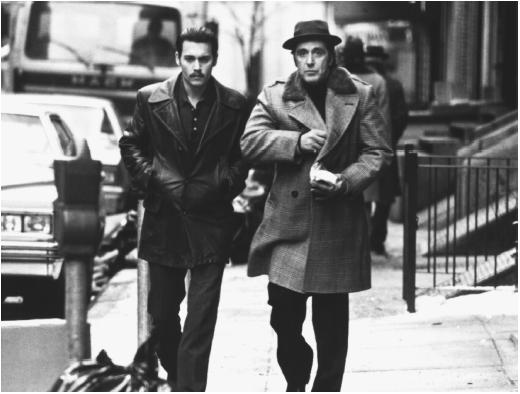
A year or so before The Sopranos, Mike Newell’s Donnie Brasco offered a glimpse of the series with this sharp, “deep cover” mob flick, alternatively brutal and funny, and at the end, touching. Donnie Brasco (Johnny Depp) is actually FBI agent Joe Pistone, who goes undercover to break a mob crew led by Michael Madsen. His entree is provided by a lower-level made guy, Lefty (Al Pacino), who vouches for Donnie, shows him the ropes, and, as Donnie loses his moorings and allegiances (to both the FBI and his suffering wife, Anne Heche), becomes a father figure.
Paul Attanasio’s (Quiz Show, Disclosure, and several episodes of Homicide: Life on the Street) script is tight and playful. We get harrowing scenes where Donnie is conscripted to dispose of a body via hacksaw or merely nearly found out:
These scenes are followed by amusing vignettes of what mobsters do on vacation in Miami (water slides, burying colleagues in sand, bad tennis) or the everyday humdrum of the criminal life, stealing boxes of steak knives or parking meters. Attanasio even includes a wry stab at marriage counseling between Depp and Heche. David Chase would do the same thing for Tony and Carmella Soprano a few years latter, to similar tragicomic effect.
As Donnie becomes enmeshed in his crew, the audience becomes invested in their survival, if not from the FBI, from rival mob crews. Depp sells this kinship very effectively. This was one of his first major dramatic roles and he shows a depth and darkness that is highlighted by Heche’s increasing frustration and anger. Tempering both performances is a rare restrained turn by Pacino, who becomes Donnie’s family. It is always a treat to see an older Pacino performance that shelves histrionics.
There are a few weaknesses. The Heche-Depp marriage, rocky as it is, seems too indomitable for reality, and Depp’s introduction into the crew seems a tad effortless. But this is a picture every bit as strong as the best of The Sopranos episodes.







 filmvetter