Matt Damon is a law student, loyal to a childhood pal (Edward Norton). They’re poker players, but guided by law professor Martin Landau and gal with the heart of gold Gretchen Moll (all grown up in HBO’s Boardwalk Empire), Damon tries to walk the straight and narrow.
But just when he thinks he’s out, he’s pulled back in! Norton gets indebted to a brutal, track suit wearing Russian mobster (John Malkovich) and he needs Damon to square him.
I’m a huge fan of Matt Damon, and consider him wildly underappreciated. He’s the engine of TheTalented Mr. Ripley and his villain in The Departed is the most interesting and challenging character in the picture. His grieving fathers in both Syriana and Contagion are deeply moving, as is his shell-shocked soldier in Courage Under Fire. I winced when I heard he was cast in the Glen Campbell role for The Coen Brothers’ True Grit, but I don’t know why. He was the perfect blend of haughty and out-of-his-depth.
But make him the hero and the feeling of somnabulence soon washes over you. His Good Will Hunting was the most boring of his pals, Bagger Vance moved golf on film from tiresome to interminable, his Jason Bourne had you stifling yawns even while he was snapping necks, and Eastwood’s Invictus showed he could be pedestrian with a South African accent.
Damon is a terrible choice for the hero in this picture. He’s dull, knows it, and eventually, just gives up. Damon’s blah performance is underscored by the fact that all the other characters are oozing and sweating and doing noir tough.
Thank God for Malkovich. He’s the only thing that save this hackneyed tripe, and the reason for both stars.
There is no more overrated talent in Hollywood than Oliver Stone. His career is supported by the twin pillars of excess and machismo, encased in a childish political ideology that reveres Chavez and Castro but reviles Bush. Three of his films – U Turn, Alexander and W – are mind-numbingly awful, The Doors ends up, like its protagonist, a bloated mess, and even some of his more solid films (Platoon, Wall Street) age very poorly with the simplicity of their characters and binary nature of their struggles. Born on the Fourth of July has its moments, but it’s propelled by Tom Cruise’s sweat glands more than anything else. JFK and Nixon are better, but they are no more than historical cartoons and do not wear well with time either. And why Stone is lauded for the abattoir that is Natural Born Killers has always escaped me.
So, where can a garish, shallow auteur obsessed with manhood and devoid of nuance find his milieu? Professional football.
Al Pacino is the coach of the Miami Sharks, world-weary and past his glory (in Any Given Sunday, you win Pantheons, not Super Bowls, and Pacino has won 3). His mentor, the team owner, is dead, and the franchise is now run by the owner’s daughter, Cameron Diaz. His star quarterback, Dennis Quaid, is breaking down, and after a mid-season injury, Pacino must rely on a selfish, gifted third stringer (Jamie Foxx). Pacino must teach Foxx how to run the team, to leeeaaaaaddddddd, and in the end, how to become a better man. As he does it, a whirlwind of images (Lebaron, Lombardi, Tittle, Unitas) whoosh by, and then there is lightning and thunder claps. It’s pretty heady and kind of exciting if you don’t dwell on how stupid this all is.
Stone doesn’t give you much time to dwell because the picture moves like a freight train even while capably handling numerous subplots. There’s the star linebacker (Lawrence Taylor, who does a fine job), literally one hit away from paralysis, yet one tackle away from a $1 million bonus. There are the team doctors (James Woods and Matthew Modine) who square off because Woods lets the players play with dangerous injuries and Modine objects. There is Quaid and his driven wife (Lauren Holly) who will not give up her throne as the quarterback queen, even slapping Quaid when he suggests he might have to retire because of injury. LL Cool J is a the selfish RB, all about “getting mine” and Aaron Eckhart is the whiz kid offensive coordinator, stunted under the old school style of Pacino.
We get games in monsoons, whiz-bang on field collisions, gruesome injuries, frenzied and ferocious linemen, hot Miami chicks galore, perfect spirals, and more. There is also a hell of a pep talk by Pacino, alternately absurd and inspiring–
Beyond the speeches, there are nice exchanges in the script, such as this one between Foxx, who is just starting to show his chops, and Pacino, where Foxx explains the other side of the schmaltzy, “no I in TEAM” crapola
FOXX: You can feed the press that whole sacrifice and glory-of-the-game crap. But I been there. I seen a long line of coaches… with that same old bullshit halftime speech … You know it’s bullshit because it’s about the money. The TV contracts, fat-cat boosters in the skyboxes. Coaches trying to up their salaries. You looking for the next black stud to take it to the top 10. Get you in a bowl game. It’s the same way in the pros. Except in the pros, the field hands get paid.
PACINO: Don’t play that race card on me, kid. 25 years I work with men of your color.
FOXX: Maybe it’s not racism. Maybe it’s placism. Brother has to know his place. Right, boss?
PACINO: I don’t understand what you’re talking about. You don’t trust anybody because of what happened in college? You knew the rules. You were the one that broke them.
FOXX: How did I break them? How? I lost a million-dollar signing bonus because I took a $300 suit from a booster to go to a wedding. What’s a brother supposed to do in college? He ain’t got money. He wants to go out on a date. Wants to get some nice clothes. Everybody had their hands out but it was me they suspended. I dropped six rounds in the draft because of that. The coaches labeled me: “He’s trouble. He don’t wanna play ball.” You talk about sacrifice. I sacrificed $10 million because dumb rednecks like the coach in San Diego made me a cornerback because I got quick feet. He separated my shoulder tackling 250-pound motherfuckers. I don’t do that! I was a great football player. But nobody let my shoulder heal, and they traded me out of there.
PACINO: You go ahead. Blame everybody but yourself.
FOXX: Whatever.
PACINO: Because that’s what a leader’s about. Sacrifice. The times he’s gotta sacrifice because he’s gotta lead by example. Not by fear and not by self-pity.
FOXX: Who you think you’re talking to? Half my career is over and you want me on the bench.
So, I like this film very much, and I like it even more every time I see, which never happens with Oliver Stone flicks. That does not, however, mean it is a good film.
For example, Oliver Stone cannot write women who aren’t whores or connivers, but at least here, he concedes the point and just makes Diaz a mannish ballbreaker. Her character is the most macho one in the film, which is not a good thing.
Stone also could not or would not get the rights to use actual NFL franchises/logos. I’m sure the cost was prohibitive or perhaps the NFL didn’t really want its brand tarnished. But if you’re going to make up teams, the Dallas Knights need to have uniforms a little less ridiculous than this:
“I shall tackle thee, m’lady”.
Stone also casts himself as a sports announcer so he can say “Holy Cow!” or “What a play!” But Stone does not have “the voice” and he sounds like he’s eating sunflower seeds. It’s not as bad as Spike Lee playing a reporter in Summer of Sam but it is pretty bad.
The theme is also oppressive. Men and lost fathers are everywhere. Foxx is fatherless, Pacino lost his in WWII, Quaid is a little boy in Pacino’s hands, Diaz was the son her father never had. All of this is served in one big syrupy ladle.
Last, in the final game, a dude’s eyeball is knocked out of his head. Come on.
Whit Stillman films are similar to Woody Allen films if you dispense with the angst and replace older urban New York Jews with younger urban New York prep school/deb type WASPs. Also, toss out the whole “big notion” premises of death, morality and faith and replace them with passing fashion, pop culture, and functional philosophy. And since Stillman does fewer films than Allen, listening to the witticisms of attractive scions of varying degrees of wealth as they contemplate their navels is neither grating or played out.
Stillman directed two prior films, Metropolitan and Barcelona, the former dealing with New York City private high school kids and the latter taking two of those characters and transplanting them to liberal, carnal Spain. If you’ve seen Metropolitan and Barcelona, this is similar in tone, content and style. However, this one is a bit more fun loving and free, as it chronicles the fall of disco in New York City through the eyes of several fresh out of college young urban professionals (though the moniker of “yuppie” is hotly debated) who negotiate their first jobs (publishing house, advertising, prosecutor’s office, environmental law firm) during the day and cruise the disco at night. It’s also a little more personal. Even though Stillman has a usual ensemble cast, which thankfully includes the brilliant Chris Eigeman, in this film, Chloë Sevigny is our primary guide and with her we suffer the perils and awkwardness of casual sex for an intellectual frump in the 80s. It is painful indeed to watch her seduction tecnhiques, which includes a breathless, “There’s something really sexy about Scrooge McDuck.”
As in all Stillman films, the conversations that meld college bull sessions and comparative literature courses are the gems, such as this back-and-forth on Lady and the Tramp.
Like Any Given Sunday, a bad movie that is occasionally engaging but makes you feel guilty for being engaged, Oliver Stone’s The Doors is indulgent, dizzying and vapid. The caricature of James Morrison invades Val Kilmer, who gives an embarrassing, showy performance. Kilmer’s idea of Morrison is little more than a faraway stare and a lycanthropic lope. So perpetual is Kilmer’s saunter that he presents less Lizard King, more inebriated catwalk model.
The film almost stops dead in its tracks a third in with a ridiculous overlong band “trip” to the desert for some peyote and pretentious native American b.s. The Doors emerge from this interminable detour performing a live version of a song as silly and overlong as the movie, “The End.” All time taken away from the only story you want to see about a marginal rock talent: rise to fame, drugs, booze, chicks, and then, crash and burn.
Stone is so enamored of his subject he not only photographs him lovingly, he actually takes the singer’s poetry seriously. Morrison is such an obvious talent Stone felt he could dispense with any back story for him. We don’t know much about his early life (except he once saw a dead Indian by the road during a family trip) because Stone is in such a hurry to show us this avant garde pioneer, a guy who riffed “mother, I want to f### you” right into the director’s heart.
We get a few fun moments, snapshots of nostalgia from the 60s, like the Ed Sullivan performance. But even that has to be gussied up and romanticized. The Doors were asked to forego the line “girl we couldn’t get much higher” from their hit, “Light my Fire.” They happily did so in rehearsal, but during a lethargic live performance, Morrison forgot and sang it. Not good enough for Stone. In the film, Kilmer lectures the band on kowtowing to “the Man” and then belts it out as a taunt just to show those suits what for. Then he starts hip swiveling, sending lily-livered execs into apoplexy.
As Morrison descends into the fat, bloated bore he would become, visions of a dour Indian pop up. In the desert. During gigs. Even before meeting Andy Warhol (portrayed by Marty McFly’s father). When unintentionally funny imagery isn’t on screen, the picture is a crashing bore. Morrison always was a pompous dick and a medium talent at best. He never really merited the Stone treatment. Or maybe that is exactly what he deserved.
With only five films to his credit (Metropolitan, Barcelona, The Last Days of Disco,Damsels in Distress, Love & Friendship) and all but one of them in the same milieu (upper class young people in comedies of manners), Whit Stillman is overlooked in discussions of great American filmmakers who are still working. This despite the fact that Stillman has written and directed all five of his films, and all have been critically acclaimed.
Barcelona, Stillman’s second picture, reprises two actors from Metropolitan as different characters. Taylor Nichols plays Ted, a neurotic salesman in 1980s Barcelona. Chris Eigeman plays his cousin, Fred, a naval officer and freeloader sent ahead of the Sixth Fleet in the midst of a wave of anti-Americanism. Both negotiate their acrimonious relationship, borne of childhood injuries inflicted by Eigeman, a truly obnoxious sort who as a visitor begins to stink after a day (unlike, as Nichols observes, the fish who takes three). They discuss religion, women, anti-Americanism, sales, history and shaving, all the while falling in and out and in love with various Catalan women.
Nobody writes quite like Stillman. His dialogue is distinct and erudite, but his characters have such a surface forthrightness that what could seem contrived comes out as wholly honest and fresh. Stillman is particularly impressive in presenting a funny, incisive culture clash between the mildly ugly Americans and the bemused, mildly antagonistic Spanish. Both treat each other as curious, and even hostile interactions over politics are amusing and revealing.
Again, Stillman has no bad films on his resume’, a rare honor. Paul Thomas Anderson comes close. Though the second half of Magnolia is bad, the sheer perfection of the first half of that film and its overall audacity generally gets him a pass, but The Master is a long, very hard slog. Scorsese is a great, but Gangs of New York and Shutter Island are very, very bad films, and his later sycophantic rock documentaries are downright embarrassing. Coppola has some late career dreck (Jack, The Rainmaker) and have you even heard of his last three efforts (Youth Without Youth, Tetro, Twixt)? Eastwood has his share of humdrum work (J. Edgar, Bloodwork, Space Cowboys). Try as I might to suggest otherwise, Wes Anderson’s The Life Aquatic is haphazard at best. Even the Coens, David Fincher, Gus van Sant, David O. Russell, Richard Linklater, and Steve Soderbergh have at least one dog (seeA Serious Man, Alien3, Psycho, I Heart Huckabees, Bad News Bears, Solaris).
Woody Allen is closer to Stillman in style but Allen also makes some really horrific pictures (less so now that he’s not acting in them as much), redeeming himself with a great surprise just when you’ve written him off. Take this list of Allen movies – Hollywood Ending (2002), Anything Else (2003) and Melinda and Melinda (2004). All pretty bad. Ballgame, right? But then, Allen offers a smart Hitchcockian crime movie, Match Point (2005), and he is resurrected. Two more sh** sandwiches follow in 2006 and 2007 (Scoop, Cassandra’s Dream), but in 2008, Allen comes off the canvas again with the charming and seductive Vicky Christina Barcelona. And last year, after another pair of clunkers (Whatever Works, You Will Meet a Tall Dark Stranger), the best original screenplay Oscar goes to Allen for Midnight in Paris, a movie I hated, but I defer to the Academy.
This is a very funny parody of the unraveling of Richard Nixon, by this story, at the hands of two high school girls, one of whom lives at the Watergate and happens upon G. Gordon Liddy and the gang during the break-in. To shut them up, the girls are given jobs as dog-walkers at the White House and become seminal in our nation’s history.
Dave Foley (from “Kids in the Hall”) is hilarious as H.R. Haldeman, Dan Hedaya is a workable Nixon – not quite as sweaty as Anthony Hopkins and nowhere near the master of all Nixons, Frank Langella, but still, he’s appropriately shifty and skulking. Priceless is one girl’s fantasy about Nixon – she has fallen in love with “Dick”, who supplants Bobby Sherman in her world – and in one fantasy, Hedaya rides up on horseback on the beach to tell the girl “Pat understands”.
Bruce McCullouch (also from “Kids”) and Will Ferrell are laugh-out-loud as a fey and bickering Bernstein and Woodward.
Lasse Hallstrom’s film about a Maine orphanage and the maturation of one of its residents (Tobey Maguire) is a beautiful and sentimental picture notable for strong performances by Michael Caine and a score of child actors, and exceptional performances by Maguire and Delroy Lindo. Filmed in Maine and Massachusetts, the film’s score is as heart-tugging as its locale (in orphanages, children leave, die and undergo numerous ordeals, so be prepared). Nonetheless, with the exception of one or two scenes, Hallstrom is restrained in his depiction of the life of a Maine obstetrician and orphanage director who also performs illegal abortions (the film is circa 1940s).
Maguire, an orphan twice-returned, becomes Caine’s protege, but as with all young men, Maguire leaves the orphanage to see the world (or more of Maine) himself. Caine wants him back to carry on his work. Maguire wants to find out about life, and does.
Nothing happens here that you don’t expect to happen, but everything is so well-paced and finely acted, the film works even in the face of your foreknowledge. Maguire, whose unrelenting wistfulness and glistening eyes can seem manipulative, is an apt choice to play a young man who has always done rather than felt – he has not yet formed his own identity through experience. Such a role can be easily butchered. Think a young Robin Williams, the naif who stares at wonderment at all he sees. This is Maguire’s sweet spot and he nails it.
Delroy Lindo, as the crew boss of a group of migrant apple pickers, is commanding. Lindo has an ability to convey so much in one chosen look – violence, confusion, pride – that you find yourself studying rather than watching him. Caine won best supporting actor, and he is, as usual, very good. But Lindo was overlooked.
The film is unabashedly pro-choice in outlook. I did not find it at all preachy, but a significant thematic rift between Caine and Maguire centers on the issue, and there is no question as to where the filmmakers come down. This may not be the kind of thing you want in a film, but the forthrightness is not offputting.
Finally, while I was uplifted by the film, I was also completely undone and what I perceived as a beautiful but painful story, others may find schmaltzy and overt. Rachel Portman’s original score is almost unfairly touching.
Roberto Begnini’s Academy Ward-winning fable is in two parts. First, the love-at-first-sight courtship of a sweet and funny man and a beautiful schoolteacher, followed by a tale of a father’s love for his wife and son and the lengths to which he will go to spare them the cruelty of a Nazi concentration camp. Both halves of the film seamlessly meld, and the picture travels a road from sunny to tense to dire, with Begnini at the heart, lending dignity as he dances faster and faster.
Begnini’s film is neither historically accurate or particularly reality-based. Indeed, the half of the film occurring in the concentration camp could have taken place over a period of months, weeks or days, and Begnini’s character essentially creates a daily circus to shield his boy from the horrors that surround them, behavior not even Colonel Kilnk would have allowed. For this reason, Life is Beautiful came in for criticism from some quarters who believe that a Holocaust movie should not necessarily be the backdrop for a comedy, however bittersweet, and/or that Begnini trivializes and historically mutated the reality of Italian Jews during World War II.
Nuts. The overarching theme of the film is a father’s attempt to protect his son from death, both physical and spiritual, effectively conveyed in a respectful manner. Complaints of inaccuracy or improper tone are misplaced and rigid, as if there is some politically correct blueprint for a Holocaust film. Conservative film reviewer John Podhoretz recently followed this line, attacking the latest X-Men movie – which traces Magneto’s powers and philosophy to his treatment at the hands of the Nazis – thusly: “Genocide and supernatural powers don’t mix”.
Nuts to him too.
Shoah has been made. So too Schindler’s List and The Wansee Conference. Go see them, I implore you, and make your own judgments (and while you are at it, check out Enemies, A Love Story, which actually mines a Holocaust survivor’s post-trauma love triangle for a couple of chuckles). But don’t stilt artistic vision in the name of grim devotion to past horror.
These criticisms smack of paternalistic preaching that might make The Catholic Standard proud. Tarantino and Stone “glorify” and thus perpetuate violence. Lolita makes child molestation all the more probable. And Begnini’s work, according to Slate‘s David Edelstein, similarly offends: “Imagine Harpo Marx giving the hot foot to a pompous official, who takes out a machine gun and blows him away: That’s how cheap Benigni’s hash of farce and tragedy is. It’s a gas, all right.”
Edelstein earned his “I’m A Sensitive Keeper of the Grim Tenor of Concentration Camp Flicks” ribbon. And with that award goes a free ticket to Showtime’s offering, The Devil’s Arithmetic – Kirsten Dunst is transported from modern day history class, where she passes notes and ignores the teacher’s recitation of the the extermination, to a WWII-era Poland. Or The Twilight Zone, where Vic Morrow’s modern day bigot was carted off in a train headed, presumably, to Treblinka.
Controversy aside, the film begins in brilliant color but mutes to near-black and white as the story continues its necessarily sorrowful pace. I can say little about the direction as my eye was trained on Begnini. His performance as an unserious man at the most serious of times mirrors Chaplin (another person we could criticize – how dare he benefit from physical comedy while aping the creator of the concentration camp, Adolf Hitler). His carefree and whimsy is tested as he becomes separated from a rich life, his wife is torn from him, and every day becomes a struggle to personally survive and protect his son. Everyone else is quite good and the son is particularly affecting (the Italians get me every time – seeCinema Paradiso).
The Bone Collector is a thriller about a police detective (Denzel Washington) who is paralyzed. Unfortunately for New York City, a serial killer is on the loose and there is nothing Denzel can do except mentor a rookie cop during the investigation. The killer dwells in the NYC subway system, so naturally, the rookie cop must be sent in its bowels, with an earpiece and camera, allowing the bedridden Washington to see what she sees and thus guide her.
As implausible as that may seem, try this on for size – the rookie cop is Angelina Jolie.
Those lips, those cheekbones, that gun!
The choice was so inept that the scriptwriter actually wrote in the fact that she is an ex-model. You half expect her to start disrobing, ala’
Truly, Jolie’s character should set the teeth of all modern womanhood on edge. When she cries, all the men pat her on the back and tell her she is “terrific” (in fact, Mike McGlone and Denzel Washington actually call her “terrific” within 10 minutes of each other). And then she bucks up with a pretty smile. When she is upset, she huffs off the job, although she is a beat cop. But then the men drop by to see if she is “all right.”
For some reason (and I am guessing “those lips, those cheekbones!”) the men don’t say, “Hey. Where the hell are you going, you piece of sh**.”
Anyone with a rudimentary knowledge of movies and a brain stem will have this figured out in a jif. That said, New York City is very spooky in this film. It gave me that same creepy, flesh crawl I felt in “Ghostbusters II.” Hence the single star.
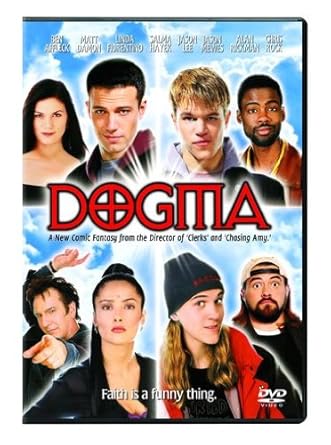
Prior to seeing Dogma, my dislike for Kevin Smith was pronounced. His “breakout” self-financed picture Clerks was wildly overpraised and when he got a big budget behind him, he produced varying degrees of crap. Mallrats showed that outside the confines of a convenience store, where camera movement is unnecessary, Smith was lost. Chasing Amy proved Smith a lame, unfunny writer, incapable of directing actors, preferring to let them exfoliate, flatulate and otherwise bleed all over his print.
Dogma sucks as well, but there are some pleasures in the sucking, because Smith has written a hit-and-miss lampoon on the perversities of Catholicism. Where he hits, he knocks it out of the park, as he plays fast and loose with the Bible in an effort to tell his modern fable (fallen angels trying to get back into Heaven; other angels, muses, apostles and assorted characters tryng to stop them). Smith also takes a few decent shots at the Pope, and offers a heartfelt tribute to true faith, all in the zany format of The Russians are Coming, The Russians are Coming . . .
Smith still does not direct actors, so the players in Dogma look like they are in home movies (Linda Fiorentino manages an entire film with a smirk and rolled eyes). But his laissez-faire approach is made less ruinous by crafty renderings of four angels (Matt Damon, Ben Affleck, Jason Lee and Alan Rickman) and the best performance to-date by Smith regular, stoner Jason Mewes. The movie is silly, but it is by far Smith’s best work. What followed was more crap (Jay and Silent Bob Strike Back, Jersey Girl, Zack & Miri Make a Porno, Cop Out), and Smith’s sensibility that his crap was actually awesome and the studios don’t “get” it and that’s what makes him awesome and everyone else not awesome.
Which leads to a biography of a director highlighting the following: criticism of Paul Thomas Anderson, as if Anderson were a peer; becoming so overweight he is kicked off of a flight for not having bought two seats; attacking Bruce Willis (“I had no f***ing help from this dude whatsoever”) because Willis did not work hard enough to promote the execrable Cop Out); an attempt to market his last cruddy picture “outside the system”; and retiring, at the ripe old age of 41.




 Those lips, those cheekbones, that gun!
 Which leads to a biography of a director highlighting the following: criticism of Paul Thomas Anderson, as if Anderson were a peer; becoming so overweight he is kicked off of a flight for not having bought two seats; attacking Bruce Willis (“I had no f***ing help from this dude whatsoever”) because Willis did not work hard enough to promote the execrable Cop Out); an attempt to market his last cruddy picture “outside the system”; and retiring, at the ripe old age of 41.
 filmvetter