Archive

80s

I’m not much for sports hokum.  The elegiac bunk of The NaturalField of Dreams, or even Any Given Sunday reveals more about the filmmakers’ insecurities than the game being played and the characters who play it.  But even I am not immune from hokum anchored by Gene Hackman and based on the true story of the 1954 Indiana state high school basketball champions from tiny Milan.

Hackman is the new coach with a dark past, bringing a fundamental style of play and stubborn ways to a cloistered small town that does not want him.  Barbara Hershey is the teacher leery of his influence.  Their conversations about what constitutes success are smartly written (she loathes the small town, plans the escape of her students and views Hackman’s” hoop dreams” as an anchor keeping young men from getting out).  Dennis Hopper is the alcoholic assistant coach, redeemed in the eyes of his player son as the team battles adversity.  David beats Goliath, and the music swells along with the heart.

The performances are all strong, and the casting of the fresh-faced team is perfect. The boys, town and milieu feel 1950s, as does the play, and the boys can play.  One only needs to watch the overrated White Men Can’t Jump to realize the foolishness of casting non-players; Woody Harrelson is passable, Wesley Snipes ludicrous.  The film is also chock full of inspiring and exciting vignettes as the boys march forward to victory. 

Hackman is commanding, in his sparring with Hershey, when he confronts the team’s star player, who is in the middle of a 1950s version of a holdout, and in his handling of the overbearing townsfolk.  I also like his simple, homespun speeches:

Ah, Bobby Knight.  

This one is better:

There are a few problems.  The love affair between Hershey and Hackman seems both improbable and awkward.  I no more want to see him kiss a younger woman than Tommy Lee Jones.  The score is also very 80s, stirring but techno infused.  But it’s still one of the better sports films made.

Barry Levinson’s 1982 classic about a bunch of young guys in 1959 Baltimore is not only a brilliant ensemble period film, but it heralded a new form of comedic art.  The film is best explained in this Vanity Fair piece , which I highly recommend and which makes any substantive review on my part superfluous —

Much Ado About Nothing

Splash put Tom Hanks on the map as a leading man, though he was not yet filled-in and substantial.  Instead, Hanks was mannered in the way an actor can be after a long stint on a sitcom (Hanks was one of the Bosom Buddies from 1980 to 1982).  The film was also Ron Howard’s biggest feature, and its success would launch his career as the director of competent, workmanlike, earnest and generally dull films.

Hanks plays a love-phobic NYC businessman (derived from a childhood trauma – he fell off a Cape Cod ferry and encountered a mermaid).  In the depths of despair over his romantic failures, he returns to Cape Cod, falls in the water again, and is again rescued by the mermaid, now grown up (Daryl Hannah), who follows him to New York.  She is pursued by a cruel scientist (Eugene Levy), captured and probed to the point of sickness (ala’ E.T.) and then is busted out by Hanks, his brother (John Candy) and a repentant Levy.

Almost 30 years later, it’s a shock to see such a callow and obnoxious Hanks.  His voice is whiny, his character churlish and childish, and he seems too much the boy for the part, light as it is.  Perhaps because a mermaid has no experience with men, she just presumed Hanks was a good catch (ba-dump) but he is not.  He’s aggravating and surprisingly unfunny.

The same cannot be said for Candy, who steals the movie as the heavy, schmoozing, hard drinking,  yuk-yukking brother, excited to have one of his letters printed in Penthouse.  Levy is also good as the nerdly, bitter scientist, and Hannah is appropriately innocent and glowing as the fish-out-of-water.

It’s a cute movie, no more, but it ends in an uninentionally ridiculous fashion.  Hanks jumps in the water, making the choice to live the rest of his live with Hannah under the sea (he cannot, for reasons unexplained, ever return to land).  The credits roll and Hanks and Hannah swim the ocean as she shows him her world.  She has a big fin, he does not (when she was on land, when dry, she had legs and what goes along with them when they meet, and they were able to have a lot of sex).  Her world is murky and humdrum.  “See, this is the ocean floor.  And there is a conch.  And there are some fish.”  And what will Hanks eat?

Image result for Splash hanks underwater

“This was a poor choice.”

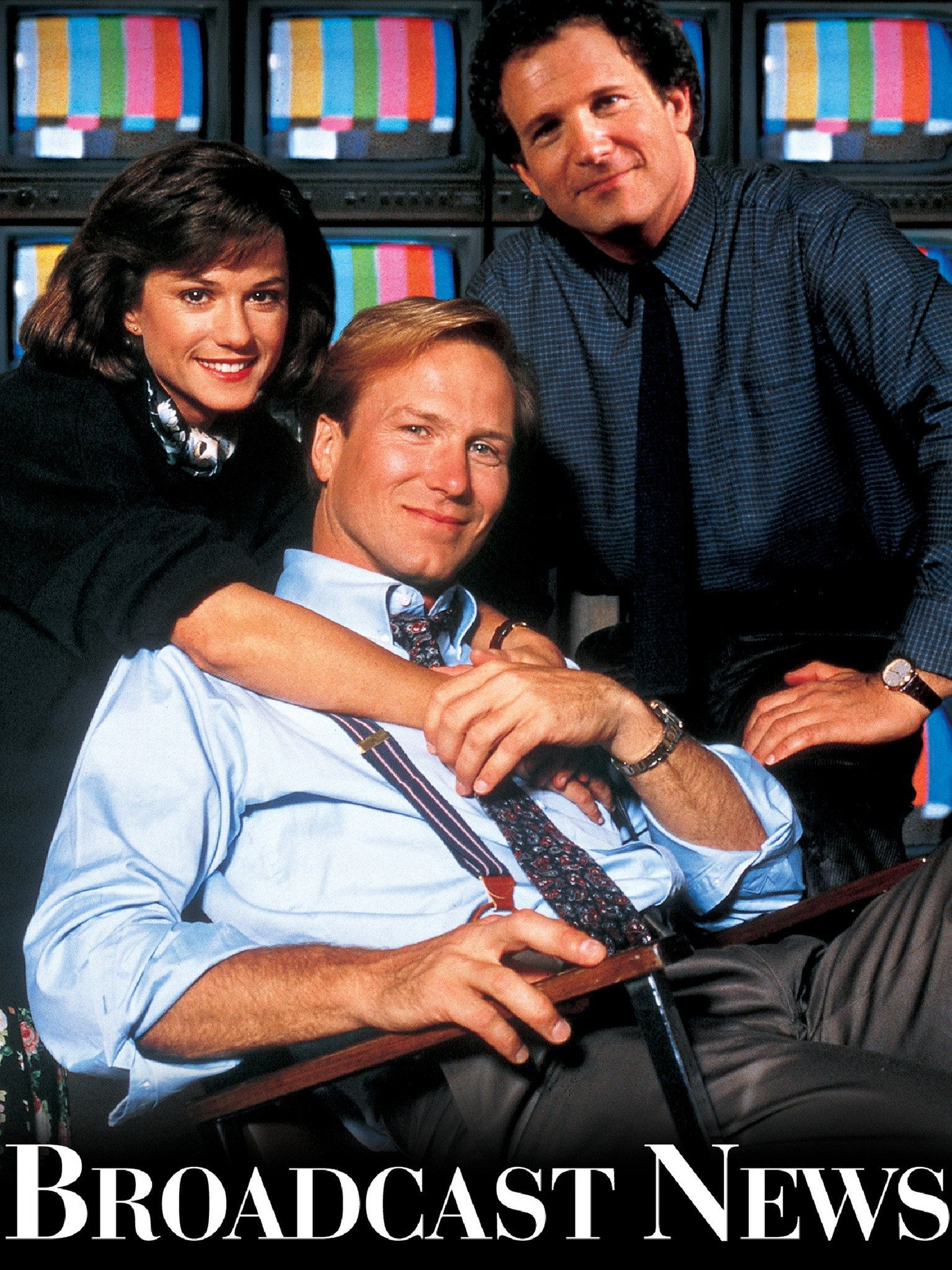
Broadcast News - Rotten Tomatoes

James L. Brooks has the ability to make you laugh out loud just before he brings a tear to your eye, a skill he has honed in Terms of Endearment and As Good as It Gets. His missteps (How Do You Know, Spanglish) still contain very funny dialogue, even if the whole doesn’t work.  But to be fair to Brooks, Paul Rudd, Reese Witherspooon, Adam Sandler and Tea Leone are not very formidable substitutes for Jack Nicholson, Shirley MacLaine, and Debra Winger.

In Broadcast News, Brooks melds a love triangle with a story about journalism and ethics that is prescient.  Holly Hunter is the producer of the Washington bureau of a major news network, Albert Brooks is a gifted but un-telegenic correspondent, and William Hurt is the new up-and-coming golden-boy, groomed to replace the current anchor (Jack Nicholson, in a hilarious cameo).  Hurt is attractive but shallow (as Brooks says, he is against everything Hunter is about).  But Hurt is also sweet and in his own way, genuine.  He fancies Hunter and when Brooks tries to anchor the weekend news in an effort to save his job, Hurt is there, giving him advice, some of which is excellent (“punch” a thought in each sentence) and some of which makes Brooks very uncomfortable (“Just remember that you’re not just reading the news, you’re narrating it. Everybody has to sell a little. You’re selling them this idea of you, you know, you’re sort of saying, trust me I’m, um, credible. So when you feel yourself just reading, stop! Start selling a little”).  Hunter becomes infatuated with Hurt, and as they grow closer, Brooks professes his long love for Hunter and reveals the ethical threat that is Hurt.

The picture is loaded with crisp, witty dialogue, and at its best, it evokes the great Grant/Stewart/Tracy v. Hepburn romantic comedies. The picture also injects something of substance (the deterioration of the news), not with the acid cynicism of Network, but gently, so as not to get in the way of the story and humor.

There is also great physical comedy, provided by Joan Cusack as a gawky assistant producer, and Brooks, who endures the great humiliation of flopsweat during his shot at anchor.  The scene is one of the funniest in film history.

The movie has one problem, but it is a big one.  Holly Hunter is so mannered and quirky that you simply cannot understand Hurt’s attraction to her, much less that of Brooks. Sure, the good looking neophyte might be intrigued by the neurotic but fascinating “other” ala’ Robert Redford and Barbra Streisand in The Way We Were.  But Hunter takes “odd” up several notches, and in many scenes, her facial expressions approximate her work in the live cartoon Raising Arizona.  Her temper is also so volcanic as to suggest mental illness.

Certain lines cannot be crossed in a romantic comedy.  I was reminded of the awful Hugh Grant-Sandra Bullock vehicle Two Weeks Notice, wherein Bullock has an attack of diarrhea on the highway and Grant has to commandeer a stranger’s RV so she can relieve herself.  This may work for Will Ferrell and Zach Galifinakis.  But no romantic lead can be shown in such an unflattering light.  Hunter does not sink to such depths here, but her portrayal does border on the grotesque and it detracts.

There is also the weakness of the import of Hurt’s great journalistic sin (he recreates a moment of emotion in an interview) .  There is no question – the act was unethical.  But in the context of some of the other stagey and easy shortcuts engaged in by Hunter and Albert Brooks, their high dudgeon (which is critical to the picture) rings hollow, and the film never gives them a comeuppance on this point other than Hurt’s rebuttal to Hunter after she accuses him of crossing the line — “It’s hard not to cross it.  They keep moving that little sucker, don’t they.”

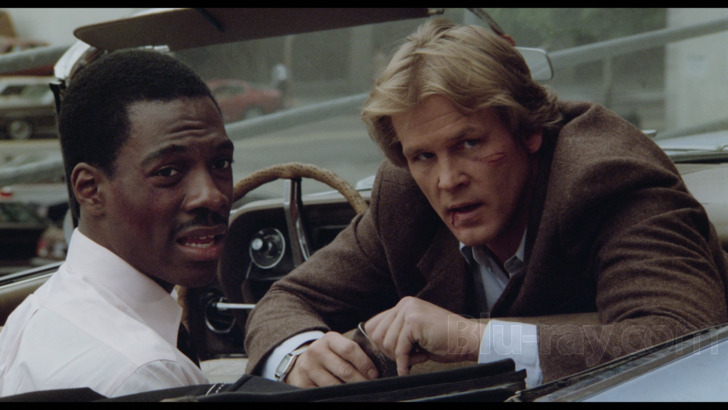
48 Hrs. Blu-ray (Remastered | Paramount Presents #19)

Eddie Murphy kinetically debuts as hustler Reggie Hammond, released from prison for 48 hours under the brutal watch of Detective Jack Cates (Nick Nolte) to hunt for Hammond’s ex-partners, who have gone on a cop-killing spree in San Francisco. The film catapulted Murphy to stardom. It was also the first picture to feature a Saturday Night Live comedian in a raw, crime story and stands as one of the better “buddy cop” pictures ever, though Murphy is really only deputized.

Yes, Murphy is very funny, sometimes side-splittingly so, but he does not treat every scene as an opportunity to do a bit or schtick.  He picks and chooses his moments, trusting in the story directed and mostly written by Walter Hill (The Long Riders). Murphy has one virtuoso scene, when he poses as a cop to roust a redneck bar, but even there, where he puts a knife to a man’s face and tells him, “I’m your worst fu***** nightmare, I’m a ni**** with a badge”, he’s in keeping with the picture’s tough tenor. Nolte’s Cates is brutal, unpleasant and an unrelenting racist, almost shockingly so, given our current advanced ethos, yet, they bond in a manner that feels authentic. Given we’re dealing with tough cops and criminals, the racial dynamic is not off-putting.  It just adds to the tension.

I was also surprised by the gritty brutality of the movie. The body count is high, but rather than explosions and elegant slo-motion, Hill takes more of a Sam Peckinpah approach. The shootings are bloody and awkward, not stylized. And the bad guys – Albert Ganz (James Remar) and Billy Bear (Sonny Landham) – are scary bad.

James Horner’s original music (he’s been nominated 5 times and won for his scoring of Titanic) is apt, a moody mix of jazz and Asian chimes.  Hill also uses San Francisco to his full advantage, mixing the grimy feel of Bullitt and Dirty Harry with a little early 80s glitz.

It has a few weaknesses. Annette O’Toole, for whom I have had my own weakness since Robby Benson’s One on One, is wasted as Nolte’s long-sufferring gal.

And the finale, where Cates and Hammond just “play a hunch.” is a bit lazy.

Still, an uproarious, and assured flick, much more than it seems.


The Shining (film) - Wikipedia

First things first.  I took my son to see The Shining at the American Film Institute Theater in Silver Spring, Maryland (they are running a Jack Nicholson retrospective).  The theater is ornate and massive and brings back the feel and style of the old movie house.

But not even the hallowed ground of a theater honoring film can persuade people to behave in a respectful fashion during a movie.  We had two fools in the front who found particular dramatic scenes funny and laughed and laughed and laughed . . . and laughed some more.  We also had two couples to our right who presumed if a character wasn’t talking, that was their cue to talk.  Stanley Kubrick films have long stretches of no dialogue.

Going to films is more and more difficult given the crude behavior of movie patrons, who cannot shut th f*** up, are now eating full meals during the show, and are otherwise oblivious to anyone around them.  Worse, those who are quiet, including myself, are often forced to simply accept the noise.  I have interceded a few times.  It has worked less often than not, because if you correct a young person in public, apparently, that is a humiliation too great to endure, and what follows is aggression and louder “I paid my ticket” talking.  Now, I’ve made the film less enjoyable for additional rows.

Okay.  To the movie.  Kubrick’s picture is methodical and creepy,  It opens abruptly with an aerial shot of Jack Torrance (Nicholson) driving for his interview at the Overlook Hotel to an ominous electronic score (think John Carpenter).  Torrance gets the job as the hotel’s winter caretaker, where he esconces his timid wife (Shelly Duvall) and his son (Danny Lloyd), who has the ability to see visions and occasionally communicate with like-talented people (i.e., he “shines”) such as the hotel’s head chef, Scatman Crothers.  Danny’s ability is also telling him that the Overlook Hotel is dangerous, a fact Crothers confirms.  Soon, the hotel insinuates itself into Torrance’s mind, turns him against his family, and he goes berserk.

The film is very scary, often terrifying.  Kubrick gives us the time to get to know the family, and all is not well:  Torrance has had recent problems with drink, injuring Danny in the process.  He is also a condescending prick, which in turn makes his wife more jittery, which in turns makes Torrance angrier and more removed.  With this fodder, the spirits of the hotel work themselves on Nicholson.

The imagery is unforgettable, be it Danny riding his big wheel (tracked by stedicam) through the halls of the Overlook, only to bump into gruesome visions, or the forbidding snow-covered hedge maze, the locale for the final scene.  Lloyd is very good:  he is withdrawn but sweet, trying to deal with a wretched home life and an amazing but confusing gift.  Duvall, whose performance has been criticized as annoying (she was nominated for a Razzie), is, in fact, very annoying, but it is a great performance nonetheless.  She is trying to hold the family together, as Nicholson is trying to destroy it, and her worry feeds his suspicion.  The hotel has to work on something; it has to find an “in” to get to Nicholson, which it does through Duvall, who is nervous and peppy and cloying.  Obviously, she doesn’t deserve to be murdered.  But the spirits of the hotel don’t need to much to convince Nicholson.

The only partial negative is Nicholson.  He’s very good as a man driven to insanity, but the performance has two faults.  First, Nicholson does not show much to recommend him when he has full sanity.  He’s superior and sarcastic and he doesn’t connect with his family.  As such, when he is enticed by the hotel, there’s not much of  struggle there.  He’s ready to fix them up right and there really was no question.  Second, there are too many “Heeeeeeere’s Johnnies” in his performance.  Nicholson goes so over-the-top that he becomes cartoonish.  Still, it’s a minor criticism and presumes the necessity of a struggle for Nicholson’s soul.