Archive

70s

Related image

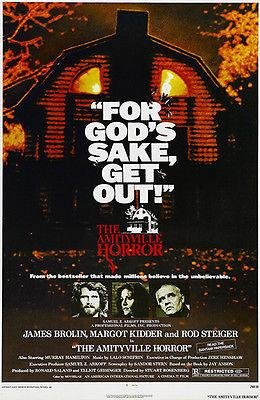
Often listed as a top picture in the horror genre, this 1979 release is rather dull and clunky.  Based on a “true” story that is decidedly untrue, the Lutz’s (James Brolin and Margot Kidder) move into a cheap dream house in Long Island knowing full well a 20 year old murdered his entire family there the year before. When their local priest, Rod Steiger, comes to bless the house, the demons therein drive him out and eventually, blind him. The house soon possesses Brolin, and Kidder (and her three children) are endangered.

The house itself is awfully creepy and the score features a chilling sing-songy ghostly whisper of children’s voices.  But Brolin is flat and ridiculously coiffed, even for 1979, Kidder is uninvolved, the children may as well have been mannequins, and Steiger overacts the hell out of his role.

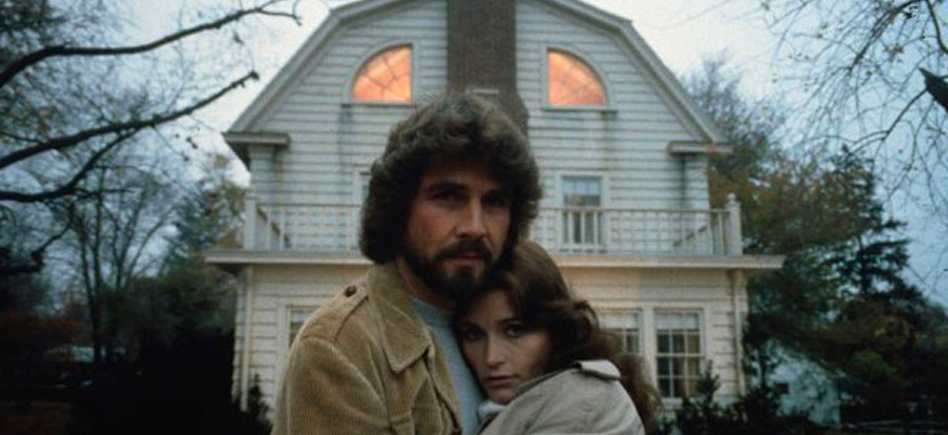
Performances aside, the movie just isn’t that scary. Sure, flies congregate, the walls bleed, creepy eyes shine in the window, and there appears to be a guy dressed as the devil behind a wall in the basement, but these features come off about as frightening as a decently prepared house on Halloween. Director Stuart Rosenberg, who helmed some interesting films (Cool Hand Luke, The Drowning Pool) is clearly uncomfortable with the genre, and apart from some disturbing externals of the house, offers very little visually. It’s a blocky, uninteresting picture, and the ending (Brolin goes back for the dog!) is ridiculous, though not as ridiculous as when locals tell Brolin he is the spitting image of the 20 year old killer.

No 20 year old killer looks like this:
Image result for Amityville horror

Carrie (1976 film) - Wikipedia

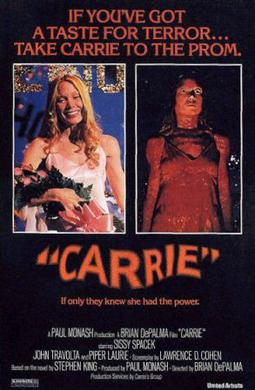
Carrie is often listed as one of the scarier films of all time (untrue) and one of the better adaptations of a Stephen King scary novel (true – in fact, The Shining and Salem’s Lot are the only rivals). It certainly has a staying power, so much so it has spawned two remakes and a Broadway musical.

The story is simple.  Untutored by her religious zealot/lunatic of a mother (Piper Laurie), Carrie gets her period in the shower after gym class, naturally freaks out and is humiliated by her classmates. When one of the more thoughtful ones (Amy Irving) tries to make amends by having Carrie escorted to the prom by her popular boyfriend (William Katt), one of the less thoughtful ones (Karen Allen) doubles down on the humiliation. Carrie, who has become increasingly aware of her telekinesis, responds, er, inappropriately.

Brian DePalma caught a much deserved rap for overly-aping Alfred Hitchcock, especially in his early films, and Carrie, his breakout picture, is Exhibit A.  It opens with a shower scene, Pino Donaggio’s score is Bernard Hermann through-and-through (Hermann was supposed to score the picture but died before filming), and when Carrie uses her powers, we hear the 4 note violins of Psycho.  The scene leading to Carrie’s ultimate indignity, where a bucket of pig’s blood is spilled on her head, speaks for itself (and much of Hitchcock’s oeuvre).  Some mock the picture for this fealty, but there are worse directors to copy.

Hitchcock aside, Carrie stands on its own, even if some of its filler seems cheezy and dated.  Laurie is riveting in her fanaticism (and her depressing prescience – they all did laugh at her), Irving and Katt offer an unheralded sweetness to the story, and the prom scene, projected with a gutsy and effective split-screen technique, is loaded with indelible, nightmarish visuals.

But the engine of the picture is Spacek, who DePalma makes downright homely and spooky.  We all knew a kid like that in school.  A few tormented her.  A few were kind.  Most ignored her, perhaps tactically, or laughed meekly when she was catching hell. Or, you just looked right through her.  Spacek shows her pain and her promise, which is viciously crushed by the bullies.

So, it’s hard to root against her, even in the midst of her wanton slaughter.

I recently saw a filmumentary” on Jaws and realized I had not reviewed the greatest summer movie ever made, an astonishing, deep blend of adventure, terror, and action, communicated by Stephen Spielberg’s great eye, the deft casting of three disparate principal actors, and a John Williams score that evokes fear and exhilaration.

Spielberg at the advent of Jaws was hardly a wunderkind. Like William Friedken before The French Connection, Spielberg had a pedestrian resume’ — a Columbo, a few TV movies and an okay feature (Sugarland Express). With a production plagued by everything from the mechanical failures of the shark to the tax problems of star Robert Shaw (if he spent more than a certain amount of time in the U.S. he would face a tax liability, so he was flown to Canada on his days off), Spielberg took Peter Benchley’s piece of summer pulp and fashioned a moving, ingenious film, evident from the opening scene credits, which give us a shark’s point of view in what is the still and peaceful deep, an image followed by the jarring, horrifying massacre of the shark’s first victim, alone, at night, where none of us ever want to be.

Like Friedken in The Exorcist, who prefaces the introduction of the demon in the child only after an hour of exposition, Spielberg waits quite some time to show us the shark in full, making what is happening beneath the water all the more frightening. Indeed, when we see the second fatality (a little boy on a raft), it is from the vantage point of a beachcomber lazing in his chair, a brief, violent act that immediately makes the viewer question, “what the hell was that?”

After Spielberg stuns the audience, he introduces them to poor Chief Brody (Roy Scheider), a landlubber from New York who marshals for the summer town of Amity, As the bodies pile up, it is Brody who succumbs to the pressure of the townsfolk dependent on summer dollars, only to be shamed by his malleability. Emboldened and in need of reclamation, Brody is assisted by the articulate and passionate wisecracker, oceanographer Matt Hooper (Richard Dreyfus) and old salt Quint (Robert Shaw). The former wants the scientific find of the century, the latter is a modern Ahab, seeking his white whale, as explained in the famous scene written not by screenwriters Benchley and Carl Gottlieb (a comic writer who presumably penned some of the very funny exchanges in the picture) , but John Milius (writer of Dirty Harry, Apocalypse Now and creator of HBO’s fantastic Rome).

The experience of the three men from their separate vantage points, with their different motives and backgrounds, is the fuel of this picture, not the shark. As good as Milius’ Indianapolis speech is, or Shaw’s monologue to the town leaders opened by his nails on a chalkboard, the scene where Shaw’s grit runs up against Dreyfus’s privilege and Scheider’s quiet authority is better:

                                     HOOPER
                         You’re going to need an extra hand…

               Quint turns to see this new voice, and starts walking towards
               him.

                                     BRODY
                         This is Matt Hooper…

                                     QUINT
                         I know who he is…

                                     BRODY
                         He’s from the Oceanographic Institute.

                                     HOOPER
                         I’ve been to sea since I was 12.

                         I’ve crewed three Trans-pacs —

                                     QUINT
                         Transplants?

                                     HOOPER
                         — and an America’s Cup Trials…

                                     QUINT
                         I’m not talking about day sailing or

                         pleasure boating. I’m talking about
                         working for a living. Sharking.

                                     HOOPER
                         And I’m not talking about hooking

                         some poor dogfish or sand shark. I’m
                         talking about a Great White.

                                     QUINT
                         Are you now. I know about porkers in

                         the water —
                              (throws him some rope)
                         Here. Tie me a sheepshank.

               Hooper ties the knot effortlessly.

                                     HOOPER
                         I don’t need to pass basic seamanship.

                                     QUINT
                         Let me see your hands…

               He takes Hooper’s hands in his own big bloody fists, and
               feels them as he talks.

                                     QUINT
                         Ha. City hands. You been counting

                         money. If you had a $5000 net and
                         $2000 worth of fish in it, and along
                         comes Mr. White, and makes it look
                         like a kiddy scissors class has gone
                         to work on it and made paper dolls.
                         If you’d ever worked for a living,
                         you’d know what that means.

                                     HOOPER
                         Look, I don’t need to hear any of

                         this working class hero crap. Some
                         party boat skipper who’s killed a
                         few sharks…

                                     BRODY
                              (interrupting)

                         Hey. Knock it off. I don’t want to
                         have to listen to this while we’re
                         out there…

                                     QUINT
                         What do you mean ‘We…?’

                                     BRODY
                         It’s my charter. My party.

                                     QUINT
                         All right, Commissioner. But when

                         we’re on my ship, I am Master, Mate
                         and Pilot. And I want him…
                              (indicates Hooper)
                         …along for ballast.

                                     BRODY
                         You got it.

During shooting, Shaw rode Dreyfus very hard, making fun of everything from his star status, stature and his ethnicity.  Any hostility was used to great effect on-screen.

As good as these three actors are, they are more than ably supported by Lorraine Gary (as Brody’s wife), Murray Hamilton (as the oily mayor) and a boatload of locals who lend the film a great air of authenticity.  Again, kudos to the script, because it allows dignity for Hamilton in the aftermath of his grave error, when, shaken at the hospital, he says to Brody, “Martin . . . my kids were in that water too.”

Finally, Williams’ score is a mixture of dread and adventure, the simplicity of dark repetition (“duh, nuh . . duh, nuh . . . dun dun dun dun dun dun dun”) followed by a near-swashbuckling romp as the men seek their quarry.

I never tire of this film and always find some new marvel or nuance when I watch it.  If only the Hollywood shit that is shoveled in summer these days could sport 1/10 of the chops of Jaws, the town wouldn’t be losing its shirt.

Was John Wayne being an old Green Beret stick-in-the-mud when, after seeing High Plains Drifter, he wrote to its director and star Clint Eastwood, “This isn’t what the West was all about. That isn’t the American people who settled this country”?

Wayne was never a lover of nuance, and he had little patience for depicting the darker side of the American psyche, as is evident from his evaluation of another film: “High Noon was the most un-American thing I have ever seen in my whole life. The last thing in the picture is ol’ Coop [Gary Cooper] putting the United States marshal’s badge under his foot and stepping on it. I’ll never regret having run [screenwriter Carl Foreman] out of this country.”

Eastwood second directorial effort was released in 1973, and he wasn’t interested in Wayne’s myth.  It was a time of callous selfishness and a vicious appraisal of the institutions so revered by Wayne, hardly the environment for an uplifting Western about the strong stock of the frontier.

Eastwood’s story of a drifter returning incognito to the town that ran him out via a brutal whipping is assured (he was clearly taking mental notes when directed by Sergio Leone and Don Siegel with this bizarre, even trippy revenge flick).  It is also supremely cynical.  Nearly everyone in the town is guilty of either directing the whipping or standing by when it happened, frauds and cowards all, and these villains unwittingly give Eastwood a run of the place so he’ll protect them from the very same thugs (newly released from prison) the town set on Eastwood. Eastwood enjoys the power, as well as sticking it to townsfolk for their hypocrisy, per this exchange with a preacher upbraiding Eastwood for evicting people from the town hotel:

PREACHER
You can’t turn all these people out into the night. It is inhuman, brother. Inhuman!

EASTWOOD
I’m not your brother.

PREACHER
We are all brothers in the eyes of God.

EASTWOOD
All these people, are they your sisters and brothers?

PREACHER
They most certainly are!

EASTWOOD
Then you won’t mind if they stay at your place, will ya?

PREACHER
All right, folks, let’s go. Put your bags here. Friends, don’t worry. We shall find haven for you in our own homes… and it won’t cost you one cent more than regular hotel rates.

But let’s not dismiss that old fuddy duddy Wayne out of hand.  High Plains Drifter is also groundbreaking in a different, uglier way. Eastwood’s character rapes a woman in the first 15 minutes of the film, yet his status as the anti-hero is none the worse for wear. While she was a complicit bystander in his whipping, even cheering, when she tries to shoot Eastwood (and misses), he asks, “I wonder why it took her so long to get mad?” to which a character replies, “Because maybe you didn’t go back for more.”

Compare and contrast Wayne: “I want to play a real man in all my films, and I define manhood simply: men should be tough, fair, and courageous, never petty, never looking for a fight, but never backing down from one either” and you can better understand his distaste.

This 1974 documentary is devoid of voicever narrative, alternating between footage of the Vietnam War, news footage of the era, anti-communist propaganda documentary clips, movie clips, and interviews with ordinary American citizens, Vietnamese villagers, American soldiers and policymakers.  The thrust of the documentary is that the conflict was precipitated by a racist, warrior society (high school football being an engine of the former malady), a hysterical fear of communism, and a hubristic, imperial policy.  It is skillful, affecting and pernicious, simplifying a complicated reality with editing that feels deceptively selective.  Worse, because it is comprised of raw footage and heartfelt interviews, it presents as an honest portrayal.  As Roger Ebert noted, “Here is a documentary about Vietnam that doesn’t really level with us … If we know something about how footage is obtained and how editing can make points, it sometimes looks like propaganda … And yet, in scene after scene, the raw material itself is so devastating that it brushes the tricks aside.”

An example: interviews with American bombers, where we never hear the documentarians, but it is clear the answers of the fliers have been elicited by questions about the experience, followed by footage of Vietnamese peasants, who are asked to recount the effect.  I imagine most viewers would deem this strategy hunky dory, but the effect is to create an easy falsity-our boys dig on the need for speed and the kick-ass of it all, encased in their imperialistic manned drones, while the carnage below them escapes their notice.  Indeed, I saw this storyline on an episode of M*A*S*H.

Another: the treatment of the policymaker interviewees.  The anti-war Senator Fullbright and Daniel Ellsberg are edited as erudite, comprehensive and certain, and Ellsberg is even filmed breaking down recounting the assassination of Robert Kennedy. Walt Rostow’s contribution as selected is halting, petulant and confused. William Westmoreland seems near-sandbagged, even in a sit down interview.

Finally, if there is a patriotic rally or demonstration, the filmmakers always find the most extreme commenter, generally dressed up in a historical costume to punctuate his inevitable, “America, love it or leave it!”

This film is the father to the staged propaganda of Michael Moore, saying less about the subject matter and everything about how the filmmakers want you to feel about the subject matter (it is an indictment of Moore’s skills that he must insert himself as the center of his films to hammer home his points). In that manner, it is comprehensive, a cinematic Cliffs Notes to the most basic conventional wisdom about the conflict.

The picture was also clearly influential on Oliver Stone’s Platoon and Born on the Fourth of July and Stanley Kubrick’s Full Metal Jacket.

George Miller’s frenetic, creepy vision of a future where a version of The Wild Ones terrorizes the roads is a confident, distinctive picture made all the more impressive by its paltry $400,000 budget. Miller went on to make The Road Warrior, cementing Mel Gibson as the most bankable of stars, but in Mad Max, Gibson barely resonates until he is transformed, ala’ Charles Bronson in Death Wish, into a silent, dispenser of retributive violence. His payback is gripping, played out on a widescreen lens at high speeds on the desolate roads of Australia. Still, the picture stops dead in its tracks halfway through as we wait for the brutal thugs of the road to incur Gibson’s rage. It is also the worst scored film in the history of movies, a blaring and bizarre Bernard Hermann knock-off.

Late Roger Moore Bond films, with the cornball quips and the hideous 80s fashion, obscure the fact that Moore used to be a pretty cool James Bond.  After the confusion of George Lazenby’s bizarre withdrawal from the series having only done one film (On Her Majesty’s Secret Service) Sean Connery was hurried back to woo Jill St. John in Diamonds are Forever for a then-astronomical $1 million.  But Connery was finished, so Moore was signed up (he’d already played a secret agent – Simon Templar – on television’s The Saint) .

Live and Let Die has Bond tracking Dr. Kananga (Yaphet Kotto), the dictator of a small Caribbean nation, after MI6 agents start dropping like flies.  Kananga is into drugs and voodoo, using Solitaire (Jane Seymour) and her gift with tarot cards to his advantage (until Bond deflowers her and she loses her “sight”).  Paul McCartney and Wings produced a rollicking theme (ranked number two here), there is a tremendous cigarette boat race, and Bond effectuates one of his better escapes from a Florida crocodile farm.

The new Bond presents as unflappable, as well as perpetually amused.  He’s also the horniest of the Bonds.  Moore, who just wrote a book on his time as Bond, articulated both his admiration for current Bond Daniel Craig and his own ethos:  “Now they’ve found the Bond—Daniel Craig…. I always said Sean played Bond as a killer and I played Bond as a lover. I think that Daniel Craig is even more of a killer. He has this superb intensity; he’s a glorious actor.”

Moore also identified his principal weakness as Bond: “Quite honestly, I do everything the same and I think everything comes out the same, whether I’m flinching as James Bond or raising my eyebrows as Simon Templar.”  His casualness often borders on disinterest and a certain “mailing it in” approach results.

As for the film, it has two primary faults.  First, an annoying Louisiana good ole’ boy, Sheriff Pepper (Clifton James), brought in for broad, Jerry Lewisesque comic relief.  Second, a very poor finale, with the delightful Kananga dispatched in a manner way beyond the special effects capabilities of the time.  He deserved better.

Me and my boy are scheduled to see The Who playing Quadrophenia from beginning to end next week, so we prepared by watching Franc Roddam’s directorial debut, a story of a miserable 1960s London “Mod” (Phil Daniels) eternally at war with his parents, his job, the girl he fancies, rival “Rockers” and all that bourgeois b.s.

Daniels is a punk, through and through, and increasingly, it appears he is mentally disturbed.  He either laughs goofily or snarls, and at no point do we feel empathy for his not particularly difficult plight.  He has a job, a super cool Vespa, a gang of friends who are pleasant and tepid, and a fondness for readily available pills.  His life is also soundtracked to The Who, fer crissakes (poorly, though – it’s clear the director didn’t know how to fit the music into the film and with the exception of the final scene, the musical contribution of band is distracting rather than evocative).

There are some charms to the movie.  It was filmed on location in London and Brighton and the final scene (where Daniels either kills himself or he doesn’t) is a pretty impressive (though overlong) helicopter shot of a precarious ride along the Brighton cliffs.

If you look close, you’ll also see a boatload of very young Brit actors who went on to solid careers, including Tim Spall, Ray Winstone, and Phillip Davis.  It’s a shame one of them didn’t get the lead, because Daniels appears to have been chosen solely for his likeness to Pete Townsend.

Sting is also featured.

EBFDF7B9-9AE9-4195-8CD8-70BF9A2C66AB
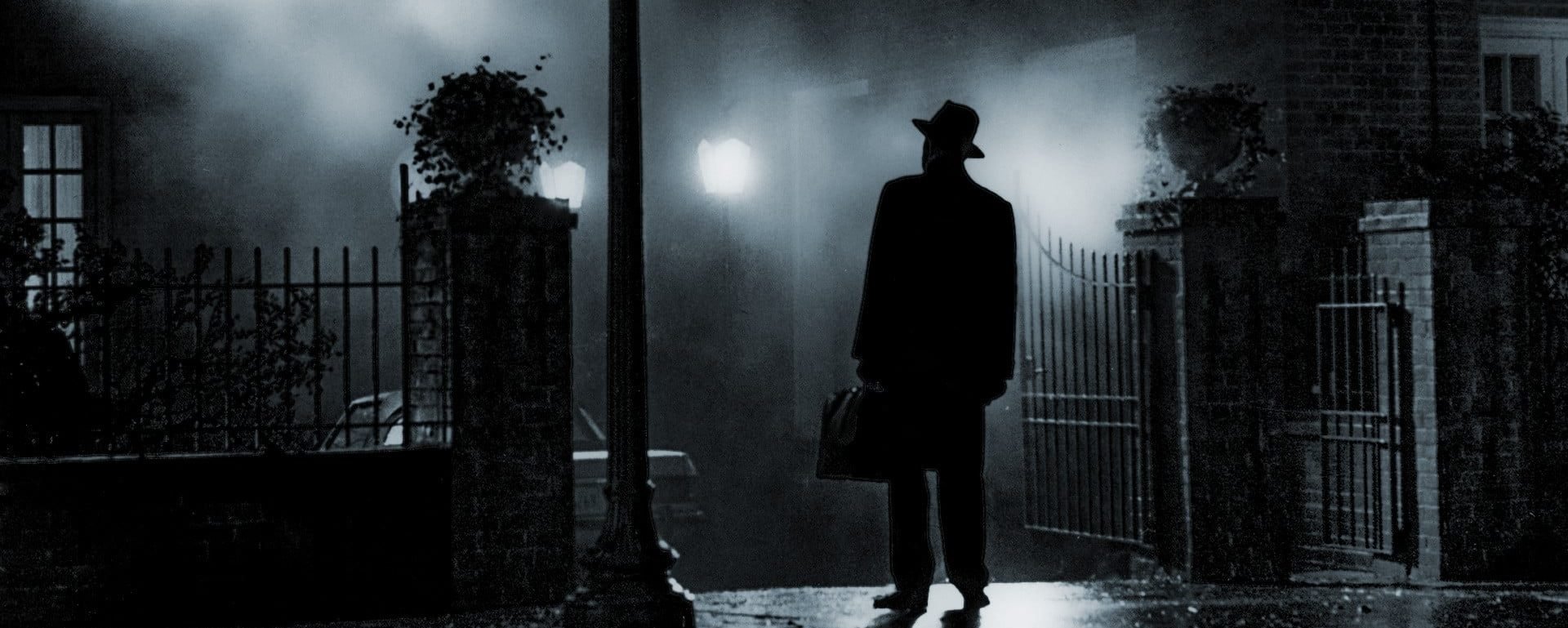
Any film where the director kicks the Jesuitical screenwriter off set because the latter wants the film to be unequivocal in its conclusion that God triumphs over Satan is bound to be unique. As that screenwriter William Peter Blatty observed:

Like so many Catholics, I’ve had so many little battles of wavering faith over the course of my life. And I was going through one at that time. And when I heard about this case and read the details, that seemed so compelling. I thought, my God, if someone were to investigate this and authenticate it, what a tremendous boost to faith it would be. I thought, someday I would like to see that happen. You know, I would like to do it . . . the research into it affected me. And the novel, it very much strengthened my faith.

Director William Friedken had other ideas.

The film opens near an archaeological dig in Iraq. There, Friedken depicts a harsh and poverty-stricken world, where the blind are led by starving children, a widow grieves inconsolably, people work in small foundries like toilers in a fiery, oppressive Hell, and Father Merrin (Max Von Sydow) receives a sign that he will soon be meeting Satan.  We are then transported to Washington, D.C., where another priest – Father Karras (Jason Miller) – is in a modern Hell.  He is counselor to unsure and shaken Catholic priests.  He tells one, “There’s not a day in my life when I don’t feel like a fraud.” To another, “I think I’ve lost my faith.”  Karras’ mother is in her own nightmare, 1970s New York City.  She needs care, she lives in a slum, and Karras is wracked with guilt over her abandonment.

Friedken masterfully portrays the connection between a society sick by sin and the infestation of one little girl, Regan McNeil (Linda Blair), the daughter of a Hollywood actress (Ellen Burstyn) filming on location in D.C.  As Regan’s personality changes, she undergoes rigorous medical procedures (an arteriogram and a pneumoenchephalogram, to name two) that are graphic and invasive, as well as psychological probing (way before its time, the film has a doctor extolling the virtues of Ritalin).  Her father forgets to call her on her birthday, pointing up the damage of divorce.  Regan is alone and left to play by herself and eventually, an imaginary friend, in a foreign town and a rented townhouse.  She is the quintessential “modern” child.

Other characters are also on the point of a knife.  Father Karras nears breakdown after the death of his mother yet he continues to counsel other priests sick at heart and doubting of faith. The director of Burstyn’s “film in the film” (Jack MacGowran) is a lonely drunk cursed by memories of the Holocaust who scathingly brands Burstyn’s housekeeper of Germanic descent a closet Nazi.  Everything and everyone seem rife with wrong and discomfort, raw and vulnerable. Von Sydow is nothing less than a condemned man, awaiting his confrontation with Satan and dependent on nitroglycerin pills for his ailing heart. 

As Regan descends into the throes of possession, Friedken and Blatty smartly turn the world on its head: the physicians, once cocky, can offer Burstyn only the Jesuits, but only because a symbol of God might suggest salvation to Regan, the idea of faith, of course, being ridiculous. And when Regan talks to Karras (himself an Ivy League trained psychologist), the priest immediately sends her back to the doctors and recommends the child’s institutionalization. This is what modernity does when confronted by evil – denies it or locks it away. Friedken’s reservations aside, Blatty gets his morality play.

But it’s a morality play encased in a thrill ride. When the nature of Regan’s torment can no longer denied, and her abuse progresses, Friedken uses all means at his disposal to discomfort the viewer, from the foul, such as the vomit and green goo and the masturbation-with-crucifix (Blair had a stunt double who was used in the disturbing sexual scenes, for those who may have been wondering – double or no, it is still quite a shock to see a little girl utter the abomination “Let Jesus fu** you, let him fu** you”) to the subtle (the use of subliminal cuts, as when Father Karras dreams of his mother and sees a death mask and then, the same mask is overlaid on Regan’s face during the exorcism).  Friedken also had the set dropped to below freezing by placing a restaurant air conditioner across the top of the set, which he then ran all night. The effect on the actors is stunning – their fear is enhanced by physical cold and the steam of breath is another frightening component.

Understandably, Blatty fretted over Friedken’s depictions: “A large section of the audience probably came because something that shocking and vulgar could be seen on the American screen. Bill Friedken always said that would be the case; that they would come to see the little girl masturbate with the crucifix . . . At the time I didn’t believe it; I thought he was destroying the film. But when I perceived that he was absolutely right, I thought it was terribly depressing.”

Friedken, however, is not only a showman, he’s a damn good one. He sets one spooky scene after another, constantly tracking his characters slowly in a manner that feels as if they being enveloped … by something. Burstyn’s walk home from a film shoot in Georgetown, where she witnesses Karras furtively counseling one priest and then passes two nuns with the wind whipping their garb, lends an eerie sense of the foreign and the what is to come.  Much of the camera work is elegant tracking and slow zooms, soon to be punctuated by the occasional hand-held jolt (mostly, when characters are rushing to Regan’s room). The effect lulls the viewer, making the terror – when it occurs – all the more shocking.

Friedken understood that the spinning head was important but not as important as verisimilitude: “It’s set in the real world, with characters who are portrayed as humanly possible. So I think that the fact the story is portrayed realistically is what disturbs people about the events in it.”

The performances are poignantly measured, just on the edge of documentary. The film should be a Hollywood treatise on the exposition of minor characters. Blair is sweet and gentle as needs be, until – with the help of a stunt double, the guttural voice of Merecedes MacCambridge and various pulleys – she transforms convincingly into a leering, goading demon. Burstyn presents as a pampered star and mother at the end of her rope, but she grows to a hardened, more simple warrior. Von Sydow is appropriately ghostly as the doomed Father Merrin. McGowran and Lee J. Cobb are memorable as the murder victim and the murder policeman. Cobb’s gentle interrogations of Karras and McNeil are the kind of quiet respites necessary for such a tense film. Cobb also represents the skeptic and a rebuttal to any sense of despair. He is, after all, steeped in the evil that men do.  But he is also kind and supportive, looking for an autograph from Burstyn and a friend in Miller. His supporting performance is one of my favorites in all of film.

 The great turn, however, belongs to Miller (a playwright who succumbed to drink and never really did much as an actor after The Exorcist). His is a tortured existence, filled with doubt. His trepidation shows in his eyes. Physically, Miller plays as a man who fears his weakness is obvious to all, so he shrinks into himself so as not to be noticed. Merrin and Karras act like a men who know Satan is looking for them. The difference is that Merrin knows what is coming and solemnly accepts it. Karras thinks he can hide, and that is why he is so compelling. Friedken almost always films Miller hunched over, or huddled in talk, or sitting down, or crouched, or in a crowd, accentuating his need to be anonymous.

In the end, despite the tension between  Friedken and Blatty, the latter need not have worried. The film is a clear triumph of good over evil.  To save Regan, Karras defies the devil, “Come into me! Come into me!” The devil obliges, and for a moment, it looks as if Satan/Karras will kill Regan. Karras, however, summons his faith and hurls himself out of the window. He is given last rites, and later, a recovered Regan (having no memory or the possession) sees a priest and kisses him.

The Exorcist is a great popcorn flick but also a cinematic declaration that palpable, defined evil exists. It is an ultimate rejection of moral relativism, a harsh check on modern mores and technological advances. It is also, despite its slick sophistication, religious.  After all, you cannot really find “good” or “justification” or “well, sure . . . but” in Satan. There is no bargain, even as Burstyn asks a herd of befuddled doctors “You’re telling me that I should take my daughter to a witch doctor?” The answer is, yes, there is no modern skate or help for you. And Friedken, the carnival barker, effectively shows you just how frightening and insidiously entertaining Satan can be.

A closing note: Blatty wrote The Exorcist many years after attending Georgetown University in Washington, D.C.  One of his inspirations was newspaper reports of a real life exorcism of a boy in Mt. Rainier, Maryland.  That boy went to my high school, and you can read about his story here — http://www.strangemag.com/exorcistpage1.html  Enjoy.

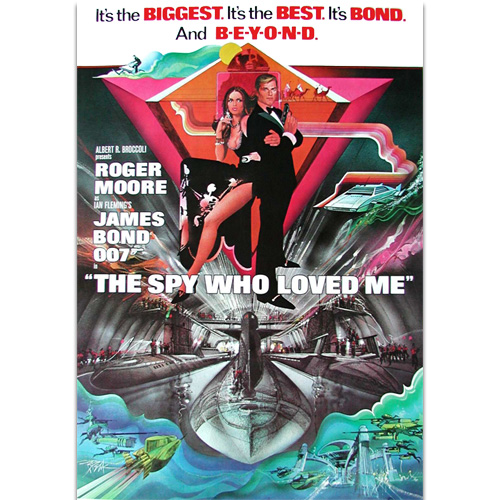
This is the second Bond film I saw in the theater, after Live and Let Die, and it is probably the last of the series that gave us a youthful Roger Moore.  By the next installment, Moonraker, the lines had gotten deeper, the hair higher yet thinner, and the bones creakier.

Billionaire Kurt Jurgens (Karl Stromberg) seeks to start a nuclear war between the Soviet Union and the United States, so he can rule a post-apocalyptic world from the sea.  Jurgens steals a Russian and American nuclear submarine to his purpose, and Bond and his female Russian counterpart Anya Amasova (Ringo Starr’s gorgeous but not particularly talented Barbara Bach) are dispatched to get to the bottom if it.  Unbeknownst to Bond, in one of the few Bond ski sequences that work, he killed Amasova’s love, and she has vowed to kill Bond – when the mission is over.

Many of the hallmarks of a good Bond film are here – exotic locales (such as Asgard Peak in Austria; Egypt, including the Giza Necropolis, Great Pyramids and Great Sphinx; and the cliffs of Sardinia), a first-rate Bond song (“Nobody Does it Better”), and several beauties, including  a favorite, the lethal helicopter pilot Caroline Munro-

The Spy Who Loved Me review - Moore's best Bond - Lyles Movie Files

The film also has an interesting and grandiose villain and a serviceable script.  The action sequence when the Soviets and Americans join forces to take on Stromberg’s army is also very exciting and novel.

However, the warning signs for the series first appeared in The Spy Who Loved Me.  The pun and snappy rejoinder quotient increased markedly.  The use of the cheezy, roving sax to denote the funny or the fanny is prevalent.   The introduction of the villain Jaws (Richard Kiel) pushed the story further, into slapstick.

There is simply too much of that and not enough of this:

(though, even here, a meaner Bond is compelled to drop, “You shot your bolt” into the action)

The changes, however, could in no way be challenged at the time.  The film cost $14 million to make and grossed $185 million worldwide.