Archive

00s

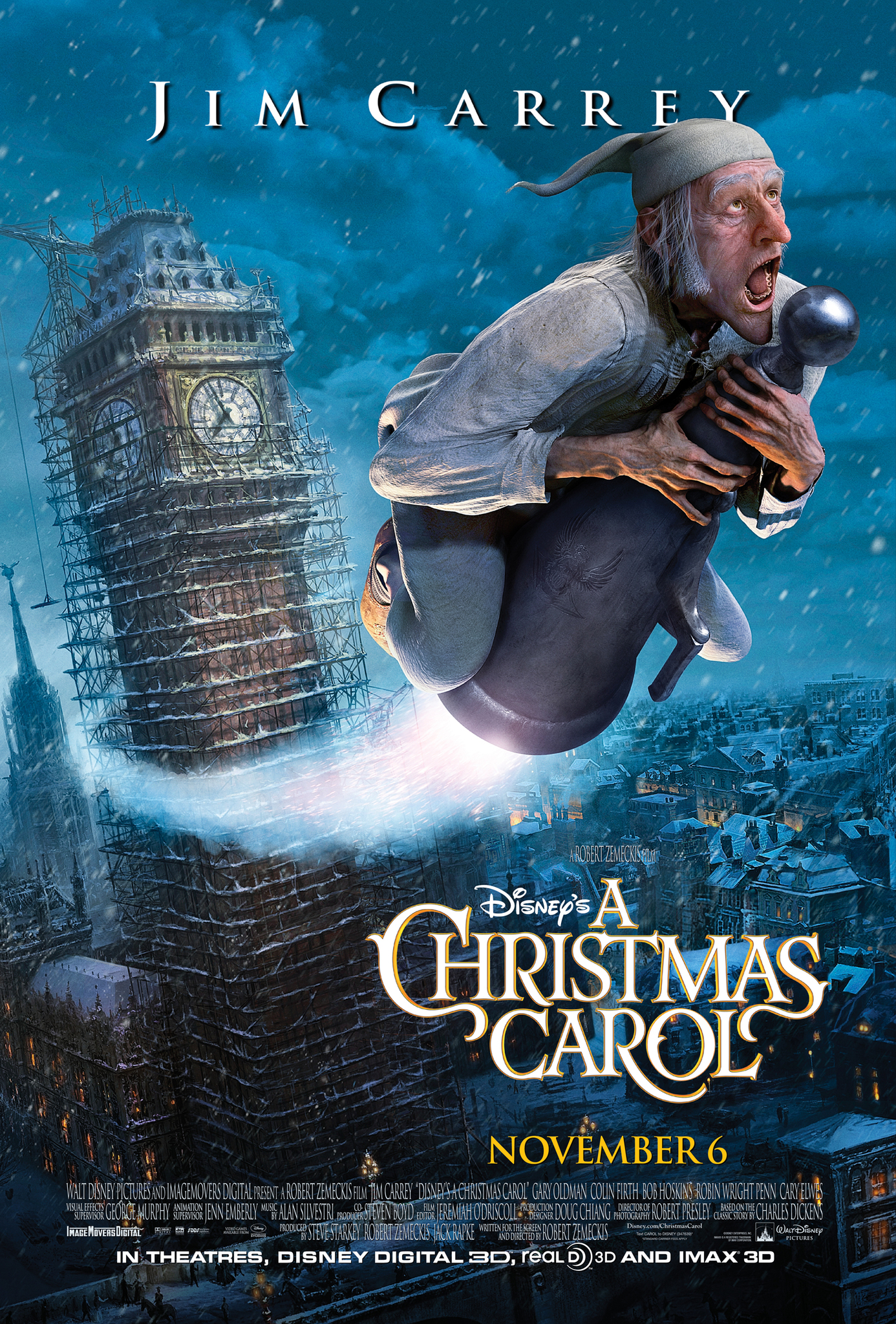
A Christmas Carol (2009) - IMDb

Take a classic Christmas tale, animate it in the creepy Polar Express method, cast Jim Carrey as Ebeneezer Scrooge, drain the tale of any nuance or subtlety, make the ghost of Christmas past child molester creepy and Marley so horrifying his jaw falls off, and dramatize it in such a manner that you fault cartoon characters for overacting, and you have a Robert Zemeckis holiday “classic.”  The only redeemIng feature is the guilty pleasure you’ll get when you imagine how terrified a child in the theater would be during this family film.  Grotesque.

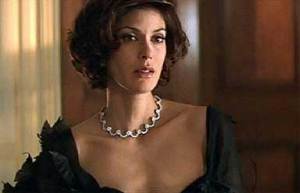
Daniel Craig’s second turn as Bond is moodier, not as brisk and bracing as Casino Royale.  Coming off the loss of the love of his life (pretending, of course, that George Lazenby and Pierce Brosnan never lost their hearts to Diana Rigg and Teri Hatcher),* Bond is bitter and ultra-violent, and he is made more so after an attempt on M’s (Judi Dench) life.  As he investigates, M upbraids him for killing all his leads, but Bond is driven, uncovering a sophisticated plot by faux-environmentalist Dominic Greene (Mathieu Amalric) to corner the market on a precious resource.

The plot is serviceable, and the film sports three exciting and audacious action sequences – car chase, boat chase, plane chase – and a thrilling shootout finale.  Amalric is also an interesting villain, not quite charming or brilliant, but casually efficient and super-creepy.  And of all the secondary Bond girls, Quantum features my favorite, Gemma Arterton as

Image result for Quantum of Solace Strawberry Fields sexy

Strawberry Fields

There is also a virtuoso surveillance scene during a performance of Tosca at the open air Opera building in Bregenz, Austria, as well as intriguing backstabbing between British surveillance and the CIA, which brings in my favorite Felix Lighter (Geoffrey Wright).

On the downside, after the death of Vesper (Eva Green) in Casino, Bond is perhaps too brooding in this flick, and the angst-level is often very high.  But you could have easily predicted the charge of excessive-seriousness, as if there were some bizarre nostalgia for the bonhomie of Roger Moore and Pierce Brosnan.   Given that director Marc Forster (Monster’s Ball, Finding Neverland, The Kite Runner) doesn’t come from action stock, it is easy to conclude that was perhaps taking itself too seriously.

Phooey.  This is one of the stronger Bonds.  It’s also distinctive.  Especially impressive is Foster’s filming of Bond’s escape from the opera.  There is no jacked-up Bond score, but rather, a dreamlike flight as Tosca dominates the soundtrack.

*  By the way, when Bond becomes emotionally involved with a woman, it’s hard to fault his choices:


Writer/director Martin McDonagh’s first feature is assured, intelligent, and deviously funny.  Two Brit hitmen, Ken and Ray (Brendan Gleeson and Colin Farrell) are exiled to Bruges in Belgium by their crime boss Harry (Ralph Fiennes) after Farrell cocks up his first job (a priest) and accidentally kills an altar boy.  What starts as a languorous wait, with Gleeson fascinated by the history of the town and Farrell bored to tears, becomes tense and edgy after Gleeson is given his next assignment (guess who?) and Farrell becomes more and more despondent over what he has done.  The duo sightsee, drink, do drugs and discuss morality, fate, death, religion, Americans, beer and various and sundry other topics until Fiennes comes to town to force the action.

The three leads are all very good.  Fiennes is a brutal yet charming Cockney, and Gleeson is a stoic solider on the brink of a moral epiphany.  But Farrell’s frenetic, comic-yet-tortured turn is the engine.  He’s barely a man, he’s killed a child, and he is denied any peace, having been placed in “bloody Bruges.”

A taste —

A vehicle for the skills of a host of accomplished Brit actors, this movie starts out swift and charming, as we watch our leads end up in India at a run-down retirement hotel that looked a helluva lot better in the brocuhure.  Judi Dench is recently widowed; Tom Wilkinson, fed up, abruptly resigns his judgeship; Bill Nighy and Penelope Wilton have had to scale down their retirement plans after an investment in their daughter’s internet company went bad;  Maggie Smith needs a hip replacement and can get it quicker in India; and Celia imrie and Ronald Pickup are fighting aging and simply along for the ride.  Directed ably by John Madden (Shakespeare in Love), the set up is deft and the upcoming culture clash looks to be fun.  Okay.  Love Actually for old people, right?

Instead, the film takes itself way too seriously.  The Nighy-Wilton union is crumbling.  Dench is regretful of her long-term marriage.  Wilkinson has a deeper secret underlying his removal to India.  Smith’s tale is even more woeful.  What seeemed a light comedy turns into a morose trek.  Even the comic relief (Slumdog Millionaire’s Dev Patel, who runs the hotel) has his own crucible – he must stand up to his mother and choose the one he loves (all with the help of some sound Brit advice).

The actors are really all very good, and they are elevating pedestrian material (not a thing happens that you haven’t guessed).  The resolutions are absurdly convenient and it ends sickeningly cloying.  Unlike Slumdog, the India portrayed here is all sweetness and dazzle, if a little crowded, and the Indian actors are given that child-like nobility that always comes off as condescending.   

The last 15 minutes is so rushed in its effort to provide a tidy, happy ending, it feels damn near like the entire endeavor was trying to make a flight.

It is in vogue to denigrate Will Ferrell, whose excess has long outlived its freshness. He’s slogged into one tiresome, repetitive project after another. Land of the Lost? A one-man show portrayal of George W Bush, The Other Guys, Casa di mi Padre, The Campaign, and soon, a repeat, Anchorman: The Legend Continues. His forays into a successful Jim Carrey-like branch-off started with promise (Stranger than Fiction) but his dramatic weaknesses were apparent in Everything Must Go. His last goofy semi-triumph was Step Brothers, which owed as much to the supporting efforts of the scene-stealing, diabolical Adam Scott and the inspired premise as to Ferrell’s adolescent sincerity as the arrested man-child, Brennan Huff.

Let us not forget, however, that when Ferrell was on a roll, it was an impressive one – Old School, Elf, Anchorman, Wedding Crashers . . . all a variation on the man-child theme, but classics nonetheless.

At the end of Ferrell’s run is Talladega Nights, the last hurrah, but what a hurrah.  Ferrell plays Ricky Bobby, an ignorant, flashy, uber-American NASCAR driver with a hot blonde wife (Leslie Bibb), a loyal race car compadre (John C. Reilly) who loves Ricky so much he happily takes second in every race, two horrific kids (Walker and Texas Ranger) and a gay French nemesis on the track (Sacha Baron Cohen). When Ricky is on top, it looks something like this:

When it all goes to crap after a brutal wreck, Ricky must re-connect with the itinerant father who abandoned him as a child (Gary Cole) and his old-school mother (Jane Lynch). With their help, and the help of a loyal, starstruck flunky (Amy Adams), Ricky regains his mojo and lives the VH1 comeback before our eyes.

The gags are inspired, the back-and-forth (much of which has to be improv, as evidenced by the bloopers in the credits) crackles, almost every supporting character delivers well (Molly Shannon as the boozehound wife of a corporate slime is particularly prime), and the chemistry between Ferrell and Reilly, which was very good in Step Brothers, is undeniable. After Ricky loses his nerve and then all, Cal replaces him, setting up in Ricky’s house and with his wife. But they do miss each other:

It’s uproarious, loaded with gem slogans (“If you ain’t first, you’re last”) and has as much fun as you can have with American excess. Even as silly an endeavor as this could have come off condescending and mean to “those NASCAR types” but Talladega Nights feels wholly respectful even as it goes to town on its target.

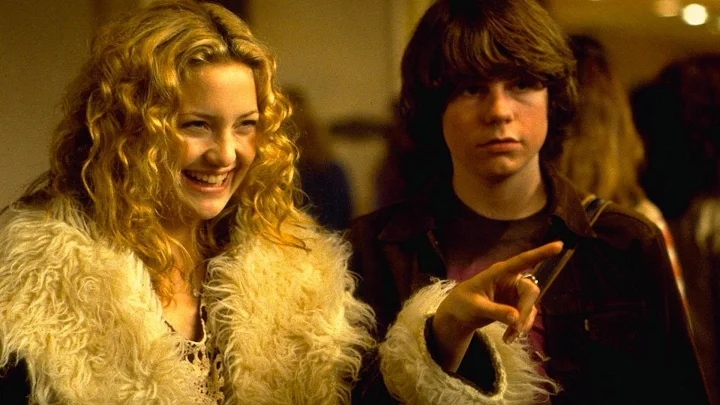
Almost Famous - Movies on Google Play
Based on writer/ director Cameron Crowe’s experiences touring with rock bands like Poco, The Allman Brothers and Led Zeppelin,
Almost Famous gives us Crowe stand-in Patrick Fugit, a 15 year old rock fan who writes for his school newspaper and a San Diego alternative mag.  His work garners the attention of Creem magazine and its famed rock critic Lester Bangs (Phillip Seymour Hoffman).  Bangs tutors Fugit, who gets an assignment from Rolling Stone to cover rising band Stillwater, fronted by the suspicious and bloviating Jason Lee and the more talented and enigmatic guitarist Billy Crudup.  As Fugit is ensonced with the band on the road, he is charmed by groupie (or, Bandaid) Kate Hudson while his mother (Frances McDormand) monitors his trip via regular phone calls.  Fugit falls in love with Hudson, who is in love with Crudup and considers herself a muse to both.

The film is unabashedly nostalgiac, particularly the scenes of McDormand allowing and then regretting letting her son go on the road with the band.  McDormand is a conflicted personality, half free spirit, half overbearing “DON’T DO DRUGS” nag.  But her affection for her child is undeniable and as she sees him grow up, their distance becomes more painful.  Worse, she intuits he has found a new family (all of whom assure her when she calls that she has raised a wonderful boy while raising the specter that he is being plied with sex, drugs and rock and roll).

This is a fan’s movie, interspersing great 70s rock with a coming of age tale.  Fugit evokes the awkward, sweet nature of a 15 year old lovestruck boy and his performance is beautifully sentimental.  Crowe shows no fear of the maudlin which is for the most part to the film’s advantage.  When the band and its coterie, breaking apart due to various strains on the road, spontaneously sing Tiny Dancer on the tour bus, you can imagine eyes rolling after reading the scene.  But it works perfectly, all part of Crowe’s love letter to rock.

This is not to say that the film never missteps.  It is occasionally too cute, a Crowe weakness.  At one point, Hudson tells Fugit, “You’re too sweet for rock and roll” as if it needed to be said.  Crowe then makes him prove it.  Hudson, despondent over Crudup’s rejection of her, overdoses on Quaaludes.  Fugit saves her and as she gets her stomach pumped before his eyes, he remains starstruck, mooning as she vomits (Stevie Wonder’s “My Cherie Amour” plays in the background).   In another scene, the band plane appears to be going down, and the members all trade simmering accusations and long held secrets, which feels pat and forced.

But by and large, the film’s tone is just right, evoking the memories of your first LP and the moments when your mother actually read the lyrics on a record sleeve and took it away.

There are also laugh out loud moments, my favorite being Lee’s first interview with Fugit, where he waxes poetic on rock:  “Some people have a hard time explaining rock ‘n’ roll. I don’t think anyone can really explain rock ‘n’ roll. Maybe Pete Townshend, but that’s okay. Rock ‘n’ roll is a lifestyle and a way of thinking… and it’s not about money and popularity. Although, some money would be nice. But it’s a voice that says, ‘Here I am… and fuck you if you can’t understand me.’ And one of these people is gonna save the world. And that means that rock ‘n’ roll can save the world… all of us together. And the chicks are great. But what it all comes down to is that thing. The indefinable thing when people catch something in your music.”

When the quote makes the article, his response is priceless:  “Rock ‘n’ roll can save the world”? “The chicks are great”? I sound like a dick!”

Midnight Screaming: Dawn of the Dead (2004) | The Long Take

AMC’s The Walking Dead is successful in part for its visceral presentation of a dystopian United States where calamity has not only brought the dead to life, but those dead have pretty much overrun the country.  Even more disturbing, our cast of characters has learned that all living people carry the virus that will make them zombies hungry for flesh after they die, and that only a post-zombification destruction of the brain can stop their lust for humans.

Still, zombies in The Walking Dead are slow, near catatonic (though, like me passing a Chick-fil-A, they get more animated when near a meal).  If you stay in an open space or avoid them in bunches, you should be fine.  These zombies are like the walking dead in George Romero’s Dawn of the Dead (1978).  Don’t get in an elevator without knowing what’s on the other side of the door and you should be okay.

This is a trial for the show’s writers, who have to continually come up with scenarios where the protagonists and the zombies must come to close quarters (i.e., the group just wrangled with hundreds trying to clear them out from a prison that, if habitable, will be the perfect fortress).

No such problem for Zack Snyder’s (300, Watchmen) unappreciated remake of Romero’s film.  Nurse Sarah Polley and her husband wake up to see a little neighbor child at the foot of their bed.  Awww.  Sally is sleep walking again. Nope.  She’s a zombie and she’s fast and she strikes like lightning.

And away we go.  The zombies are like bullets, carbon copies of the victims of “the rage” in Danny Boyle’s 28 Days Later.  The decision is brilliant, because now, it becomes plausible that zombies actually took over the world (a ridiculous notion if, to become zombies, they had to die, and then get up and move about at the speed of latter years Andy Griffith).  A motley crew of survivors, including Polley, Vingh Rames as a cop, Mekhi Phifer as a hood, Jake Webber as the conscience, and an impressive Michael Kelly as the security guard who traverses from self-interested and greedy to semi-heroic, hole up in the mall.  All is well until they try and help a man they can see from their binoculars and it goes poorly, to say the least.  What follows is a harrowing escape from a their breached fortress.

First time director Snyder makes his mark at the outset with an introduction showing the breakdown of society as scored by Johnny Cash

It’s a helluva a ride and has numerous touches that elevate the material.  I’ll list three.  First, the film has the guts to show us what happens to a baby in the womb if that womb belongs to a zombie.  Second, it can be very funny, one such moment being target practice on the top of the mall that becomes a competition to shoot Burt Reynolds:

Third, it features my favorite zombie ever

Ty Burrell of Modern Family.

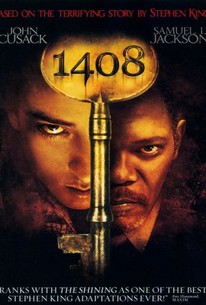
1408 (2007) - Rotten Tomatoes

With Halloween nearing, and my son in eighth grade, the number of scary films appropriate for him to see is increasing, and he is chomping at the bit (he’s already secured a promise from me that I will take him to The Exorcist for its 40th anniversary next year).  I remembered 1408 as having been both scary and appropriate and so we watched it this weekend.  It is scary and appropriate, but on a second viewing, it is pretty weak tea,

The movie is based on a Stephen King short story, so naturally, the protagonist (John Cusack) is a writer, and not just any writer, but that certain writer whose first book was brilliant and serious and moving, but it just didn’t sell (how could “The Long Road Home” not sell?).  Cusack is James Caan in Misery, even down to the sole cigarette.  So now, embittered, Cusack writes a schlocky travelogue based on his visits to haunted hotels, inns and B&Bs.  Cusack is enticed by an anonymous invitation to spend the night in New York City’s The Dolphin Hotel, room 1408.  Despite the best efforts of its manager (Samuel L. Jackson) to dissuade him, Cusack insists, and soon, he is ensconced and psychologically assaulted.

The lead up is good stuff.  Cusack is convincingly cynical in his pooh poohing and Jackson is effectively ominous in his warnings.  Moreover, the plot is equipped with a nifty “in” to the room – Cusack’s agent (Tony Shalhoub) engaged lawyers to find a civl rights statute that prohibits a hotel from refusing to rent an available room.

But there are only so many holes that can be patched.  Cusack learns that there have been 56 deaths, both natural and unnatural, in Room 1408, and Jackson also informs him that recently, a maid went in the room and gouged her own eyes out.  Cusack doesn’t believe it, which is fine, but Jackson knows the room is a meat grinder.  How in the world could the room be made available to anyone under any circumstances?  The civil rights law wouldn’t override gutting the room, or making it a part of the hallway, or simply declaring it off limits to any renter.   And who needs to tidy up this room?

This is a failure of writing.  There are any number of ways around the “we have a haunted room but it is still available” conundrum, but first, you have to cut the body count down by 46 to make its availability to Cusack, even under threat of litigation, reasonable, and its availability to victims 15 and up plausible.

Once Cusack gets in the room, it becomes a decent fright fest, starting with a few slight tricks (chocolates on the pillow appearing magically, a creepy clock radio that only plays The Carpenters).  Ghost jumpers follow, then an unexplained slasher and soon, you name it, it happens.  The room plays on Cusack’s pain, and torments him, inevitably, with the memory of his dead daughter.

Cusack is excellent as a man fighting losing his mind, but without backstory, the movie becomes all about the visuals.  And those remain interesting only for so long.

Still, state senator Clay Davis from The Wire (Isiah Whitlock, Jr.) steals the picture in his one scene as a reluctant air conditioning repairman.  So there’s that.

Sheeeeeeeeeeeeeeeeeeeeeeeit!

Certain films transcend criticism because of the place they hold in the national consciousness.  Saving Private Ryan is a forceful, indelible picture with opening and closing battle scenes so visceral I found myself ducking in the theater as a complete stranger in the seat next to me gripped my arm.  Shorn of the opening Omaha beach sequence and the fight for the town of Ramell, the film is just north of pedestrian.  Robert Rodat’s script is functional but hokey (the constant banter over Tom Hanks’ occupation is an example).  The characters – the intellectual, the caring medic, the goombah, the Southern, bible-loving sniper, the New Yahker, the Jew – are unrealistic archetypes.  The John Williams score is just so much syrup.

Who cares?  The picture means more than its parts and speaks to a certain time and sacrifice.     Every American high school kid should be forced to watch the damn thing the next time they bitch about the trials and tribulations of their lives.

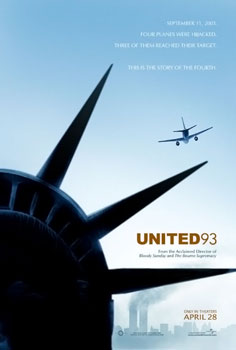
In many ways, 9-11 was much like the day American soldiers alit from their Higgins boats onto Omaha.  We were wholly unprepared for the savagery of the attack, we reeled at its success, and then brave and innovative heroes, ordinary citizens all, adapted, driving one of the planes meant to decapitate the government into a field in Shanksville, saving the lives of hundred and perhaps thousands of others.  Paul Greengrass’s film depicting that day, however, suffers no flaws and accordingly, does not need to transcend criticism.

Greengrass made his mark with a style blending documentary and drama in his depiction of a 1972 Irish civil rights protest march and subsequent massacre by British troops, Bloody Sunday.  As in that film, in United 93, Greengrass keeps us just over the shoulders of the military authorities, the air traffic control personnel, and the passengers of United 93 as the horror of what is occurring dawns on them, paralysis sets in, and then the process of acceptance and adaptation commences.  We’re there, but we are not, and we feel thankful for both the intimacy and the remove.

The casting is brilliant.  A decision was made to use actors who are familiar but who are not stars.   You know you’ve seen many of these people, but they do not bring any recognizable persona, so they feel real.  For the passengers on the plane, Greengrass went out of his way to cast actors who looked like the person they were playing.  Moreover, he wanted people who had a tie to the project.  As explained by Greengrass, “What we did on this film was to gather together an extraordinary array of people wanting to get this film right, aircrew from United Airlines, pilots, the families of the people who were onboard, who gave us a sense of what their family member might have done given the type of person he or she was in any given situation; controllers and members of the military. We had a lot of expertise that in the end allows you to get a good sense of the general shape of events.”

Finally, Greengrass at no point indulges in communicating a larger message.  In Saving Private Ryan, Spielberg, as always, just couldn’t trust his audience.  He had to have Hanks tell Matt Damon “Earn it” even though the story was told skillfully enough to leave it unsaid.  Greengrass is a neutral, not in the ideological struggle of 9-11, but in the explication of evaluating these people at this critical time.  The result, for me, was a clearer vision of just how extraordinary the acts of heroism were.


William Friedkin is apparently “back” with his black crime picture Killer Joe, but he never really went away.  I suppose what critics mean about Friedkin’s return is that he’s “back” in his 1970s The Exorcist and  The French Connection form, the one-two punch of Friedkin’s career.  These films are nothing to sneeze at, the former being the greatest high-brow scare flick ever made, the latter number 93 on AFI’s top 100, but since those halcyon days, Friedkin suffered his Heaven’s Gate (Sorcerer); helmed some off-kilter duds (Deal of the Century, a black comedy about arms dealers with Chevy Chase (?)) and Bug (here’s the IMDB set-up so you can run quick to your Netflix queue — “An unhinged war veteran holes up with a lonely woman in a spooky Oklahoma motel room. The line between reality and delusion is blurred as they discover a bug infestation”); and delivered a gripping, underappreciated crime picture that utilized the musical stylings of Wang Chung for the score (To Live and Die in LA).

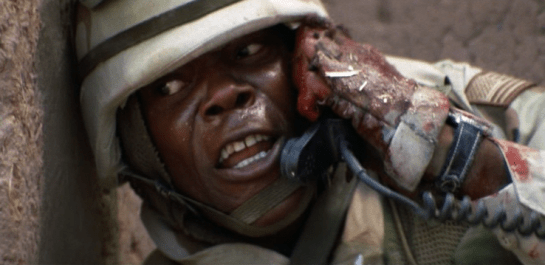
Rules of Engagement, an effective, thoughtful, political potboiler about a Marine officer (Samuel L. Jackson) tasked with protecting an American embassy under siege in Yemen.  In extricating embassy staff, the ambassador (Ben Kingsley) and the ambassador’s family, Jackson gives the order for his men to fire into a crowd that includes women and children.  For that act, he is brought up for court martial and must rely on his Vietnam pal (Tommy Lee Jones) who is squaring off against a tough, determined prosecutor (Guy Pearce).  The shooting is recapitulated from various vantage points, the characters compellingly provide their assessment of what happened (of particular note, Blair Underwood, who was probably too good looking to be a bigger star, is excellent as part of the Marine contingent), and political skulduggery is uncovered.

The picture moves fast, alternating between flashbacks of the shooting, courtroom drama and a sojourn back to ‘Nam.  It is also topical and adult, reluctant to direct us to any pat conclusion (Stephen Gaghan wrote it, and followed it up with the Academy Award winning Traffic and the Academy Award nominated Syriana).  Jackson and Jones are not exactly breaking new ground here, but they are very good actors who know what to do with the material.  Finally, with the exception of Kingsley (whose imperiousness and cowardice are cartoonish), all the characters feel real.  Roger Ebert disliked the film, noting, “At the end we have a film that attacks its central issue from all sides and has a collision in the middle.”  That’s exactly true, and it is the movie’s strongest attribute.  There is no assured resolution of many of the issues it raises, but the story at the center holds you to the point where you can come to your own conclusions.  The political shenanigans at the end feel very tacked-on, but otherwise, this is a strong movie.

Of course, anything less than a full filmic indictment of the Jackson character was enough to send some reviewers into apoplexy.  Hence, Michael Atkinson from The Village Voice: “William Friedkin‘s bathetic flag-fucker Rules of Engagement is as dogged and concise an apologia for using militarist might to control civilians as any City Hall publicists could ever concoct . . . . Who’s talking this neo-con psycho-talk, exactly”?   Given that, as noted, Gaghan wrote it and was pilloried later by the right for his allegedly lefty take in Syriana, consider Atkinson’s broadside a strong recommendation indeed