Archive

2024

There are figures who defy biography. Some are dolts who we lionize because of an electric public persona, but after we peel back the skin, dig in, and nothing but soft goo is revealed, we adorn them with meaning if only to combat the dullness and our disappointment. Some are opaque, having lived a purposefully secretive life that does not lend itself to exposition. Some are so mythic, hagiography follows, lest a god be sullied. And many are just boring through and through, even if their impact was monumental.

How best to approach Donald Trump? I was thinking about why Saturday Night Live has such a problem caricaturing Trump and concluded that it is difficult to lampoon a cartoon. Trump is thuggish, brash, bombastic, ridiculous, and his persona – both before and during his political career – is that of someone who is already playing a part, man as product. Someone once observed that Bill Clinton was the most authentic phony they’d ever encountered, which makes him Trumpian on one level. The persona so effectively swallows the person that the former becomes innate.

Now, I don’t know what Donald Trump (or Bill Clinton, for that matter) is like privately, and Hollywood has yet to take on Clinton in biopic (we’ve had snippets, most recently Ryan Murphy’s rendition of the Lewinsky scandal, but nothing penetrating or overarching). And neither does screenwriter Gabriel Sherman. But he takes a fair stab, and it’s a game effort, for a time.

We meet Trump (Sebastian Stan) in the 70s, an ambitious son of an old-fashioned real estate developer who strives for entrée’ into tony Manhattan clubs while working for Daddy, collecting his rents in cheap New Jersey apartment housing. Donald has a dream – to develop a hotel in the then-hellscape of 42nd Street – something his father (Martin Donovan) considers an ill-advised fantasy. But Trump persists and soon, he meets another father figure, Roy Cohn (Jeremy Strong), who becomes his tutor and mentor. Cohn, a sybaritic fixer, protégé’ of Joe McCarthy, and executioner of the Rosenbergs, blackmails those who attempt to thwart his new charge, facilitating Trump’s rise. We watch Trump ascend, while negotiating the death of his alcoholic brother, eclipsing his father, and falling in love with Ivana (Maria Bakalova), all the while with Cohn in his ear. This is the part of the film that works, as we see a progression, both maturation and degeneration.

When we hit the 80s, Trump is on top, Cohn is crippled by AIDS, and their relationship deteriorates. With what feels like the snap of a finger, Trump is callous and brutal, as he repeats the Cohn mantra (attack, deny, always claim victory). But we don’t really see him ever employ those rules. In fact, he just reappears as a brute, and we are treated to the litany of rumor, concoction or well-known unflattering fact without context or explanation. Trump abandoned his brother, raped and verbally abused Ivana, tried to take financial advantage of his doddering father, gave Cohn fake diamond cufflinks, swung and missed in Atlantic City, took a lot of speed, wrote The Art of the Deal, mused about a political future, got liposuction and a scalp reduction, and is a germaphobe. One box after the other perfunctorily ticked. Just overt capsules, with all character-development jettisoned for dizzying visuals of the corrosive jet set life.

I suppose Sherman was trying to portray the seduction of Trump in concert with the go-go 80s, but it was done much better by Oliver Stone with Bud Fox in Wall Street, and even that movie can be garish and obvious.  

What does work, however, works very well. The Trump-Cohn relationship is beautifully drawn. The elder sees talent and vitality in the son he never had and a young man he refrains from seducing sexually, while the understudy finds the father who truly believes in him. When the former imparts his wisdom, it would have been nice if Sherman could have employed it more directly as the basis for Trump’s rejection, but it is enough that the devil gets his comeuppance from his Frankenstein, and you know it works, because you kind of feel bad for the devil.

Stan and Strong are riveting and I expect both actors to be nominated. Even if they were undeserving, Trump is irresistible bait for the Oscars and given the unflattering vignettes of the film and the fertile environment for decrying the Bad Orange Man, we and the Academy shall not be denied.  

Luckily, the actors are deserving. Strong is quickly becoming one of the most innovative character actors of his generation (I cannot so on enough about his turn in last years’ Armageddon Time, which, ironically, also included a young Trump character), and Stan manages to humanize a cartoon while incorporating the now ubiquitous Trump cadence and physicality, but doing so in a way that shows the features in infancy, so we can envision what they will be when we turn on our TVs today. Per Sherman, “And I think what Sebastian did so brilliantly is that he doesn’t try to impersonate Trump. He finds his own version of the character. And it works in a way where you feel like you’re watching a real person. You’re not watching Sebastian trying to be Donald Trump.” Dead on.

A solid, game, entertaining, very flawed near-hit that peters out.

On demand.
Writer-director Jeremy Saulnier’s Blue Ruin, an earthy, dark meditation on the messy and corroding influence of family blood oath and violence in rural Virginia, was such an assured debut, I was blown away. He followed up with the canny, creepy Green Room – where a band gets the worst gig ever playing for skinheads in the Upper Northwest – a commercial failure, perhaps because it was such a grounded horror film. No unstoppable evil or chop-licking psychos, just nasty, human, unregulated criminals with Swastikas and 12 packs who dig punk rock and live in the deep, deep woods. 

Rebel Ridge again showcases the director’s dead-on familiarity with small town America. No Chevy Truck “backbone of the USA” schmaltz or easy tropes of the rural downtrodden being done in by “the man’s system.”  Saulnier understands that most people are in some form or fashion paid by “the man’s system” and that system is what keeps mortgages current, power boats afloat, and Carnival cruises filled. In the small Southern hamlet that is our setting, graft, skimming, and railroading drifters end up just being part of the fabric, the next logical step for a speed trap town. 

What follows is a gripping, subtle melange of liberal fear of cops and conservative “power of the deep state” fear of the government, good old fashioned small town Walking Tall corruption via asset forfeiture and  … Rambo: First Blood.

No preening, no speeches, a lot of surprises, and a boffo, visceral, satisfying revenge fantasy ending, powered by Aaron Pierce’s reserved, steely leading turn. 

In spots, a bit ragged for Saulnier, and there is an underdeveloped relationship between Pierce and a plucky court clerk (AnnaSophia Robb), but those are nits.

On Netflix. 

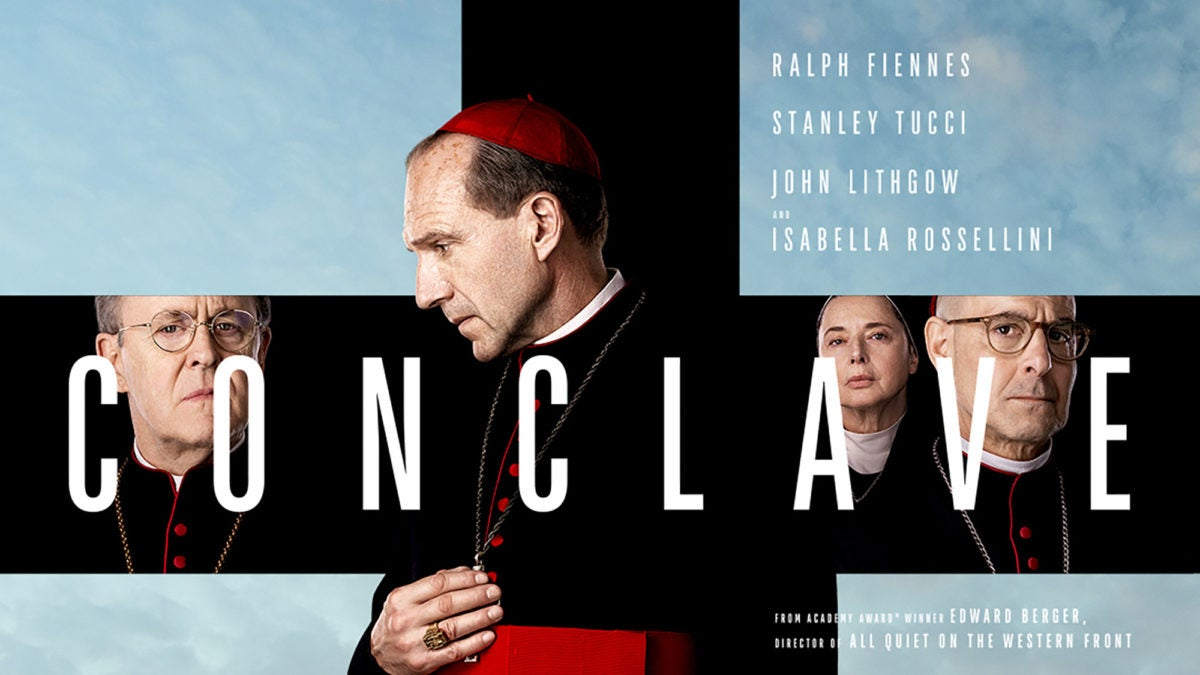
A movie that works beautifully on several levels.  First, if you ever wanted an “inside” look at how a pope is selected, someone did their homework. Just like William Peter Blatty’s research into the ritual seemed so authentic in The Exorcist, and the hierarchy of a late 60s parochial school was nailed by John Patrick Shanley in Doubt, the convening of the cardinals to pick the next pontiff exudes legitimacy. Based on a Robert Harris novel, screenwriter Peter Straughn has a solid feel that comes from some religious experience and curiosity (“It was a world I was interested in. I was brought up Catholic. I was an altar boy, and I went to a Catholic school, so, in some ways it felt like home territory, even though I’m no longer a believer. I had one foot in the world and one foot out, so that interested me”).

Second, and I can’t write much on this, there is a satisfying Sixth Sensian reveal that is confident enough to leave it at that, without delving into the machinations of the ultimate selection. I was concerned we’d recap with a Murder on the Orient Express flashback diagram, but the picture is less about how we got to the selection than what it meant to get there and what it means. Better, the end is the kind of reveal that could have been wielded like a sledgehammer, but Straughn and Director Edward Berger (All Quiet on the Western Front) celebrate subtlety over all else.  

Third, the film is a feast for the actors. Ralph Fiennes is masterful in his portrayal of the manager of the conclave, fighting his own ambition and anger at his designation as a mere facilitator rather than a spiritual leader. Fiennes is ably supported by John Lithgow, Stanley Tucci, Lucian Msamati, Sergio Castellitto, and Carlos Diehz, who represent different future paths for the papacy while vying for the top slot. Isabella Rossellini plays her own game as the sister who, for lack of better title, is the site manager for the election. Her hand may be well hidden and guiding, but given her near vow of silence in the world of men, even though her face tells so much more by necessity, nothing is confirmed. Nominations will be accorded generously and she is a shoo-in.  

Last, the Catholic Church comes out well in this. In and of itself, not necessarily a recommendation, but the movie offers a different view of an institution so maligned of late that another broadside would just feel hackneyed. Sure, there are shenanigans and skullduggery, but there is also great deference to the awesomeness of the task, the mysticism and seriousness of the process, and the weight placed on the jurors. The debate between the “new” and more traditional Church is also given a fair airing and ultimately, without taking a side, the picture elevates a philosophical point to a logical, if arguably heretical conclusion.        

One of the best of the year.

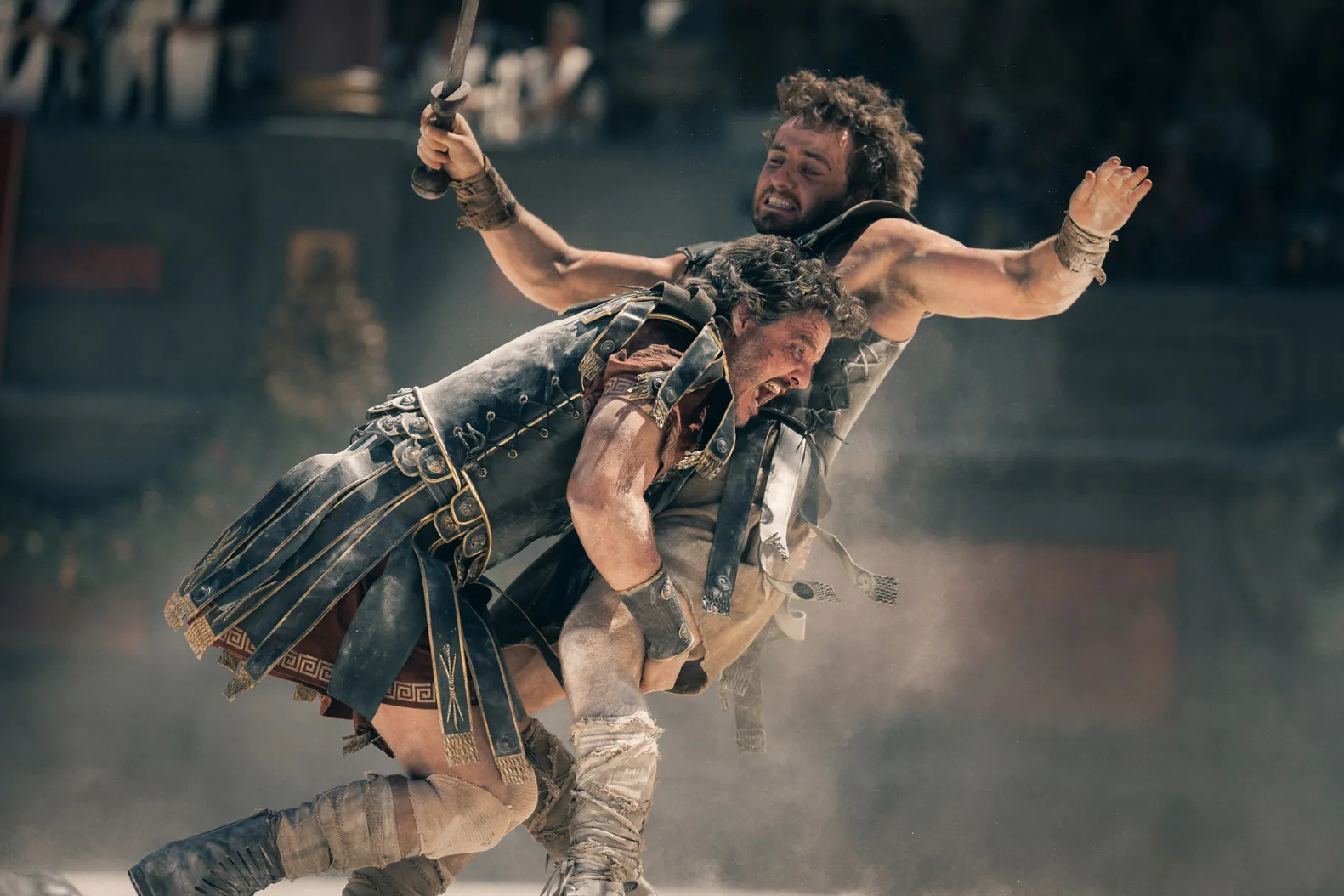
Imagine Gladiator, a fun, glorious, bloody romp. Now, forget about that film. It will only make things worse.

Here, the lead is not the captivating Russell Crowe but rather, the much younger Paul Mescal. Mescal has none of Crowe’s gravitas. He is not a Roman general, weary of war and politics, who just wants to go home to his wife and children. Instead, he’s a happy agrarian bean-picker, kissy-facing with his wife, when a new Roman general (Pedro Pascal) threatens their idyllic, multi-cultural commune in Africa. Mescal and wife strap on their gear and fight side-by-side. Pascal wins. The wife dies. And now, Mescal is a slave, soon to be gladiator, bent on revenge.

So, the same picture, but worse in all respects.

Every smart line in the original is replaced with “up with people” pablum and a dull dispute as to whether there is a “glory of Rome” or a “glory to the idea of Rome”, and every minor character who exuded their own agency and flair in the first film is replaced by cookie cutter figures infused with a boring wisdom that anachronistically presents as spiritually worldly.

While Gladiator II provides more combat than the original, it is juiced with unconvincing CGI monkeys, a big ass rhinoceros, and sharks. Even the hand-to-hand combat seems obligatory. You don’t care and no amount of spraying blood, gutting, and decapitation can involve you.

Our protagonist, Mescal, is supposed to be filled with “rage” but, at his most engaged, seems ironic and perhaps annoyed. The romanticism of the first picture was fueled in no small part by Crowe’s seething hatred at the needless and cruel slaughter of his family. Here, you think, “Maybe Mescal wasn’t so into his wife.”

There is little you don’t see coming. Mescal is the biggest non-mystery man ever and when the film finally gets to someone who can generate interest – gladiator merchant Denzel Washington – his grand plan and motive hit too late and quickly, right when you are nodding off. Washington, however, is at least having fun. Everyone else seems to be in mid-root canal.

And no one seems Roman here. The machinations are more on-the-fly than crafted, the concern for the people preposterous, and the finale – where two armies unite with “Huzzahs!” after an unconvincing “aren’t you sick of death?” speech by Mescal – has the feel of the old Coke ad where everyone wished they could teach the world to sing.

There is no greater dissonance than the emperors. In the original, Joaquin Phoenix was delicious, funny, just chewing scene after scene, but also substantial. Here, we have two emperors, sybaritic brothers who flounce about and exude a “let them eat cake” mien. They have no backstory, no goal, just dull, giggly, face-painted, effeminate schtick.  

Interminable. Avoid. 

This entire review is a spoiler.

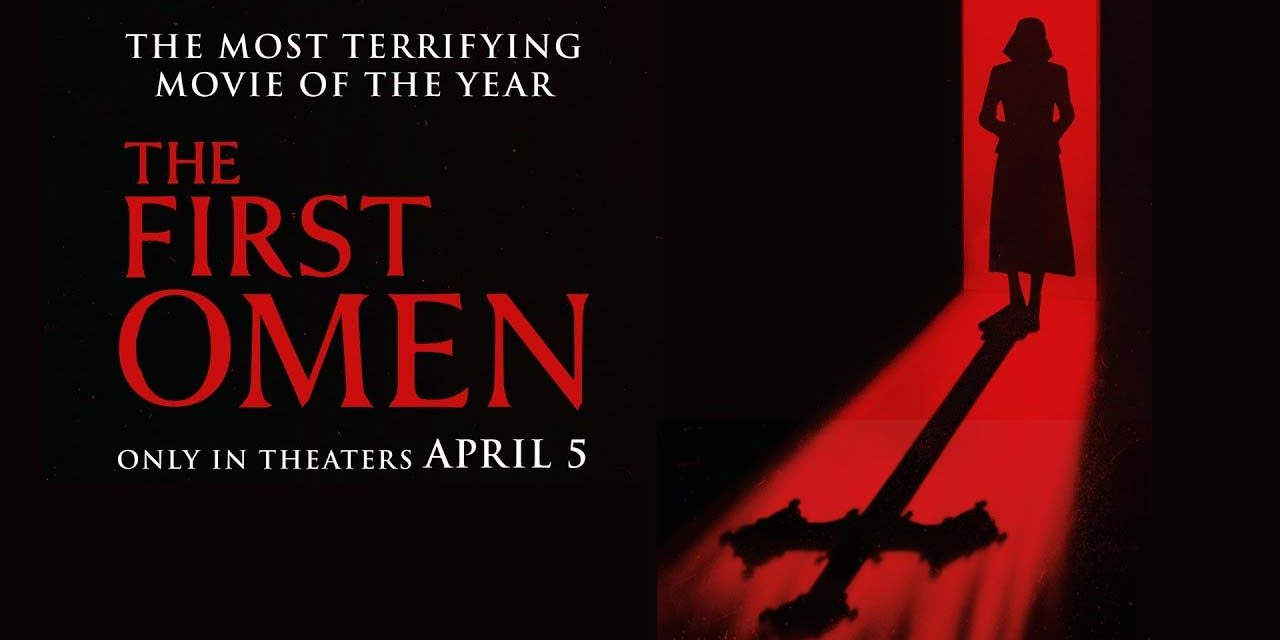
As you may or may not know, when Damien Thorn was placed with the American ambassador to the Vatican (Gregory Peck), his own wife (Lee Remick) had just “lost” their baby during childbirth. Mrs. Thorn would have been devastated, but the ingenious Catholics were Luigi-on-the-spot, procuring another baby boy – Damien – for the old switcheroo. Soon, Damien is in America, freaking out baboons, having the temper tantrum of the ages when driven to church, and killing (or having killed) everyone in his way, including, eventually, Mom and Dad.

I’m a huge fan of the original and even like the sequel, where William Holden and Lee Grant have to deal with their devil of a teenage adopted son. I sort of lost track after that but understand there was a third flick, which wasn’t so good.

So now we go back to before Peck and Remick became the unwitting guardians of Satan. It is 1971 and Margaret, a fresh and seemingly innocent nun, comes to Rome, where she is stationed at an orphanage. Before long, she notices strange doings, and is soon approached by a dissident priest, who informs her that this is no ordinary orphanage, but rather a cabal of right-wing radicals within the Church, so desperate to regain power against secularism – gasp! – they are willing to bring Lucifer back in human form, if only to make themselves relevant.

Because evil had been on a real downslope in the century.

As a cultural Catholic, well-versed in the Church’s byzantine rituals and excesses, I have a lot of bandwidth for this kind of silliness. But even for me, this is painfully stupid. And also, I think, a ripoff of Ron Howard’s hideous fireman movie, where an embittered fireman lights a lot of fires in Chicago to avoid budget cuts.

You do not want to steal a lot from Backdraft.

Sure enough, Margaret finds a fake door that brings her to old files of hideously deformed babies.

The orphanage is, in fact, a baby factory, where Satan (in the form of a jackal) impregnates the girls. Most of the grotesque babies die, confirming they are not The One.

But Old Satan keeps at it.

And I think, this is a ripoff of M. Night Shymalan’s Unbreakable, where Samuel L. Jackson blows up every plane, train and automobile he can hoping to find the “unbreakable” Bruce Willis, who will have survived what cannot be survived.

Also stupid, but somehow, it worked for me.

When Margaret rifles the files, there is a missing picture of one of the would-be hosts.

Guess what?

That girl is Margaret.

You see, the whiz kids in the rectory figured out that if Satan mates with his own spawn, and a child is delivered, then the Church will finally get Damien, not a deformity, and the pews will be full again! And when Margaret first got to town, her nun roomie took her out clubbing, like when the Amish get one crazy weekend in New York, and someone slipped Margaret a mickey so the Devil could get at her.

So, Margaret gets a C-section in the creepy catacombs, and Damien is born.

As is his twin sister.

Sigh.

This is not as bad as it reads. There are some very scary touches, and a smart buildup.

But there is no fun in this picture. In the first Omens, there was real dread and investigation as Peck got closer to the truth, and you wanted to know how folks who found out were going to buy it, and if they’d get Damien in the end.

Here, Margaret acts rather than thinks, and she does not need to be persuaded – dawning hits like a blinding light rather than a slow revelation. Why keep any files at all? Lazy lazy lazy.

Worse, we know they don’t get Damien, and how people meet their end is either repetitious (as in the first movie, a priest catches a piece of a church in the skull and a nun hangs herself after announcing, “It’s all for you!”) or just humdrum.

What is built up to is so hurried and confusing, it cannot sustain interest.

Also, if Margaret is necessary for coupling with Satan and producing Damien, why are the evil nuns so mean to her?

Well, I know the answer to that.

Nuns can be mean.

The umpteenth remake of Stephen King’s classic tale of a town feasted upon by a vampire.

A sickness borne of a haunted house in an isolated New England hamlet, a pre-COVID parable for an existential plague, and Halloween approaching? I’m in. I mean, it’s Stephen King, fer crissakes!

Plus, the story lies deep within me. When I saw the original Tobe Hooper miniseries as a kid, it was at my friend Joe’s house on a school night. I had to ride my bike home in the dark alone right after the episode where the first victim – a boy – is killed. I was more than freaked out. I was terrified.

Well, had I seen this version, it would have been me whistling zip-a-dee-doo-da. Not a care in the world.

Hard to settle on any one fault. Just riddled with nonsense and idiocy throughout.

Off the bat, the vampire familiar (a Renfield stand-in) who brings his master to the town is so laughably sinister he should be twirling his mustache. When he steals a little boy to feed him to the Nosferatu, he tells the kid what’s going to happen, so we, the morons, are not confused.

“Master!  Dinnahhhhhhhhhhhhhh!”

And when the little boy goes missing, all signs point NOT to the mustache-twirling Renfield character but to the famous author from New York who has come back to his hometown. Sure, let’s definitely not look at the weirdo who just opened a creepy antique shop and had a big coffin shipped in. What would be the point of taking a closer look at the new guy who also follows kids slowly in his stupid old car practically handing out Werthers? The guy who also bought the old Marston house, which has been haunted for 40 years?

No. It couldn’t be him.

Must be the aaaaaahhhthaaaaaaaah from New York.

Another. When they try to convince the doubting town priest of the infestation (we know he is doubting because when someone asks if he knows the time, he says, “There is no God” and when someone asks when Mass is, he says, “I’ve lost my faith”), they bring him a book.

Dracula.

Swear to God.

Okay. One more. When they try to get at the vampires, it is always-

A) 7:30 am
B) 9 am
C) 10:30 am
D) 6:54 pm

Guess!

The flaws of this execrable flick aside, like a lot of movies based on Stephen King’s work, it also sports the same lazy hallmarks. A town of bullies, dimwits, busy-body caricatures and Baaaaaahhhston accents. A school principaaaaaaaahl who knows the bully but appears powerless to do anything about him. A sheriff who calls pernicious anemia persimmaaaaaahhhn. A place that does not like outsidaaaaaaahhhhs. Everyone just this side of cartoon.

In the original mini-series, there is a beautiful scene between a loner teen son (Lance Kerwin) and his father, the latter unable to connect with his geeky boy who is so into monster mags and magic and all that is spooky. It sets up the later relationship between Kerwin and the returning author (David Soul), who as a little boy was also fascinated and traumatized by the Marston House. The characters have a connection and a backstory and as the town degenerates, they cleave together as, at first, the only two believers.

Here, the Kerwin “character” is an Urkel knock-off able to suss out the vampire infestation with a quick read of a comic book (presumably, because the priest had the sole town copy of Dracula) who is given nothing to work with other than moxie. In fact, everyone kind of lands on “vampire” pretty quick. So quick, I expected someone to say, “Hey, isn’t this what happened to a town in an old Stephen King book?”

Basically, there are no characters. Just targets for the night feeders.

Bad, through and through. Depressing.

On MAX.

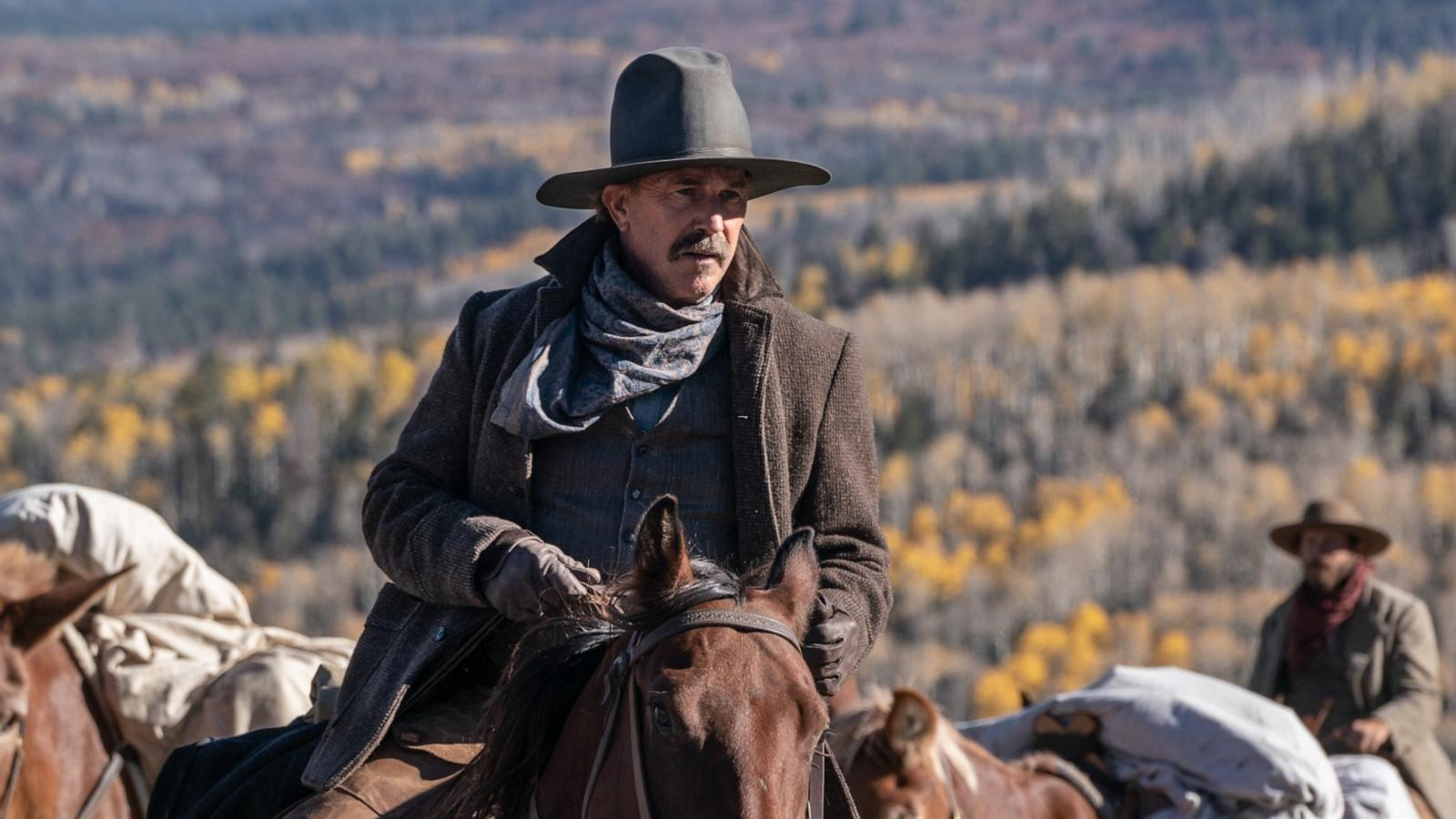
Kevin Costner had a dream.  Four theatrical releases for an ongoing Western. As foretold in the title, a “saga.”

Well, the dream is a bit deferred. Or curtailed. Hard to say.

The first picture – Horizon: An American Saga – Chapter 1 – clocked in at 3 hours, cost $50 million, and returned about $30 million, after which, it was quickly deposited on HBOMAX, where I caught it this weekend.

The story is ambitious. Set in the early 1860s, there are four separate threads that will converge, spanning the Montana territory to the San Pedro Valley in Arizona. There is a fair amount of exposition which is strange, given that Costner’s last two westerns (the overpraised Dances with Wolves, and the under-heralded Open Range) were downright laconic. There’s a lot of chatter, and some of it is sharp (Costner and a would-be assassin walking up to the same cabin, neither knowing the aim of the other until they reach their destination, is a master class in tension building), and some of it anachronistically wearying (can we finally let go of the noble Apache, who dresses down his violent son, “for now the white man will come and make us miserable and throw trash at our feet on a highway in the 1970s, which will make us shed a single, terrible tear”?)

Overall, it is fine, and if you like westerns, you’ll like this. You won’t love it. But you’ll like it.

Even if you don’t dig the picture, the film is shot so beautifully, you often thrill to the visuals without a sense or care as to what is going on.

But it ends just terribly. Horizon 2 is in the can and releases in November, thought likely not in theaters.  Horizon 3 is filming.  Horizon 4 – who knows, but Costner is putting on a brave face.

At the end of Horizon 1, there is a long preview of what is to come, no dialogue, just visuals, as if Costner is desperate to keep you engaged. I stopped it because it showed the intersection of characters and violent, maybe lethal encounters, threatening to ruin what may be coming.

But the gambit seemed a bit needy. Poor choice.  

Goddawful, save for the winning Glen Powell and the fact I saw it in 4D, so the chairs moved and rumbled, wind blew on us, and lightning flashed in the theater.

Sensurround updated!

Otherwise, a complete dung heap.

Our story begins in Oklahoma, with one set of DEI/ChatGPT generated, wisecracking, riffing storm chasers, led by the charmless Daisy Edgar-Jones (Where the Crawdads Sing). Their endeavor feels like a Mentos commercial, until catastrophe strikes, and then it feels more like a darker Skittles commercial.

Five years later, after Daisy has run away from her fears to New York City, she is drawn back home, because, well … she’s a tornado whisperer. She can scan the topography, watch the wind disassemble a dandelion, take a deep breath, and she just knows where that pesky sky is gonna’ funnel.

Soon, she runs into Powell, a YouTube sensation who chases, or “wrangles,” tornados for fame and followers. Daisy must overcome her fears. Glen will help.

She also confronts the laziest form of corporate skullduggery one can imagine (so thin it is dropped immediately).

The script is banal and nonsensical. There really is nothing to say other than, “whoa!” given the impressive CGI and pyrotechnics (though someone does say, “be careful out there” – ugh), so you wait on some solid jokes and clever banter to get you to the next tornado, maybe some insight into other characters beyond “quirky” and “loud” and “ostentatiously, individualistically hip.”

Not gonna’ happen. Sure, there are a few spots for Powell to shine. But otherwise, he too has a coterie of kooky storm chasers, and they too look and speak like they’ve been assembled by a DEI/ChatGPT witch doctor, and while they all say “whoa!” differently, they don’t say it in a funny or interesting way (SPOILER – not a one of these wafer thin “characters” dies, which is a huge disappointment).

Powell pretty much has to steer this leaden ship with his impressive charm. God knows he tries, but he is thwarted by his co-star and a script written for dimwits.

Edgar-Jones has two faces – sad and sadder. So, for a rollicking, high octane joyride, one of your hosts is on thorazine, and Powell just can’t get past, into, or through her innate dullness.

And when they bond, there is nothing for them to chew on.  Case in point,  They are at a rodeo. Glen thinks Daisy is from New York City originally, so he is showing her the sights. There is great potential for some fun to be had here, the girl who knows the rodeo like the back of her hand letting the cowboy puff out his chest and wax poetically. But no. The kicker is she gets to say, mournfully, that this is not her first rodeo.

Then they talk about their first tornados. Again, this doesn’t have to be Oscar-worthy, but you can have a decent sexual double entendre or two here. God, anything to break up the verbal monotony. But Daisy demurs, Powell tells a story of how he saw one when he was 8 and realized he was supposed to be scared, she asks if he was scared, and he says . . . “yes.”

This is unintentionally moronic dialogue better suited to Idiocracy. Or Quest for Fire.   

As badly abused as the audience may have been, the people of Oklahoma are sitting on a winning class action suit for defamation. Here they are, living in a hellscape where tornados appear in an instant and ravage their communities. It’s all over the news! But damn if they don’t insist on proceeding with the town fair or the Little League playoffs or the Annual Pie-Eating Contest or running lightweight old-timey trolley cars down their streets.

Those plucky Okies won’t be dictated to by mere weather!

Yet, when the tornados arrive, you’d think these weathered veterans were from New Hampshire. They run around screaming and trying to gather belongings, hiding under metal containers, holding knives and bags of broken glass, doing all the other things people in tornados are advised not to do, until Daisy and Glen show up to remind them to seek shelter.

In a movie theater.

That is playing Frankenstein.

Because they don’t get first run movies in Oklahoma.

They do get a shitty country song about how you can’t spell Oklahoma without “home” and there’s a lot more of those ditties throughout this dog.

Gonna’ have to give a second look at Sharknado after this turd.

There are very real and unsettling moments of dread and terror in this story about FBI agent Lee Harker (Maika Monroe) tracking a serial killer in the rural areas of Oregon, circa 1990s. The film is eerie, creepy, and meditatively brooding. It also commendably avoids gore porn and hackneyed, now seemingly obligatory jump scares, while credibly blending the occult with the manhunt. Director Oz Perkins is deft and ingenious with the camera, particularly in flashbacks to various murders. He, or his editor, know how to cut a film.

But … the picture is loaded with plain dumb choices. Perhaps the dumbest being the selection of Nicolas Cage as the serial killer.

I’m not spoiling anything. He appears in the first scene and he is most definitely the serial killer. Ghostly white, screechy voice, clearly deranged, and yet, comfortably ensconced in the same community that has been suffering mass killings for a significant period of time. He’s almost as bad as Pennywise, the clown in It, who lives in a burg where children have a 43% mortality rate. Okay, the FBI can’t really do anything about a supernatural clown that haunts the sewers, though people inexplicably stay in whatever preposterous New England town Stephen King presents (“But honey, the teacher-to-student ratio in Londonderrychester is to die for!”). But a clearly deranged loon who looks like the adult child of Edgar Winter and Phyllis Diller flipping out when he buys supplies at a hardware store that he frequents, and no call to the police? Too much.

The story also relies on a plot device that could work if some care were given. A little bit of a spoiler does follows in this paragraph. The supernatural force controls individuals, and thus they are possessed, for lack of a better word, into doing the Devil’s work. The explanation of how that possession works, is, shall we say, lacking in elucidation (a trusted film correspondent writes, “The silver ball. WTF? Dumb. Dumb. Dumb”). There is also the problem of how the ball is deposited. Better suited to the 1950s and early 60s in terms of getting a foot in the door. Not in Bill Clinton’s America.

There’s also the issue of Agent Harker, who appears to be on the spectrum and whose own tortured background plays heavily into the story. She just doesn’t seem like an FBI agent. She veers between catatonic and stilted, but Monroe can’t imbue any heart. It is critical you care about her fate, but as presented, she’s often just above a mannequin. Worse, other characters (her boss, Blair Underwood and family) are supposed to somehow warm to her, which, given her clear aberrant mien, is asking way too much. 

And for a picture that in many ways rejects some of the formula and tropes of the genre, are we really going to put a rookie agent on the floor, poring over spread-out photos and reports as she tackles the conundrum of Phyllis Winter, who practically wears a sash emblazoned with, “Been Killin‘ Families Since the 70s!”?

 And light switches. Nobody seems inclined to turn on the lights. That’s Jimmy Carter’s America!  

Okay. I’m being hard on a film that ultimately, I recommend. Because the feel and tone and a lot of the choices are right. And it was directed by Anthony Perkins’ son. Who played this guy in Legally Blonde. Which is, like, my favorite movie ever. 

iPhones to films are what mustard is to ice cream.  In the theater, they are pernicious, and I yearn for the day when those who are on their devices during a picture are summarily placed in stocks in front the multiplex where they can be freely pelted with Milk Duds and Cherry Icees.

At home, the impact is no better, but at least you’re only draining your own brain.

That said … the iPhone test is real, and it is reliable.

If you are watching a movie, and you feel the urge to check your texts, a sports score, or social media, or Bumble, you should resist that urge.

But the existence of the urge is telling you something valid.

Well, more than one thing.  Primarily, it is telling you that your attention span has so deteriorated that you lack the capacity to engage singularly with art.  You might think you’re a keen multitasker, or that your capabilities to receive the flow of information from many sources simultaneously makes you special. But you’re wrong.  You’re just mentally degraded, and it will only get worse, until the apocalyptic end, when we are caught flat-footed by Skynet because we are gobbling increasingly dumber morsels of bite-sized shit that has been pre-packaged, pre-engineered, and pre-spiced to scratch the itch Zuckerberg identified and aggravated so we could keep coming back to his mental Calamine.

Speaking of spice, I liked Dune plenty, though it was too dark, too grey and a bit anticlimactic. While it was one of the first movies I saw in the theater post-COVID, I didn’t review it, but I dug it.

Dune: Part Two has hit HBO Max and it is long.  So long, I needed two nights, because I get sleepy.  But I was drawn in and eventually, riveted, and now find myself yearning for the next installment.

Denis Villeneuve has created an epic, grand, sweeping yarn with a lot of truly fine actors, and the world created is adult, forbidding, and intriguing.  A full recap is unnecessary, but there is a Game of Thrones quality, with Great Houses vying for a facsimile of oil (spice) as well as the emperorship and control. There is also sinister magic, geopolitics, religious fanaticism, hand-to-hand fighting, big ass sandworms, and a love that dare not speak thy name (Zendaya and Timothée Chalamet).

Full disclosure: we paused the movie because at my advanced age, I have to pee more than I’d like.  And I did a quick rinse of the dishes because I hate when the food sticks.

But I don’t think I thought about looking at my phone.

One nit – Christopher Walken is now such a caricature, he just doesn’t work outside of quirky, comedic roles.  As an emperor, he shambles in (actually, kind of phones it in), and distracts.