
Archive

Monthly Archives: January 2026

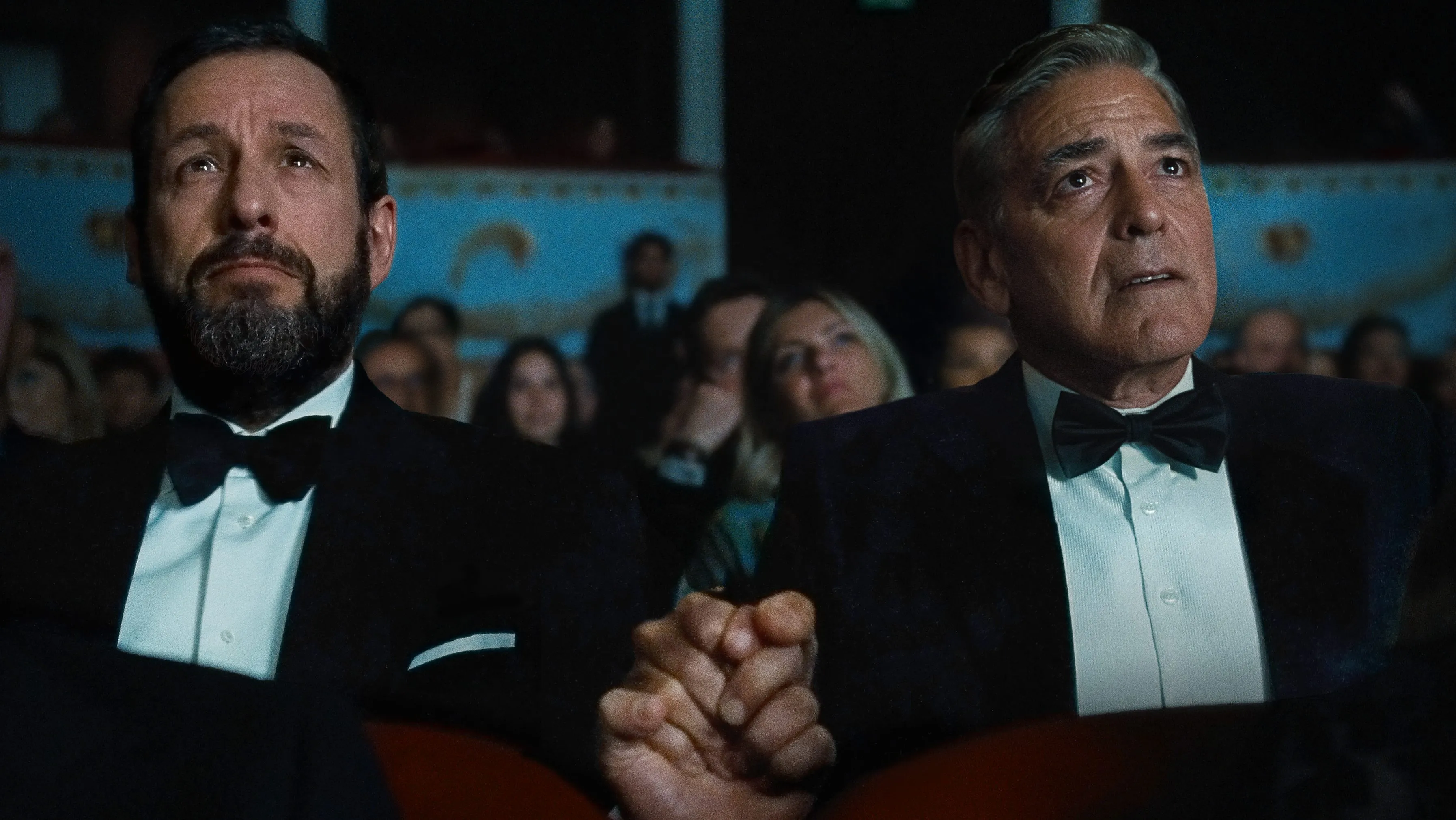
I was hoping this touching film would be properly rewarded at Oscar time, but it was ignored. The omission is even more galling given the Academy’s decision to nominate 10 films this year, including the dreck of F1 and Frankenstein. Getting an Oscar nomination is never a confirmation of merit. But with 10 nominees? Please. Noah Baumbach’s story of mega Hollywood star Jay Kelly (George Clooney) in midlife crisis is clever, entertaining, and tender, and Clooney gives his best performance since The Descendants. The picture deserved better.

After the death of a mentor, the man who “discovered” him, Clooney is approached by an old friend from acting school (Billy Crudup). In the hope of establishing more of a real connection with both his past and normality, Kelly invites Crudup for drinks to reminisce about the old times. Unfortunately, Clooney is a massive, unknowing target, and he becomes the repository for Crudup’s bitter regret, as well as a TikTok sensation when the two get into a fist fight in the parking lot. Clooney, however, is not deterred, and takes his retinue, led by longtime manager Adam Sandler and publicist Laura Dern, to chase his younger daughter through France on his way to a tribute ceremony in Italy. To be unencumbered is a freeing experience for Clooney, albeit one that is laughably abnormal. He is recognized, fawned over, and catered to by a staff of five, and soon, even he sees the absurdity in his efforts.

The trek is infused with real heart and pathos, and throughout, Clooney flashes back to his ascent to stardom. While he seeks to reconcile himself to failures with family and friends, including his father (an irascible Stacy Keach) and an older adult daughter, who is estranged and embittered and attributes all of her mental torments to her wanting father, ultimately, they are not there for his moment. Clooney is left to the expected support from his longtime manager and assistants, but Sandler himself is going through his own crisis, realizing the limits of friendship in his uneven relationship as the fixer of all things for megastars. Dern has had it, and bolts with a “save yourself, this man does not love us” warning for Sandler. Eventually, Clooney is alone.

There are wonderful exchanges, poignant moments but, thankfully, no real resolution. Baumbach studiously avoids the pat. This type of film would normally result in some kind of oath, or commitment, or suggest a rapprochement, a teachable moment. Here, it ends with Clooney at the festival given in his honor to credit him for his life‘s work on the screen, and his lesson is not quite clear. Yes, like all men and women, Clooney has made mistakes, but when you get to see the joy in the faces of the people who love his work, work that has accompanied and maybe even inspired many of the moments in their own lives, there is at least a rebuttal to the regret.

For some, this, I suspect, may be too much sentimental log rolling for Hollywood. I ate it up with a spoon and wanted more.

A lovely film, one of the best of the year, replete with fantastic, unheralded performances. Sandler is particularly good, vulnerable and piercing. Though he has impressed enough, however sporadically (Punch Drunk Love, The Meyerowitz Stories, Uncut Gems, Hustle) that I can no longer register surprise.

I signed up for Tubi because it has a lot of older movies that don’t get run on some of the other streaming services. This very competent Peter Yates (Bullitt) flick from 1977 beguiled me as a young teen for a couple of reasons. First, it was a Peter Benchley, post Jaws vehicle, with Robert Shaw as yet another boat captain, though this time his quarry is treasure, not a shark.

Second, well … I was 13 years old, Jacqueline Bisset, enough said.

My prurient childhood fascination aside, this is a pretty solid picture. Two tourists (Nick Nolte and Bisset) happen upon two collided shipwrecks while snorkeling. They cross a local drug lord (Louis Gossett) who also has an interest in what they’ve found (tens of thousands of vials of morphine from an old WWII medical ship) and must enlist a wily old diver and antiquity collector (Robert Shaw) to help them find treasure from the other vessel, deliver the drugs, and otherwise negotiate their way out of the mess.

Nolte exudes charisma as the thrill seeker captivated by the jewels of the sea. Shaw is Shaw, commanding and interesting even when he is probably phoning it in. Gossett is oozily charming as a lethal Haitian trafficker interested not in treasure, but in the drugs, until he learns of the treasure and gets greedy.

Bisset is every bit as alluring as she was when I was 13, and it turns out, now that I can focus, she can act. She is menaced throughout the picture and her terror is palpable.

The film gets balky when Gossett inexplicably harasses the trio even though they are working on his behalf, and the ending is the cheesiest finale in movie history. But otherwise, sexy and solid.

If AI did not write this film, then we need more AI in film. 

I feel confident, however, AI had a hand in this empty, soulless picture, which feels like a Marvel flick but doesn’t even meet that low bar. The movie looks good, moves relatively well, and the actors are for the most part fine. But the script is predictable slop and the presentation so dumbed down, all things equal, it must have come from an algorithm. Writer/director James Vanderbilt has a few Screams and Spidermans under his belt, but, inexplicably, co-wrote Zodiac. So color me perplexed.

The picture also offers a glimpse as to what the future holds for historical films. Not a single bit of this recitation of the Nuremberg trial rings true. Sure, it technically comports with some of the facts, but the feel is all “now.” Viewers can glean just enough information to get a sense as to historical stakes (Nazis bad, Herman Göring bad but sneakily charming), but the picture never nears informative or elucidating.

The Nazis have lost the war, and in an over-long lead-up, we learn it is critical they be placed on trial through Supreme Court Justice Robert Jackson (Michael Shannon), who spars over the wisdom and efficacy of such a trial with his wife via witty banter. When the trial becomes threatened, Jackson goes to the Vatican to enlist the Pope’s blessing, which he receives by blackmailing the Church as an arguable co-conspirator with Hitler, a complete fabrication. But a lie that serves an exchange in keeping with this simplistic rendition.

Pope cowed. Full steam ahead.

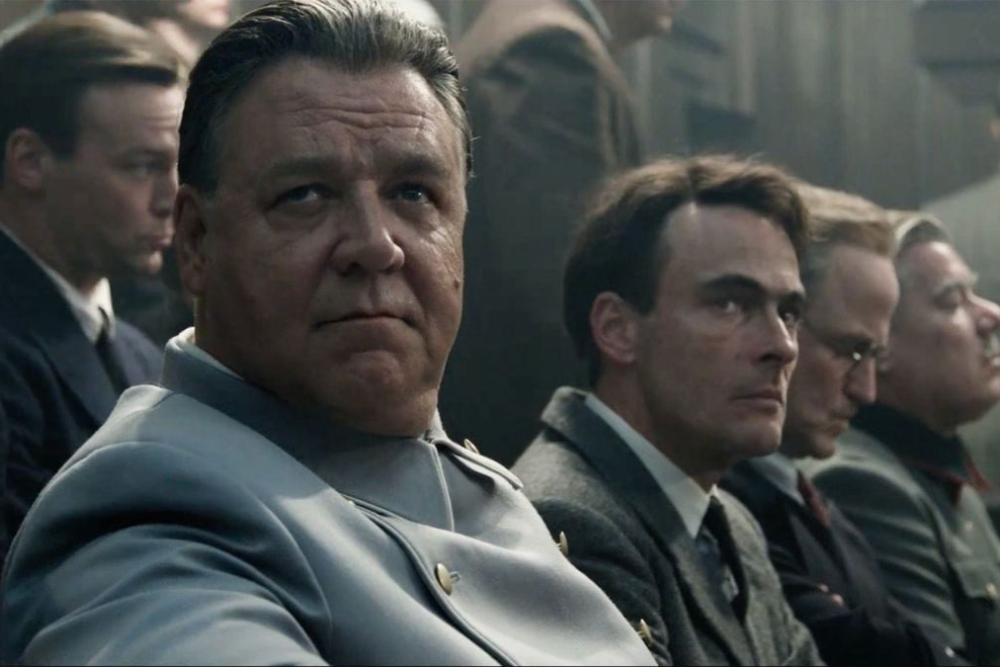
Russell Crowe plays Göring, the biggest fish in the dock. He must go to toe-to-toe with army psychologist Rami Malek, a cynical practitioner so full of himself his eyes bug out.

Okay. Cheap shot.

The men bond in verbal exchanges that are dull and unilluminating. One gets the sense Crowe got the role because he’s heavy and imposing, but he competently delivers the muck given him. As for Malek, his casting is a mystery. He should not receive any further film roles unless in Bohemian Rhapsody II or movies where he plays offbeat or weirdo. When Malek engages with Göring’s young daughter, as he passes letters between father and family, he almost takes on the mien of a molester. Peter Lorre as William Holden.

Malek gets deeper into Göring’s psyche while acting as Jackson’s mole and stoolie, which is incongruent, given all of Jackson’s testaments to fairness. Malek also intercedes on behalf of Göring‘s family when they are arrested. Depressed, he takes refuge in the arms of a buxom reporter and spills his guts. She prints a front page article betraying him and leading to his ouster from the Army.

Most of these plot points are either false or distorted. In reality, the Malek character was not cashiered; he was promoted and back in the U.S. by the time Göring took the witness stand.

In the film, Malek attends the trial and before so, he rushes in to see Jackson to offer his book of notes entitled, How to Get Herman Göring.

The big day arrives.

The Nazis and lawyers don their outfits for legal battle.

Göring does pushups in full regalia and walks out amongst cheers from other caged Nazis. Like in Gladiator.

Cue AI dialogue. 

“In seven hours, the whole world will be focused on this room. This is it. This is everything.”

“Let’s finish this war.”

“This is your day. You’re ready.”

“Bury him.”

“He’s got him.”

While watching this drivel with my family, we started a game. A character would say something. We would pause the movie and take a stab at what would be said in response. Our success rate was shockingly and depressingly high.

Example. The interpreter who works with Malek offers him a cigarette. When Malek notes the interpreter does not smoke, he explains he carries cigarettes to curry favor with officers. The interpreter then states wistfully that perhaps, at the end of the war, he will have a cigarette. Malek responds, “the war has ended.”  There is a silence.

The movie was paused. Bets were placed on whether the interpreter would have his cigarette at the moment of conviction of the Nazis.

EXT. PALACE OF JUSTICE – NIGHT

Howie stands outside. Silence save for the crickets. He pulls out the pack of cigarettes. Takes one out. Puts it in his mouth. Goes to light it. Hands shaking…From inside, we hear the gallows drop again. Another man down. Howie stands there. Pulls the cigarette from his mouth unlit and tosses it away.

There is a great deal of this hackneyed bullshit throughout the flick.

Thankfully, the dreck eventually ends. Malek, who writes a book about the experience, is portrayed as a haunted soul, desperately trying to warn the world that the good German is in all of us.  And then, he kills himself, just like Göring.

Sans the push-ups.

Streaming.