Archive

Monthly Archives: February 2024

I was not a big fan of Yorgos Lanthimos. He is clearly talented, but he also revels in the ugly. The Lobster was inventive, but also, masochistic, even abusive. The Favourite was evocative but also grotesque. Lanthimos traffics in the absurd, but he luxuriates in meanness and the darkly visceral, with all its bleeding, flatulence, fluids, and muck. Yet, here, in this hilarious and charming re-telling of Frankenstein, he allows himself whimsy and some gut-busting hilarity.

The time is Victorian London. Emma Stone (Bella Baxter), a fully grown drowning victim fished from the Thames, is brought back to life by none other than a Dr. Frankenstein (actually, Dr. “God”win Baxter, Willem Dafoe) and given life via the insertion of her own unborn baby’s brain. When we meet her, she’s a mere child, eating like a infant, urinating where she stands, stubborn and defiant. But she grows, quickly, and when she happens upon sexual pleasure, she is out and free, with the assistance of a dandy (Mark Ruffalo) who haughtily acts as her tutor even as he is slowly enslaved. Soon, Bella becomes worldly, and learns a few hard lessons, but she quickly masters (speaking of absurd – this word was tagged by spell check as problematic) the ability to make her own destiny in a world that would normally relegate her to docility and subservience. To see her eat, to come, to dance, it is hard not to be as captivated by Stone’s gifted performance as Bella is by the world. And Ruffalo’s foppish moth to her carnal flame is riotous. Bella’s journey is wondrous, funny and beautifully shot, deftly lifting from the best artistic visions of both Tim Burton and Wes Anderson.

I laughed uproariously and sat in wonderment at Lanthimos’ ingenious world.

Two nits. First, I never really thought I’d say, “Hey, there’s just too much of Emma Stone naked” but the film is 20 minutes too long, and there’s just too much of Emma Stone naked. I think Lanthimos became entranced by Stone’s moxie, but soon, all of the sex seems less like a revelation, and more like an obstacle course.

Second, Jerrod Carmichael makes an appearance and there is no other way to put it – he’s terrible. Stilted, clunky, confused, and aggravatingly amateurish. You kind of feel bad for him, but you brighten when you realize he is gone.       

Otherwise, great, smart fun.

Seven down, three (Past Lives, Killers of the Flower Moon, The Zone of Interest), to go.

A man falls from a window and dies. Was he pushed?

Like HBO’s The Staircase, this is a courtroom drama about one spouse accused of murdering the other, but this film is like nothing you’ve likely ever seen before, simply because half of it is in a French courtroom, where as near as I can tell, a criminal trial is-

  • Nothing but a series of closing arguments between the prosecutor and defense counsel.
  • A venue where they let anything in as evidence, including absolute, groundless conjecture.
  • A therapy session.     

As someone steeped in both American and British procedurals, the picture is fascinating. Think about a prosecutor who elicits, “Well, I think she did it because I was the victim’s therapist” from a witness, and then the prosecutor turns to the defendant and basically says, “Well??? What say you to that!” And all other witnesses get to hang out and watch.

Also, if there were ever a cautionary tale that French and German people should not marry, this is the one.

This is edge of your seat stuff, a film that jams in a flashback of a fight between the spouses on the day before the murder, an exchange that far eclipses the tension of the courtroom.

I am somewhat burdened by the “whodunnit?” aspect of the picture to get deep into analysis, so I’ll focus on the performances, which are stellar.  Sandra Huller has the misfortune of coming up against Lily Gladstone (Killers of the Flower Moon) and Emma Stone (Poor Things), so, no chance. But her turn as the accused is riveting.    

It’s a bit long, and ambiguity has its limits, but a great picture nonetheless.

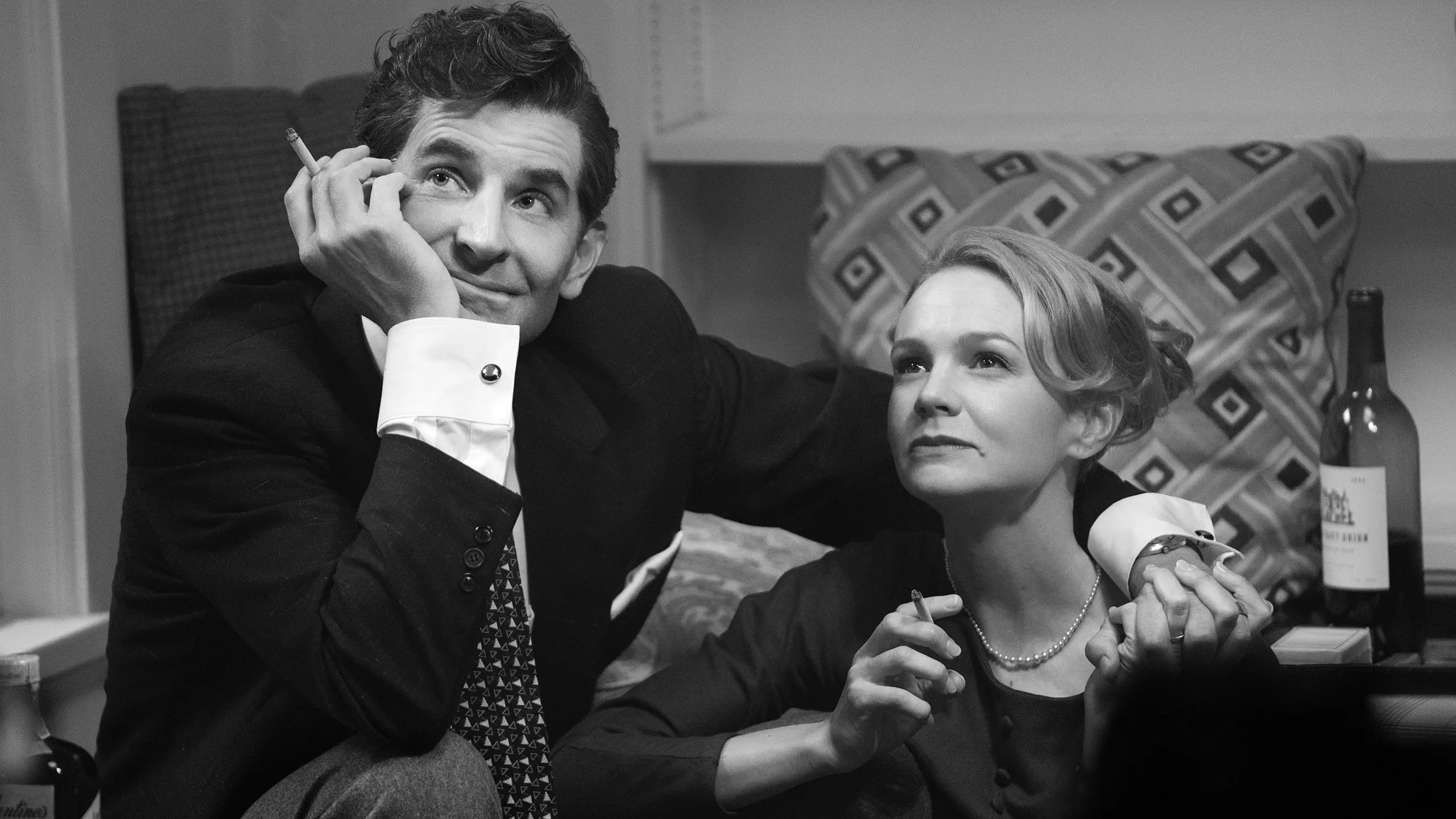
Leonard Bernstein was a significant man. But you wouldn’t know it from this film. Bradley Cooper’s labor of love makes Bernstein seem rather humdrum, and as the film progresses, Cooper certifies that reality, eventually discarding Bernstein’s story for that of his wife (Carey Mulligan).

Look, it is clear Cooper reveres Bernstein, but too much is too much. Think of when someone you know introduces you to someone they love. They are already in thrall, and they have explored every nook and cranny of their idol so, in your introduction, you don’t come to your appreciation organically, the way your friend did. You start with, “He is the greatest.” And then, after that, your friend just keeps saying, “Isn’t he? Told you!”

Here, Cooper is so entranced, he glosses over what makes Bernstein Bernstein – his music. Sure, there’s tons of scenes of Cooper directing with the panache and flourish of Bernstein, but Cooper is more interested in having mannerisms down pat than exploring why we’re here. Cooper’s meticulous impersonation cannot substitute character.

Worse, since Cooper has little interest in Bernstein’s craft, we focus on his domestic struggles, which are pedestrian, even for a famous man living a barely disguised double life. He is not denied his pleasures, nor is he punished for them. Rather, they create some marital strife. And that’s what we get to see until cancer closes the story out. No war time concert in Israel in 1948. No silly cocktail party for the Black Panthers (sent up so wonderfully by Tom Wolfe). No concerts after the assassinations of JFK and RFK. No philanthropy for AIDS as it decimated his profession (and killed his longtime lover Tom Cothran, for whom he left his wife). 

We learn very little about what Bernstein should be remembered for.  Hell, he could have been a periodontist.

A well shot chore. On Netflix.


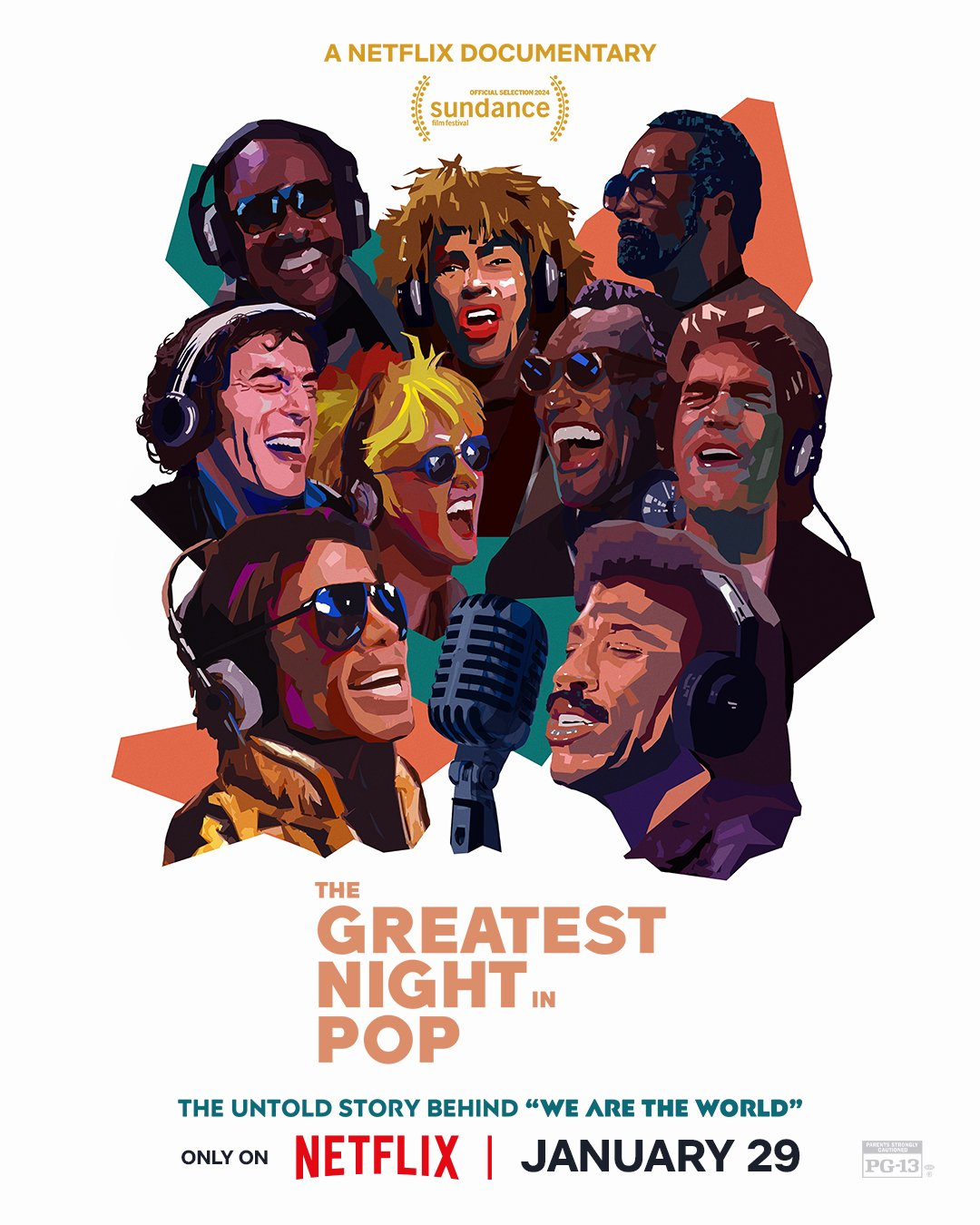
The best part of this documentary is the beginning, where the famine in Ethiopia is juxtaposed with the difficulty of wrangling stars who might alleviate such monumental, global suffering. But it must be done the night of The American Music Awards, because, you know, they all have busy schedules.

That, and when someone observes that had Michael Jackson not participated, it would have been “one of the biggest mistakes of his career.”  Well sure. One of them.

Also, Cyndi Lauper almost bails because “I was so punch drunk tired” after the awards show. Oh, and her boyfriend didn’t think it was a hit.

This is, unknowingly, pretty funny, clueless shit.

There are, however, some genuinely cool moments that aren’t fully mockable.

I liked how Kenny Rogers drove his own shitty car to the studio amidst the fleet of limos.

I liked how Steve Wonder wanted to sing a made-up Swahili line and Waylon Jennings just split.

I liked how Bob Geldof saved the project, torpedoing Wonder’s stupid idea by explaining that the song was not for Africans, as they would likely not be hearing it, but rather, eating because of it, and further, Ethiopians don’t speak Swahili.

I liked Bob Dylan on whatever drug he was on looking like a dude who does not know what portal he fell through to be amongst these people. And it was very sweet to see how Quincy Jones and Wonder got this addled fool thru his part.

I liked how Kim Carnes’ solo was reduced to two lines in favor of a Huey Lewis harmony, which she handled better than Sheila E, who sussed out that she was only invited as Prince bait, whereupon Sheila pulled a Waylon.

But, ultimately, as perhaps preordained, this documentary must fail, because it does not explain the presence of Dan Ackroyd.   He is inexplicably back there in certain scenes, doing absolutely nothing. Like Bigfoot.

On Netflix.

My mother tells people that The Boys in the Boat is a book “every young man must read.” In point of fact, the book has been on the New York Times bestseller list for quite a long time. But I am not a young man, so I settled for taking her to the picture.

She was rightfully disappointed. I was bored to tears or underwhelmed. For the following reasons.

1. The actual boys in the boat were supposed to be destitute, desperate, and worn down from the Depression, lean, hungry, rough boys who found rowing as a way to eat. Unfortunately, they all look like this:

2. The lead, Calum Turner, has all of the character and nuance of a Nilla Wafer.

3. Rowing does not lend itself to film. We don’t learn much about the mechanics of it, so it’s difficult to discern the issue when the boys falter (they just start to bicker at each other and their stoic, forgettable coach merely shakes his head). In races, they start out slow, and through grit, pluck and determination, the boys pick up the pace and win. That’s it.

4. Hitler shows up. But he looks like Charlie Chaplin as The Little Dictator, and I’m not sure that was the effect Director George Clooney was aiming for. 

5. Jesse Owens also shows up. He says one line that is impactful and wise, with the effect being one’s own rumination: “Damn, I wish this movie were about Jesse Owens.”

The film looks classic, but presents as inauthentic. It has a hazy, postcard visage that feels both obligatory and unnatural.

Ultimately, the film is not terrible, but it is instantly forgettable, of no real moment, and about as safe a production as you’ll find.