Archive

Monthly Archives: February 2012

Image result for Big bad mama

Five things recommend this film.

1) Angie Dickinson is both beautiful and naked in the picture. First, with a very young Tom Skerritt and next–

2) with William Shatner, who is also semi-naked in the picture, which significantly detracts from Dickinson being naked.

3) Angie Dickinson is one helluva woman.

4) It is an exploitation, low-budget picture that tried to be period (1930s Texas).  It is worth the rental alone to watch the modern 70s pop up in the 1930s.

5) This is Steve Carver work. Lone Wolf McQuade? Yes. That Steve Carver.

If you’re in a hurry, Dickinson’s naked scenes are about halfway through (it’s only 83 minutes).

P.S.  I saw this picture when I was 12 or 13 at my father’s apartment (he had the earliest version of cable-ready movies, which would show “racy” movies on weekend nights, so when we’d be at his apartment for the weekend, and he’d gone out, me and my brother got to see Russ Meyer movies, or movies with a naked Police Woman, from Big Bad Mama to Pretty Maids All in a Row, or Jacqueline Bisset in Secrets).  So, there’s that.

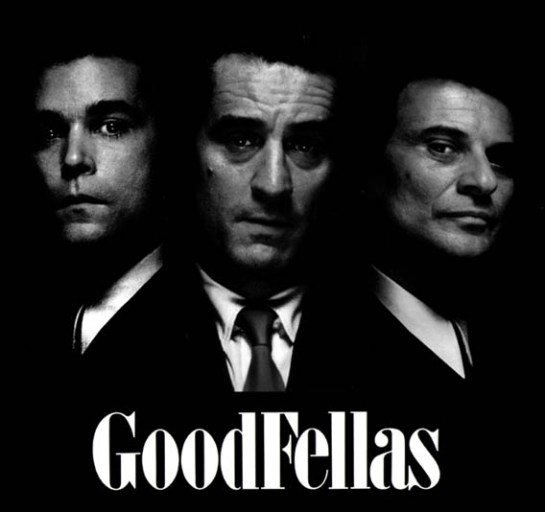
This movie is so good that AFI’s ranking of 94 is an embarrasment (Forrest Gump is rated almost 20 slots higher). From the moment of Ray Liotta’s first voice-over line (I don’t think there is more effective voice-over work in any film ever) to the maniacal, miserable fall, Scorsese chronicles the mob as fantasy to the crime as reality from Liotta’s boyhood to Witness Protection schlub. In re-viewing, here are my thoughts on what makes Goodfellas the greatest crime picture ever made.

The camera-work. The sheer audacity of Scorcese’s tracking shots make their counterparts in The Player and Boogie Nights seem gimmicky.  Scorcese goes on without an edit, not as flourish, but to introduce the cast of mob characters and their life  The uninterrupted trip of Liotta getting into a nightclub speaks volumes about the life – the excitement of his date (Lorraine Bracco) as they are being guided to the best table in the house is shared by the audience.  As we take the trip with Bracco, we are introduced to the glitz during a seemless dreamy waltz.  This is the difference between Spike Lee silliness (floating characters) and skill with purpose.

The Feel.  It looks and sounds right in every respect, from the kitschy Tiki bars to the outlandishly tacky apartments and home to the ghastly look of the mobster wives to the diners and late night drives.   Better, Scorsese, as always, picks the right song for each trip.

Liotta, Pesci and DeNiro, especially Pesci. Liotta, like us, is the outsider, though he is effortlessly conscripted.  Still, he plays Henry Hill as a shade removed from the crazy of DeNiro and Pesci.  He’s a brute but he is not an innate killer.  Thus we are capable of remaining empathetic.  Robert De Niro also keeps vestiges of humanity, though in fact, he is only one notch below Joe Pesci in terms of sociopathy. Pesci, however, is the most honest character and the heart of the picture.  He is a killer, his code is barbaric and his emotions uncontrolled. Which means that he can beat you near to death and comfortably have a meal right after.

Authenticity. The best example of this is not in the look or the sets or the music, but rather, in Scorcese’s portrayal of the easy violence, which one assumes he knows from his roots and/or from working with writer and former Mafia journalist Nicholas Pileggi. No better example is when Pesci comes back to kill the “made” guy (Scorsese and The Sopranos regular Frank Vincent) for busting his balls.  We know Pesci is going to snap, but the moment Pesci attacks him, De Niro jumps in viciously to assist, no hesitation. De Niro knows that killing the guy is stupid. In fact, De Niro was calming Pesci down earlier in the evening, trying to smooth things over. But the attack sets him off like a shark smelling blood, and he instinctively jumps in to rip the guy’s head apart. He’s an animal in a feeding frenzy.

Scorsese’s Casino is actually a deeper film about the Mob, but Goodfellas is the landmark, a precursor to the humor of The Sopranos and an obliteration of the operatic grandiosity of the life left to us by The Godfather.

 

Scarface travels well and survives the excesses of Al Pacino and the 80s Vision Quest/Flashdance/Top Gun cheeseball musical interludes (as Tony Montana’s crime empire grows, we are treated to a flashy 80s number, “Push it to the Limit” by the estimable Paul Engemann). The plot is simple. Cuban Marielitos (Pacino and Steven Bauer) come to Miami, work their way up the drug trade, do too much blow, and flame out. Scarface is an exercise in excess equal to the appetites of its characters. Pacino’s performance is gruesomely cartoonish, the violence is extreme, and DePalma lovingly lingers on each grisly moment.

The film is also very funny, not as camp, but intentionally so. DePalma does what David Chase does with Tony Soprano on HBO – he shoves Tony’s barbarism in your face, but he surrounds Tony with even more despicable characters, so you can root for him. Oliver Stone’s script loads Tony up with his own set of Harry Callahan one-liners. When his one-time boss, Robert Loggia, begs for his life, Tony leans down and says “I not gonna’ kill you.” As Loggia kisses Tony’s feet and thanks him, Tony turns to Bauer and says “Shoot this fu**ing cock-a-roach.” It’s a funny moment. Later, Harris Yulin, the corrupt Miami cop, takes one in the gut from Tony and he’s stunned. “You can’t shoot a cop,” he says, as he looks at the hole in his belly. But then he puts his hand up, and screams “Wait!” I love that moment. He’s still in the game. He thinks he can still make a deal. And as Tony becomes more powerful and self-pitying, he announces himself with “Make way for the bad guy.”

Scarface is also very effective at creating tension. Scene after scene ratchet up a fair amount of dread, from Tony’s favor knifing in a Miami holding area; to the botched drug transfer, where Tony’s compadre is chopped up with a chainsaw; to an unsuccessful nightclub hit on Tony, to Loggia’s murder. The doomed love story between Bauer and Tony’s sister, Mary Elizabeth Mastrantonio, also works. They seem to have a real affection for each other, and while you may root for Tony with guilt, you really like Bauer, who seems a very sweet thug. It’s also good to see Pacino, F. Murray Abraham, Mastrantonio and Loggia taking a stab at Cuban. They all come out with a different interpretation. The ending is giddy and ridiculous. Tony has become a coked out Superman. As assasins swarm over his estate like . . . well, like cock-a-roaches, he emerges from a pile of blow to kill almost all of them, with a very big gun.

A not very funny Jackie Chan movie, though Owen Wilson has a few good lines as the gun-slinger/bank robber who is into the gig for the chicks (my favorite is when he turns to one roughneck new to his train robbing crew and says, in all earnestness, “You all right? I know, I know. This is hard. You’re new. But you’ll do just fine”). It lags after 30 minutes and the rest is a hard road to hoe.

Ed Norton’s clunky directorial debut about two childhood friends – a rabbi (Ben Stiller) and a priest (Norton) – who reconnect with a third, Jenna Elfman. Hijinx, romantic entanglements and hurt feelings ensue. A few funny moments, but Elfman’s hyper-active me-me-me-ism is distracting, and Stiller is lost as a romantic lead. Worse, Norton knows nothing of pace.

An amusing, sweet story about a young NYC writer (Sandra Bullock) who is forced into rehab in Tennessee after her alcoholism accompanies her on a car ride. The film is essentially about her stint there, and while predictable, it is moderately affecting and consistently funny. Bullock is also a surprise. While her range is not exactly expansive, she plays a damaged daughter of an alcoholic mother (who eventually died and abandoned Bullock and her sister as children) with some skill. Better, her part is loaded with wry rejoinders, her strength. A lot of good supporting turns, including Viggo Mortenson as a baseball pitcher working on a coke addiction; Steve Buscemi as Bullock’s counselor; Dominic West as her charming boozehound lover; and various other characters. This is not heavy lifting, and it is very AfterSchool Special, but it is well done.

Before I saw Castaway, I was assured that if I had to spend time on an island with a major male film star, Tom Hanks would probably be a good choice.  He seems affable, neat and even-keeled.   I was not disappointed.  His Fed-Ex plane goes down in the South Pacific, he is stranded on an island, and he combats the elements and his various misfortunes while making attempts to escape to civilization.  The time spent with Hanks is well worth it.

The problem with Castaway, however, is that director Robert Zemeckis tucks a love affair between Hanks and Helen Hunt (Washington, D.C.’s City Paper correctly observed that Helen Hunt was again cast as Helen Hunt) pre-stranding that is mundane and equivocal; post-stranding, it is confused and drawn out.  While Hanks is on the island, out of necessity, he strikes up a relationship with a volleyball.  Unintentionally, this relationship towers in depth and complexity in comparison to the one depicted between Hanks and Hunt.  So, when Hanks gets back to civilization, the meat of loose ends and forged relationships and a changed world are not there to greet him, or us. Rather, the only thing we get to see him confront is the bland Hunt, and her on-again-off-again Tennessee drawl.

Side note:  Tom Hanks is given the worst maladies in movies.  In Philadelphia, it’s AIDS.  In Castaway, he has to give himself what appears to be a root canal.  In The Green Mile, he has a urinary tract infection that has him peeing what appear to be razors.  What the hell?

BlowEh.  Johnny Depp is convincing as drug dealer George Jung, but George Jung’s life, even as he amasses $60 million in cocaine profits and pals around with Pablo Escobar, is tedious.  In the last fourth of the film, Depp is outfitted with a paunch.  Is that a pillow under his shirt?  It looks ridiculous and it is distracting.

Atlantis: The Lost Empire.  I thought this was a good, very unique Disney movie.  A different style of animation, a little darker, tons of violence, with deaths in the hundreds (and a funeral to boot), and more than a little sex appeal.

It probably bombed because no animals talked and no heart-strings were tugged.  It did drag a little, but picked up quickly, and my only real complaint is that Michael J. Fox’s gee-willickers voice is grating.