Archive

Monthly Archives: February 2012

In Inglorious Basterds (2009) Lt. Aldo Raine wears the First Special  Service Force's insignia of crossed arrows on his collar and red arrowhead  shoulder patch. This was an elite US-Canadian commando unit

I was teed up to hate this picture, given how juvenile and overpraised Quentin Tarantino’s last offerings were (the Kill Bills, and the truly execrable double feature, drive-in homage).  Those movies were the toasts of critics yet belied all of his worst qualities – excess, self-regard and juvenilia.

But Tarantino returns to his sweet spot here, with crackling dialogue, edgy and beautifully crafted set pieces, and a brisk pacing, comic but not immature. It’s a clever and exciting popcorn film, anchored by the actor who plays the primary Nazi baddie (Christoph Walz) with such relish, you near root for him.

Great fun, and yet, highly intricate and accomplished.  The shootout scene in the French cafe’ basement is one of the most tense and exciting I’ve ever scene on film.  A worthy Best Picture nominee.

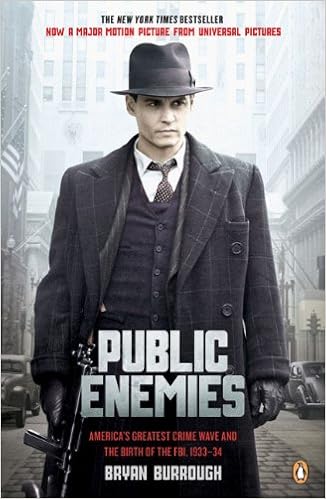
Public Enemies: America's Greatest Crime Wave and the Birth of the ...

I watched 40 minutes, which was 40 minutes too much.  Michael Mann’s last picture – Miami Vice – was bad in exactly the same way Public Enemies is bad – all mood and cool, beautifully photographed, and as interesting as a super model on a talk show.  Within 20 minutes, we learn all we would ever learn about our lead, John Dillinger (Johnny Depp).  He is cooly attractive, wear a suit well, lives for the moment and . . . he is cooly attractive.

Moll: What do you want?

John Dillinger: Everything. Right now.

Blech.

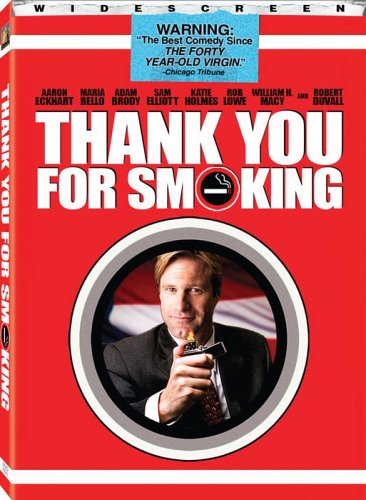
Amazon.com: Thank You for Smoking (Widescreen Edition): Aaron Eckhart,  Cameron Bright, Maria Bello, Joan Lunden, Eric Haberman, Mary Jo Smith,  Todd Louiso, Jeff Witzke, J.K. Simmons, Marianne Muellerleile, Alex Diaz,  Jordan Garrett,

The sharpest of satires.  Aaron Eckart is slick motormouth and p.r. flack Nick Naylor, a smooth and ingratiating shill for the tobacco industry. In his rise, fall, and semi-rise, the film’s message – think for yourself because there’s money and power in letting folks tell you what is good for you, be they corporate behemoths or self proclaimed protectors of the common good – is hilariously delivered. 

As Naylor struggles internally with selling death, the fight is not a one way dawning. It goes 15 rounds and the preening self-regard and power seeking of the do-gooders is contrasted with the soulless, rapacious greed of the baddies.  It’s a close run thing, and an enjoyable fight to watch.  

Indeed, this movie should be required viewing for every ex-hippie who now clamors to ensure that his or her child live a risk-free life, at the expense of everyone who might otherwise own a gun, light a smoke, have a drink, eat a transfat, shout an obscenity or injure budding self-esteem. 

I mean, we know the corporations are bad, as exemplified by my favorite line from the film, from the President of The Academy of Tobacco Studies (played by J.K. Simmons):  

We don’t sell Tic Tacs, we sell cigarettes. And they’re cool, available, and addictive.  The job is almost done for us.


How To Watch The Ring In Order (All 14 Movies)Unnecessarily convoluted but pretty creepy, it’s too bad this movie – which melds the historical ghost story of The Changeling with the silly modern fright of Videodrome – isn’t better.  Director Gore Verbinski (The Mexican, Pirates of the Caribbean) lards on more and more ridiculous plot twists and dumb plot contrivances that eventually, the pictures sinks under its own bloat.

The plot is simple: if you see a particular videotape, you get a phone call, and then you die in 7 days.  Reporter Naomi Watts gets on to the story, incredibly and laughably finds and watches the tape, receives the call, and wham! – we embark on a race to find the origins of the tape, going to places that make very little sense given where the tape was found.  During the process, Watts shows it to her ex-husband and then, is so negligent, she allows her spooky son to see it as well.  One shudders to think what would happen if she had a gun or her sex tape in the house, but either way, you’re not loaded with sympathy for this dimwit.

What follows is no more than hints and allegory as the story gets more cockamamie and out-of-control. 

It’s also pretty hard to be scared of a VHS tape.  As observed by the estimable Aldous Snow: 

Image result for The Pianist

Roman Polanski won best director and Adrien Brody won best actor, so I expected something special.  I was disappointed. The story of a Polish pianist and his grueling fight for survival during the Nazi occupation (and extermination) of Warsaw depends on one caring for the lead (Brody). And to the extent one cares for any human made to endure unendurable suffering, the film carries you through.  But it becomes more of an assignment than an enjoyment. Brody is a blank slate in freedom and notoriety (he is a well known musician), and he becomes even less interesting during the Nazi occupation (most of which he spends hiding in apartments provided to him by sympathetic non-Jewish Poles).

The picture is beautiful – the scenes of a devastated Jewish ghetto are particularly memorable.  And the slow, desperate demise of Brody’s family, who incur one withdrawn right after another while managing to stick together, is affecting.  But the film is 150 minutes long, and the family loses its struggle about half way through.  That leaves us Brody.  He is not enough, and soon, the film becomes tedious and stubborn.  Many characters help Brody (from an old flame to fellow musicians to a Nazi collaborator to a Nazi officer), but we don’t get to know them.  Polanski is content to stay with Brody as he becomes more emaciated and desperate, and in the end, little more than a caged animal.  To the extent Polanski wants to demonstrate that even through the most awful of horrors, people can survive and return to the pre-horror life relatively undamaged, The Pianist succeeds.  But as drawn in the film, it’s a minor success.

25th Hour - Wikipedia

Further confirmation that sometimes, when Spike Lee does not write a movie indoctrinating viewers as to the racial dogma of a wealthy courtside-sitting Knicks fan, he can forego the lecture and make solid entertainment .  See also Clockers and Inside Man

Edward Norton is spending his last day and night in Manhattan before serving a 7 year stretch for drug distribution.  He deals with the certainty of his impending brutalization and agonizes over the choices he made, all while saying his goodbyes to friends and family, reliable New York City archetypes to a one.  His father, Brian Cox, is a former fireman (the film is a post- 9-11 story and it is reliant on that catastrophe) and now proprietor of an Irish tavern; his girlfriend, Rosario Dawson, a luscious Puerto Rican who had never been to Puerto Rico until Norton took her; his best friends are Barry Pepper (a tough, cynical, New York Post reading conservative trader) and Philip Seymour Hoffman (a tentative, caring, Jewish public school teacher who lives a meager, sheltered life and has a hidden trust fund).  Anna Paquin is Hoffman’s vixen of student, all freedom and possibility, just on the edge of pregnancy and disease and the first steps to getting used up. Norton’s employers are Russian mobsters.

Norton’s choices are delicate and a man on the brink is a tough character to deliver.  He does not sweat or ooze like so many would-be Brandos, but runs the emotional gamut (anger, recrimination, fear, acceptance) with authenticity.  The story holds you, and Lee’s lyrical skills give the picture a haunting vibe. Solid watch.

23 Things We Learned From the 'Road to Perdition' Commentary

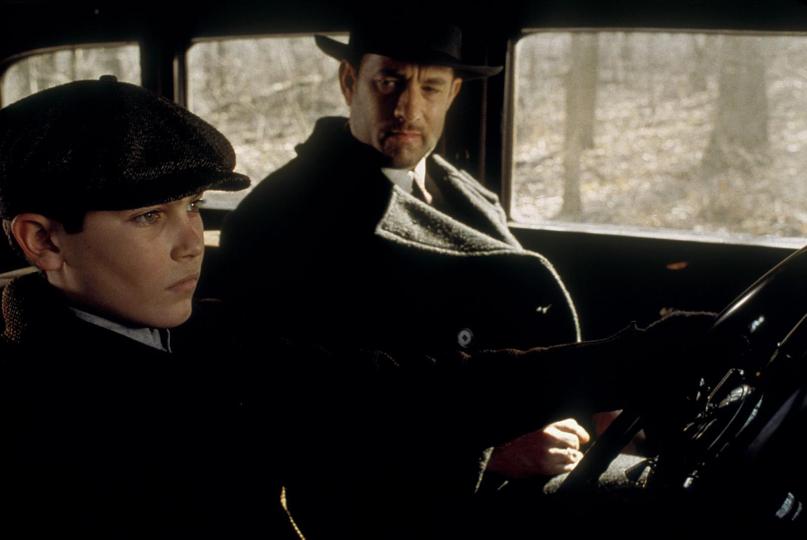
Sam Mendes’ follow-up to the overpraised American Beauty almost survives the miscasting of Tom Hanks, the overacting of Jude Law, an at-times leaden script, and an unhealthy preoccupation with slow visuals.  With all of that, Road to Perdition is also a beautiful movie graced by some very smart, substantial performances by Paul Newman (his last big screen role) and Stanley Tucci as mobsters working in the same organization.  Thomas Newman’s haunting score is perfect for the material, and the set design, art direction, costumes and cinematography recreating the Depression-era Midwest are impeccable.

But a film about fathers and sons cannot survive a child actor who does not resonate.  The actor playing Hanks’ son is not awful but he’s not very good either.  As our narrator, he simply doesn’t register, and as the guide to the life of his father (mob enforcer but family man Michael Sullivan, played by Hanks), this cannot do. Indeed, the last line of the film is “He was my father.”

It didn’t really seem like it.

Hanks is also problematic. His character is a bit like Eastwood’s William Munny in Unforgiven.  He is supposed to have demons.  The way Sullivan is played by Hanks, however, is as more of an automaton.  When things are going well, Hanks seems grimly fine with family and pot roast and a solid 9 to 5 job committing violence on behalf of his boss and father-figure (Newman).  When things go poorly, you get the sense Hanks doesn’t really have much to reassess.  He just seems sad that the easy 9 to 5 gig is up (and up in a rather cruel manner).  When he does soften, it seems too easy, like a swell guy has been just beneath that hard surface all along. The role is a lily-pad to a villain, but Hanks drowns on it.

And can Hollywood please take the “powerful and honorable man driven to treachery by his weak issue” trope out back and put it down with a bullet?  The weak son here – Daniel Craig – is entertainingly rotten, but God, I’ve had enough!

Hanks does have some moments, such as his meeting with an amused Tucci, where he tries to offer his services in return for permission to exact revenge on his old employers.  But overall, I don’t think he was the right call.  Bruce Willis may have been a more apt choice.  Certainly Ed Harris.  The best choice would have been Chris Cooper.

Still, there is enough good in here to watch.

24 Hour Party People quad poster.jpg

Michael Winterbottom’s time capsule sells itself as a rendering of the birth of the rave culture.  In fact, as the film’s protagonist – Manchester television personality and producer Tony Wilson – constantly informs us in fourth wall breaking break away chats and insights made directly to the camera, the film is about at least a half dozen things: Manchester itself, the rave culture, the birth of what I then-called the British moany-boy bands (Joy Division, New Order), punk, “selling out”, and the comforts of being the next big thing.

The picture has been reviewed in the following manner: “if you liked New Order, you’ll . . . “, as if enjoying the music is intrinsic to enjoying the picture.  Untrue. The picture is sharp and funny, regardless of whether you dig the music at its center (I never did).  Indeed, Winterbottom explicitly dispenses with the necessity of the bands being good.  With the constant wild Kurt Loderesque accolades to the bands (there are even two “geniuses”), Winterbottom is mocking the creation of mini-gods to fuel the gravy train.

Smartly filmed, sometimes gonzo, always electric, and all the performances – especially Steve Coogan’s Wilson (our self-interested cum true-believer-in-the-music guide) are tops.

The Piano Teacher.  An icky foreign film about a gruesome piano teacher (Isabelle Huppert) who self-mutilates and otherwise sexually degrades herself. Why?  She’s over 40, lives with her overbearing mother, has a father in an insane asylum, and a deep loathing for love, joy or compassion.  When she finds a love (in the form of a young piano student), she does not know how to receive it and thus, she must pervert it.

Why would you want to watch a 2 hour foreign film about such a person, even if it were well acted and adequately directed?  Perhaps you too have a deep loathing for love, joy or compassion.  You should get that looked at.

Hollywood Ending (2002) |

My how the semi-mighty have fallen.  The Woody Allen stable of Diane Keaton, Diane Wiest, and Mia Farrow are replaced by Tea Leone, Debra Messing and . . . wait for it . . . Tiffany-Amber-Thiessen.  Worse, the 67 year old Allen still insists on casting himself as a love interest (this time, with 36 year old Leoni).  The courtship is ridiculous and the images revolting.

Worse, the film lacks one funny premise, line or sketch.  Allen plays Allen, arms waving and neuroses on all cylinders. But oh does he have some subversive things to say about filmmaking.

Allen is directing a $60 million picture.  He he he.  And he’s stricken by psychosomatic blindness. Te he he.  But he makes the film anyway, and in the process, reunites with his ex-wife.  And again, they kiss (just vile – you’re praying his teeth do not fall out).  And guess what?  In the end, the French love the film.

Har har har.

Nyuk nyuk nyuk.

It is the worst film of 2002, certainly one of Allen’s most terrible and perhaps the shittiest film of the millennium.  In the face of Hollywood Ending, saying “Well, Allen directed Annie Hall and Hannah and Her Sisters,” is like saying “Well, Hitler built the Autobahn.”