Archive

Tag Archives: leonardo-dicaprio

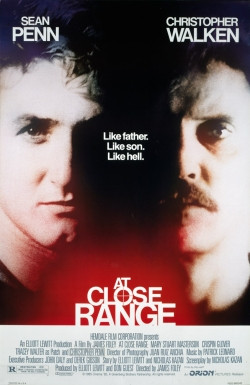
James Foley’s (After Dark, My Sweet) film never really decides what it wants to be, a family drama or a crime picture. Foley eventually throws up his hands and cedes everything to the captivating Christopher Walken.

Not the worst of decisions. Walken plays a minor rural Pennsylvania crime kingpin. He skippers a crew that includes his two brothers and a few other hardened locals. They do heists, car thefts, drugs, and, if necessary, murder, a lethal but merry band of crooks.

Walken’s estranged son, Sean Penn, is a townie still living at home with his mother and grandmother. The women smoke, glare at the TV and otherwise exude the hopelessness of abandonment and near poverty. Penn, seeking something more, falls in at-first-sight love with Mary Stuart Masterson, who looks his way as he cruises at night around the town square. It is for her that he joins up with his father’s crew, to “get out while we’re young … ’cause tramps like us …” 

When Penn realizes murder is part of the gig, he splits from Walken, gets arrested working his own “baby” crew (which includes his brother Chris and a very young Crispin Glover and Kiefer Sutherland), and is incarcerated. There, the cops work on him to fink on his father.

Here, the film becomes ridiculous. Walken, paranoid Penn will flip on him, kills nearly every one of the kids working with Penn, even though Foley does not show them to be integral enough to his operation to be much of a threat. He also rapes Stuart Masterson, which makes even less sense if the plan is to bring Penn back into the fold. Penn comes out of jail, tries to make a run for it with his gal, fails, and in a rushed, abrupt ending, testifies against his father (for 30 seconds).

That’s that.  Lights up.

None of it makes much sense, but the thematic indecision is worsened by gross character underdevelopment. Walken is a charming sociopath, but how did he get here? No clue. We even have his ex-wife moping about, warily eying the establishment of a relationship between Walken and Penn. Foley, however, suffices to use her as a sad totem, so we don’t get any insight into Walken from her. Similarly, Penn needs a Daddy. Then, on a dime, he doesn’t. As he is near mute for most of the picture, we are left to guess as to what he has missed and the basis for his immediate and strong moral stand. Stuart Masterson is looking for something, but as she and Penn prepare to light out for the territories, leaving her house, she is clearly from money. So why is she hanging with these lowlifes? Unexplored.

The film has its strengths. Foley’s feel for rural Pennsylvania is strong. The fields and woods are spooky and forbidding at night. During the day, the crappy cars and houses, the dead-end bars, they all contribute to Penn’s lust for some way to get out. Foley shows just how big and cold this country can be, the kind of place that swallows you up and tells no tales or grinds you down little by little. The murder spree is indelible.

As noted, Walken is the picture, and in every scene, he is riveting. Penn, however, goes low to Walken’s high, and the effect is somnambulant. He’s in with Daddy, then immediately out, then annoyingly internal until his final nose-to-nose with Daddy, all to the conclusion that he needed a better Daddy.

The story is apparently based on a true criminal, Bruce Johnston Sr.

Another note – at the time of the picture, Penn was married to Madonna. She had a song for the picture which then became extended to the soundtrack. It is synthy, mid-80s fare, better suited to Vision Quest or even Risky Business. It has no business being near this gritty movie.  Sure, I joked about Springsteen above, but his music would have been pitch perfect to the film.

On Amazon Prime.
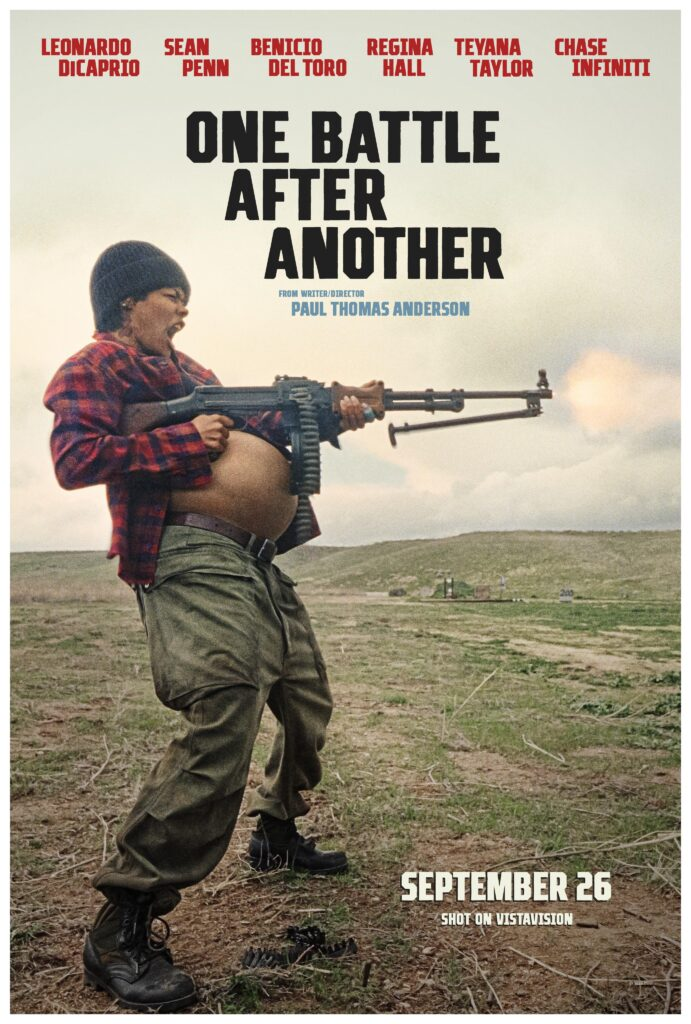
A wild, screwball thrill ride, Paul Thomas Anderson infuses adrenaline with wit and a surprising knack for action sequencing. Leonardo DiCaprio, after Once Upon a Time In Hollywood again demonstrating he is our most accomplished dramatic/comedic actor, plays Bob, a former American domestic revolutionary. Think Weathermen, or Symbionese Liberation Organization, but hyper-charged with comic book pizzazz. Bob got out of the game when he had a daughter, Willa (Chase Infiniti). When Willa is endangered by the past, DiCaprio must save her from a dangerous man on a mission, the government, and a white supremacist society that feels like a mix of Eddie Bauer and SPECTRE. If you wish to stop the review here, as this is a current release, no worries. Enjoy and come back. This is one of the better flicks of the year.

*MINOR SPOILERS FOLLOW*

DiCaprio’s wife, Perfidia Beverly Hills (Teyana Taylor), is a mix of Coffy and Angela Davis. After Willa is born, Perfidia cannot quit the rush of the struggle or face the yoke of motherhood, so she abandons the family, continues to participate in robberies and bombings, and is eventually captured. Her kick-ass bravado exposed, Perfidia squeals on her fellow compatriots, leaving DiCaprio vulnerable and forced to lam it with infant Willa. Bob gives up the life and settles in a quiet town a fat happy stoner, where Willa’s safety is priority number one. 15 years later, a loose end from the past, Sean Penn as Colonel Lockjaw (yes, this is indeed a comic book), needs the daughter, DiCaprio must rouse his flabby mind and body to save her, and the giddy, hilarious chase and race are on.

**MAJOR SPOILERS FOLLOW**
On the minus side, and the basis for deductions.

The film is overlong. Penn is offed twice, to no good end in a film nearing 3 hours. Anderson also tacks on a sop, Willa reading a “Fight the Power!” letter from Perfidia, which, if you do not see it coming means you do not watch many movies.

Penn is also problematic, some of it his fault, some not. He is well-developed as a rigid, top-of-food-chain guy who is so sexually attracted to Perfidia (and she to him) his obsession seems genuine and all-encompassing. They are warriors, on opposite sides, feral, carnal, battle junkies. But when Perfidia is gone, and 15 years pass, Penn’s fixation stems from a funny cartoon creation. “The man,” as in white supremacist corporatist types in a suburban star chamber, come calling for Penn and offer him entree’ to their racial purification club. To enter this august body, however, Penn must erase the fact of his mixed-race daughter. If Anderson had expeditiously grounded Penn’s desires for acceptance and/or the roots of his racial enmity as well as he did his hunger for Perfidia, the film would have been stitched tighter, and Penn’s dilemma would have been more interesting.   

Penn himself is also over-the-top at times, which is sometimes called for (Mystic River) and sometimes not (his William Holden in Anderson’s Licorice Pizza was a masterclass in cool understatement, but he still has the sin of Casualties of War for which he must atone). Given that we spend so much time on Penn’s fate, he needed to be better fleshed out and ratcheted back.  

There is also the matter of the film’s politics. While the revolutionary group opposes all forms of classist, misogynist, racial establishment dominance, ICE-like deportation raids are at the center of the story. Indeed, DiCaprio is ensconced in a sanctuary city. Naturally, this has raised the hackles of observers on the right, another sad development in a world where you can’t even eat a Chick-Fil-A sandwich or drink a Bud Lite without a political colonoscopy.  Nonetheless, Anderson is not interested in proselytizing. He wants action, slowing only to have a little fun, such as when DiCaprio forgets a password and must deal with a punctilious comrade much as we all have to deal with help desks and call centers:

  • Bob: I need this rendezvous point, you understand what I’m saying? I need it.
  • Comrade Josh: I understand and the question is “What time is it?”
  • Bob: Fuck! If you don’t give me the rendezvous point, I swear to God I will hunt you down and stick a loaded, fuckin’ hot piece of dynamite right up your fuckin’ asshole.
  • Comrade Josh: Okay, this doesn’t feel safe. You’re violating my space right now.
  • Bob: Violating your space? Man, come on – what kind of revolutionary are you, brother? We’re not even in the same room here. We’re talking on the phone, like, man!
  • Comrade Josh: Okay, there’s no need to shout. This is a violation of my space to me. These are noise triggers.
  • Bob: Fuckin’ noise triggers? Listen, I wanna know something. I wanna know one thing when this is all said and done: what is your name? I need to know your name.
  • Comrade Josh: My name is Comrade Josh.
  • Bob: Comrade Joshua? Get a better name. “Comrade Josh” – that’s a fuckin’ ridiculous name for a revolutionary. First off. Second off, I want to know your coordinates. I want to know your location right now. What is it?
  • Comrade Josh: I’m in a secure location somewhere between the stolen land of the Wabanaki and the stolen land of the Chumash.
  • Bob: You’re fuckin’ intolerable, man. You’re really intolerable. This is not the way revolutionaries do shit. Do you know how hard you are to talk to? Do you know the information I’m trying to give you? You’re a little nitpicking prick! That’s what you are: a little nitpicking prick. And do you know what I’m gonna do to nitpicking pricks? I’m gonna call in a Greyhawk 10.
  • Comrade Josh: You’re calling in a Greyhawk 10?
  • Bob: I’m calling in a Greyhawk 10, all right? I want you to get your supervisor on the phone right now, because I know you’ve got one. I know you’ve got one, Comrade Josh. All right, I’m going way over your fuckin’ head. Way over your head, all right? Put your commanding officer on the phone now!
  • Comrade Josh: Cause you’re calling in a Greyhawk 10?
  • Bob: I’m calling in a Greyhawk 10, Comrade Josh.
  • Comrade Josh: Please hold.

The interlude is a reminder that this is a trip, not a treatise, and the revolutionaries and their adversaries on the ground are presented as professionals or cogs rather than ideological heroes or villains. They never veer too far from a wink and a nod.  

Ultimately, I think liberal audiences will love the flick no matter their artistic sensibilities. As I feel the excitement of conservative retributive justice (rights be damned!) in a Dirty Harry or Equalizer movie, this flick is the fantasy of glorified gutsy, cool, strutting anti-fascists who possess skill, discipline, and smarts. As opposed to their meh real-life counterparts, living in their mother’s basement, contributing to the revolution one bag of Cheetos and social media post at a time.   

I pledged to go to the theater Saturday to see the three-and-a-half hour The Brutalist. I begged off at the last minute, but then, the guilt of it made me do penance.

I watched Killers of the Flower Moon, another glaring omission, especially on the part of an unpaid film reviewer. Killers was adapted from David Grann’s best-selling book about a series of murders of Osage Indians in the 1920s, crimes borne of their oil wealth and societal vulnerability.

The good.

Martin Scorsese is no slouch behind the camera, and he ably presents the grandeur and sweep of Osage life and the peculiar opulence that sprouted about it. The film looks and feels like a $200 million picture. The detail is impeccable and the feel authentic (not the garish, silly design of Gangs of New York).

Lily Gladstone. Her job as the stoic sufferer of any number of depredations could have been capably performed with simple solemnity. But she infuses it with charm, passion, and subtle resignation. In a film during which I often found myself stifling a yawn, she was captivating.     

To the bad.

Scorsese seems to be having a late-in-life problem with repetitive scenes. Here, we are treated to at least a half dozen scenes of Robert De Niro (the bad guy) telling Leonardo DiCaprio (his nephew and henchman) what to do, DiCaprio getting more and more upset, and De Niro just yelling at him again and again. Much like The Irishman, the movie is 3.5 hours. In that film, it was “1.5 hours … trying to get Jimmy Hoffa (Al Pacino) either to his senses or a meeting.” Here, it is De Niro and DiCaprio bickering.

Worse, their interminable mugging is to the detriment of more interesting characters and subplots, from the resistance of one white man (played quite ably by Jason Isbell), to the genesis of the federal investigation, to the intervention of an Indian investigator, to the actual murders themselves.  Simply put, no one gives a flying fig about these two one-dimensional, barking characters, but there they are, hogging all the scenery at the trough.

The film is also painfully confused. Is this a testament to a historical wrong? A little. But that factor seems mailed in, with scenes of Osage registering objection, but no real agency. Which is fine.  Most people in history have little to no agency. They are subject to the cruelties of their surroundings. It leaves us the machinations of the criminals. But they are so simple (Osage sheep, whites sheep shearers), they don’t lend themselves to captivating drama. Also, Scorsese’s tie to the Tulsa race massacre seems cheap and manipulative.

Is it a procedural or whodunit? Nope.  We know the villain from moment one, he only lacks a mustache to twirl, and when the case is cracked in the last third, it is by far the best part of the picture. But the way it is solved is mundane. They try to break a guy, he gives a bit of guff but soon talks. The book was very much a whodunit and a procedural, grippingly so.

Is it a love story? Scorsese tries, but there is no real chemistry between DiCaprio and Gladstone, certainly, not enough to sustain his serial abuses, i.e., his central part in the murder of her family and friends. The lovable scamp!

Is it a psychological portrait? Perhaps. DiCaprio is the guilty henchman, no doubt, but he is so glaringly stupid (Scorsese even give him pointless unwieldy teeth, this side of Simple Jack), you wonder if the character’s psychology is worth the inquiry.

The writing is not so much weak as it is misdirected. If you’re going to pay $5 million for adaptation rights to a book, why jettison the most interesting parts? The book really digs into the strange origins and dichotomy of the Osage and their oil wealth, which was borne of their savvy as much as their geographic fortune. Here, they hit oil, and the rest is a surface coverage of their spendthrift ways and the fact that to access the wealth, they need white guardians. Scorsese presents this in a sort of mashed up montage. Similarly, the book covers the birth of the FBI and the investigation of the corrupt locals from a federal agent, a first. Here, the Feds just show up (led by a criminally underutilized Jesse Plemons) and start to brace some dudes.          

Like The Irishman, I felt this would never end, and like The Irishman, the universal plaudits feel like they are being artificially elevated on the vapor of Scorsese’s status and the ennobling of the cause.