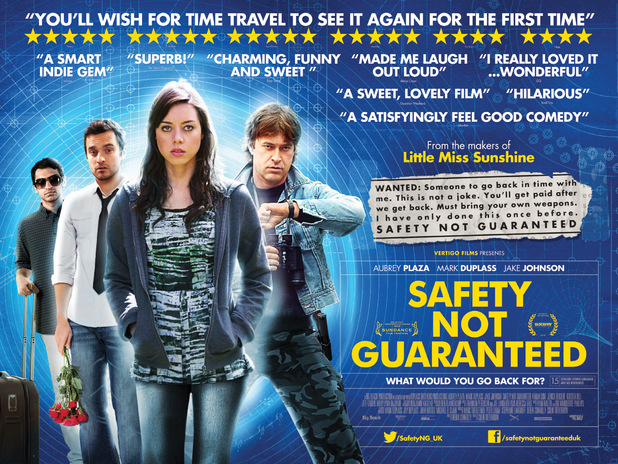
What are the chances I’d see two Mark Duplass movies back-to-back much less one I’d rate a 0 and one I’d rate a 5?  This is a sweet, whipsmart picture about three Seattle magazine employees – two interns (Aubrey Plaza and Karan Soni) and a writer (Jake Johnson) – who go to Northern California to do a piece on a guy (Duplass) who put out an ad to go back in time, looking for a companion.  The writer took the job solely to nail an old high school girlfriend he found on Facebook (Jeneca Bergere).  Plaza is along for the ride and Soni, a geeky Indian techie, only took the internship to round out his resume’.  Plaza becomes intrigued by Duplass, Johnson falls for his target, and it turns out time travel may be possible.

This is a dual story between four people looking to connect.  Duplass bonds with Plaza while Johnson and Soni engage in a mentor-mentee dance.  Best, what seems a goof assignment to write an ironic, hip piece on a quirky dude masks a couple of crises of conscience, place and purpose.

Everybody is excellent, but Johnson is particularly strong as an urban scammer who uses the story as a cover to hook up with a high school flame and realizes how empty he feels in the arms of a real woman.  She asks what he’s doing, he responds that he has an Escalade, she clarifies “no, I meant with your life” and he responds “I just told you.”

When she puts up her guard, points out the error of his idealization, and his fairy tale collapses, he runs to Soni and screams in the geek’s face to get off the Internet, away from his safety bubble and live a life.  Johnson’s character is emblematic of the maturity of the writing.  Normally, he’s the dick, the full-of-himself comic relief.  As a character, it’s an honorable job, ala’ Bradley Cooper in Wedding Crashers.  But Johnson (and really, all the characters) are given more depth in an economical fashion, making a very funny movie poignant and multi-layered.  One of the best films of the year.

Your Sister's Sister (2011) - Rotten Tomatoes

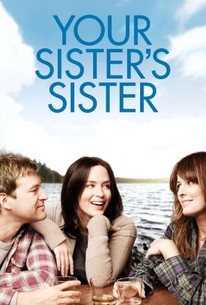
Mark Duplass (Humpday, Safety Not Guaranteed) is the brother of a recently deceased.  We meet him at the one year anniversary of his sibling’s death.  After a gentle eulogy by his brother’s friend, Duplass offers his own, explaining that his brother was a bully who only changed for the better after watching Revenge of the Nerds and realizing that the bully doesn’t get laid.  His brother’s ex (Emily Blunt) intervenes, let’s Duplass know he’s in a bad place and offers her remote family house so he can sort it out.  When Duplass arrives, he finds Blunt’s sister (Rosemary DeWitt) sorting her own issues out, having just left a 7 year relationship with another woman.

With a promisingly caustic first scene and the idea of a romantic angle perhaps immediately removed from the equation, the possibilities are momentarily intriguing.  But Duplass and DeWitt share a bottle of tequila, they have sex (she actually says “I’m game if you’re game”), and the movie craps out.   Duplass achieves orgasm in less than a minute to establish his bona fides as a regular schlub and to ensure that no connection was achieved.  Blunt, in love with Duplass, shows up.  It gets weird.

The film tries desperately to be cool, but the dialogue is stilted and humorless.  Duplass is presented as a bit of a crack-up, but he is unfunny (a sample bon mot is his observation that they go to an IHOP but will need passports), superficial, and self-involved.  Both women are crashing bores and for a romantic triangle of sorts, it is surprising how sterile and sexless they seem.

Though Duplass is desperate to keep the fact he had sex with DeWitt from Blunt, you know and hope it will out.  Anything to break the monotony, which is quite something for a 90 minute film.  These are the three most boring people in the world, characters created by the writers who pen quips traded by couples in Ikea commercials, if an Ikea commercial was sound-tracked by acoustic guitarists who play at contemporary Christian services.

The film is also amateurishly acted (Duplass is the poor man’s Ron Livingston, DeWitt is dishwater dull and Blunt one-note dewy eyed).  Is there depth under those still waters?  Most likely, just brackish, gloomy ennui.

Another criticism.  There is no lazier writing tic than the use of “fucking” before every noun, a regular staple in this film.

How I Met Your Mother is better paced and funnier and that show sucks.  This is hipster drivel without a single genuine moment.  Avoid.

A soldier in Iraq (David Anders) is gunned down and dragged away into the desert. He comes home to LA for a full military funeral, but after being put in the ground, he rises. And goes straight to the apartment of his wastrel friend (Chris Wilde, who looks like David Spade but acts funnier). There, he realizes he cannot eat. Soon, he craves blood. He robs a blood bank but realizes he is better served appearing vulnerable and then feeding off of criminals (a mix of Charles Bronson in Death Wish and Dexter).

The first half of the film is fresh and clever.  The “what the fu**!” reaction of Anders to his plight is gut-busting and the aplomb with which Wylde greets his pal is the perfect pitch. The picture has a wicked sense of humor, harkening back to American Werewolf in London and Reanimator. This could easily have been a bigger budget, Paul Rudd/Seth Rogen project. Indeed, feeding your back-from-the-dead pal is the ultimate validation of a bromance.

Alas, two thirds in, and it runs out of gas. The plot shifts to the woes of Anders’s girlfriend, who still unconvincingly loves him with all her heart, even if he actually rots and stinks when unfed. It gets more and more absurdist, and after we dispense (in gruesome fashion) with the girlfriend, the movie doesn’t know what to do with itself.  So it opts for over-the-top excess and a high concept finale. The former is numbing. The latter comes off cheezy. The film’s low budget, hidden nicely by well-chosen LA locales and unambitious special effects, becomes an issue when we get into police chases, an overlong massive shoot-out in and outside of the subway, and sci fi nonsense that cries out “Student film.”

Still, promise from director D. Kerry Prior and a noble failure.

Skyfall' sends Bond franchise soaring again

In his third turn as James Bond, Daniel Craig is close-cropped, weathered (think a better-tailored Steve McQueen in Papillon) and dispirited.  M (Judi Dench) put him in his funk.  She made a tough call without batting an eye and as a result, Bond was shot and presumed dead. He survived the bullet but left the job to drown his sorrows. Another former 00 agent (Javier Bardem), however, harbors a much nastier grudge against M, bringing Bond back to life and service.

There are weaknesses.  Skyfall is merely a revenge flick.  All of Bardem’s efforts are directed at killing M, which is not all that interesting. Moreover, Bardem not only wants to kill M, but he wants to do it face-to-face (early in the film, he proves how vulnerable she is by blowing up her London offices via computer).  So, his master stroke (a hit on M as she testifies before a board of inquiry) seems unnecessarily elaborate given that if successful, he’s probably going to shoot her in the back in a confused firefight.

The film is also heavy on exploring Bond’s psyche. We learn he is an orphan (thus, his wounds from M’s callousness are all the deeper).  We also see his psychological interview (to determine his fitness for duty) and even the crawl space where he hid as a lad upon hearing of the death of his parents. The interview has funny moments (including a clever word association; the psychologist says “murder” and Bond responds “employment”) but it also reveals Bond’s “Rosebud.” The revelation of the childhood hideout and trauma feels too close, too modern.

Bond’s generational clash is another theme, one better delivered. We meet a new Q (a twenty something played by Ben Whishaw, who was impressive in BBC’s “The Hour”). Q fences with Bond about the utility of having live agents searching for intel. Meanwhile, forces all around Bond and M are telegraphing it is time to pack it in.   Even the villain, Bardem, positively winces at the rigor of field work. He can do it, but he elegantly expresses his preference for the click of a mouse.

Bardem is perfect. He’s psychotic, charming and empathetic. His opening speech on what to do with rats on an island is riveting and his playful sexual come-on to Bond is surprising and convincing.  He steals the show.

The Bond women are distinct and sexy.  The first is a lithe, capable agent (Naomie Harris) who is given the order by M to take her shot in the opening scene (she misses the bad guy and plugs Bond, resulting in some clever repartee’ upon his return).  The second (Bérénice Marlohe) is a doomed beauty, in mortal fear of Bardem, latching on to Bond as her salvation.

The action sequences are up to snuff, if not dazzling. The finale is an old fashioned shootout where Bardem and his army attempt to get at Bond and M at his childhood home, an ancient Scottish manor house. They are assisted by the property’s game keeper, Albert Finney, which could have been cutesy but works out fine.  It also introduces shotguns. Shotguns are cool.

Sam Mendes (American Beauty, Road to Perdition, and the ghastly Revolutionary Road) seemed a strange choice to helm. But he proved capable of action in Road to Perdition, and he puts his stamp on the franchise. Mendes is patient and methodical, comfortable with a moody but chattier Bond, where the discussions are not rushed.

Perhaps indicative of a future lighter touch, Skyfall closes with not only a Bond lightened by catharsis, but the introduction of a captivating new Moneypenny (Harris) and a report to his new boss, Ralph Fiennes.

A vehicle for the skills of a host of accomplished Brit actors, this movie starts out swift and charming, as we watch our leads end up in India at a run-down retirement hotel that looked a helluva lot better in the brocuhure.  Judi Dench is recently widowed; Tom Wilkinson, fed up, abruptly resigns his judgeship; Bill Nighy and Penelope Wilton have had to scale down their retirement plans after an investment in their daughter’s internet company went bad;  Maggie Smith needs a hip replacement and can get it quicker in India; and Celia imrie and Ronald Pickup are fighting aging and simply along for the ride.  Directed ably by John Madden (Shakespeare in Love), the set up is deft and the upcoming culture clash looks to be fun.  Okay.  Love Actually for old people, right?

Instead, the film takes itself way too seriously.  The Nighy-Wilton union is crumbling.  Dench is regretful of her long-term marriage.  Wilkinson has a deeper secret underlying his removal to India.  Smith’s tale is even more woeful.  What seeemed a light comedy turns into a morose trek.  Even the comic relief (Slumdog Millionaire’s Dev Patel, who runs the hotel) has his own crucible – he must stand up to his mother and choose the one he loves (all with the help of some sound Brit advice).

The actors are really all very good, and they are elevating pedestrian material (not a thing happens that you haven’t guessed).  The resolutions are absurdly convenient and it ends sickeningly cloying.  Unlike Slumdog, the India portrayed here is all sweetness and dazzle, if a little crowded, and the Indian actors are given that child-like nobility that always comes off as condescending.   

The last 15 minutes is so rushed in its effort to provide a tidy, happy ending, it feels damn near like the entire endeavor was trying to make a flight.

It is in vogue to denigrate Will Ferrell, whose excess has long outlived its freshness. He’s slogged into one tiresome, repetitive project after another. Land of the Lost? A one-man show portrayal of George W Bush, The Other Guys, Casa di mi Padre, The Campaign, and soon, a repeat, Anchorman: The Legend Continues. His forays into a successful Jim Carrey-like branch-off started with promise (Stranger than Fiction) but his dramatic weaknesses were apparent in Everything Must Go. His last goofy semi-triumph was Step Brothers, which owed as much to the supporting efforts of the scene-stealing, diabolical Adam Scott and the inspired premise as to Ferrell’s adolescent sincerity as the arrested man-child, Brennan Huff.

Let us not forget, however, that when Ferrell was on a roll, it was an impressive one – Old School, Elf, Anchorman, Wedding Crashers . . . all a variation on the man-child theme, but classics nonetheless.

At the end of Ferrell’s run is Talladega Nights, the last hurrah, but what a hurrah.  Ferrell plays Ricky Bobby, an ignorant, flashy, uber-American NASCAR driver with a hot blonde wife (Leslie Bibb), a loyal race car compadre (John C. Reilly) who loves Ricky so much he happily takes second in every race, two horrific kids (Walker and Texas Ranger) and a gay French nemesis on the track (Sacha Baron Cohen). When Ricky is on top, it looks something like this:

When it all goes to crap after a brutal wreck, Ricky must re-connect with the itinerant father who abandoned him as a child (Gary Cole) and his old-school mother (Jane Lynch). With their help, and the help of a loyal, starstruck flunky (Amy Adams), Ricky regains his mojo and lives the VH1 comeback before our eyes.

The gags are inspired, the back-and-forth (much of which has to be improv, as evidenced by the bloopers in the credits) crackles, almost every supporting character delivers well (Molly Shannon as the boozehound wife of a corporate slime is particularly prime), and the chemistry between Ferrell and Reilly, which was very good in Step Brothers, is undeniable. After Ricky loses his nerve and then all, Cal replaces him, setting up in Ricky’s house and with his wife. But they do miss each other:

It’s uproarious, loaded with gem slogans (“If you ain’t first, you’re last”) and has as much fun as you can have with American excess. Even as silly an endeavor as this could have come off condescending and mean to “those NASCAR types” but Talladega Nights feels wholly respectful even as it goes to town on its target.

Me and my boy are scheduled to see The Who playing Quadrophenia from beginning to end next week, so we prepared by watching Franc Roddam’s directorial debut, a story of a miserable 1960s London “Mod” (Phil Daniels) eternally at war with his parents, his job, the girl he fancies, rival “Rockers” and all that bourgeois b.s.

Daniels is a punk, through and through, and increasingly, it appears he is mentally disturbed.  He either laughs goofily or snarls, and at no point do we feel empathy for his not particularly difficult plight.  He has a job, a super cool Vespa, a gang of friends who are pleasant and tepid, and a fondness for readily available pills.  His life is also soundtracked to The Who, fer crissakes (poorly, though – it’s clear the director didn’t know how to fit the music into the film and with the exception of the final scene, the musical contribution of band is distracting rather than evocative).

There are some charms to the movie.  It was filmed on location in London and Brighton and the final scene (where Daniels either kills himself or he doesn’t) is a pretty impressive (though overlong) helicopter shot of a precarious ride along the Brighton cliffs.

If you look close, you’ll also see a boatload of very young Brit actors who went on to solid careers, including Tim Spall, Ray Winstone, and Phillip Davis.  It’s a shame one of them didn’t get the lead, because Daniels appears to have been chosen solely for his likeness to Pete Townsend.

Sting is also featured.

Almost Famous - Movies on Google Play
Based on writer/ director Cameron Crowe’s experiences touring with rock bands like Poco, The Allman Brothers and Led Zeppelin,
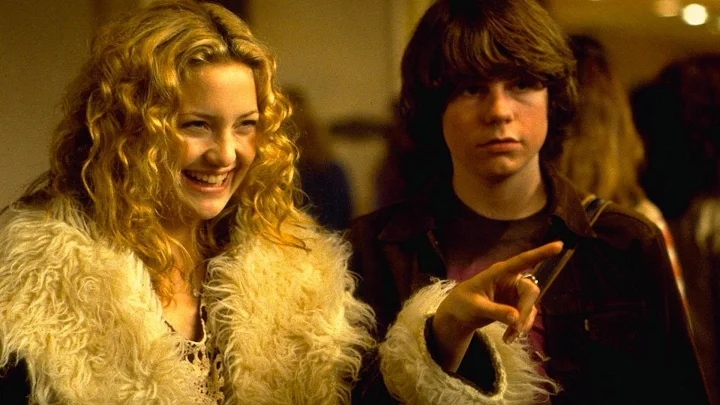
Almost Famous gives us Crowe stand-in Patrick Fugit, a 15 year old rock fan who writes for his school newspaper and a San Diego alternative mag.  His work garners the attention of Creem magazine and its famed rock critic Lester Bangs (Phillip Seymour Hoffman).  Bangs tutors Fugit, who gets an assignment from Rolling Stone to cover rising band Stillwater, fronted by the suspicious and bloviating Jason Lee and the more talented and enigmatic guitarist Billy Crudup.  As Fugit is ensonced with the band on the road, he is charmed by groupie (or, Bandaid) Kate Hudson while his mother (Frances McDormand) monitors his trip via regular phone calls.  Fugit falls in love with Hudson, who is in love with Crudup and considers herself a muse to both.

The film is unabashedly nostalgiac, particularly the scenes of McDormand allowing and then regretting letting her son go on the road with the band.  McDormand is a conflicted personality, half free spirit, half overbearing “DON’T DO DRUGS” nag.  But her affection for her child is undeniable and as she sees him grow up, their distance becomes more painful.  Worse, she intuits he has found a new family (all of whom assure her when she calls that she has raised a wonderful boy while raising the specter that he is being plied with sex, drugs and rock and roll).

This is a fan’s movie, interspersing great 70s rock with a coming of age tale.  Fugit evokes the awkward, sweet nature of a 15 year old lovestruck boy and his performance is beautifully sentimental.  Crowe shows no fear of the maudlin which is for the most part to the film’s advantage.  When the band and its coterie, breaking apart due to various strains on the road, spontaneously sing Tiny Dancer on the tour bus, you can imagine eyes rolling after reading the scene.  But it works perfectly, all part of Crowe’s love letter to rock.

This is not to say that the film never missteps.  It is occasionally too cute, a Crowe weakness.  At one point, Hudson tells Fugit, “You’re too sweet for rock and roll” as if it needed to be said.  Crowe then makes him prove it.  Hudson, despondent over Crudup’s rejection of her, overdoses on Quaaludes.  Fugit saves her and as she gets her stomach pumped before his eyes, he remains starstruck, mooning as she vomits (Stevie Wonder’s “My Cherie Amour” plays in the background).   In another scene, the band plane appears to be going down, and the members all trade simmering accusations and long held secrets, which feels pat and forced.

But by and large, the film’s tone is just right, evoking the memories of your first LP and the moments when your mother actually read the lyrics on a record sleeve and took it away.

There are also laugh out loud moments, my favorite being Lee’s first interview with Fugit, where he waxes poetic on rock:  “Some people have a hard time explaining rock ‘n’ roll. I don’t think anyone can really explain rock ‘n’ roll. Maybe Pete Townshend, but that’s okay. Rock ‘n’ roll is a lifestyle and a way of thinking… and it’s not about money and popularity. Although, some money would be nice. But it’s a voice that says, ‘Here I am… and fuck you if you can’t understand me.’ And one of these people is gonna save the world. And that means that rock ‘n’ roll can save the world… all of us together. And the chicks are great. But what it all comes down to is that thing. The indefinable thing when people catch something in your music.”

When the quote makes the article, his response is priceless:  “Rock ‘n’ roll can save the world”? “The chicks are great”? I sound like a dick!”