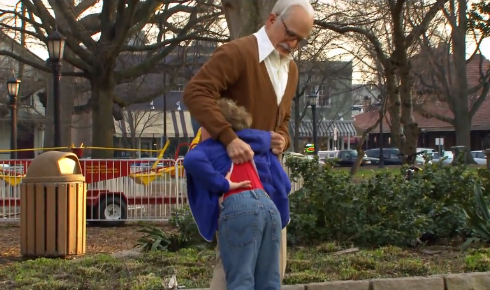
There is a difference in this installment of the Jackass series.   Creator Johnny Knoxville and collaborator Spike Jonze have given us an actual character. Instead of a gaggle of cut-ups and clowns crashing golf carts or defecating in showroom toilets, we have an old man (Knoxville in convincing makeup and prosthetics) who is recently widowed (in fact, his dead wife is in the trunk of the car) and whose daughter was just jailed.  The old man is forced to drive his grandson from Nebraska to North Carolina to drop him off with his deadbeat father, pranking merrily along the way.  Some pranks hit (his uninvited involvement in a male strip show and his being hurled through a plate glass window while astride a kiddie ride), some are okay (a malfunctioning bed that crushes him, a drunken trip thru a drive-up window in a shopping cart) and some are too uncomfortable or disgusting to recapitulate.

Ultimately, like Borat before it, Bad Grandpa is accidentally patriotic.  As bad as this grandpa acts, as much as he destroys and mucks up, the tolerance and kindness that greets him is noteworthy.  As Christopher Hitchens observed about Borat, whose hijinks were decidedly more cruel and condescending than Knoxville’s shock routine, “Americans are almost pedantic in their hospitality and politesse.

The patience of the prank-ees in Bad Grandpa is its strongest feature and, for that, we should be thankful.

Enough Said is an engaging, touching semi-romantic comedy for adults in the target market of 40 to 60. The trials of Julia Louis-Dreyfus, a middle aged masseuse, do not include keeping the sex drive hot with the advent of a new baby, or struggling with the fact that all of her friends are married while she is not. Rather, she is divorced, working, plagued by her daughter’s move from LA to NY for college, and the hunt for a man has been reduced to a mere occasional flare. But she meets a man, and his ex-wife, and develops a romance with the former and a friendship with the latter, initially ignorant of their connection. She is soon wise and makes the calamitous decision to use intelligence gathered from the ex-wife to evaluate her new partner.

Enough Said is a beautiful epitaph for James Gandolfini as the love interest, who plays a portly middle-age loner in angst over the departure of his own daughter to college with a subtlety and nuance that may well have freed him from the shackles of Tony Soprano once and for all (the Lord works in mysterious ways, and there is no greater example than having Enough Said released after The Incredible Burt Wonderstone).

Louis-Dreyfus is also impressive. There is no questioning her comedic chops (HBO’s Veep shows how effortless she moves in that milieu), but here, she draws deeper, and slowly reveals repressed fear and insecurity. Not in the paroxysm of a self-revelatory banner speech or after undergoing the withering but “true” dressing down of a gal pal in the penultimate act, but in ascending scenes of awkwardness, comfort, quiet resignation as to her actions toward Gandolfini, and then need.

The film also handles secondary characters with maturity. They err and recover, but we are not let off the hook by cartoonish villains or easy marks. This is a bit of a departure for writer-director Nicole Holofcener (Lovely and Amazing, Friends with Money), who was previously very tough on her protagonists and supporting characters in a manner that bordered on condescending. Still, in Friends with Money, Holofcener zeroed in on the casual iciness of an outwardly happy marriage between Catherine Keener and Jason Isaacs and her skill depicting the dynamics of couples has not eroded.

One of the, if not the best film of the year.

Rear Window, or the World's Scariest Bottle Episode – Scriptophobic

I just engaged in a donnybrook of a discussion with a few friends over this film, the primary contention being what it was actually about. It was the kind of exchange only the participants could enjoy, but the spirited debate about the film and Hitchock in general led me to re-watch Rear Window this weekend.

Jimmy Stewart is an adventurous photographer who has a broken leg (but he got the shot of the crashing motor car before it hit him). Cooped up in his New York City apartment, he spends the time peeping on his neighbors across the way (he has a splendid view of their windows and courtyards), and in the process, he begins to suspect one (Raymond Burr) of murdering his wife. He enlists his socialite girlfriend (Grace Kelly), whose marriage entreaties he is fending off, in his investigation, leading to a thrilling conclusion.

The film succeeds on three levels. First, it is a witty comedy, with sharp exchanges between Stewart (the confirmed bachelor and super snooper) and Kelly, as well as Stewart’s health care attendant, the brusque Thelma Ritter. The women are pro-marriage and anti-peeping. As these discussions develop, Stewart enlists them in his monitoring of Burr, and thereby, Kelly “proves” herself to Stewart as something more than a rich, pampered girl. At its best, it plays like a David Ogden Stewart or Ruth Gordon battle of the sexes script.

It is also a love story, initially very light, but when Kelly is in harm’s way, Stewart evinces true passion. Stewart has been lampooned so often (“Zu Zu’s petals!”) that one forgets his ability to communicate depth of emotion, but before those petals, there was his haunting breakdown in Martini’s bar. Also, given the 21 year age disparity, it is surprising Stewart and Kelly manage chemistry, but it’s there.  Indeed, the insane idea of rejecting Grace Kelly is made more comprehensible by Stewart’s cranky maturity.

Finally, this is a meticulous thriller with a few dark overtones. Stewart peeps as a lark, but soon, he is obsessed and a little ashamed.  He sheepishly admits to Kelly that they’re viewing “pretty private stuff going on out there.”  She retorts, “We’re two of the most frightening ghouls I’ve ever known.”  And what they see is generally pretty depressing: a suicidal Ms. Lonelyhearts, a composer in despair, newlyweds from shine to routine. And, of course, a killer, nagged by his wife and driven to extremes. It’s not a happy place, as is shown by one neighbor whose dog, sniffing in the wrong garden, meets an untimely end.

I’ll end with the thoughts of someone more distinguished, David Thomson, from his book The Moment of Psycho: How Alfred Hitchcock Taught America to Love Murder:

Hitchcock knew that a system locked into watching and seeing can misread its surroundings and can even lose its identity and ordinary human sympathies because of the pressure of voyeurism. The voyeurism is so heavy, so forceful, it can smother real human nature. Psycho is the conclusion to a set of films beginning with Rear Window, and for me that is Hitchcock’s best film in that the smile of satisfaction at the end covers without hiding the loneliness that affects real people. Rear Window is a romance, a comedy and a thriller, but a portrait of alienation too. The apartments and windows are screens, of course, but they are traps, or cells – in that entire courtyard no one seems to “know” anyone else; neighborliness has not been invented.

This BBC 5 part mini-series is a taut crime story, lovingly detailed, and anchored by a powerful, understated Gillian Anderson performance. A serial killer is loose on the streets of modern day Belfast and he is targeting professional women of a particular physical type, who he tracks, monitors and then strangles in an elaborate, almost artistic ritual. Stella Gibson (Anderson) is brought in from London to perform a review. When the killer strikes again, she is assigned the case.

This is not a whodunit, as we are introduced to the killer in the first few moments. Instead, The Fall is a meticulous police procedural with a distinct take on Belfast.  Be it the ways of a tough neighborhood, the politics of the investigation or specifics of a crime scene, the feel is assured and authentic.  The characters are also very strong, in particular, the killer (Jamie Dornan).  While he is in no way sympathetic, he is unique in that we see him not only planning and executing his gruesome acts, but as a seemingly loving father and husband, and a conscientious civil servant (of all things, he is a grief counselor). 

The Fall was created by Alan Cubitt, who has credentials as a writer for the Helen Mirren series, Prime Suspect, and at first blush, Anderson’s Gibson and Mirren’s Jane Tennyson have some similarities. They are both Detective Chief Inspectors in a male-dominated profession and they both do not have a significant male others. There is where the similarity ends, as Gibson is in a new environment (the last Prime Suspect was almost a decade ago), one that is more friendly to women, but also one where male expectations and bias evince themselves in a subtler fashion. Anderson’s Gibson is also clearly more reserved and in-control than Mirren’s Tennyson, who was rock-solid on-the-job, but more vulnerable in her private life. Gibson is not vulnerable at all, but she is not brittle or overtly righteous. In many ways, she is a “first” for a female police lead, as male as any officer, certainly stronger and smarter than most, and emotionally detached without lapsing into copycat or bitch. When a married detective with whom she has casually slept with is investigated, and she is questioned as to the liaison in a manner different than a man would endure, she suffers the double-standard with a certain patience before matter-of-factly telling the investigator that the detective’s wife was her lover’s problem, not hers. She also has somewhat of a sexual kink. Not Clint Eastwood in Tightrope kinky, but a kink nonetheless, a true rarity for a female lead.

It’s a great character and Anderson has left a lot to develop.    BBC Two has renewed the series for a second season and I hope Gibson becomes the next Jane Tennyson, who carried us through 7 Prime Suspects.

Available on Netflix streaming.

Alfonso Cuaron’s first feature since 2006 (Children of Men) is both a traditional, seat-of-your-pants thriller and a meditation on isolation and impending death. In the latter category, it more than succeeds. I saw it at an IMAX theater in 3D, and in an era of distraction, I’ve never seen such rapt attention given a film. The stillness of space transported the theater, and understandably so. The visuals are jaw-dropping, and Cuaron depicts space in such a unique manner, both expansive and claustrophobic, the viewer feels lost and vulnerable in the great unknown. At the end, the audience breathed a collective sigh of relief, satisfied but a little antsy to get out on the street. For once, the technological wizardry of Hollywood was employed in sync with the other elements of a film, rather than as it primary recommendation.

Now, I am sure even a lowly NASA intern might look at the technical specifics of the plot and chortle. Astronauts Sandra Bullock and George Clooney are working on a space station when debris from a destroyed satellite not only rips through their command but through near every satellite and space station in a line, as if all were posted on the same space highway. The catastrophe leaves them dislocated, and the only way back home is to propel themselves from the U.S. station to a Russiain one to a Chinese one, improvising along the way. Interestingly, of all the leaps the audience has to take, I was most confident you can’t use a fire extinguisher as a jet pack, but dammit if Bullock didn’t do just that, it seemed perfectly plausible while I was watching it, and it is theoretically possible. Regardless, niggling about what could and could not happen in real life is an indicator that you should have seen Captain Phillips.

If I have a criticism, it is on the meditation aspect, and even then, it is minor. Not that the film wasn’t well-written. Bullock’s journey from helpless to frantic to resigned to resistant is compelling, and she has collected some gravitas as she’s aged, transforming from spunky to flinty. Clooney, however, is badly miscast. His wisecracking, country music listening solid leader is formulaic, and he communicates a sly grin in even the most dire of circumstances. You need more than a really strong turn as Dennis Quaid in the role.

Still, at 90 minutes, the film doesn’t dawdle, and as solely a visceral joy, it’s one of the best pictures of the year.

Guillermo del Toro’s fairy tale is a rebuke to the taming of the Brothers Grimm.  His story of a young girl, Ofelia, is set at the tail end of the Spanish Civil War.  She has just been brought to the camp of her new father, Nationalist fascist Captain Vidal, by her pregnant mother.  The former is a sadistic, obsessive-compulsive, suicidal and the latter is simply desperate to have found a protector in the new Spain.  Ofelia escapes to the nearby woods of Vidal’s headquarters, and a world of faeries, fauns and monsters who give her arduous, often terrifying tasks that offer her majesty in a fairy tale land.

Unlike del Toro’s The Devil’s  Backbone, the films’s forerunner, the war makes a more pronounced, visceral appearance.  Vidal is cartoonishly vicious, obsessed with the birth of his son and a new Spain, bent on torture and extermination not just of his enemies, but of those who would infect the future. It borders overkill, but with with half of the deaths in the war attributed to executions and murder of the defenseless, the depiction is apt. The fate of Vidal’s son is del Toro’s rebuttal.

The film is visually stunning (it won Oscars for art direction, cinematography and makeup) and movingly juxtaposes the brutality of the war with Ofelia’s hidden place. But del Toro doesn’t make Ofelia’s choice easy.  Her fantasy world can be every bit as treacherous and horrifying as the war she seeks to escape.  In particular, Pale Man, who guards the quarry of Ofelia’s third task, is one of film’s most frightening visions (and has a gait similar to that of Mama, the spook in del Toro’s last film).

And you can be Pale Man at home!


Joseph Gordon-Levitt directed, wrote and stars in this surprising romantic comedy about a New Jersey working class lothario who prides himself on an ability to bed the most beautiful girls at the clubs (the “dimes”) but maintains a more personal, lasting relationship with on-line porn.  When the dimiest of dimes, Scarlett Johannson, comes between Levitt and his smut, he is forced to make a choice, with the assistance of an older friend, Julianne Moore.

The picture starts out fresh and funny, getting the most out of Levitt’s conundrums and fetish, but it takes a sweet and slightly deeper turn as he comes to realize the degenerative, asocial impact of his choices.  Gordon-Levitt is a winning performer, and even as a slightly dim palooka, you invest in him. Johannson and Moore are also strong in support. In fact, the entire cast is sharp, save for Tony Danza and Glenne Headley doing a louder, less capable Robert De Niro/Jackie Weaver from Silver Linings Playbook.

In some ways, this movie appears to be the last thing a teen should watch, especially a younger one.  It is crude and deservedly R rated.  But I’m going to recommend it to my high school freshman son and senior daughter because it is original and clever and, as importantly, because it communicates a positive lesson about sex and love in a world where, well, you have porn stars wondering why they just aren’t accepted and the medical community searching for yet another clinical addiction.

When I saw there was a critically acclaimed documentary about The Shining, I purposefully read nothing about it so I could come to it fresh. Well, that was a mistake, because Room 237 has very little to do with the making of Stanley Kubrick’s horror masterpiece. Instead, it fleshes out the interpretations of the film by a bunch of lunatics. To them, The Shining is about the genocide of the American Indian, or the actual Holocaust, or it contains hundreds of subliminal sexual images, haunted demons sexually attracted to humans, feeding off of them. Or it is about impossible interior design, or the real history of the state of Colorado, or when Barry Nelson meets Jack Nicholson, the file folder at his crotch level is really a boner.

I’m sure there are other interpretations, but I turned this stupid documentary off before getting to all of them. An utter disappointment, a colossal waste of time and shit sound to boot.