Archive

2012

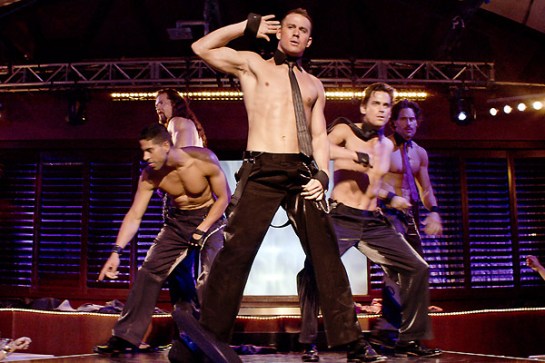
Steven Soderbergh’s semi-rags to not-quite-riches story of a young Tampa male stripper and his introduction to the world confirms two things.

First, Soderbergh is one of those rare talents who can direct most any kind of film, be it jokey caper flicks (The Oceans movies), intricate ensemble thrillers (Contagion, Traffic), meditative crime pictures (Underneath, The Limey), comic crime pictures (Out of Sight), period pieces (King of the Hill), star vehicles/accessible treacle (Erin Brockovich), action flicks (Haywire), and biographical comedies (The Informant).  Hell, Soderbergh even coaxed a passable performance from porn star Sasha Grey (EntourageSlut Puppies 2) in The Girlfriend Experience.

Second, while Channing Tatum is a huge star, he’s also going to be an enduring one.  He showed a real affinity for comedy in 21 Jump Street and in Magic Mike, he reveals depth to go with his light touch.   He is undeniably attractive, but he’s also winning and vulnerable.  He will be touching the erogenous, mommy and soulmate zones of female viewers for a long time.

Tatum is one of a troupe of male strippers under the sway of club owner Matthew McConaughey, who has taken oily to new heights.  The men live in a bubble world, scoring $500 a night to dance for Tampa’s enthusiastic females, while living a dream of sun, fun and ecstacy (the drug and constant and varied sex).  Tatum, however, has a bigger dream.  Though he wants equity in the club, which will soon be going big time in Miami, he has other irons in the fire.  When he becomes the big brother to a new 19 year old dancer (Alex Pettyfer), he falls for Pettfyfer’s protective sister (Cody Horn) and rethinks his situation.

Soderbergh manages to make the world both enticing and seedy (though not as comic as Demi Moore’s milieu in Striptease, it is a similar evocation), which makes Mike’s dilemma convincing.  Tatum delivers his crisis of conscience and his desire to “be something” so you buy in.  A weakness, however, is Soderbergh’s decision on too many dance/strip/hump sequences.  Admittedly, I am not the target audience for these scenes, if they were meant to be erotic or titillating, but save for one scene where Horn actually watches Tatum ply his trade (her response is equivocal, a mix of fascination and discomfort), I don’t think that’s where Soderbergh was heading.  Indeed, the male revue world is loudly bacchanalian, with women whooping and hollering in mock lust and real joy, a jarring contrast to the world of female stripping, where, as Larry Miller used to joke, the men eye the strippers like lions eye antelope.

Quentin Tarantino’s Achilles heel is his immaturity and obsession with genre.  Be it Japanese ninja films or 70s drive-in schlock, his bad pictures (and the Kill Bills and his contribution to Grindhouse are bad pictures, “fear of not being hip” critical acclaim notwithstanding) are foreordained by his choice of an homage to shit, which merely produces higher caliber shit.

Hence, my trepidation walking into Django Unchained.  Fortunately, spaghetti westerns are stronger source material than Japanese ninja crap and American drive-in crap, and Tarantino doesn’t become engulfed by this particular genre.  Sergio Leone is ever present, but the picture does not attempt to ape or glorify his work.  Tarantino also adds humor with a very modern sensibility.  Finally, Christoph Waltz, who electrified Inglorious Basterds and collected a well-earned supporting actor Oscar for his work, and Leonardo DiCaprio, who embodies oily, smooth charm and venom, elevate the material, so much so that when they are absent from the film, you can hear it leaking air.

Django (Jamie Foxx) is a slave freed by a bounty hunter (Waltz) who needs Django to identify some targets.   A partnership develops and soon, the duo endeavor to retrieve Django’s wife (Kerry Washington) from Mississippi slavemaster DiCaprio and his conniving house master (Samuel L. Jackson).  Cartoonish, bloody, often wildly funny, and fast-paced, Django would have scored higher save for a tacked-on ending that adds a wholly unnecessary 25 minutes to a film that was satisfyingly concluded.  Worse, it is in these 25 minutes that Tarantino the actor appears, with a befuddling Aussie accent, to jerk the picture to a standstill.  From there, surreal becomes outrageous and outrageous becomes boring.

Still, what precedes the unsatisfying ending is a blast, part blaxploitation revenge fantasy, part loving tribute to Italian westerns, and part sly, broad comedy (the scene where a posse of pre-Klan night riders argue over the utility of their white sheet hoods is more Blazing Saddles than Once Upon a Time in the West).  Best, professional scold and Knicks fan Spike Lee, who I understand used to have something to do with filmmaking, is not amused by the melding of a slave story and a western  When Lee is up in arms, it is a strong endorsement indeed.  Lee’s criticism is almost as stupid as the Village Voice‘s defense of Tarantino’s use of the word “nigger” (over 100 times) on the grounds of historical accuracy.  Even if that word hadn’t been used in the Mississippi of 1858, Tarantino would have used it nonetheless, for two reasons.  First, he loves that word, and he loves it most when uttered by Samuel L. Jackson.  Second, just to spite Spike.

Liam Neeson works in Alaska as a sniper protecting workers from wolves.  He’s at the end of his tether, trapped in a faraway hell where all around him, the dregs do the hard work in a barren wasteland, drinking, drugging and fighting at night.  Near suicidal, Neeson grabs a flight to Anchorage, which goes down in a part of the frozen tundra controlled by a marauding wolf pack. Neeson leads a group of men in their attempt to survive the elements and the wolves.

At first blush, The Grey seems a drearier, heavier The Edge, without the sharpness of a Mamet script or the tension born of a romantic entanglement.  Surprisingly, given the director’s track record, this story of men turns out to be a great deal more than a thriller.  We learn a little about each of the survivors, and Neeson, who was ready to throw his life away, draws purpose from and provides comfort to men suddenly facing death.  There is a beautiful scene after the crash, where Neeson consoles a gravely injured passenger, tells the man he is dying and asks him to think of one he loves to walk him out of this world.  What follows is indeed very thrilling, but also deep and even elegiac.  As characters meet their fate, you find yourself empathizing strongly with them, not only because of their plight but because you have invested in them.

Neeson is strong as a lost man reconnected to humanity through this nightmare. He should be nominated for an Oscar, but given the vehicle, it cannot be. The ensemble cast is also formidable, with special mention to Frank Grillo as an ex-con survivor who naturally resists Neeson’s leadership.

The Grey was directed and co-written by Joe Carnahan, who helmed the excessive and stupid Smokin’ Aces and The A Team, so things are looking up.

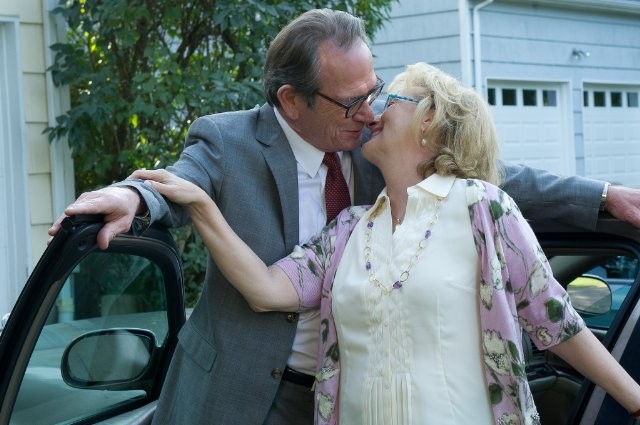
Meryl Streep is incredible, as always, flawlessly and effortlessly inhabiting the character of a repressed, unhappy Nebraska housewife, married to a removed, cantankerous Tommy Lee Jones.  She signs the couple up for a week of couples counseling in Maine under the tutelage of Steve Carell, during which their marriage is analyzed in order to fix it.

Most of their problems stem from intimacy issues.  They haven’t had sex for 4 years.  So that’s where Carell focuses.

The performances are uniformly good and the interplay between Streep and Jones is often genuinely affecting.  The film, however, becomes repetitive and ends in a cloying renewal of vows that is much too much.  The movie also features some of the worst, most intrusive and blaring pop songs to accompany emotional stretches.

Be prepared.  As I said, the central problem for Jones and Streep is sexual.  Which means frank talk about and between people I’d prefer not to think about in sexual situations.  It also has a scene of Streep trying to give Jones a blowjob in a theater, a failed endeavor. Sure, there is some humor in Streep purchasing “Sex Tips for Straight Women by Gay Men.” But watching her put those tips into practice?  Sorry, kemosabe.  Deal me out.

https://i0.wp.com/3.bp.blogspot.com/-mFvHmYCWyDo/T-NFPL6w4pI/AAAAAAAACmk/W1uhlxULVuA/s1600/Abraham-Lincoln-Vampire-Hunter.jpg

Spielberg’s film was more authentic, but not as much fun.  The plot is simple.  Abe’s mom is killed by a vampire, he vows revenge, is tutored by a vampire hunter, and thereafter lives a double life, rising to power in the day while hunting vampires at night.

It’s a big, flashy, superficial comic book, but it moves, and when Lincoln’s political ambitions intersect with the battle against the undead, the Lincoln story gets going.  If there is to be a war over slavery, it will be brutal and vicious, because, in the words of Lincoln’s mentor, the blood of the slaves “is the only thing that has kept [the vampires] sated for this long.”  Their feed stock threatened, the vampires step up the game, kill Willie (Mary Todd’s insanity is better explained) and bolster the ranks of the Confederates.  Lincoln, however, shows great ingenuity and the tide is turned.

I saw this film’s lead blow the crowd away in Broadway’s “Bloody, Bloody Andrew Jackson” and in his second turn as an American president, Benjamin Walker remains compelling. But this is a broad action pic, heavy on CGI.  The actors aren’t pressed.

The film is also the appropriate length.  Whereas The Avengers has the temerity to run 2 hours and 35 minutes, this popcorn flick is a swift 1.45, which is still a tad long but fine.

It falters when it approaches seriousness.  The writing can also be pedestrian and it lacks a needed sense of humor.  The picture also steals its ending from The Road Warrior.  But when Abe starts swinging that axe, it regains its footing.

Lincoln - Rotten Tomatoes

The previews for Lincoln filled me with ambivalence.  Stephen Spielberg is a gifted filmmaker, yet his penchant for the glib and over dramatic is well-established, and what was presented in the trailers seemed overly earnest and self-important.

The first scene of the film did not help.  President Lincoln surveys the troops.  Two white soldiers (including, inexplicably, the peculiar looking Lukas Haas from Witness) unconvincingly quote the Gettysburg Address to him while a black soldier ahistorically makes demands on the president, such as equal pay for equal work.  As the white soldiers fail in recitation, the black soldier delivers the full verse.  And courtesy of John Williams, stirring horns blare.

The exchange feels wholly unrealistic.  I was reminded of the great scene in Frost/Nixon where Sam Rockwell, playing the Nixon-hating James Reston, Jr., practices excoriating Tricky Dick upon their meeting, and then when his big moment comes:

Richard Nixon: [Reston swore to Zelnick earlier he would never shake Nixon’s hand] Pleasure to meet you. [Offers Reston his hand]

James Reston, Jr.: [after a pause, he shakily extends his own hand] Mr. President…

Bob Zelnick: [after Nixon leaves] Oh that was devastating, I don’t think he’s ever going to get over that.

James Reston, Jr.: Fuck off.

There’s none of that here.  The black soldier is as comfortable as if he were speaking to his city councilman in 1987.

But Christy Lemire of The Huffington Post gets it right: “For anyone who cringed just a little while watching the trailer for ‘Lincoln’ and worried that it might be a near-parody of a Steven Spielberg film, with its heartfelt proclamations, sentimental tones and inspiring John Williams score, fret not.”

After its inauspicious start, Lincoln settles into a proficient, if overlong, political potboiler having more in common with Advise and Consent than grand, gauzy history.  Lincoln needs to get the 13th Amendment passed in the House, but he is squeezed by moderate Republicans (led by Hal Holbrook as Preston Blair) who seek a negotiated peace with the South; radical Republicans (led by Tommy Lee Jones as Thaddeus Stevens)  who distrust Lincoln’s expedience; and fiery Democrats who look for every advantage to stymie the bill.  Lincoln works the room and the town trying to thread the needle of events and demonstrating not only his keen intellect and gift for homespun stories but a progressive mind that regularly churns.

As Lincoln, Daniel Day Lewis is masterful.  The weight of his worry and the tragedies that have befallen him are etched in his face, yet his Lincoln is not merely an icon.  Day Lewis communicates Lincoln’s anger, his canny sense for politics, his exasperation at his unstable wife (Sally Field), and his physical nature, not only with his children but with others to whom he instinctively feels fatherly.  Field is also noteworthy, fleshing out Mary Lincoln and capturing her irrationality as well as her cunning.

There are some problems.  While the history feels right, and most of it is indeed accurate, some of it is not, and in ways that matter.  For the final vote on the amendment, free blacks pack the galleries and Mary Lincoln observes with her personal dressmaker, played by Gloria Reuben (who I have not seen since ER).  This did not happen and it feels cheezy, part of a clear effort by the filmmakers to give agency where none existed.

Sometimes this works, as when Lincoln has a White House porch discussion with Reuben about the fate of blacks after the war.  It is clearly a concoction but feels legitimate, especially when Lincoln says, “I don’t know you.”

Sometimes it doesn’t work, as in the opening scene.  But you can feel Spielberg and screenwriter Tony Kushner trying mightily, mainly by use of the ennobled, stoic black.

They had to know Kate Masur’s New York Times op-ed about the film’s depiction of the the passivity of its black characters was coming (Masur suggests that perhaps the director could have shown Reuben and Lincoln’s black butler “leaving the White House to attend their own meetings”), but they did the film no favors in trying to head it off.

Tommy Lee Jones is also all wrong as Pennsylvanian Thaddeus Stevens.  He’s either too Western, too Southern, or simply too rugged to play this man in this time.  When he brings home the actual version of the final bill to read to his housekeeper and lover in bed, it was hard to stifle a groan.  And the ending, where Appomattox, the assassination, and an inaugural speech flashback are quickly tacked on, is unwieldy.

Finally, it is time for Williams to hang it up.  The score is a lazy rip-off of his work on Saving Private Ryan.

Criticism aside, The New Yorker dubs the film a civics lesson for children, and indeed it is (I brought both of mine to the movie and we had a great discussion afterwards).  As one of my professors told me, history is in many ways the stories we tell about ourselves, and this is a story about ourselves told fairly well.

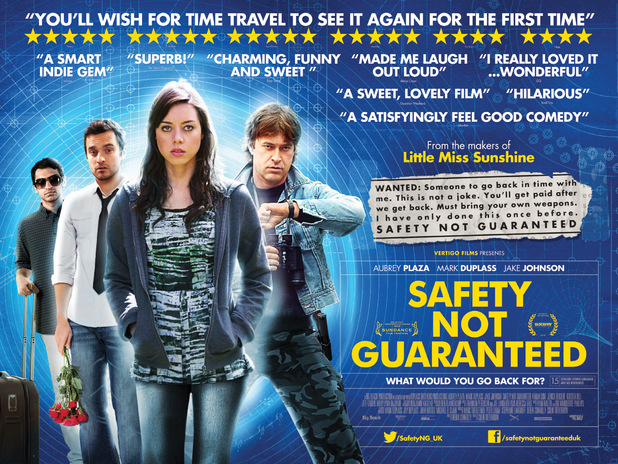
What are the chances I’d see two Mark Duplass movies back-to-back much less one I’d rate a 0 and one I’d rate a 5?  This is a sweet, whipsmart picture about three Seattle magazine employees – two interns (Aubrey Plaza and Karan Soni) and a writer (Jake Johnson) – who go to Northern California to do a piece on a guy (Duplass) who put out an ad to go back in time, looking for a companion.  The writer took the job solely to nail an old high school girlfriend he found on Facebook (Jeneca Bergere).  Plaza is along for the ride and Soni, a geeky Indian techie, only took the internship to round out his resume’.  Plaza becomes intrigued by Duplass, Johnson falls for his target, and it turns out time travel may be possible.

This is a dual story between four people looking to connect.  Duplass bonds with Plaza while Johnson and Soni engage in a mentor-mentee dance.  Best, what seems a goof assignment to write an ironic, hip piece on a quirky dude masks a couple of crises of conscience, place and purpose.

Everybody is excellent, but Johnson is particularly strong as an urban scammer who uses the story as a cover to hook up with a high school flame and realizes how empty he feels in the arms of a real woman.  She asks what he’s doing, he responds that he has an Escalade, she clarifies “no, I meant with your life” and he responds “I just told you.”

When she puts up her guard, points out the error of his idealization, and his fairy tale collapses, he runs to Soni and screams in the geek’s face to get off the Internet, away from his safety bubble and live a life.  Johnson’s character is emblematic of the maturity of the writing.  Normally, he’s the dick, the full-of-himself comic relief.  As a character, it’s an honorable job, ala’ Bradley Cooper in Wedding Crashers.  But Johnson (and really, all the characters) are given more depth in an economical fashion, making a very funny movie poignant and multi-layered.  One of the best films of the year.

Your Sister's Sister (2011) - Rotten Tomatoes

Mark Duplass (Humpday, Safety Not Guaranteed) is the brother of a recently deceased.  We meet him at the one year anniversary of his sibling’s death.  After a gentle eulogy by his brother’s friend, Duplass offers his own, explaining that his brother was a bully who only changed for the better after watching Revenge of the Nerds and realizing that the bully doesn’t get laid.  His brother’s ex (Emily Blunt) intervenes, let’s Duplass know he’s in a bad place and offers her remote family house so he can sort it out.  When Duplass arrives, he finds Blunt’s sister (Rosemary DeWitt) sorting her own issues out, having just left a 7 year relationship with another woman.

With a promisingly caustic first scene and the idea of a romantic angle perhaps immediately removed from the equation, the possibilities are momentarily intriguing.  But Duplass and DeWitt share a bottle of tequila, they have sex (she actually says “I’m game if you’re game”), and the movie craps out.   Duplass achieves orgasm in less than a minute to establish his bona fides as a regular schlub and to ensure that no connection was achieved.  Blunt, in love with Duplass, shows up.  It gets weird.

The film tries desperately to be cool, but the dialogue is stilted and humorless.  Duplass is presented as a bit of a crack-up, but he is unfunny (a sample bon mot is his observation that they go to an IHOP but will need passports), superficial, and self-involved.  Both women are crashing bores and for a romantic triangle of sorts, it is surprising how sterile and sexless they seem.

Though Duplass is desperate to keep the fact he had sex with DeWitt from Blunt, you know and hope it will out.  Anything to break the monotony, which is quite something for a 90 minute film.  These are the three most boring people in the world, characters created by the writers who pen quips traded by couples in Ikea commercials, if an Ikea commercial was sound-tracked by acoustic guitarists who play at contemporary Christian services.

The film is also amateurishly acted (Duplass is the poor man’s Ron Livingston, DeWitt is dishwater dull and Blunt one-note dewy eyed).  Is there depth under those still waters?  Most likely, just brackish, gloomy ennui.

Another criticism.  There is no lazier writing tic than the use of “fucking” before every noun, a regular staple in this film.

How I Met Your Mother is better paced and funnier and that show sucks.  This is hipster drivel without a single genuine moment.  Avoid.

A soldier in Iraq (David Anders) is gunned down and dragged away into the desert. He comes home to LA for a full military funeral, but after being put in the ground, he rises. And goes straight to the apartment of his wastrel friend (Chris Wilde, who looks like David Spade but acts funnier). There, he realizes he cannot eat. Soon, he craves blood. He robs a blood bank but realizes he is better served appearing vulnerable and then feeding off of criminals (a mix of Charles Bronson in Death Wish and Dexter).

The first half of the film is fresh and clever.  The “what the fu**!” reaction of Anders to his plight is gut-busting and the aplomb with which Wylde greets his pal is the perfect pitch. The picture has a wicked sense of humor, harkening back to American Werewolf in London and Reanimator. This could easily have been a bigger budget, Paul Rudd/Seth Rogen project. Indeed, feeding your back-from-the-dead pal is the ultimate validation of a bromance.

Alas, two thirds in, and it runs out of gas. The plot shifts to the woes of Anders’s girlfriend, who still unconvincingly loves him with all her heart, even if he actually rots and stinks when unfed. It gets more and more absurdist, and after we dispense (in gruesome fashion) with the girlfriend, the movie doesn’t know what to do with itself.  So it opts for over-the-top excess and a high concept finale. The former is numbing. The latter comes off cheezy. The film’s low budget, hidden nicely by well-chosen LA locales and unambitious special effects, becomes an issue when we get into police chases, an overlong massive shoot-out in and outside of the subway, and sci fi nonsense that cries out “Student film.”

Still, promise from director D. Kerry Prior and a noble failure.