Archive

Rating

image

(Reporting from the blizzard of ’16)

My childhood memories of kick-ass Clint Eastwood are vivid. I think I was first mesmerized by him as the cool, sardonic killer in the World War II drama Where Eagles Dare, and after that, as Dirty Harry Callahan, a cops’ cop, rejecting Miranda and spitting in the eye of pencil-pushing bureaucrats who were the real menace to San Francisco. Somehow, I missed the westerns, catching them in the 80s.

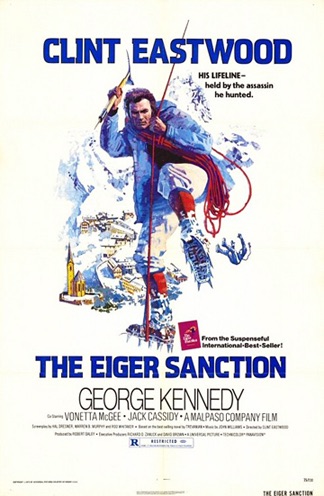
The Eiger Sanction was on the Channel 7 daily movie rotation, and I’m sure I saw it several times. It’s a testament to the sway of Eastwood that I did, because I watched it today, and the impact was decidedly different. Eastwood directed (his fourth feature) and let’s just say he wasn’t at peak form. Very pedestrian, and hum drum, it tells the story or an art professor (Eastwood) who is actually a retired assassin for the government. He is summoned by his former boss, a straight-out-of-early-Bond albino with a Germanic voice who will die if the sun touches him, and cajoled into taking on a contract, an unknown member of a party he is to join attempting to scale the north face of the Eiger mountain. Eastwood’s clue as to the man’s identity? The man has a limp.

The mountain climbing sequences are the best thing about the film. Eastwood performed many of his own stunts, and, certifying the danger, a stunt climber was killed in the filming. But this is a dated flick, not only in its blocky, unimaginative feel, but in its dialogue.  For example, the bizarre line Eastwood gives to a stewardess he is seducing: “You never know. Sometimes people do things…they thought they’d never do again. (pause). Like rape, for instance. I thought I’d given up rape, but I’ve changed my mind.”  And then they kiss and make love by the fire.

This is the second film Eastwood got after Paul Newman passed.  Newman was wrong about Dirty Harry but not this one.
image

(Reporting from the blizzard of ’16)

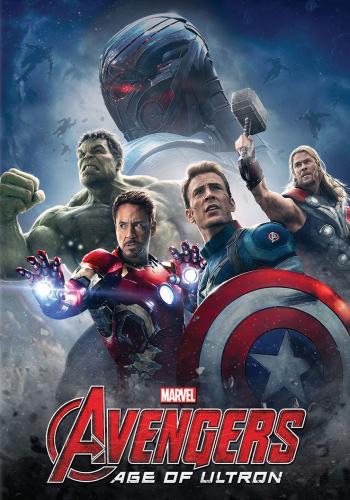
Oof. The first scene demonstrates everything wrong about the movie. Forced patter straight out of How I Met Your Mother, nauseating CGI, dozens of violent acts but no deaths, and not for a minute do you sense that any of the Avengers, outnumbered as they are, are in the slightest bit of danger. Good for kids; good for a parent or adult with a kid who needs a nap; soul-rotting juvenilia for anyone else.

Best part. A friend of Captain America asking if he’s found a place to live in Brooklyn yet and Captain America responding that he doesn’t think he can afford it.  Because what’s missing from these films is the Avengers at a cocktail party.

Full disclosure: turned off at the halfway point.


image

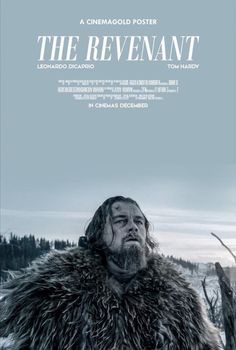
Like Birdman before it, there are scenes in this movie so visually audacious, I gasped. But where that picture hit you like a ton of bricks based on the cumulative effect of its dizzying pace and construction in the close confines of a Broadway theater, Alejandro Inarritu’s The Revenant – which is essentially a lone survivor/revenge flick, with a little spiritual mumbo jumbo thrown in for good measure – presents dazzling set pieces interspersed with awesome portraits of the vastness of nature. The year is 1823, and Leonardo DiCaprio is a guide for a fur trapping expedition in South Dakota beset by a brutal Indian attack, and in escorting the survivors back to the safety of their fort, he is viciously mauled by a bear, a scene so expertly rendered I could not believe it had not happened, yet, of course it had not. DiCaprio seems a committed actor, but no one is that zealous.

After the attack, DiCaprio has many more hurdles before him, including a suspicious and dangerous member of the surviving group (Tom Hardy, channeling Tom Berenger in Platoon, a compliment) and pretty much every calamity the brutal world of the wilderness can provide.  DiCaprio has little to say, but he brings all the physicality he mustered in The Wolf of Wall Street, only this time, during his infirmity, he exudes animalistic fury instead of stoned near-paralysis.

This is one of the most thrilling, visually stunning films I’ve ever seen. Inarritu used natural light and subjected the actors to enormous rigors (some say, “a living hell“).  Like George Miller in Mad Max: Fury Road, Inarritu dispensed with CGI, remarking, “If we ended up in greenscreen with coffee and everybody having a good time, everybody will be happy, but most likely the film would be a piece of shit … When you see the film, you will see the scale of it, and you will say, ‘Wow.'”

Wow indeed.  It all pays off in making the picture visceral, authentic and epic.  My only nits are a bit of anachronistic, stale “you have stolen everything from us” dialogue from the primary Indian and one depiction too many of DiCaprio hallucinating his Pawnee wife welcoming him to death ala’ Russell Crowe in Gladiator. But these are very minor criticisms. This is a great film and certainly one of the best of the year.

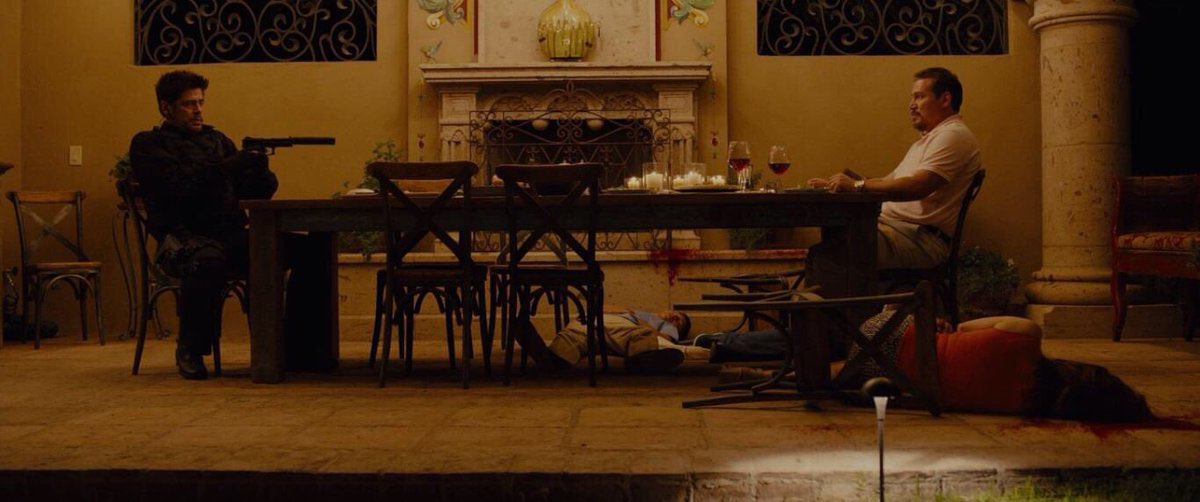
Deric Poston on X: "Is the final scene in Sicario the best revenge ending  in a movie ever??? I think so https://t.co/xYUmzFrDzb" / X

Engrossing, often pulse-pounding, and armed with a realistic sensibility, Sicario tells the story of an FBI agent in the drug war (Emily Blunt) recruited by a U.S. government task force leader and its consultant (Josh Brolin and Benicio del Toro, respectively) to assist with an exfiltration of a drug lieutenant and then a targeting of a Mexican drug lord. As Blunt gets deeper into the mission, the motives of the players and other aims of the endeavor are revealed. Blunt is excellent as a hardened officer who struggles with the seeming futility of her job and the machinations around her. Who would have thought that the arch, bony fashion assistant in The Devil Wears Prada was capable of projecting such strength? But this is the third role where I’ve seen Blunt play a convincing, strong, physical woman (the others are Looper and Edge of Tomorrow).  By that, I mean that she doesn’t shed gender and its attributes, nor does she just merely ape a man in what is a male-dominated role, where she’s chucking dudes around because, hey, that’s equality! She has a scene of physicality where the director demonstrates not only Blunt’s own strength but its limitations when pitted against a strong man. Its’ authenticity melds perfectly with the film, gritty and direct and disinterested in symbol.

On the downside, while Blunt can convey heart and strength, she can’t create a character where one does not exist, and writer Taylor Sheridan’s first screenplay doesn’t really provide her one. There’s nothing that makes you claim or invest in her. The moody, sparse setting of the film and Blunt’s no-nonsense portrayal can only go so far. It’s a testament to the taut pacing of the picture that you don’t recognize its emptiness until afterwards. Still, a good watch.


About halfway through this dour documentary about Nirvana front man Kurt Cobain, his widow Courtney Love reveals that at the advent of their courtship,  “I had already done heroin, beat the thing, had a rule.  I loved it still, but I didn’t have a fantasy that he had. He had a fantasy. His fantasy was, ‘I’m gonna get to $3 million and then I’m gonna be a junkie.'”  Nirvana bassist Krist Novoselic echoes Love, observing that drug use was “all part of the package of building a home” for Cobain.

So, halfway in, you learn that the subject of the documentary is a putz, and much to your dismay, he took a crapload of home video in the last few years of his life demonstrating his putzitude.  What follows is a lot of dismal footage of a bedraggled, strung out Cobain and Love spouting banality (either under the influence of heroin or not; it’s hard to tell) while holding their baby, which is like watching two winos toss a crystal vase.

Director Brett Morgen does his best to jump up the material, creatively using all of the detritus of Cobain’s life (scribblings, drawings, home movies, cassettes, paintings) to tell his story, but the story is just not that compelling.  Troubled kid, broken home, hates “the man”, puts it all into his angry band, big sound, superstardom which is near immediately resented, and then, the repellent creation of a sneering, condescending persona that presents as tortured and deep only by the efforts of rock critics who use phrases like “voice of a generation” (a moniker lobbed up solely to be spit upon by the acid Cobain) and a shotgun.  And at the end, Nirvana really was about a sound.  It was a helluva sound, I will grant that, but Cobain only made one record that lyrically matched that sound (Nirvana’s last, In Utero).

For the most part, a whole lot of nothing, though for fans, there’s a lot of good early footage.

Will Ferrell has seemingly gone to the well too often with his super clueless white dude schtick (as I write this, he dropped another one into theaters with Mark Wahlberg; Ferrell is the super clueless white stepdad to Wahlberg’s bitchin’ cool real dad). There’s nothing new to it, but I have to say, coupled with Kevin Hart, in Get Hard, you have the two hardest working men in show biz peddling standard physical, fish-out-of-water yuks. and they hit more targets than they miss. And by hardest working, I don’t mean they do a lot of movies (although they do), but that they work the ever-loving shit out of a bit, no matter how lame the premise or how Hindenburg-esque it feels. And I have to give them credit. Ferrell, as the super clueless white dude hedge fund manager set up by his boss, and Hart, as the man who washes his car and acts like an ex-felon to prepare Ferrell for hard time, create laughs on the sheer strength of their dedicated efforts. It’s almost as if they’re beating them out of you in their riffs, and it jumps this movie a full 2 stars. Interestingly, what murdered the movie with the critics was the constant refrain of Ferrell fearing forced sex (or otherwise) in prison; those halcyon days of making mirth of prison rape have passed (The Atlantic‘s Christopher Orr gave the film the “Gay Panic Award” and Salon took the time to provide a compendium of reviews deeming it “a racist, homophobic mess”). I’ll leave it to others more sensitive than myself to judge the film’s racism or homophobia, but I confirm it is a mess, albeit one that has some very funny bits (including some centered on Ferrell’s fear of gay sex), made funnier by the blood, sweat and tears of the leads.


image

When Noah Baumbach makes movies about miserable people, they tend to be miserable experiences. Ben Stiller was a depressed, egocentric bundle of nerves in Greenberg. In Margot at the Wedding, Nicole Kidman was a near hysteric mother, so casually cruel to her teen son it set your teeth on edge. And Jeff Daniels’ insecure, superior father in The Squid and the Whale was a textbook narcissist and a gasbag academic to boot. While talent is evident in these films, they are neither enjoyable or incisive. Rather, they are merely intricate portraits of unpleasant people doing awful things to themselves and those around them.

But Baumbach has a breezier side, one that was shown in his writing of Wes Anderson’s The Life Aquatic and Fantastic Mr. Fox, and of late, his films seem less like autopsies and more like entertainment. In Frances Ha and While We’re Young, Baumbach could not quite leave the realm of the neurotic, but at least we had characters to semi-root for. In Mistress America, we have an unqualified heroine, Greta Gerwig (who dates Baumbach and co-wrote the script), a whirling dervish of a climber, all idea and no follow-through, who latches on to a lonely college freshman (Lola Kirke), lifts her spirits and serves as her muse. What follows is a hilarious social and then drawing room comedy, which has a bit of a Whit Stillman nostalgia, but is decidedly more modern in its literate and canny observation of academia, money, status and success. Gerwig is truly a force of nature, and Kirke is genuinely touching as a child adrift in the cold realm of college and New York City. I laughed out loud throughout, one of the best films of the year.

 image

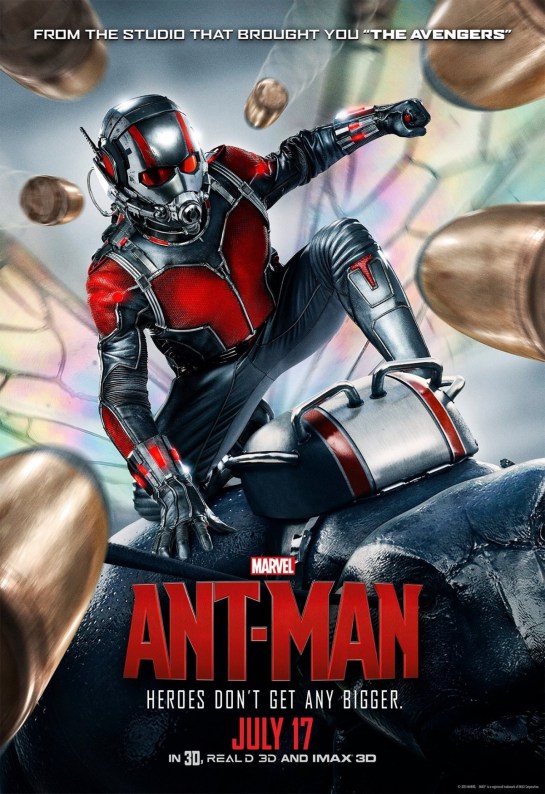
I’m not a big fan of the super hero flicks, and now that they are mixing and matching and packaging ad infinitum, I’m even less enamored.   For the most part, they are CGI Dramamine, and in the wrong hands (like those of Zach Snyder), they add a seriousness that is self-parody (the preview for the new Superman v. Batman, or whatever the heck it is called, is so dour you almost brighten up when Wonder Woman is inexplicably thrown in the mix).

And yes, they are going to pigeonhole Ant Man (Paul Rudd) into the franchise, which will mean we have another wiseacre to compete with Tony Stark, but still . . . I liked this movie very much.  Rudd is charming as an ex-Robin Hood con who is used by Michael Douglas to get miniaturizing technology out of the hands of his evil protégé (Corey Stoll) and the CGI for the transformation is both nifty and ladled out sparingly.  Ant Man seems a nice fella’, as if you dropped an Apatow character into a super hero guise, and he’s aided by a hilarious trio of bumblers, one of whom (Michael Pena) made me laugh out loud repeatedly.

image

Key Largo melded with Quentin Tarantino’s bravura scenes in Inglorious Basterds and his crackling dialogue in Reservoir Dogs. I had the pleasure of watching this picture on Christmas Day in 70mm at the AFI Silver Theater, complete with an overture and an intermission. The latter occurred after 1:46 minutes, and I remarked to my son that the film was flying by, particularly so because almost all that had occurred was conversation. Obviously, a Tarantino film cannot subsist on talk alone, but when the violence occurs, it is supported by the rich, if broad, characters developed beforehand (unlike in Django, where the carnage at the end felt like an indulgent spasm, revealing an insecurity at what came before).

It’s one of the best films of the year and it’s also one that should not be in any way spoiled by a plot summary or any other commentary that could lessen the fun. Accordingly, I’ll make my review brief and non-specific in the form of a few notes.

First, Spike Lee once disrespected Samuel L. Jackson when the latter was a working character actor and the former was the auteur du jour. Lee is also made apoplectic by Tarantino, who wades into race with a daring and incisiveness that obliterates Lee’s rote and easy observations. As it turns out, Lee and Jackson have achieved a rapprochement (they do commercials together), but any rift between Lee and Tarantino is settled by Jackson (“Spike saying, ‘I’m not going to see Django because it’s an insult to my ancestors’? It’s fine if you think that, but then you have nothing else to say about the movie, period, because you don’t know if Quentin insulted your ancestors or not,”).

Also, Jackson should receive an honorary Oscar for this alone:

This is an ensemble picture but it’s Jackson’s picture (though costars Walter Goggins and Jennifer Jason Leigh give him a run for his money).

Second, Tarantino masterfully blends genre, history, comic books and violence, but sometimes, it is to the detriment of his narrative. Not here. When the necessary resolution explodes, it’s almost a disappointment because you know there will be less talk. Tarantino’s script is razor-sharp, hilarious, suspenseful and a brilliant mix of modern pop culture and historical grievance.  It’s really something.

Third, I generally do not read any reviews or commentary about a film before seeing it or writing my own review, and I did not do so here. But I presume there is the same hullabaloo about Tarantino’s liberal use of racial and sexist insults. All I can say is that he uses them beautifully, like David Milch in Deadwood.  This is how you would expect low, dangerous comic book characters who steal and murder to parlay.  Any objection is likely coming from the same humorless prigs or their progeny who objected to the hyenas in The Lion King because they were villains voiced by minorities. In fact, in creating a movie depicting a roomful of lethal people who must sleep with one eye open as they brave a blizzard and their own treachery, opprobrium aside, it’s one of the most egalitarian rooms you’ll find in film.

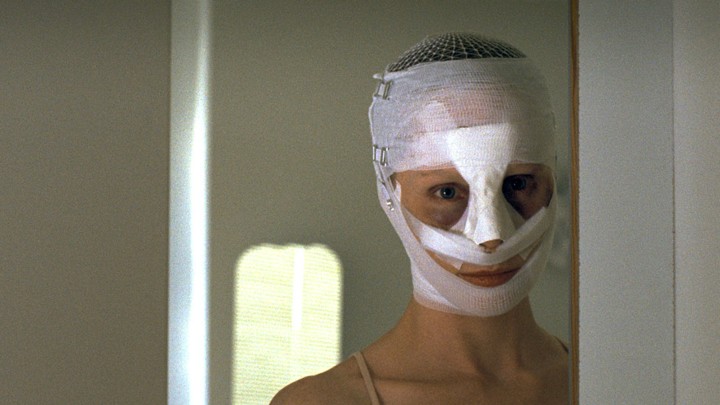
Image result for Goodnight Mommy

A psychological thriller from Austria that pits two young boys against their mother, who has been in a car accident, undergone facial reconstruction surgery and who, as time passes and the bandages come off, they suspect is not their mother. The critics hailed this (82% on rottentomatoes.com) as rising above genre, both terrifying and revolutionary, but the audience, who scored it at 67%, is closer to the mark.  The film starts intriguing (if a bit obvious in it’s The Sixth Sense twist), but soon becomes monotonous, artily sterile, and then simply cruel. I turned it off.