Archive

Rating

image

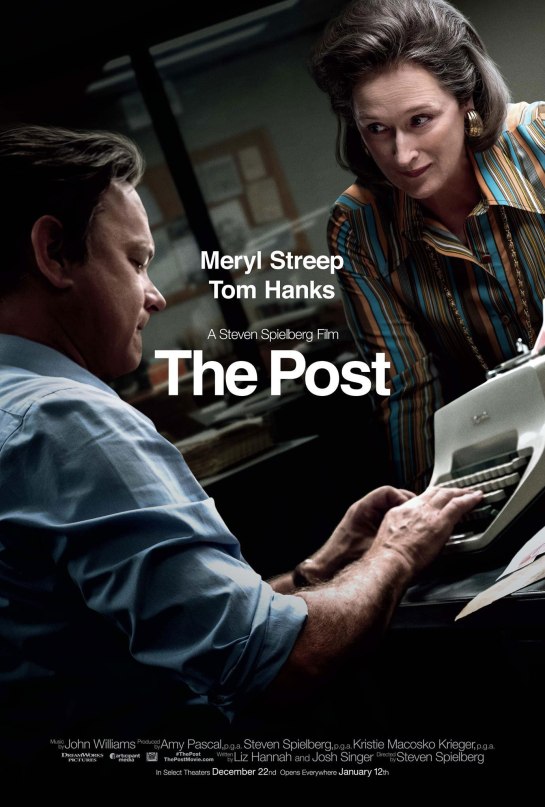
There are things to like about this film, but most of them occur in the first half. The script is smart and economical, delivered by a cast with an exceedingly high percentage of “where have I seen him/her before?” types. And Meryl Streep again absolutely captivates as the insecure publisher of The Washington Post, negotiating her new role as a corporate leader in a male-dominated world, where her father and husband (prior publishers) are not there to protect or assist her.

The look is also spot on. Primarily set in 1971 Washington DC, it felt like a a tour of every Northwest Washington den and kitchen I inhabited and, necessarily, every living room and dining room I avoided.

But I should have been warned as to the coming danger when the first scene, which occurs in Vietnam, featured the music of Creedence Clearwater Revival, such a trope that whenever I hear John Fogerty, I assume the sound of helicopter blades will follow.

As minor as that hackneyed facet appears, it is a fissure that later becomes a chasm. After all of the fantastic work Streep does to subtly and movingly depict the stakes from a personal and political vantage point, and they are large (her family newspaper is betting its future in publishing top secret documents that indict four administrations), Spielberg just doesn’t trust you to get it. “This is big,”you can hear him thinking. “I’m afraid that the audience won’t understand that it was hard to be a woman in 1971, that Nixon was bad, and that a free press is really, really important.”

So, out comes the Louisville slugger, and the director proceeds to bashing all of the important points into the heads of the audience, rendering it senseless.

Two scenes with Streep and her fiery editor, Ben Bradlee (Tom Hanks) are illustrative. In the first, when Hanks condescends to Streep by suggesting she is covering up for her good society friend Robert McNamara, she deftly parries his thrust with the observation that when he was close friends with President Kennedy, surely he must have “pulled some punches.” Later, however, when Hanks comes to Streep again to acknowledge his prior failures, we get a moist, awkward and unconvincing speech about how reporters can no longer be clubby with politicians going forward because, you know, Vietnam.

We had it, dummy.

Speaking of Vietnam, Spielberg’s rendition of it is so simplistic as to be offensive.  In his mind, The Pentagon Papers catalogued a multi-administration conspiracy almost wholly bent on killing innocents and saving face.  One can fault U.S. engagement in Vietnam until the cows come home, but when Spielberg distills it to such a childishly elemental basis, you can almost hear Ken Burns sighing, “I guess I didn’t need nine of those ten episodes.”

Spielberg‘s handling of the feminist theme is even more egregious. Everything Meryl Streep does in her performance makes superfluous the film’s later choices when dealing with the issue. Nonetheless, again, because Spielberg trusts no one, we are forced to endure a speech from Hanks‘s wife (Sarah Paulsen) that it sure has to be tough for Streep, because she is a woman; another woman approaches Streep at the Supreme Court, solely to thank her for her selfless sacrifice on behalf of her brother who is in, wait for it . . . Vietnam; and then, as Streep leaves the Supreme Court, in a scene that would have returned my breakfast had I had one, we see her walking down the steps of the building, cutting a line through throng of women, all of whom beam at their idol. DeMille’s parting of the Red Sea in The Ten Commandments was more understated. This is not to mention the penultimate and final scenes, where a Post editor reads out the first line of the Supreme Court decision exonerating the paper in a manner that would only be appropriate for “The only thing we have to fear is fear itself” and then, a security guard calling in a break-in at a little place called the Watergate. Because, can you believe it? This Nixon went on to be even more troublesome. Nuts, right?

You may feel good after you leave this movie, but take heed.   The feeling is akin to the immediate euphoria one receives from eating a whole carton of ice cream. Soon, you will feel sick and/or shame. It is a testament to all of the other good things about the movie that the final excesses did not render a zero star rating. But really, if you want to see a great movie about a newspaper, re-watch Spotlight or All the President’s Men.


Logan Lucky [DVD] [2017]Steven Soderbergh is a more-than competent director with some solid films (Contagion, Traffic, King of the Hill, two of the three Oceans movies), some overpraised ones (Sex, Lies and Videotape, Erin Brockovich), a few minor masterpieces (The Limey, Out of Sight)  and some super duds (The UnderneathSolaris, The InformantThe Good German).  A few years back, he announced his retirement, leaving as his last directorial effort the minor, pedestrian Behind the Candelabra, the definitive Liberace movie literally no one was waiting for.  Soderbergh had concluded, “I just don’t think movies matter as much any more, culturally”, and it showed.

I presume Soderbergh recognized that he didn’t want to go out on a pop fly, and that his exit was a little whiny (“The worst development in film-making – particularly in the last five years – is how badly directors are treated” he huffed), so he’s gotten back into the game, directing a few TV series, and, returning to the big screen with Logan Lucky.

Unfortunately, if there was ever a movie that didn’t matter, culturally or otherwise, Logan Lucky is it, a limp re-make of Soderbergh’s Oceans flicks, sans the charm of Clooney, Pitt and gang. It also lacks the fun plotting of the casino heists and the Vegas glitz.  Instead, we get Channing Tatum, Adam Driver and Daniel Craig playing at Boss Hog accents; a big score (at the Charlotte Speedway) that is plodding and lazy; and dull West Virginia and Charlotte standing in for the Bellagio fountains.

Instantly forgettable and in at least one way (using Seth McFarlane as a Brit with a worse accent than Don Cheadle in the Oceans movies) unforgivable.


Image result for Blade Runner

I was underwhelmed by Denis Villeneuve’s Arrival, mainly because of its dreary look and my own intellectual limitations.  Thankfully, Blade Runner 2049 is visually dazzling with a plot that is intricate but not byzantine.  Ryan Gosling is a Blade Runner (i.e., a hunter of older model replicants – think Westworld – who have a tendency to go haywire).  Unlike Harrison Ford in the original film, Gosling is unequivocally a replicant himself, but in the process of putting down a replicant fugitive, he becomes ensnared in a larger, metaphysical mystery that melds corporate malfeasance, potential civil war, and Genesis.  It could have been ridiculously heavy, but Gosling manages a wry yet naïve countenance and the bloviations of the corporate would-be god (Jared Leto) are both few and leavened by Gosling’s running battle with a particularly fierce replicant (Sylvia Hoeks).

The film’s look is stunning and the real star is Gosling’s navigation of the eye-popping world around him.  Other than Robin Wright being horribly miscast as Gosling’s supervisor (her insistence on being ballsy is over the top, and her Sam Spade delivery is clunky) and the picture running a little long, this was well worth the time.

Image result for Mudbound

A beautiful picture, depicting the lassitude and lethality of post World War II Mississippi as two families, one white and one black, are challenged and near-consumed by the stifling climate and punishing soil, as well as the psychological toll of war and the rotting cancer of racism.  It is rightly nominated for Best Cinematography and Adapted Screenplay, and Mary J. Blige stands-in as supporting actress nominee for any number of deserving performances (especially Rob Morgan as a stoic, beleaguered tenant farmer).  There is a stretch where the budding friendship of haunted war vets Garrett Hedlund and Jason Mitchell skirts cliche’, but other than that, the film is rich with authenticity and heart.   It is currently available to stream on Netflix.

image

During WWII, the Germans occupying Denmark laid 2.2 million mines on its coast in anticipation of an Allied invasion. The Danes employed their former occupiers to clean up those mines, the subject matter of this harrowing and haunting film. We follow a group of very young, very scared German soldiers who are given mine-clearing training and then a quadrant containing 45,000 mines. If they clear them at a certain rate, they will be allowed to go home in three months.

The process is nerve wracking. Mind you, these boys have instruction and some support, unlike the Iranian children during the Iran-Iraq war who were simply sent into the mine fields to clear by suicide in some glorious sacrifice. But the toll, both physical and psychological, is brutal, especially when inflicted on ones so young. They are homesick, hungry (their care was not paramount) and under the leadership of an embittered Danish sergeant who is fighting his own demons but is also humanized by their plight.

This is a beautiful picture, enhanced by touching, sensitive performances. There is talk every year of creating an Oscar for an ensemble, and this cast would be a deserving nominee. The film, however, is not for the faint of heart.


Image result for darkest hour

Joe Wright’s (Atonement) film is repetitive, didactic, simplistic, and eventually, in one of the most cringe-inducing scenes you’ll ever see, when Winston Churchill finds himself on the Underground getting his back stiffened by “the people”, patently ridiculous.  The only thing missing on that subway car is Tiny Tim exclaiming “God Bless Us, everyone” and thereby spurring Churchill to reject appeasement and declare that England would “never surrender.”

The picture is also unnecessarily arty (a bombing scene is a particular sin, evoking Michael Bay’s Pearl Harbor, a film you really don’t want to ape in any manner) and annoyingly expositive – we learn about Churchill’s background via random members of the House of Commons speaking to each other as if they – or we – are dunces (“and his father died of syphilis!”  Harumph!)

Churchill was a lion. But he was also a snake. Now, one could argue that his lies were of necessity. But here, they are simply ignored or recast as tactical blunders. Don’t lie to the people, King George VI counsels.  Be straightforward, and they shall corner you in a subway car and show their true mettle.

And, apparently, it was Churchill and Churchill alone who deduced that you could send civilian boats to pick up stranded men at Dunkirk. He is the oracle. Everyone else on his war council is a dimwit, a ninny or a quitter.

Ostensibly, the real reason to see this movie is Gary Oldman‘s performance, and it is not bad. But it is not great. Oldman gets the fussiness, the hidden mirth, and the anger, but his stabs at insecurity come off as petulance, and on balance, the performance feels more like a mimicry.  Recently, John Lithgow (The Crown) turned in much more nuanced and effective turn as Churchill.  The best performance in this film does not belong to Oldman, but to Ben Mendelsohn as King George, who is subtle and moving.

Watch The Crown.  Hell, watch King Ralph.

Image result for Scrooge Sim

Alistair Sim is by far and away the best Ebenezer Scrooge.  He is hardened and fierce yet he carries a barely perceptible regret and tenderness that makes his eventual transformation more of a de-icing than a bullet-dodged.  His exhilaration and mirth upon redemption are infectious, his realization he can play some awesome practical jokes on the likes of his housekeeper and clerk is hilarious, and his heartfelt apologies are actually very moving.  This is my favorite of the film adaptations.  DVR at once.

image

Almost everything wrong with modern cinema is exhibited in the first five minutes of this 2016 loose remake of the John Sturges classic. The bad guy (Peter Sarsgaard) arrives to plague a town, the surrounding land of which he needs to rape, er, mine.  He tortures a child, burns a church, shoots an unarmed man in front of his wife, and then, one of his men throws an axe into the back of a fleeing woman churchgoer.

That’s what the filmmakers believe is necessary for you to give a shit.

It ain’t nearly enough.

It’s an execrable film.  The score is excessive and deafening. The western garb is better suited to a Manhattan runway. The heroes escape no demons, and no one ever misses a shot.  Everyone is twirling a gun or a knife or a mustache. Marvel movies have more depth and gravitas. Video games carry greater danger.

Worse, the film is plotted by a moron. In a seminal scene, Chris Pratt (aka, Billy Rocks, I shit you not) takes all of the money from a poker table, yet within 15 minutes, he miraculously does not have the five dollars to buy back his own horse. Thus, he is enticed by Denzel Washington to save the town!

Speaking of Pratt, he is fundamentally, constitutionally unserious and insubstantial. He’s perfect for light, wiseacre comedy. He can’t do much else, and when he tries the hard stare, Lord, is it painful.

Five more dummies sign up for the suicide mission because, well, just because. I suppose some inducement comes in the form of a frontier gal whose husband was shot in front of her. Her pitiful story serves to secure Washington‘s agreement to save the town. Or maybe it was her cleavage, which seems discordant to her “I am just a simple farm woman” mien.

image

Come on.

After Washington and Pratt, we get syrupy Southerner Ethan Hawke (hand to God, his name is Goodnight Robicheaux, and he had “23 confirmed kills at Antietam” – ha ha ha ha ha, you can’t make this dreck up); Vincent D’Onofrio (who comes off like Steinbeck’s Lenny had Lenny become a bounty hunter); the inevitable Indian (Martin Sensmeier as Red Harvest, who is mystical, perfectly painted and manicured, and accompanied by his own tom-tom score); and two other total nobodies, all of whom join up for similarly unexplained reasons.

Red Harvest is the easiest touch.  Washington tells him, “we go to fight wicked men.  Probably we all die” and Red Harvest is in.  Washington did bring the gal with the ample bosom to this recruitment meeting, so maybe that did the trick. It is all I can figure.

Before signing on in cement, Red Harvest (which upon reflection sounds like a maize-based cereal rather than a fearsome warrior) does cut the heart out of a deer and makes Washington eat it. Later, Red Harvest kills a bad guy Indian, to whom he says, “You’re a disgrace.”

All to the tom-tom-tom-tom-tom-tom-tom score.  Just in case we forgot Red Harvest was an Indian.

Of course, we learn in the end that Washington has a personal score to settle.  Turns out Sarsgaard had men rape and murder Washington’s  homesteader mother and sisters.

Which makes the recruitment effort by the buxom farm woman superfluous, as Washington should have been spending his every waking moment hunting Sarsgaard sintead of playing coy.

He needed to be talked into this?

The whole flick is a violation.

image

Writer-director Greta Gerwig’s picture is assured, ingenious, and alternatively, hilarious and moving. A coming-of-age story that touches on the themes of leaving home and the mother-daughter relationship is not exactly original, but in Gerwig’s hands, it is fresh. Lady Bird (Saiorse Ronan of last year’s beautiful Brooklyn) is a Catholic school senior in Sacramento navigating her college choices, academic ennui, sexual inexperience, insecurity, and her family’s economic frailty, all while negotiating an increasingly strained relationship with her passive-aggressive (and sometimes, aggressive-aggressive) mother (Laurie Metcalf).

Gerwig stitches a narrative together with brisk and evocative vignettes, and her characters carry the nuance and surprise of real people. Lady Bird’s reach for popularity and desire for something beyond what she deems the stodgy and suffocating Sacramento might normally make her empathetic, but she is of her age, which means selfish and even cruel, in her ambition. This harsh light prevents the film from becoming maudlin. She’s a real girl and her world feels authentic. I watched the film with my wife and daughter, and their knowing glances and nonverbal communication throughout certified the truth of its nature.

I was reminded of different films at different times while watching Lady Bird. Gerwig’s command of pace and sharp timing evokes Wes Anderson’s The Royal Tenenbaums, shorn of his mannered style. Her strong portrayal of the bond of family and place also brought to mind last years’ incredibly under appreciated 20th Century Women. Finally, the mother-daughter dynamic on the eve of separation made me think of Nicole Holofcener’s Enough Said.

I don’t mean to convey that Gerwig’s picture is derivative, only exceedingly accomplished. These are great pictures for purposes of comparison.

This is one of the best of the year, and I expect nominations for best picture, best director and best original screenplay. At a time when Hollywood may very well want to go with films that are smaller and more pure, keep this one in mind when filling out your Oscar ballot.

image

Taylor Sheridan, the writer of Sicario and Hell or High Water, has turned in a stunning directorial debut melding his signature economy of dialogue with an accomplished feel for the ebb and flow of backcountry America and a lyrical visual style. The frozen mountains of Wyoming serve as the locale to a murder investigation where FBI outsider (Elizabeth Olsen) partners with a fish and game tracker (Jeremy Renner) and an Indian reservation sheriff (Graham Greene) to solve the rape and murder of a teen found in the snow.

Sheridan is the nephew of a former U.S. Marshal and a Texas sheriff, and as with his prior films, his replication of the patter of law enforcement feels as if he has spent much time at their knee. His characters avoid the bravado and cliche’ of many movie cops. They inhabit a matter-of-fact world, not cartoonish macho, but one that exudes a professional cynicism. Like Emily Blunt in Sicario, Olsen is not the standard female law enforcement officer who has to “prove” herself in a near-all male world. There is no overcompensation.  She just is.

The performances are understated and genuine, and Renner in particular well renders the pain of a haunted but determined man.

Sheridan is also deftly political, never overt but still seamlessly intertwining some of the cultural realities in rural American with the narrative.  It never gets in the way of the pace, and Sheridan’s handling of the thrill part of thriller is expert.  The crescendo to a violent explosion is damn near excruciating

One of the better films of the year, which admittedly ain’t saying much this year, but that shouldn’t be held against this picture.