Archive

3 stars

Man on the Moon. Milos Forman wastes a fair amount of his time on minor but bizarre figures (see The People versus Larry Flynt). Fortunately, Andy Kaufman was an inoffensive comic with a streak of ingenuity, as opposed to a pornographer who later wrapped the First Amendment around his gynecological forays. So, the ride is a little more pleasant and accomplished, and there is no false, big issue at stake, as was the case in Flynt.

Jim Carrey’s turn is very good, and the supporting work of Danny Devito (as Kaufman’s agent) and Paul Giamatti (as Kaufman’s sidekick Bob Zmuda) helps to round out the character. Forman, however, goes to the well once to often in casting Courtney Love as the love interest. She worked as a porn mogul’s gal in The People versus Larry Flynt, but here, she’s lost.

Unfaithful. Diane Lane received some buzz as a best actress nominee for her portrait of a lustful suburban housewife in Adrian Lyne’s film. She is excellent, but the film is unconvincing, for several reasons. First, before Lane begins her tryst with the French hunk book seller who sweeps her off her feet, we are given a glimpse of her home life. It seems pretty nice. Not that we need to have a bad home life to presage her immersion into a lustful, dangerous affair, but some indication of wanderlust or dissatisfaction is called for. Second, her paramour is attractive but no great shakes. With a home life that seems healthy (both sexually and otherwise), it might help to give us an irresistible draw – say, a Jude Law in The Talented Mr. Ripley. Instead, we get a bland French model straight out of a GAP commercial. Third, Lane is so incredibly stupid that you lose all sympathy for her plight and just feel bad for her husband (Richard Gere), who may be so distressed because his wife is cheating on him AND she’s so bad at it.

An amusing, sweet story about a young NYC writer (Sandra Bullock) who is forced into rehab in Tennessee after her alcoholism accompanies her on a car ride. The film is essentially about her stint there, and while predictable, it is moderately affecting and consistently funny. Bullock is also a surprise. While her range is not exactly expansive, she plays a damaged daughter of an alcoholic mother (who eventually died and abandoned Bullock and her sister as children) with some skill. Better, her part is loaded with wry rejoinders, her strength. A lot of good supporting turns, including Viggo Mortenson as a baseball pitcher working on a coke addiction; Steve Buscemi as Bullock’s counselor; Dominic West as her charming boozehound lover; and various other characters. This is not heavy lifting, and it is very AfterSchool Special, but it is well done.

Before I saw Castaway, I was assured that if I had to spend time on an island with a major male film star, Tom Hanks would probably be a good choice.  He seems affable, neat and even-keeled.   I was not disappointed.  His Fed-Ex plane goes down in the South Pacific, he is stranded on an island, and he combats the elements and his various misfortunes while making attempts to escape to civilization.  The time spent with Hanks is well worth it.

The problem with Castaway, however, is that director Robert Zemeckis tucks a love affair between Hanks and Helen Hunt (Washington, D.C.’s City Paper correctly observed that Helen Hunt was again cast as Helen Hunt) pre-stranding that is mundane and equivocal; post-stranding, it is confused and drawn out.  While Hanks is on the island, out of necessity, he strikes up a relationship with a volleyball.  Unintentionally, this relationship towers in depth and complexity in comparison to the one depicted between Hanks and Hunt.  So, when Hanks gets back to civilization, the meat of loose ends and forged relationships and a changed world are not there to greet him, or us. Rather, the only thing we get to see him confront is the bland Hunt, and her on-again-off-again Tennessee drawl.

Side note:  Tom Hanks is given the worst maladies in movies.  In Philadelphia, it’s AIDS.  In Castaway, he has to give himself what appears to be a root canal.  In The Green Mile, he has a urinary tract infection that has him peeing what appear to be razors.  What the hell?

Made.  Jon Favreau’s follow-up to Swingers is less hilarious, less fresh, and more edgy, but it is still a very, very funny buddy movie.  Vince Vaughn plays Favreau’s childhood pal, a jumpy, almost Rupert Pupkinesque accomplice, unnerving, entertaining, and perhaps chemically imbalanced.  Favreau, a dopey boxer and bodyguard for his stripper girlfriend (he has a tendency to beat up the recipients of her lap dances) is assigned by LA mob boss Peter Falk to a drug buy in New York City. Favreau vouches for Vaughn and their travels become the movie.  Puff Daddy even holds his own as a New York thug.

If you liked Swingers, you’ll probably like this movie, but if you liked Swingers and King of Comedy, you almost assuredly will like it.

Frost/Nixon.  Expertly acted, well-paced, and ultimately, pat and unsatisfying.  Screenwriter Peter Morgan takes the characters of Frost (Michael Sheen) and Nixon (Frank Langella) in a manner that mirrors his treatment of Tony Blair and Queen Elizabeth in The Queen — the upstart versus the titan, with a quest for moral concession at the end of the saga.  For Queen Elizabeth, she had to change with the times and accept the sorrow of the British people over the death of Diana, and Blair helps her achieve this trek into modernity, in the process, gaining great respect for her.  In Frost/Nixon, Nixon has to accept responsibility for his crimes and thus, help the American people heal, and Frost has to trap him in interview to wrangle the confession, which, of course, ultimately lessens the psychic burden both Nixon and the nation carry.  For dummies in the audience, this theme is explicated by a drunken call from Nixon to Frost on the eve of their last interview (set up as an interview version of a heavyweight bout, The Thrilla’ in the Villa), a wholesale fabrication.

But Nixon had a 20% stake in the sales of the interviews.  And Nixon knew as well as Frost that they couldn’t be a love letter to himself, that there had to be a draw, a teaser, a hook.  So, in the interview on Watergate, he apologizes, though in dramatic, stubborn style.  But he does not, as the film depicts, concede.  And in the end, through their own conspiracy, Frost is lionized, Nixon starts a second comeback (as opposed to the laughable postscript of the film’s closing lines — “[Nixon] never achieved the rehabilitation he so desperately craved.  His most lasting legacy is that, today, any political wrongdoing is immediately given the suffix ‘-gate'”), they both make buckets of dough, and television wins!  A much better story, but also much harder.  Much easier and more crowd-pleasing for Howard and Morgan to revise the impact of the interviews themselves, to make them a definitive win in a titanic battle of wits that finally earned Nixon the calumny he so richly deserved. 

Which is nonsense.

This is not a terrible film.  It’s fine.  It is at about the level of a solid TV movie and about as ambitious.  Moreover, the interviews themselves as depicted curiously lack the crackle of some of the better moments of the real ones, and unfortunately, offer a somber, sonorous Nixon.

I don’t want to come off as some sort of niggling prig.  My discomfort with Frost/Nixon is not predicated on the fact that it is historically inaccurate. My concern is in the manner in which the writer and director chose to be historically inaccurate.  For example, the fabricated drunken phone call from Nixon to Frost seems to fall within the reasonable artistic license.  But the problem is that the movie created a pat, simplistic morality tale, distorting history so egregiously in service of that dramatic aim that it exceeded the admittedly blurry lines in place.

It would be akin to a writer of Bobby/Lyndon penning a script geared toward Bobby being the driver of the civil rights movement, finally impressing upon Lyndon (also drunk on a call – it’s always the old man who is drunk) the importance of completing his brother’s legacy.  It could play well, it could be beautifully acted, but the historical point it serves is not only false, but utterly contradicted by the actual facts.

Indeed, a great interview with Frank Langella shows that he gets the problem:

Q. The movie does make you sympathetic to Nixon, this monster. It really makes you feel sorry for the bastard.

FL: Well, in one sentence you’ve called him a monster and a bastard. You see how totally and completely prejudiced you are?

Q: Well, you said “these two epic monsters.”

FL: Well, I meant monster in the larger sense. But that’s ingrained in you to think that way, and you don’t have any right to judge him that way. You’re not walking in his shoes. If you think Nixon is a monster and a bastard, what do you think of the presidents we’ve had since? That’s the thing: it’s very easy to use these words about this man, and very facile, because we live in a time where it’s sound-byte time.  Let’s see… Richard Nixon? Monster, bastard. Anna Nicole Smith? Dumb, blonde. We just do it. We just narrow everybody down to a tiny little spectrum, and you really can’t and you really shouldn’t. I do it too, though, because it’s really fast, and it’s really quick. It would’ve been totally uninteresting of me to play him as a drunk, or as a crook. Those were two facets of a very, very complicated man, and we mustn’t forget that he was a brilliant statesman.  [Nixon] was an extraordinarily intelligent man. I spent hours and hours of reading his books. His hopes and dreams for this country in foreign policy were extraordinary, and what he did in China and other places was wonderful. It would be a shame to let all that [go to waste] — history has done it, and he brought it on himself. Nixon was not destroyed by anything or anyone but himself.

Adventureland.  I had counted on being a worthy addition to the Knocked Up, Forgetting Sarah Marshall oeuvre, which would have been fine.  But instead, the film is more Dazed and Confused meets Tadpole (with a little Say Anything thrown in) with a deliberate pace, a keen sense of time (late 80s nod to The Replacements on the soundtrack), and a sweet love story taking the place of bro-mances, snappy male rejoinders and broad physical comedy.  It’s a very leisurely picture and an especially affecting performance by Jesse Eisenberg as the college grad consigned to working his local amusement park the summer before grad school.  Downside – Kristin Stewart as the love interest.  This limited actress who made her bones in the Twilight saga is charmless.

Amazon.com: The Blind Side [Italian Edition]: sandra bullock, tim mcgraw,  john lee hancock: Movies & TV

A good old fashioned heart-tugging, crowd-pleasing weepy, and Sandra Bullock’s brassy performance is perfect for the material.  The actor who plays “Big Mike” has a devastating mixture of nobility and tenderness and there are some very funny lines (Bullock’s husband – “Who would’ve thought we’d have a black son before we met a Democrat?”).

25th Hour - Wikipedia

Further confirmation that sometimes, when Spike Lee does not write a movie indoctrinating viewers as to the racial dogma of a wealthy courtside-sitting Knicks fan, he can forego the lecture and make solid entertainment .  See also Clockers and Inside Man

Edward Norton is spending his last day and night in Manhattan before serving a 7 year stretch for drug distribution.  He deals with the certainty of his impending brutalization and agonizes over the choices he made, all while saying his goodbyes to friends and family, reliable New York City archetypes to a one.  His father, Brian Cox, is a former fireman (the film is a post- 9-11 story and it is reliant on that catastrophe) and now proprietor of an Irish tavern; his girlfriend, Rosario Dawson, a luscious Puerto Rican who had never been to Puerto Rico until Norton took her; his best friends are Barry Pepper (a tough, cynical, New York Post reading conservative trader) and Philip Seymour Hoffman (a tentative, caring, Jewish public school teacher who lives a meager, sheltered life and has a hidden trust fund).  Anna Paquin is Hoffman’s vixen of student, all freedom and possibility, just on the edge of pregnancy and disease and the first steps to getting used up. Norton’s employers are Russian mobsters.

Norton’s choices are delicate and a man on the brink is a tough character to deliver.  He does not sweat or ooze like so many would-be Brandos, but runs the emotional gamut (anger, recrimination, fear, acceptance) with authenticity.  The story holds you, and Lee’s lyrical skills give the picture a haunting vibe. Solid watch.

23 Things We Learned From the 'Road to Perdition' Commentary

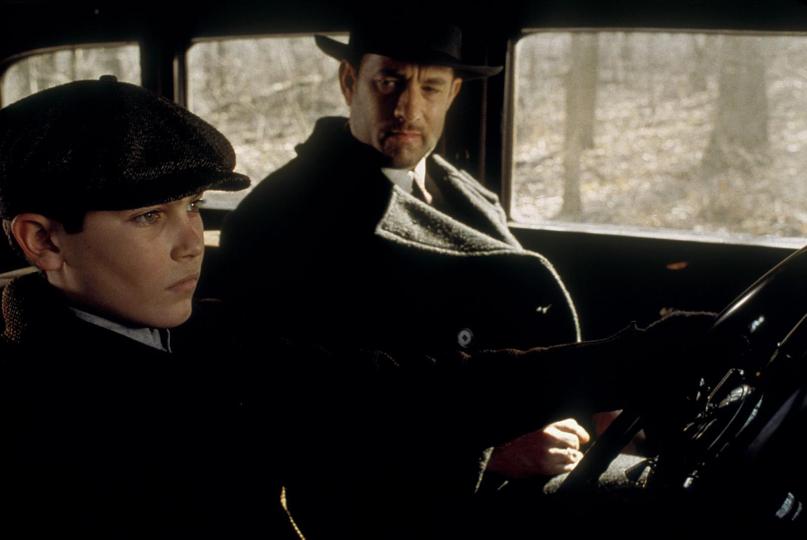
Sam Mendes’ follow-up to the overpraised American Beauty almost survives the miscasting of Tom Hanks, the overacting of Jude Law, an at-times leaden script, and an unhealthy preoccupation with slow visuals.  With all of that, Road to Perdition is also a beautiful movie graced by some very smart, substantial performances by Paul Newman (his last big screen role) and Stanley Tucci as mobsters working in the same organization.  Thomas Newman’s haunting score is perfect for the material, and the set design, art direction, costumes and cinematography recreating the Depression-era Midwest are impeccable.

But a film about fathers and sons cannot survive a child actor who does not resonate.  The actor playing Hanks’ son is not awful but he’s not very good either.  As our narrator, he simply doesn’t register, and as the guide to the life of his father (mob enforcer but family man Michael Sullivan, played by Hanks), this cannot do. Indeed, the last line of the film is “He was my father.”

It didn’t really seem like it.

Hanks is also problematic. His character is a bit like Eastwood’s William Munny in Unforgiven.  He is supposed to have demons.  The way Sullivan is played by Hanks, however, is as more of an automaton.  When things are going well, Hanks seems grimly fine with family and pot roast and a solid 9 to 5 job committing violence on behalf of his boss and father-figure (Newman).  When things go poorly, you get the sense Hanks doesn’t really have much to reassess.  He just seems sad that the easy 9 to 5 gig is up (and up in a rather cruel manner).  When he does soften, it seems too easy, like a swell guy has been just beneath that hard surface all along. The role is a lily-pad to a villain, but Hanks drowns on it.

And can Hollywood please take the “powerful and honorable man driven to treachery by his weak issue” trope out back and put it down with a bullet?  The weak son here – Daniel Craig – is entertainingly rotten, but God, I’ve had enough!

Hanks does have some moments, such as his meeting with an amused Tucci, where he tries to offer his services in return for permission to exact revenge on his old employers.  But overall, I don’t think he was the right call.  Bruce Willis may have been a more apt choice.  Certainly Ed Harris.  The best choice would have been Chris Cooper.

Still, there is enough good in here to watch.