Archive

0 stars

Lurid, inane, bordering on the sick, Simon West’s picture attempts to tell the story of the murder of a military woman on a Georgia base. She is tied to the ground by tent pegs, spread-eagled, naked, and strangled. West lovingly lingers on the image. Worse, her physical entrapment is connected to a gang rape in similar circumstances years prior. West cruelly enjoys that image as well.

But forget The General’s Daughter as a pseudo snuff film. Even if you can get by that horror, you are left with four insurmountable handicaps.

First, the story is absurd. When a new clue is required to move it along, boom! – it drops out of nowhere. When the investigators (John Travolta and Madeline Stowe) must wrangle information from the daughter’s psychiatrist, they suggest a breach of his medical ethics that is so moronic you can’t believe it has been penned for the screen. If another clue is needed, Travolta just sticks a gun to the head of a character and there you have it -the beans are spilled. When Stowe confronts a suspect in the gang rape seven years earlier, she uses the most obvious technique in the book (the threat of DNA evidence on the daughter’s panties), he succumbs, and voila’ – case solved. Apart from the hackneyed interrogation technique (gasp! – they were just-bought panties, not old panties, and it was all a bluff!), the suspect confesses that he tried to stop the rape, but was unable to do so. Which begs the question: WHY WOULD A BLUFF AS TO HIS DNA ON PANTIES FAZE HIM IN THE SLIGHTEST IF HE WAS NOT ONE OF THE GANG RAPISTS?

Second, the acting is abysmal. Travolta is particularly awful, a condescending bore overly taken with himself. Stowe is useless, and her puffy, mis-shapen face, distorted by collagen and who knows what else, is upsetting, especially when one remembers her in The Last of the Mohicans. With the exception of an interesting weird turn as the daughter’s mentor by James Woods, the rest of the characters are forgettably stock.

Third, the film unintentionally creates a sub-theme of backlash against women in the military. Ostensibly, the film presents women in the military as a good thing, and West clumsily ties the daughter’s gang rape and murder years later to this new phenomenon. Yet, when Travolta and Stowe question a female guard who was on post the night the daughter was murdered, the female solider is a) incompetent; b) blubbering like a brook; and then c) blase’, as she explains to the investigators that people on base often came to the scene of the crime all the time “to fu**.” Add the truly bizarre behavior of the daughter (she essentially sleeps with everyone under her general father’s command), the depiction of military men as almost crazed in their dislike of women in their ranks, the creepy mutual attraction of Woods and the daughter (he is her superior in the chain of command), the fact that Stowe and the daughter – both military women – are made to look sexually enticing (even sporting cherry red lipstick), and an early sexual foxtrot between Travolta and the daughter, and you get the feeling that maybe this film is anti-women in the military. Either that, or West is doing some recruiting. Join Up! The Chicks are Hot!

Finally, if you don’t know who the murderer is in the first 20 minutes, you were probably shocked that the boat sank in Titanic.

How bad? Shortly after release, Liam Neeson told a magazine that The Phantom Menace was his last film (he recanted shortly thereafter). I’m guessing Neeson’s despair had nothing to do with The Phantom Menace.  This is the kind of film that makes me think Alec Baldwin was lying when he told Charlie Rose that when a film doesn’t work out, “it’s not like we planned to make an awful picture.”  The Haunting is made more wretched because it is purports to be a remake of an excellent supernatural, psychological thriller from 1963.

The Black Dahlia. Right at mid-point, you realize that Brian De Palma actually makes the Elizabeth Short murder, one of the most sensational in American history, humdrum. Worse, the entire film is spent with Josh Hartnett, who is attempting a medium cool but merely achieves dull. His weak performance doesn’t really matter, because you don’t know what the hell is going on anyway. The film is grotesque, confusing and embarrassing. Based on the first of author James Ellroy’s L.A. quartet, its only value is as a crappy comparator to the classic L.A. Confidential.

Bulworth.  Warren Beatty advised George McGovern in the 1972 campaign. Nixon won in a landslide.  Later, he went on to have sex with Madonna and enjoyed it enough to allow himself to be filmed in her grotesque documentary Truth or Dare (wherein he actually looked to be a beacon of sanity and maturity).  Somewhere in between these ignominies, he must have conceived Bulworth.

Not Birth of a Nation but closer to Huggy Bear in “Starsky and Hutch” offensive, the film begins as a lampoon of the modern American politician beholden to the evil and corrupt corporations.  It ends as a morality tale that even “the brothers” are supposed to understand.  The senator, you see, has sold out and – gasp! (a gasp probably heard most audibly in the relative splendor of Beverly Hills) – is in the collective pockets of the health insurance industry, the welfare reformers, and the anti-affirmative action crowd.  For those of Beatty’s stripe, this is the modern equivalent to enslavement.

Beatty, as the senator, suffers a breakdown in the midst of his crisis of conscience (and finances).  On the eve of a primary, and, in a suicidal funk, he arranges his own murder to provide insurance money for his heirs.  Why?  Who cares? The cheap plot device allows Beatty to speak the plain truth in his final days.

He embraces the African-American urban culture, or at least, Beatty’s vision of same (it appears to be culturally tone-deaf, more “Jeffersons” than Beatty might want to admit).  As he speaks the truth, he raps, and wears the acoutrements of the urban ghetto.  He also fumbles his way through the closing days of his primary.  He preaches, in garbled rap, that the parties are all the same, the rich folk are bad, and the country is controlled by a monolithic entity (including the media) that keeps “the brothers” down.  As for the brothers, they are portrayed either as beatific, just-seen-the-light types, “You go, Bulworth” fly girls or mere background for the Beatty-as-homey sight gag. 

Message?  All it takes for racial justice is an addled but straight-up white man to stand up to the racist LAPD, eschew the drug trade and stick it to “the man.” In the telling, the black characters are relegated to the worst kind of condescension. Halle Berry, the whitest of the black characters in skin tone, is hired to be Beatty’s demise, yet becomes his soulmate (Beatty always gets the girl); the little drug-dealers are treated to ice cream by the kind white man who stands up to the bad white cops; and the drug lord (Don Cheadle) changes his ways at the sight of such honesty and compassion. 

Beatty not only touches the people, he is touched.  What he sees in the ‘hood – the desolation wrought by Cigna and Humana – almost brings him to tears. 

But let’s not get too maudlin. Beatty also eats collard greens.  Except, it isn’t collard greens.  It’s kale!  Get it? A funny white man eats collard greens, but it turns out, it isn’t collard greens, it is kale, and he doesn’t know the difference.

Knee slapped.

More yuks follow.  Because if the “the brothers” are to be engaged, it got to rap, it got to groove, and it got to be Jimmie JJ Walker funny.  So Beatty bounces from one venue to the next, saying “co**sucker” and “motherfu**er”  because that’s the truth both “the brothers” and the American people will understand.  And Beatty employs various get-ups, often approaching the comic genius of Eddie Murphy as The Nutty Professor

At the heart of this self-satisfied broadside against the status quo is the rich Hollywood conceit that, if only someone talked straight to the anaestethized, bamboozled people about the falsity of their existence, the system would be fixed, schools would be changed, health care would be free to all, the ghetto would be energized, and Huey Newton would get his props in the pantheon of social reformers.  And who better than an aging Hollywood type who dabbles in politics and used to hang with Hef to deliver this message?

By the end, Beatty’s revelation to the people (never fully realized through either McGovern or Madonna) is a big hit.  He wins his primary.  Hints of a presidential run are dropped.  We see the light!  He’s not Clinton. He’s not Gingrich.  He’s not Dole.  He’s Bulworth.  And he’s down.

On the plus side, the performances are all rather good.  Beatty exhibits deft physical comedy and Oliver Platt as his scum-sucking campaign manager has some very funny moments. 

I am glad of the film, for there are people who still adhere to the tripe Beatty is selling, and between hosting talk shows, touting anti-bullying, fighting trans-fat, and rushing to “Larry King” to bemoan the horror of celebrity when a Princess Diana dies, it is nice to know that they have a good rental. Still, in the genre of self-congratulatory, lefty sermons, they’d do better with Bob Roberts, An American President, or Wag the Dog.

All pretty awful films, but, in comparison to Bulworth, true gems.


It’s hard to explain the kind of bad that Appaloosa is, but it is cemented at the end of the film, during the credits.  First, we get a nifty Tom Petty song.  Then, a warbling, low, off-key Johnny Cash rip-off sung by none other than Appaloosa star, writer and director Ed Harris.  Much is explained.

Harris has essentially made Kevin Costner’s Open Range, but a very bad version (and Open Range ain’t no masterpiece).  Whereas Costner and Robert Duvall were authentic and had chemistry, Harris and his partner, Viggo Mortenson, are all about studied cool (Harris actually tells Mortenson that he is not as fast as Harris because he is “emotional”).  Whereas Open Range sported an appropriately weather-beaten and weary Annette Bening as the love interest, in Appaloosa, we get Renee Zelwegger, who is quirky and hopelessly out-of-place.  Whereas the villain in Open Range was the scene-chewing, vicious and bloody Irish cattle baron played by Michael Gambon, in Appaloosa, we get Jeremy Irons, who is of indeterminate origin, and who is a little more convincing as a gun hand than Don Knotts.  Finally, Appaloosa is chock-full-of anachronistic dialogue, and much of the time, it is just plain boring.  Whereas, Open Range managed to redeem some of its faults with crisp and thrilling scenes, such as the final shootout.

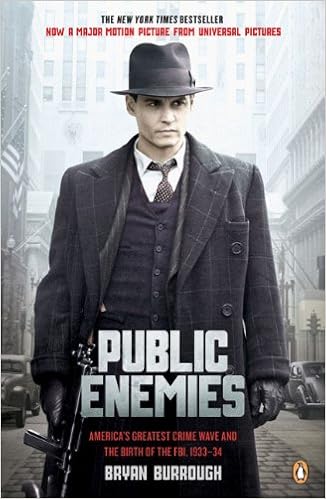
Public Enemies: America's Greatest Crime Wave and the Birth of the ...

I watched 40 minutes, which was 40 minutes too much.  Michael Mann’s last picture – Miami Vice – was bad in exactly the same way Public Enemies is bad – all mood and cool, beautifully photographed, and as interesting as a super model on a talk show.  Within 20 minutes, we learn all we would ever learn about our lead, John Dillinger (Johnny Depp).  He is cooly attractive, wear a suit well, lives for the moment and . . . he is cooly attractive.

Moll: What do you want?

John Dillinger: Everything. Right now.

Blech.