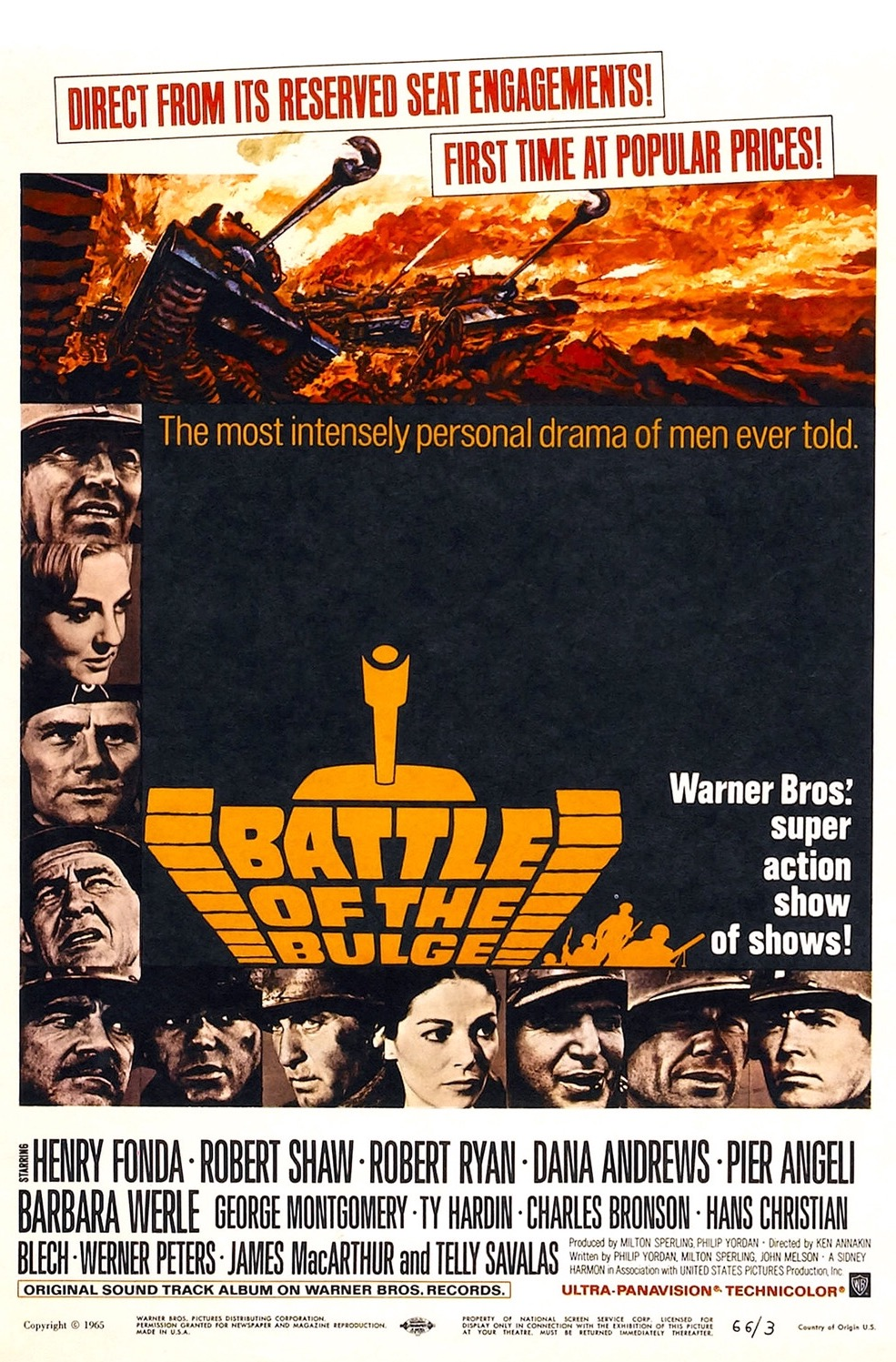
Tediously directed by the same person who helmed The Longest Day, once dubbed “The Longest Movie,” Ken Anankin’s resume’ does not inspire confidence. The picture takes forever to start, and when it gets going, it is permeated with flat ahistorical battle sequences and clunky dialogue. All the actors seem to be taking their cue from Henry Fonda, who plays the lone officer who foresaw the Nazi surprise attack through the Ardennes. Fonda sports a ho hum bemusement that screams, “Did the check cash?” The usual suspects for WWII flicks – Telly Savalas, Robert Ryan, Charles Bronson – make their bank as well, and similarly phone in their personas.
A bore through and through, it looks cheap and inauthentic, particularly when they put the leads in tanks with the actual film footage on a screen behind them.
Very Batman and Robin TV show driving.
Though it maintains a soft spot in this old heart for reasons having nothing to do with artistic merit.
When I was in high school, due to economic strain, my mother was forced to take in boarders. One, Klaus Kristmas (name changed because if my Googling is correct, he’s a rather accomplished German government official) was a smart, ramrod straight, punctilious young man whose father was in the Bundestag. Klaus was great fun, and my mother immediately made him part of the family. He even came to the beach with us, where we recoiled in horror as he pulled down his shorts to reveal a European look, the mini-Speedo.
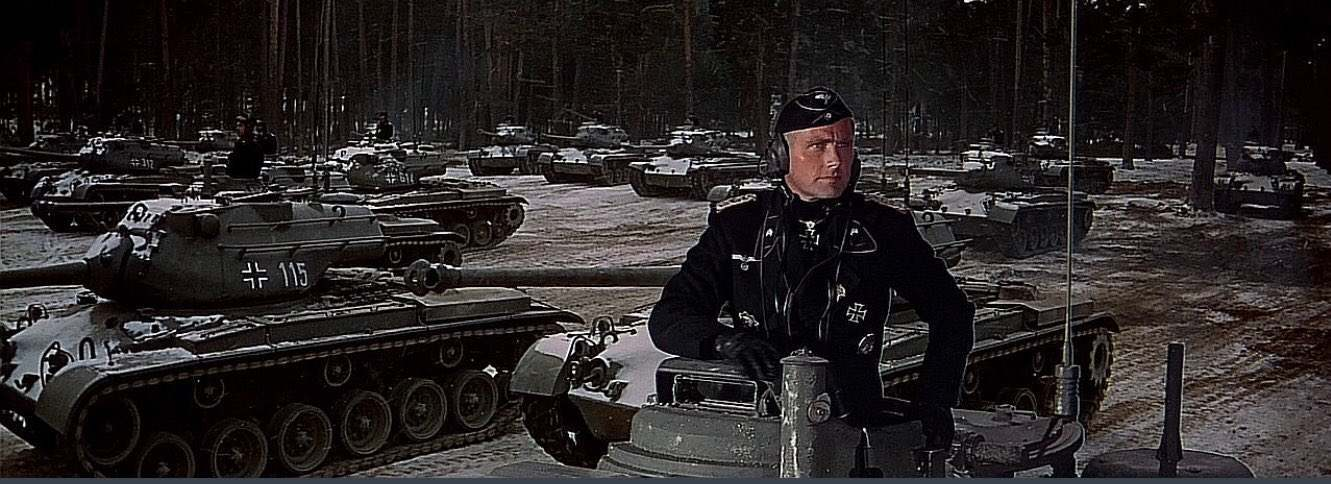
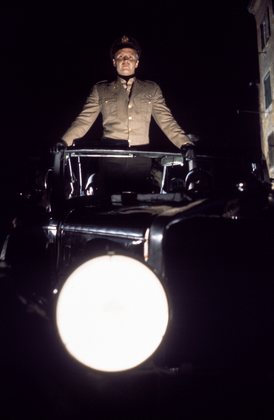
At home, I would hang out with Klaus and watch TV. One night, sure enough, we watched this flick, which is all Germans kicking ass for the majority of the picture. When Robert Shaw, as the lead Panzer commander, nears the oil depot that will allow his continued advance, however, things have shifted. Shaw burns to death when a fuel drum hits his tank.
A timely watch, as I recently finished Nuclear War, A Scenario, an eye-opening, cautionary theoretical which envisions North Korea lobbing several nuclear warheads at the United States, thereby testing decades- old protocols from all major powers and igniting a nuclear Armageddon.
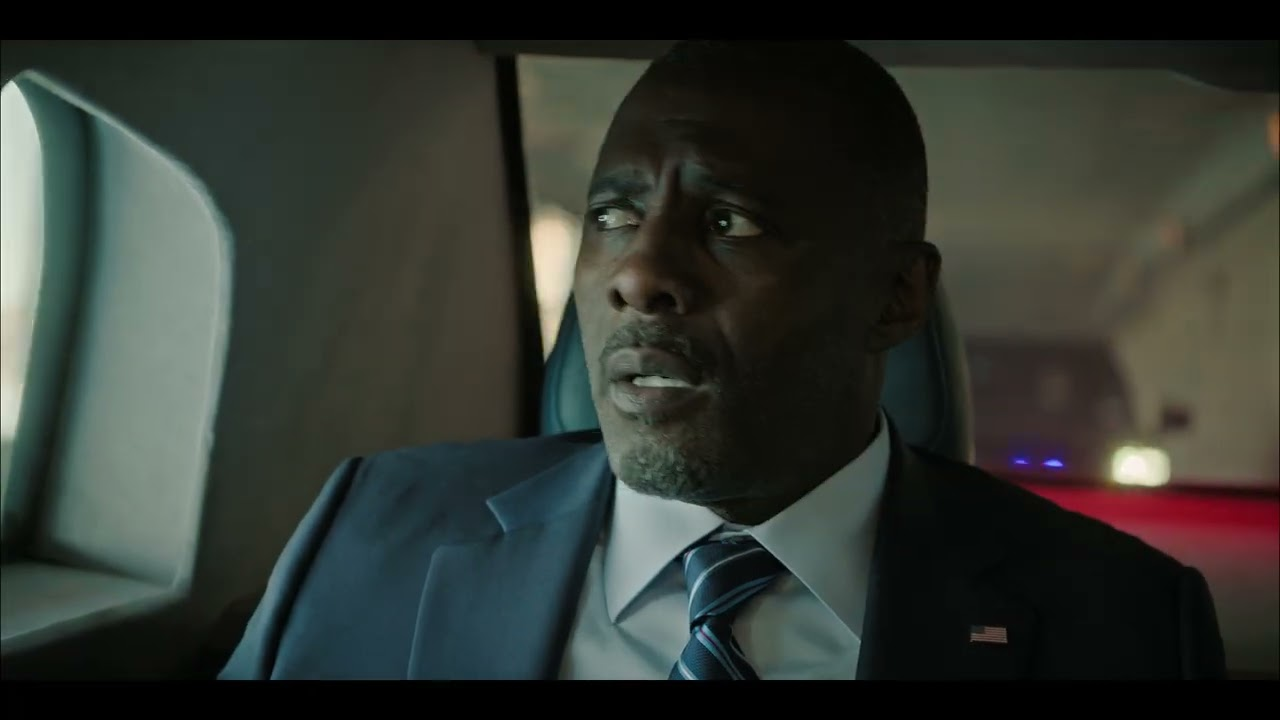
Here, Kathryn Bigelow (Zero Dark Thirty) dramatizes the story via three timelines, all ending at the moment of decision as to response. Just as the attack is reported, after which we have 16 minutes before detonation, President Idris Elba, harkening back to George W. Bush reading to little kids when informed of the terror strikes of 9-11, is shooting hoops at a basketball camp run by Angel Reese.
And … there goes another minute.
Heart-pounding, riveting, and expertly paced, I was most reminded of Paul Greengrass’ United 93, a picture that elevated the professionals and non-professionals in a nightmare scenario, finding bravery, competence, and no matter the outcome of their particular hell that day, a rise to the occasion, with beautiful moments of humanity and humility. Bigelow’s characters are authentic, capable, and thus, all the more engrossing, and she does not neglect them in a film primarily about process and protocol. We learn but tidbits about who they are and what they do. With 16 minutes, there is not time enough, but Bigelow’s economical explication is superb.
On Netflix, one of the better flicks of the year.
*SPOILERS*
There is one major hole. In the book, the scenario had more than one missile coming and they were definitively from North Korea, which truly made the decision as to retaliate more salient. Were more coming? If so, now may well be the time to counterstrike to ensure they were interdicted, even if it meant destabilizing Russia and/or China and inviting a counterstrike based on their misapprehension.
Here, by using a single missile, and making the striking of Chicago a foregone conclusion, on reflection, the response, for which we are all obviously waiting on pins and needles, is not really in doubt.
You would wait on the single missile to hit, see if it detonated, and then wait to see if any more were launched. Nothing that you could do two minutes before the missile hit, you could not do after the missile hit.
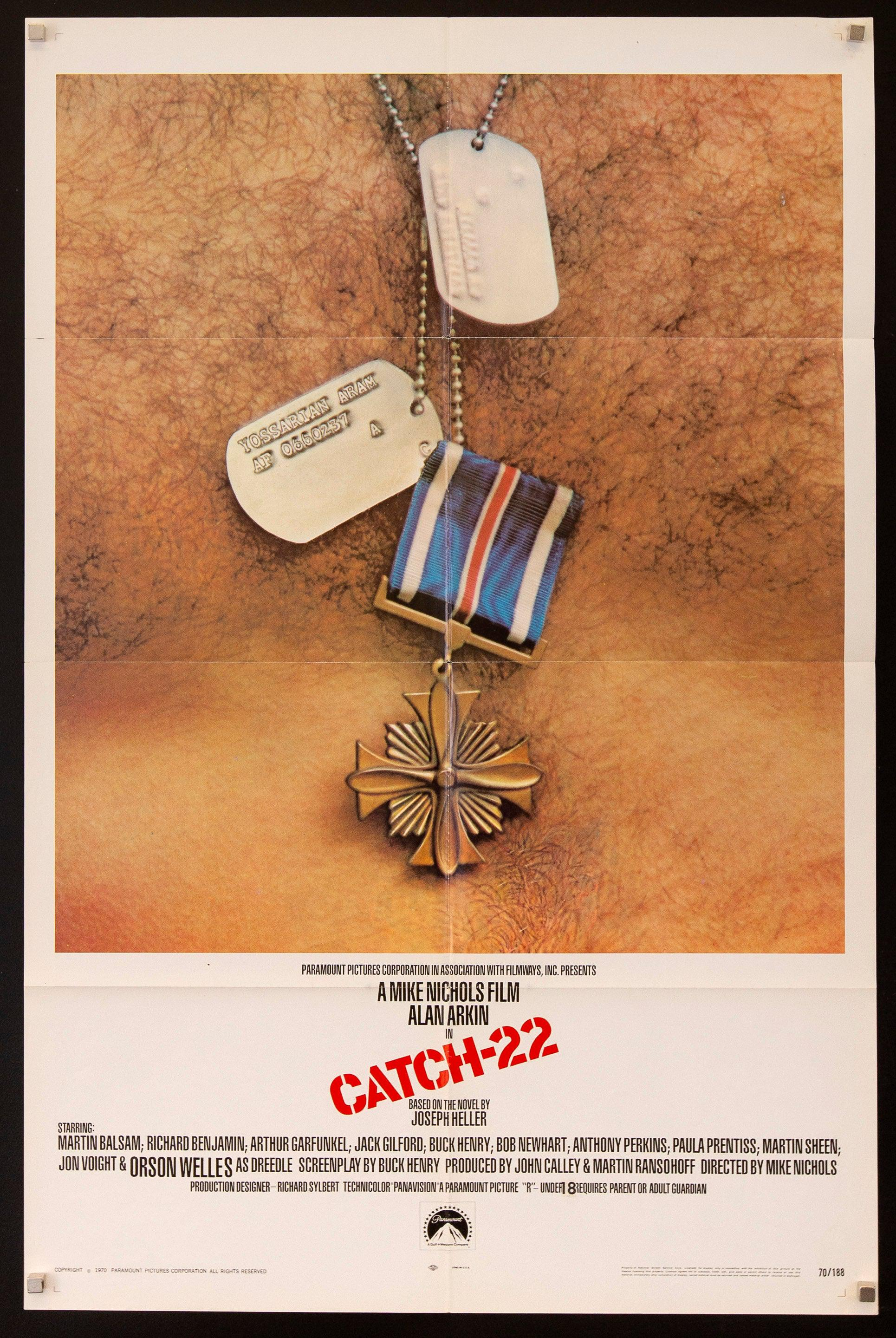
Mike Nichols’ adaptation of Joseph Heller’s dark comic novel is energetically brisk and sometimes entertaining. Tonally, however, the film is an uneven mess, a pointless downer playing bleakness for laughs.
As the original Corporal Klinger, Alan Arkin’s Captain Yossarian is the engine of the picture, a bombardier stationed in Italy who is losing his nerve and wits. His superiors (Bob Newhart, Buck Henry, and Martin Balsam) vex him by upping the number of bombing missions necessary for a ticket home to curry favor with their commanding officer (Orson Welles). Yossarian’s fellow fliers (including Martin Sheen, Richard Benjamin, Anthony Perkins, Charles Grodin, Bob Balaban, Jon Voight, Art Garfunkel, Jack Gilford and Norman Fell ) all suffer under the same yoke, but with cheerful acceptance or apathy rather than the indignation of Arkin’s whirling dervish. How the Academy overlooked Arkin astonishes me; whatever the flaws of the picture, his commitment and on-the-edge turn requiring an actor’s entire skill set is unforgettable.
The film’s main problem is rooted in the see-sawing expanse of the endeavor. Yes, war is FUBAR, and aspects of it are both craven and bizarre. In the world of Nichols and Heller, the poor bombers are riddled with asinine and unctuous leadership, wackadoodle stir-crazy types, suicidal loons, sex-crazed fiends, one murderer, and one uber-capitalist who trades parachutes for commodities on the open market.
When played for laughs, the picture is solid, and no one is begging for verisimilitude. However, when pathos is introduced, such as truly tragic deaths of compatriots (including a particularly brutal death of a young flier) and civilians, the film feels incongruously cruel.
Worse, the picture is more than anti-war. It is anti-American, maybe even anti-everything. As nothing matters, there is no investment in the fates of anyone. A fair juxtaposition is Robert Altman’s M*A*S*H, in which the madness of the endeavor is clear but even in that madness, the professionalism of the medical staff is unquestioned and laudable, the loss of life truly sad. Nichols himself felt M*A*S*H did his picture in: “We were waylaid by MASH, which was fresher and more alive, improvisational, and funnier than Catch-22. It just cut us off at the knees.” All of which is true. But M*A*S*H also had heart and a respect for the craft of combat surgery. Here, there is no respect for anything or anyone and the characters seem more from Looney Tunes than Heller’s book.
Indeed, every hallmark of the American ethos is there for Nichols to malign. The military leaders are insecure dolts, silly and moronic, who care not a whit for the men. The fliers are chumps or burn outs, pawns in the great game, either oblivious or devious in their plans to get out and shirk. Everyone is also an automaton, caring for nothing, even each other. The goal and aim of the war, and this is World War II we are talking about, is at best corrupt and ultimately criminal, as we bomb not only towns with no military significance, but, in a perversion of capitalism, we allow the Germans to bomb our own base for profit. The Italians are victims of the Americans, just as they were victims of the Germans, because, you see, there is no difference between the two. By the end of the picture, the genius behind the corporate conglomerate, Jon Voight, is now close to full Nazi in regalia and trappings.
Hell, even parents who come to Italy to see their dying son are treated as props for a goof.
Yes, yes. None of this is to be taken literally in a “war is madness” story, and the film is a black comedy grossly overgeneralizing for the laughs. Still, it’s the kind of smart set entertainment that fairly encapsulates the philosophy of the sophisticate, a sneering besmirchment that puts the last torpedo into a sinking ship.
I wonder what Heller made of the movie’s iciness. Obviously, his book was a cynical send-up (I read it in high school, along with Vonnegut’s SlaughterHouse-Five), but Heller also flew 60 combat missions as a B-25 bombardier during the war.
There are many many fine war films, but to a near fault, the pictures are accompanied by moving scores and dialogue that seeks to translate the madness into something articulable as a broader goal. The characters negotiate their horror, sometimes in a simplistic, overly cynical or patriotic manner, often anachronistically. A common fault is too much explication. Think Eric Bana telling Josh Hartnett in Black Hawk Down that the only thing that matters is the man next to you, after which he poetically slips away to do more of God’s work in Mogadishu. Or the often trying banter of Spielberg’s platoon, looking for Private Ryan, with their hopes and dreams too much on their sleeves. Or Charlie Sheen’s overt “what are we doing here, who am I?” voiceovers in Platoon.
Then there’s the misery and degradation in all its forms, seen on Spielberg’s Omaha Beach or in the trench hell of the most recent remake of All Quiet on the Western Front. Hamburger Hill, We Were Soldiers, Hacksaw Ridge, Flags of Our Fathers, and dozens of other combat flicks, all which show us the meat and the grinder and the indomitable or broken spirit of those who survive or die in its gears.
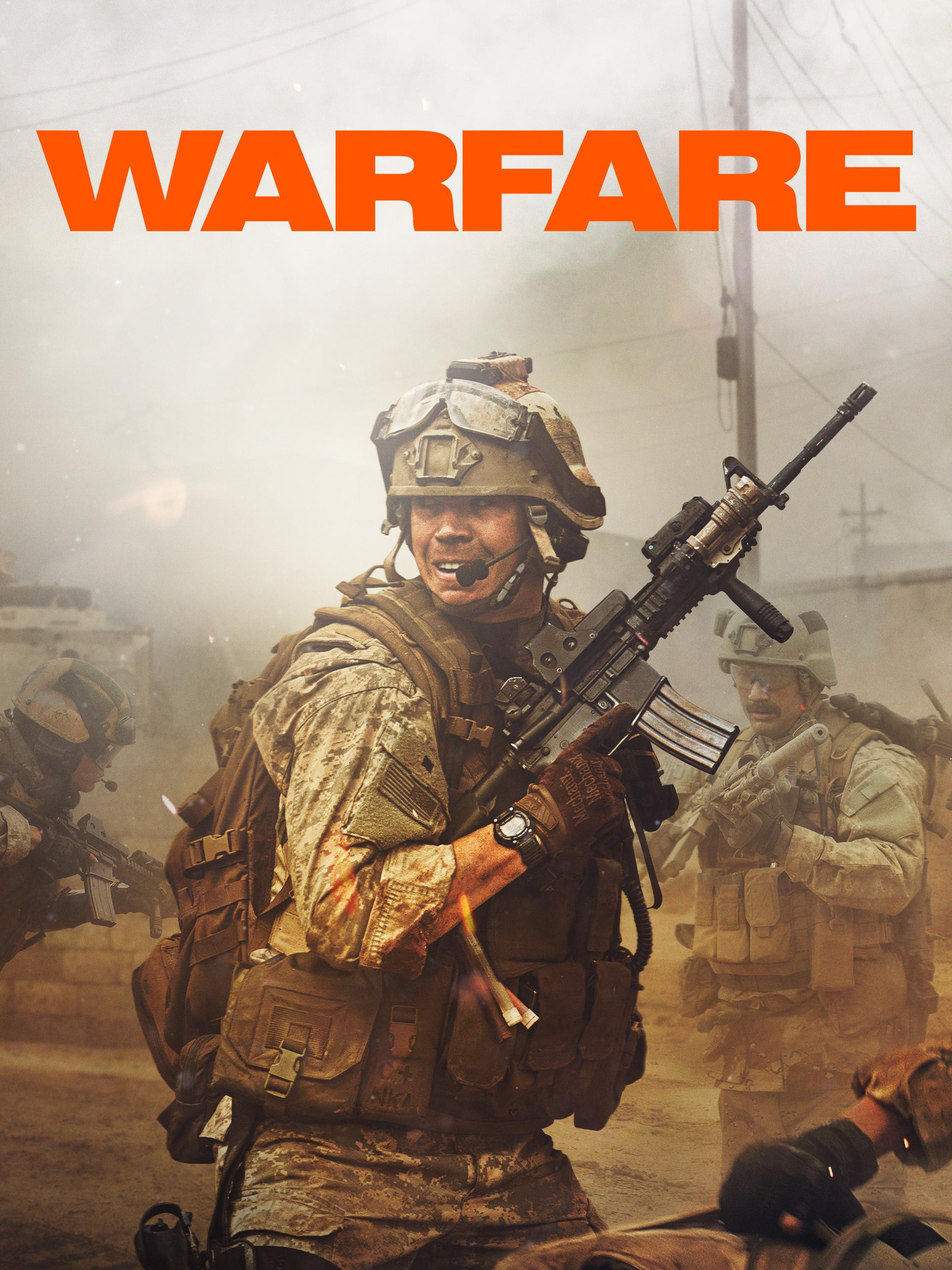
Warfare, directed by Alex Garland (Ex Machina, Civil War, 28 Years Later) and Navy Seal Ray Mendoza, a veteran who served during the action depicted, is like none of these films. A platoon on a observational mission in 2006 Iraq after the Battle of Ramadi soon becomes the quarry. What ensues is a riveting recreation of their fate as they are besieged on all sides. What is revealed is a professionalism in a real time pressure cooker, less heroism than necessity. There are no speeches, no mournful strings, no hoo-rah. No soul searching or leather strap biting (well, a little, but for before morphine is administered, it is a terrible, pitched screaming).
In the place of such war film hallmarks, there is increasing tension and isolation. As the fear and confusion mount, it is met with collaboration, spine, and ingenuity, all hampered by human foible under great stress. Mistakes are made but they are almost built into the scenario and they are not dwelled upon. Terror abounds but it is revealed subtly. The soldiers, pinned down in an Iraqi home for the entirety of the film, have every weapon and gadget American fighting ingenuity can provision. They have surveillance from above, as well as the ability to call in armor or air support. Yet, the unit seems near overmatched by the persistence of their foes, which enhances a secondary threat, the possibility of panic and loss of discipline. There are no dramatic explosions, not unit uprising, no philosophical meanderings. There is hesitation, the glance of doubt, the zoning out to cope, the “are you fucking serious?” look, the nano-second wait for someone else to step up, the grudging assumption of the task when they do not, and the missteps that would occur in any such maelstrom.
There is a beautifully rendered scene where the besieged platoon is reinforced. The first platoon’s lieutenant says to his newly arrived counterpart, “I’m fucked up.” He is not injured, though concussed and disoriented, but he is spent and incapable of command. His near wordless relinquishment, met by acknowledgement, dawning and the assumption of responsibility, is poignant.
The film is really about the business of war, and the exercise of it as craft when literally and figuratively all is crashing down about you. It’s an original work of art in the genre.
I’ll add one contemporary observation. There has been much talk of late as to the physical standards necessary for combat. This film will educate you as to a basic requirement. If you can’t pull a wounded man from harm’s way, you have no business being in the business.
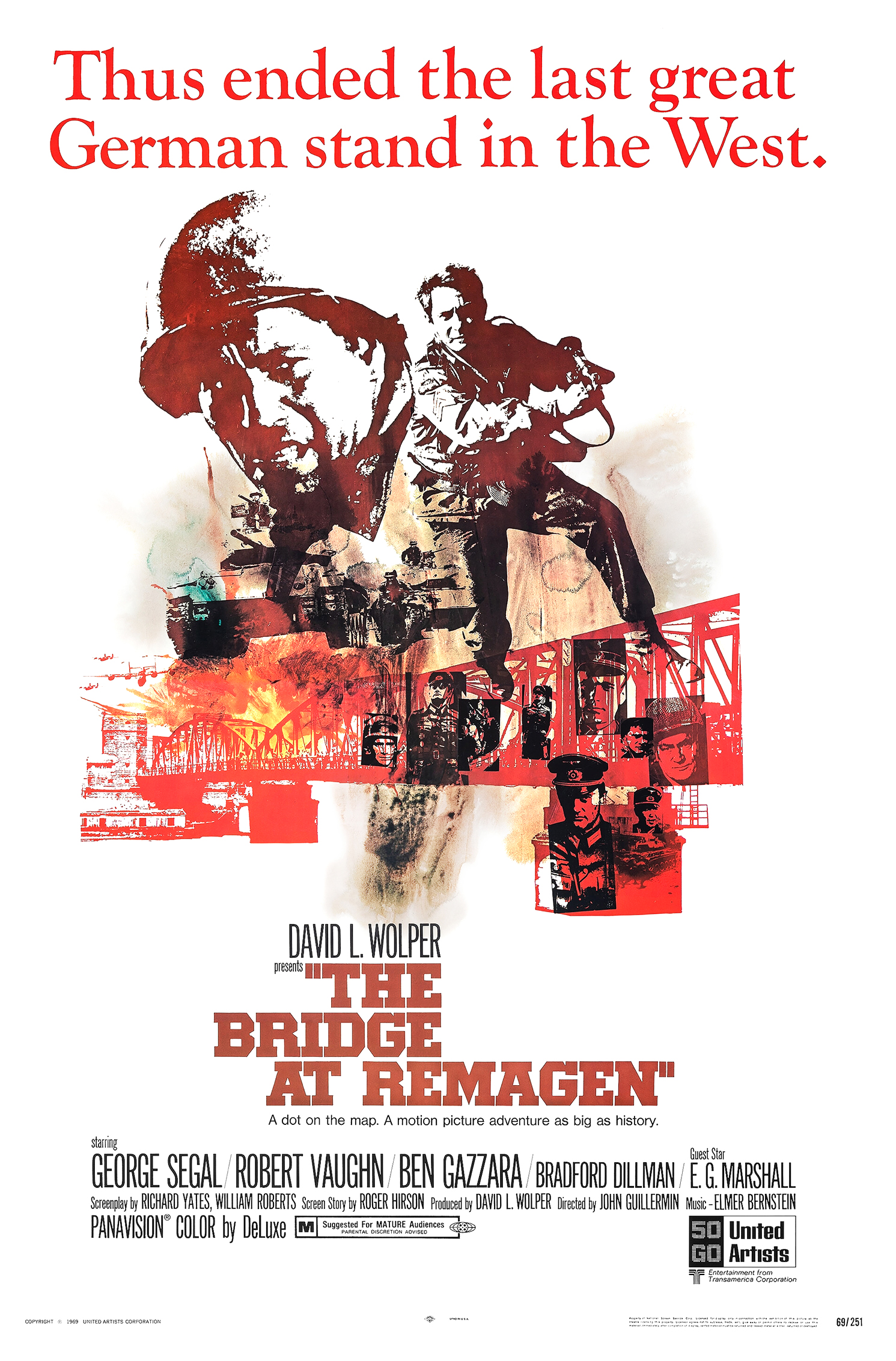
Another war flick I watched in grade school with my Dad. Cynical Lieutenant George Segal is being ridden by gung ho Major Bradford Dillman to save or blow (the mission changes) the last bridge across the Rhine in the waning months of World War II. Segal in turn rides Sergeant Ben Gazzara, who eclipses Segal’s cynicism (he’s a looter of the dead) and then some. On the other side, cynical German Major Robert Vaughn is sent by his superior officer to save or blow (the mission changes) the bridge. All the subordinates are let down by their superiors, and they wear their hard-bitten sensibilities on the bedraggled sleeves of their fatigues (or in the case of Vaughn, his snappy leather trench coat).
The picture is competent if forgettable, with a few interesting facets. This is one of several World War II pictures that carry a Vietnam mentality, where the mission is FUBAR, the line of authority weak, the sense of duty subordinated to the futility and the carnage. Even the coda – that the bridge collapsed 10 days after Segal’s unit gave so much blood to take it – is steeped in Hamburger Hill pointlessness (the filmmakers leave out that in those 10 days, 25,000 American troops crossed and three tactical bridges above and below Remagen were built). The picture is also notable for the introduction of the sympathetic Nazi. Here, it is Vaughn, juxtaposed with the evil SS officers in impeccably tailored outfits who are busily shooting civilians and deserters. The same dichotomy can be found in Peckinpah’s Cross of Iron (James Coburn), as well as The Eagle Has Landed (Michael Caine). The phenomenon petered out (along with WWII films) until years later, in Band of Brothers (the surrender scene and subsequent speech by a German general to his defeated troops), Land of Mine, Das Boot, Stalingrad, and, later, more controversially, Downfall, which rankled many given Bruno Ganz’s commanding performance, which elicited some innate sympathy. Per one reviewer, “the very thought of humanizing Hitler makes me queasy. If he had a good side, I don’t want to know about it.”
Historical note: when the movie was near complete, the Soviets invaded Czechoslovakia, where it was being filmed. Most of cast and crew decamped to a hotel in Prague, where they voted on whether to split or stick it out. They split, to Germany, in a long wagon train of cars, until things simmered down.
I’ve seen this film, conservatively, a dozen times. I cannot turn it off. It is flawless, and I never tire of watching. It is not just an exemplary historical drama and period piece, which would appeal to me more than others, but it is one of the finest films ever made.
Based on a Patrick O’Brian novel, it is 1805, the time of the Napoleonic wars, and we travel with Captain “Lucky Jack“ Aubrey (Russell Crowe), a protégé of Lord Admiral Nelson. Aubrey’s ship, The HMS Surprise, is hunted by, and then pursues, a French privateer with twice her guns and speed. As Aubrey drives his crew and spars with his more humanistic friend and subordinate, ship surgeon Stephen Maturin (Paul Bettany), we are immersed in the customs, allegiances and frailties of the crew. Director Peter Weir (Witness) provides the feel of an early 19th-century war vessel, a routinized machine held together by the lash, grog, duty, honor, deep-seated universal superstition, and a shared sense of oneness with the sea.
The action sequences are jaw-dropping. The final sea battle is the most effective and stunning rendition of combat on film, save for the opening scene of Saving Private Ryan. Weir is expert at close quarter action and translating the ebb and flow of a battle that has been explained in its strategy at the outset. What follows is a stunning, intelligible melee’, and the only respite is a brief, awesome aerial tracking shot to provide scope and a quick catch of breath. And then, Weir dives right back in. The scene is even more impressive given the film’s commitment to authenticity. As with Spielberg’s triumph, Weir has made, in the opinion of one reviewer,“one of the most historically accurate movies of this century”.
Yet for all its visual delights and precision, the film is also memorable in its depiction of numerous secondary characters. Yes, the philosophical interplay between Aubrey and Maturin is well-honed, and both actors more than occupy the roles – their engagement is both familial and genuine, with a constant pull between friendship and chain-of-command. But the midshipmen, some as young as 12, and the salty crew, are the true stars. To see the former in such distress, under such pressure, and in the midst of terror and violence is heart rending. When one (Max Pirkis) must have his arm amputated, it is hard to choke back tears, such is his strength and vulnerability (if you have a son, it is doubly difficult). The mental breakdown of another young sailor is equally poignant. These boys, thrown into carnage, still do their duty, and Weir goes to great lengths to portray their bravery in tandem with their innocence.
The film is also unreservedly old fashioned in its championing not only of manly camaraderie, but valor, pluck, and devotion to country. Most war films follow a certain post-Vietnam philosophy, often clumsily injected into period pieces of prior times. The combatants’ first devotion is to each other and then to the goal, and they are guided by training and solidarity. When the training fails and/or the goal is revealed as corrupt, or bleakness eclipses all, things break down, and atrocity normally follows. Which is all very modern and ignores any sense of longing for the sting of battle or patriotic instinct, both generally derided or characterized as the province of dimwits and cannon-fodder. It is always the smart guy anti-hero who says, “This is hell, we need to get out alive and with our souls intact, and [for the less cynical] the only thing that matters is the man next to you”’ or some such trope.
Not here, as Weir flatly rejects anachronism save for a few moments with the good ship doctor, but even Maturin’s more liberal stances are suited to his position. To put a finer point on it, there is a wonderful scene where one of the young midshipman, Calamy, implores Aubrey to share a tale of his service under the great Nelson. At first, Aubrey parries the request with a joke (Nelson once asked him to pass the salt, he laughs). The boy’s disappointment is palpable, and then Aubrey obliges:
Capt. Jack Aubrey : The second time… The second time he told me a story… about how someone offered him a boat cloak on a cold night. And he said no, he didn’t need it. That he was quite warm. His zeal for his king and country kept him warm.
[Maturin sighs]
Capt. Jack Aubrey : I know it sounds absurb, and were it from another man, you’d cry out “Oh, what pitiful stuff” and dismiss it as mere enthusiasm. But with Nelson… you felt your heart glow.
As fewer people know or cherish history, it will become a less desirable vehicle for entertainment. And that just ain’t going to change. But there will be this film and a few others that stand the test of time. Huzzah!
A WWII thriller and a staple on the Channel 7 four o’clock movie growing up, Steven Spielberg once named it as his all-time favorite war movie. I don’t know about that, but as a kid, I was pretty jazzed.
Richard Burton and Clint Eastwood lead a group of commandos dropped behind enemy lines in Bavaria – where the barmaids are buxom and the enemy plentiful – to kill an American general who has been captured by the Nazis. They must get to the general before the Germans extract critical information from him.
The picture is more than competent (though overlong at nearly 2.5 hours; in the 70s, on TV, it was cut to 90 minutes, and did not suffer for it). The movie is also smart, as much a whodunit as war thriller, and uber-violent to boot.
One major problem, however, is the setup. The American general is held in a castle fortress accessible only by cable car. Putting aside the suspension of belief necessary to accept ingress and egress, which is right and proper, the castle also houses hundreds of soldiers, heavy equipment, a barracks, a helicopter pad, a radio room, and enough ammo and explosives to blow itself up. All, of which, apparently, was ferried up in two cable cars that hold 8 people a piece.
Another problem is just a terrible cheat. In The Dirty Dozen, Lee Marvin and Charles Bronson, dressed as German officers, must mingle with the Nazis in the chateau they plan to blow up. The fact that only Bronson knows how to speak German amps up the dread, leaving Marvin to play it stern and taciturn whenever a real Nazi speaks to him at a pre-all-hell-breaks-loose soiree’. Quentin Tarantino does the same thing with Brad Pitt at the film premiere in Inglorious Basterds , though he plays a bit more comic. But Tarantino also utilizes the speaking of German, or, rather, the sign language of a German, to brilliant, suspenseful effect, when Michael Fassbender makes a critical error and is thus found out, which was presaged in The Great Escape:
But I digress.
Here, as Burton and Eastwood approach a checkpoint, where their papers are to be reviewed, you wonder which one is going to speak German. I assumed Burton. Then again, I never assumed Eastwood would sing in a musical, but Lord Almighty, that’s him singing Gold Fever in Paint Your Wagon:
So, who knows, right? Well, it turns out, neither of them speak German. Instead, they speak English LOUDLY, and the guards figure they don’t want to interrupt two German officers speaking loudly. Translated? Neither actor wanted to learn a little German, so we are left to believe that the guards heard German, even though we did not. Very lame.
On the plus side, Eastwood is Eastwood cool and he conservatively, single-handedly, kills at least 100 Nazis. At 10 years of age, I was sold. There’s also a fair amount on double-crosses (the picture is written by Alistair MacLean), and while I can’t prove it, I suspect Tarantino saw the picture and it informed his unparalleled French cellar bar shootout in Basterds.
On HBO Max.
P.S. After writing my suspicions about Tarantino, I Googled a bit and now claim semi-vindication. Tarantino has lauded the picture on numerous occasions, particularly during his promotion of Basterds.
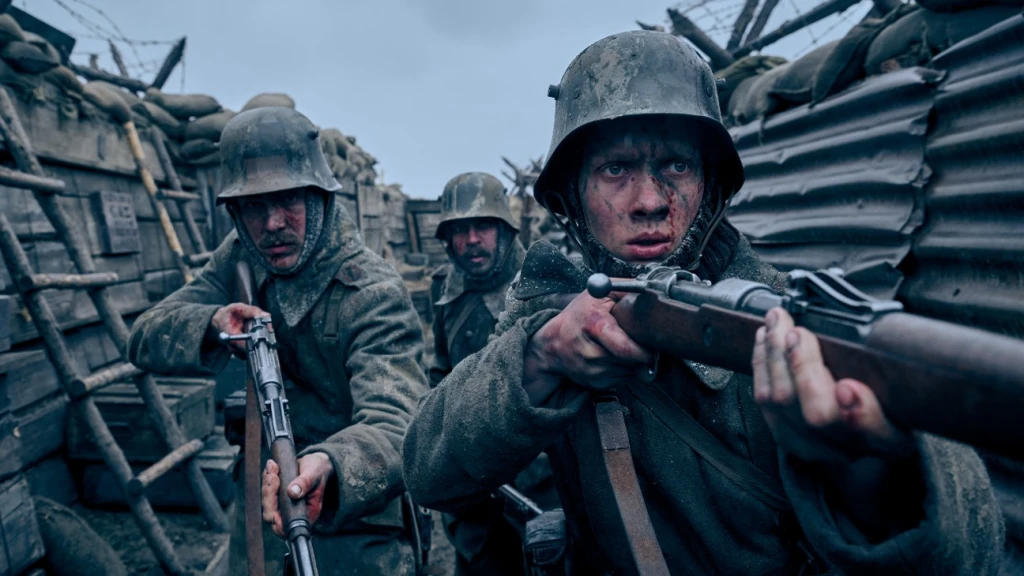
Visually arresting, wonderfully acted, and almost unbearably bleak (as only a World War I trench drama can be), director Edward Berger has created the filmic equivalent of Erich Maria Lemarque’s language (“We are not youth any longer. We don’t want to take the world by storm. We are fleeing from ourselves, from our life. We were eighteen and had begun to love life and the world; and we had to shoot it to pieces”). The miserable existence of the characters is interspersed with moments of such great humanity – the joy at the theft and cooking of a shared goose and the circulated kerchief of a French girl for sniffing come to mind – the pointlessness of it all is underscored.
But there are problems.
First, the dramatization of a last-ditch attack before the official armistice is over-the-top. In the book, Paul, our protagonist, dies on a peaceful day, which is in many ways more poignant. Here, he and his comrades are felled after a foolhardy and hubristic final charge ordered by a madman. The plot change feels insecure. Similarly, the injection of peace negotiations allows for some clunky foreshadowing along the lines of, “If you dictate such harsh terms, Pierre, there’s gonna’ be schnitzel to pay!”
Second, Saving Private Ryan has placed such a premium on verisimilitude in war pictures that they seem to one-up each other in conveying both the horror and the disorientation. Which is normally to the good, save for an overuse of technical wizardry that can often border on the distracting (I am wondering if the drone is the new CGI). At some point, you feel a little dirty for being exposed to so many new and awful ways to depict death.
A behind-the-scenes vignette from this film distorts its true putrescence. As the story goes, before scenes, serious actor Sean Penn kept whispering to the out-of-place and in-over-his-head small screen star Michael J. Fox the words “television actor”, to either torment him or to rally him.
It didn’t work.
That said, while there is no question Fox is terrible, his awful performance serves the purpose of obscuring a host of other faults in this debacle.
There are, for example, hideous performances all around. Penn is execrable, delivering a turn of overacting so extreme you can almost smell it. He’s like a whirling dervish of beef, brew and Old Spice. Young John C. Reilly, John Leguizamo, and Ving Rhames are near incompetent and, like most everyone, entirely unconvincing.
But no one was given anything very good to say anyway. The script by playwright David Rabe is so overt it hits like an ABC “After School Special.” A stagey “What are we doing here, Sarge?” is pretty much every line of the picture.
Rabe served in Vietnam as a medic, which just goes to show that experience isn’t always the best progenitor of art.
Watch and see if you can hold your breakfast.
Brian De Palma’s direction is self-indulgent. I can think of few auteurs less suited for the verisimilitude of a period war picture than a guy who fetishizes Hitchcock. There is a scene where Fox’s fellow soldiers attempt to frag him by putting a grenade in the latrine where, for no reason other than an ostentatious build-up similar to the baby carriage in The Untouchables or the bucket of pig’s blood in Carrie, Fox has gone to attempt to light a cigarette, interminably. Because, when you want to smoke, no place is better than a Vietnam shithouse surrounded by big pails of excrement to enjoy it. His lighter won’t work and after trying it for the umpteenth time (maybe more than 15, he really wants that smoke), Fox drops it, and lo and behold, the grenade is reflected off of the lighter’s stainless steel.
A Vietnam picture is no place for this sort of arty playfulness.
It gets worse. When Fox survives, he sees one of his tormentors, Reilly, peeking at him from behind sandbags, and all I could think of was–
The film also sports terrible art direction and location scouting. Vietnam looks like Disney’s Jungle Cruise, an incredible feat given some of it was shot in Thailand. Wherever they were, the actors were serviced by some of the best spas and salons available to them. I just never knew the combat experience in Vietnam was so tidy. Fox in particular looks like he was steam cleaned in every scene. Even when he has a head wound, his bandage is so brilliant white, it almost looks like a headband missing a feather.
Finally, there is Fox’s height. In the old days, an actor’s short stature was taken into consideration. They’d put him on a hidden box, or shoot him from an angle that would favor him. Hell, in a tracking shot, they’d even build a trench for his leading lady as they ambled down the street.
Most film actors are short. 5’7″ seems to be the norm, but at 5’4″, Fox is diminutive, near tiny. Yet De Palma offered him no help. In the scene above, when Fox grabs a taller soldier, a “cherry”, by the lapels to chew him out, he looks like a toddler clinging to an adult’s overalls. Which is fitting, because for most of the film, with his childish, plaintive-comic mien, Fox presents like he lost his Mommy in aisle five of the Long Binh PX. Yes, he’s short, but that’s not the whole of it. There is not an ounce of gravitas in the actor. “Oh, Jeez” sounds perilously close to “Oh Jeez, Mallory.”
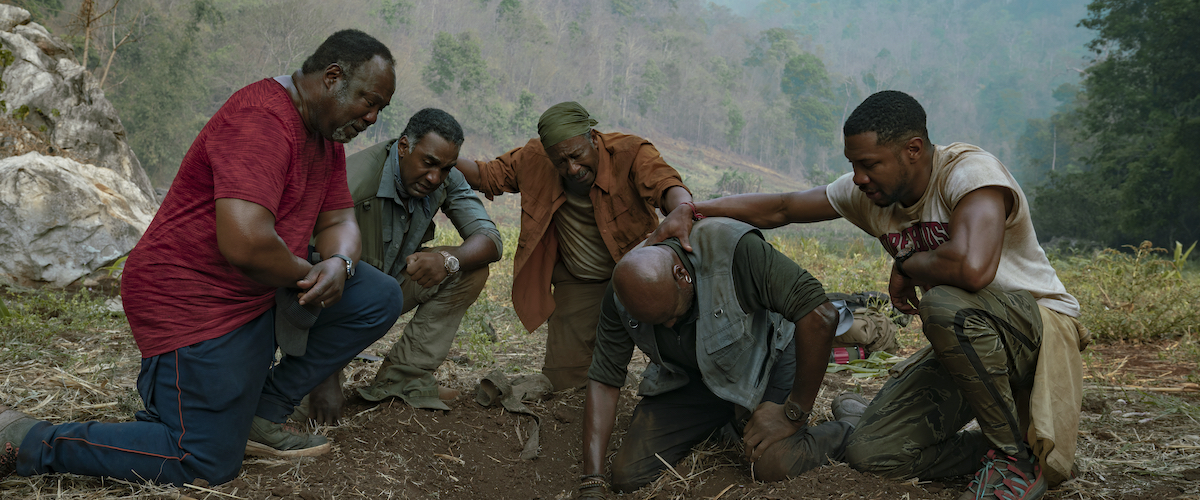
I ran across this today on The Ringer: “Sadly, having been snubbed by the Globes and the SAGs, Delroy Lindo would do well to even get an Oscar nomination—let alone win—for his career-defining performance in Spike Lee’s Da 5 Bloods. Da 5 Bloods may struggle to get any Oscars love outside of a Supporting Actor nod for the late Chadwick Boseman, as Spike Lee also failed to garner a WGA nomination for his screenplay. All told, it’s a disappointing outcome for one of the best films of the year. (Granted, the Academy doesn’t have the best track record at recognizing greatness—Green Book won Best Picture just two years ago.)”
I’m more than happy to kick Green Book until I’m blue in the face. And when I saw Da 5 Bloods many months ago, I was just happy to leave it alone. But now, it may well garner some awards, so, I am duty bound to weigh in.
The picture is awful. Didactic, overwrought and pointless, with a decidedly cheap feel. While Delroy Lindo is a force, he is unrestrained to the point of wince-inducement. His turn as a Vietnam veteran who has gone over to the dark side (he wears a MAGA hat) is so over-the-top, I started to fiddle with my phone because I felt bad for him, for the other actors, and then, myself. To call his turn “career-defining” may well be accurate, but if that is meant in a good way, what a horrible verdict on his fantastic work in Clockers and Crooklyn, two excellent Lee movies where Lindo soars rather than perspires.
The film is also wildly uneven, at turns madcap screwball and then deeply serious. Lee had the same problem with Black KkKlansman, but that picture at least held together as just barely watchable (until the atonal offensive coda shoe-horned in at the end).
Da 5 Bloods also looks and feels like a low-budget student film. Lee makes the Mỹ Sơn temples look like a place the Brady Bunch found a haunted Tiki idol. Worse, Lee doesn’t really know what to with action sequences (seeThe Miracle of St. Anna), so all the running around just comes off like kids playing war.
All of that aside, even if the film had been passable, it could never have overcome the Road Runner-esque demise of a character who you just knew had to step on a land mine hidden in the jungles of what appears to be Tarzana. He’s backing up and you just know it, and then, the cartoonish visual aftermath . . .




 filmvetter