Archive

Sci-Fi

Star Wars' Reborn: A Reflection on 'The Force Awakens' and 'The Last Jedi'  - mxdwn Movies
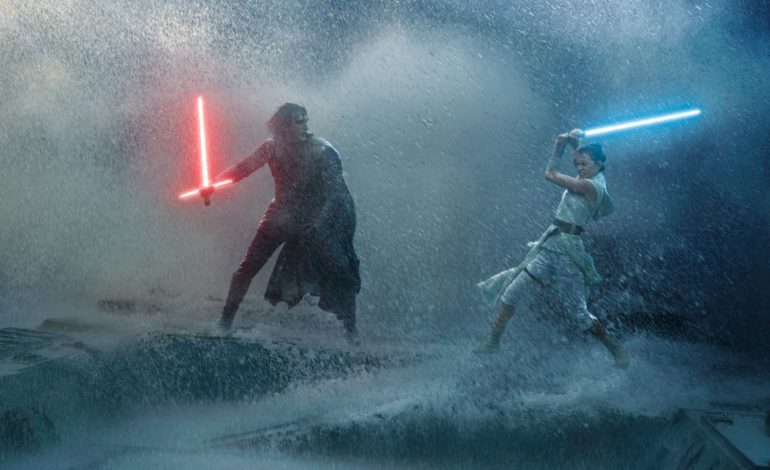
J.J. Abrams pulled off a neat trick with this picture. First, he purged from our filmic consciousness the abominations that were George Lucas’ middle three Star Wars films, which were bloated, antiseptic stories populated by green screen zombies and seemingly produced for the sole purpose of reinvigorating the merchandising arm of his global empire. For more on this, see Red Letter Media’s brutal takedown of those films and The People versus George Lucas.

Second, Abrams eased into it, essentially hewing to the first film in both style and story. There is nothing new or even particularly daring here, but Abrams is wisely more interested in establishing his bona fides and recreating the feel of the first three films. This one is a mix of action, fun and nostalgia, self-referential but not so self-referential as to be lazy.

Third, he strongly established four different new characters – three of whom have true motivations that emanate from a backstory – for the franchise to rely upon going forth.

It’s not perfect. Some of the self-reference is a little haggard, and the plot at the end is a little thin, pat and hurried. Yet, Abrams needed to exorcise the franchise of its demon menace, Lucas the bloodless toy purveyor, and he has done so in a movie that can reconnect new viewers to the wonders of the first pictures.
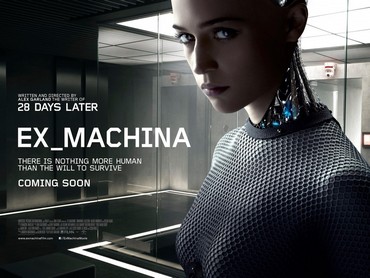
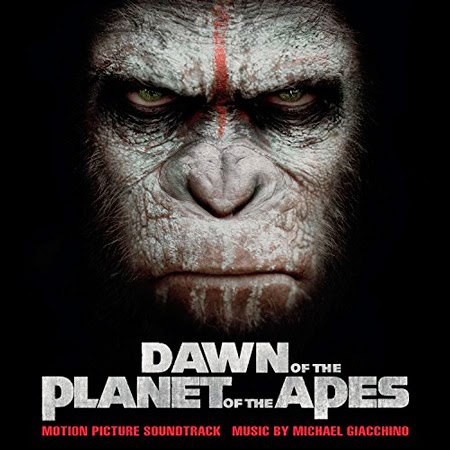
Image result for ex machina

Writer director Alex Garland has written several very distinct dystopian films (28 Days Later, Dredd) and his directorial debut is assured and not unexpectedly, unique. Oscar Isaac is Nathan, a Steve Jobs-esque reclusive titan who invites Caleb (Domnhall Gleeson), a coder at his web service monolith, to his retreat deep in the mountains to conduct the testing of an artificial intelligence being (Alicia Vikander) he has created. While Nathan and Caleb start off in an awkward forced friendship hampered by their employer-employee dynamic, and the fact that the reason for Caleb’s selection seems flimsy, they soon become adversarial – with Nathan chastising Caleb for his unscientific approach and Caleb increasingly distrustful of Nathan’s methods. It then becomes unclear exactly who is being tested, Eva, Caleb or Nathan, as the three negotiate their roles while strategizing to achieve their aims.

Expertly paced and beautifully photographed, there is a little bit of Her and Spielberg’s A.I. in here, but ultimately, the film that best captures the ethos of this picture is Mousetrap. This is an intelligent, absorbing and imaginative sci-fi thriller which rejects shocks for a slow dance and smartly realized  dawning at the end.

Better than its predecessor, for a couple of reasons: the perfunctory heartless, nasty corporation is not in the mix, the film is not saddled with the herculean task of presenting James Franco as a scientist, and we spend more time with the apes than the humans. The apes, led by Caesar (Andy Serkus), are decidedly more interesting, having created a thriving, peaceful colony outside of San Francisco. Since this sequel is set only 10 years after the apes escaped their Bay area zoo at exactly the moment mankind became afflicted with a disastrous plague, it appears the simians got right down to the nasty, because there are a shitload of monkeys hiding out in Muir Woods.  But man comes a calling . . .

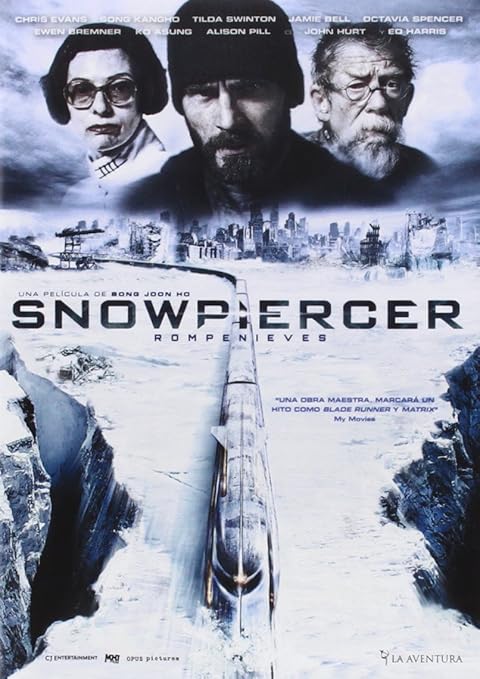
Amazon.com: Snowpiercer: Movies & TV

Mankind is threatened by global warming, and in an effort to turn the tide, introduces a cooling agent into the atmosphere. A deep freeze results and the only survivors live on a train run on perpetual motion that circles the earth, said train having been developed by a prescient bazillionaire (Ed Harris). The poor, led by Chris Evans (Captain America), eat mushy protein bars in the last car, while the rich are pampered with sushi, drugs, saunas and opulence in the front. Evans leads a revolt and the proletariat move from car to car to get control.

This is high concept, ambitious dystopia, but it is also unsubtle, mostly ridiculous, high concept dystopia, inadequately explained (a perpetual motion train?) and saddled with an unwieldy end (Harris shows up, like the wizard behind the curtain, to explain all). I’m all for ambition, but this is several trestles too far.

The film also contains a simplistic Have v. Have Nots political theme, which probably accounts for its appearance on so many top ten lists. For an example of the film tickling the right funny bone, one need go no further than The San Francisco Chronicle’s Mick LaSalle and his juvenile conclusion: “It’s a film that, in its own peculiar way, forces viewers to question their values and ask themselves how much they’re willing to sacrifice for a functioning society, and how much is too much.” If it takes the likes of Snowpiercer to force LaSalle to question his own values, I’m surprised he didn’t join a monastery after The Hunger Games.

The picture is also unwisely reliant on Evans, who lacks the gravitas of a dark, brooding action hero and the chops to handle the big, tortured soliloquy at the end. We’re supposed to be dazzled, but like most products of graphic novels, it’s a slick, empty endeavor with a few interesting parts. Tilda Swinton is also very funny as a bucktoothed toady for Harris.

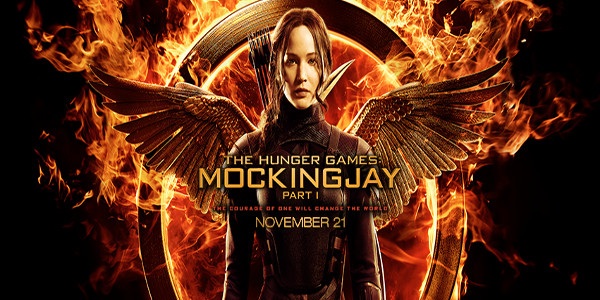
image

The main draws of the first two Hunger Games movies were the thrilling and terrifying nature of the games themselves and the frivolous corruption of the Capitol. Katniss (Jennifer Lawrence) was our guide, and after her selfless act (volunteering to take her sister’s place in the games), she served mainly as an action hero. As those movies progressed, Katniss became romantically tied to her teammate, Peeta (Josh Hutcherson) and her tie to him remains strong in this third installment. Unfortunately, this picture has neither games nor Capitol nor action. Instead, there’s a lot of Katniss pining for Peeta.

As the film opens, Katniss is ensconced in a drab underground facility that hides rebels under the leadership of the steely and completely uninteresting Julianne Moore. The primary conflict is whether Katniss will assist the rebels for propaganda purposes, and when she balks because of their hostility towards Peeta, who appears to be a collaborator, it is annoying. When she continues to prove difficult after surveying the carnage wrought against her own district (90,000 dead) and witnessing the Capitol bombing a rebel hospital she had just visited, it is very annoying. Her actions might be better accepted if she didn’t seem so mature; Katniss of the books is a teen while Lawrence is mid twenties.

There are bright spots. Phillip Seymour Hoffman, Elizabeth Banks and Woody Harrelson return, providing the film necessary humor and spark. And this is clearly a set-up for what one hopes to be a big finale. Let’s just hope Lawrence doesn’t appear to be in her early 30s, still reluctant to play a featuring role in the rebellion because she is mooning over Peeta.

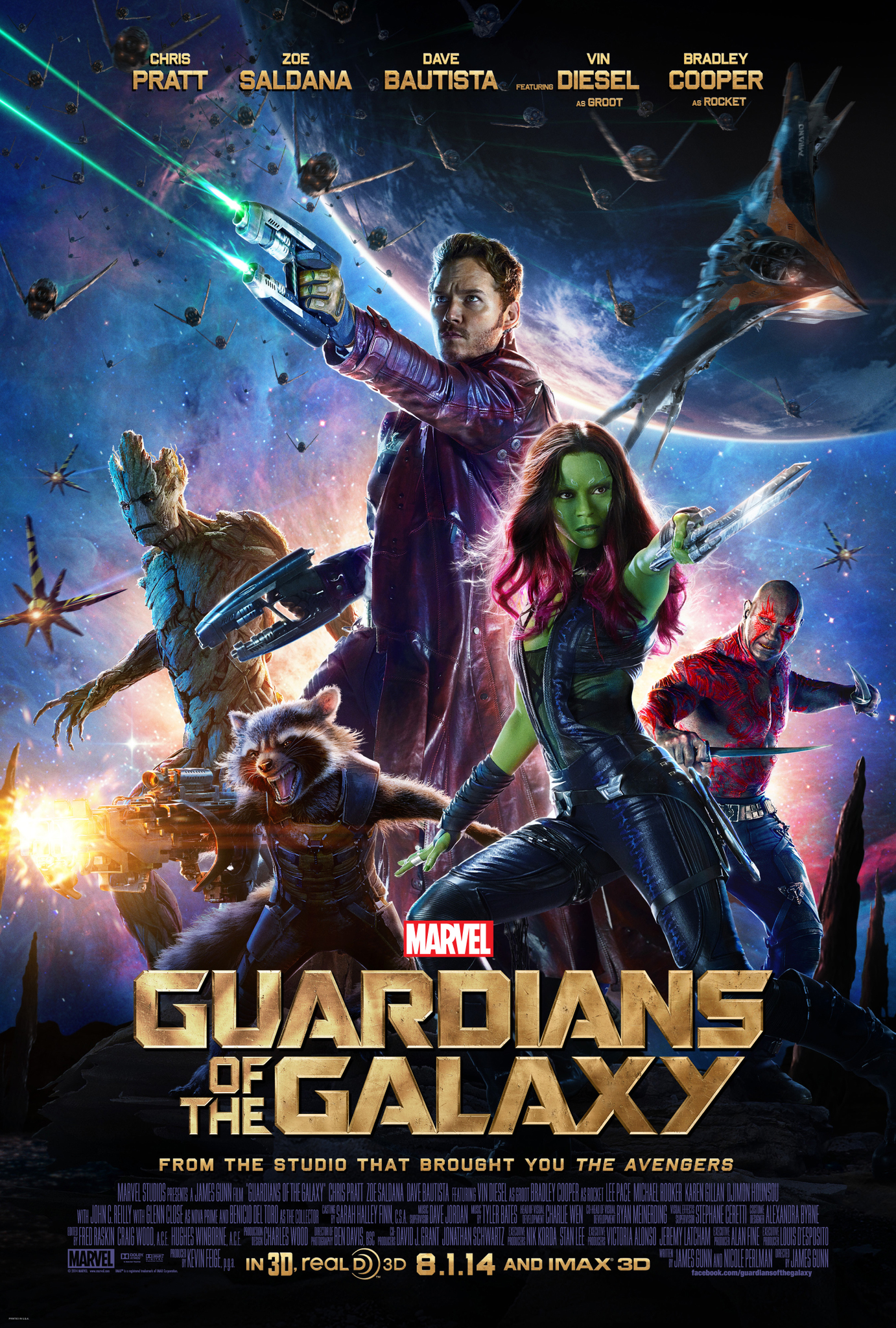
Image result for Guardians of the Galaxy

The model summer movie, with perfectly distributed action, humor and homage.  There is nothing original in the film – Chris Pratt as intergalactic robber “Star Lord” is a younger, hipper Han Solo, Vin Diesel is Chewbacca without the fur, and the Death Star has been miniaturized to a tiny crystal – but if not unique, it is fresh. Rather than reaching for the myth of Star Wars, Guardians opts for more humor, and the operatic sweep of John Williams is replaced by vintage pop, courtesy of Pratt’s 70s mixtape. There is sweetness (Bradley Cooper voices a surprisingly moving raccoon) and while director James Gunn’s resume’ (Slither) contains nothing suggesting an ability to handle this fare, the actions sequences are expert, comprehensible and brief, avoiding the mind-numbing excess of so many Marvel pictures.  The only criticism is the short shrift given to the motives and backstory of the villains, but I assume that comes in the inevitable and welcome sequel.

Space aliens called mimics (lethal, metallic, whirring Battling Tops) have landed in France and after checking their advance at Verdun, a global force plans a knockout punch in a D-Day redux. Tom Cruise is unexpectedly assigned to that landing and upon his near immediate death on the beach, wakes up ala’ Groundhog Day to relive the event, again and again. The hero of Verdun, Emily Blunt, recognizes the potential and together, they train, re-live and work to gain the advantage.

Doug Liman’s (Swingers, The Bourne Identity) film is clever, straightforward in concept, and for sc-fi, plausible. Cruise is refreshing playing a reluctant if not cowardly cad thrust into the role of mankind’s savior and Blunt is a convincing, modern Joan of Arc. The blend of London and Paris with CGI is expert and the alien force is intricate and scary.

The picture also sports a sly, muted sense of humor, which Cruise delivers alone, as Blunt takes on the role of the tortured, stoic warrior. Naturally, it tries to establish a deeper connection between the leads, an attempt that largely fails (Cruise is still cursed with a 100% to 0% charm to romance ratio), but Liman doesn’t stubbornly force the issue.  The end is also unsatisfyingly upbeat.  Minor complaints.

Alfonso Cuaron’s first feature since 2006 (Children of Men) is both a traditional, seat-of-your-pants thriller and a meditation on isolation and impending death. In the latter category, it more than succeeds. I saw it at an IMAX theater in 3D, and in an era of distraction, I’ve never seen such rapt attention given a film. The stillness of space transported the theater, and understandably so. The visuals are jaw-dropping, and Cuaron depicts space in such a unique manner, both expansive and claustrophobic, the viewer feels lost and vulnerable in the great unknown. At the end, the audience breathed a collective sigh of relief, satisfied but a little antsy to get out on the street. For once, the technological wizardry of Hollywood was employed in sync with the other elements of a film, rather than as it primary recommendation.

Now, I am sure even a lowly NASA intern might look at the technical specifics of the plot and chortle. Astronauts Sandra Bullock and George Clooney are working on a space station when debris from a destroyed satellite not only rips through their command but through near every satellite and space station in a line, as if all were posted on the same space highway. The catastrophe leaves them dislocated, and the only way back home is to propel themselves from the U.S. station to a Russiain one to a Chinese one, improvising along the way. Interestingly, of all the leaps the audience has to take, I was most confident you can’t use a fire extinguisher as a jet pack, but dammit if Bullock didn’t do just that, it seemed perfectly plausible while I was watching it, and it is theoretically possible. Regardless, niggling about what could and could not happen in real life is an indicator that you should have seen Captain Phillips.

If I have a criticism, it is on the meditation aspect, and even then, it is minor. Not that the film wasn’t well-written. Bullock’s journey from helpless to frantic to resigned to resistant is compelling, and she has collected some gravitas as she’s aged, transforming from spunky to flinty. Clooney, however, is badly miscast. His wisecracking, country music listening solid leader is formulaic, and he communicates a sly grin in even the most dire of circumstances. You need more than a really strong turn as Dennis Quaid in the role.

Still, at 90 minutes, the film doesn’t dawdle, and as solely a visceral joy, it’s one of the best pictures of the year.

It’s the height of audacity to incorporate your name into the title of your film. Imagine High Plains Clint or Reservoir Quentins? Eastwood and Tarantino aren’t exactly shrinking violets, but there are limits and there is etiquette.

Will Larroca dispenses with both in his sophomore feature, Will Will Kill.

The title not only suggests hubris, but an homage to Tarantino. He’s not quite there yet.

Still, this is leaps and bounds above Larroca’s first feature, The Monster. For several reasons.
First, The Monster provided us the chilling visage of Reid Brown as a crazed ghost. Here, he’s criminal mastermind Rico Brown, and he is again pretty damned chilling. Something about that shock of red hair makes it easy for you to put your guard down.

Second, the acting is generally first-rate, and Larroca smartly casts actors who look distinct.

Third, on a shoestring budget, I was impressed by the low-tech approach. It felt real. Visceral.

Finally, I was intrigued by the approach, derivative as it was.

Still, there are problems.

Why do Larroca’s characters always wear hoodies? Is this some kind of Trayvon Martin deal?

Why the finger in the camera? Is it amateurism or something else?

Why is Larroca’s vision of a clone-infested future so mundane? Is the future really as bad as all that? Does everyone wear shorts?

Why would a clone engage in a samurai fight with a hand in his pocket?

Who rides a train to Las Vegas?

Would Rico Brown really have a tag coming out of his shirt?

Again, the word is that Larroca is working with a bigger budget and should have a fall release of his third picture.

It better be special or he may go the way of David Caruso.

Another esteemed reviewer weighs in.


The follow-up replicates many of the good things about Star Trek.  The characters are fresh and in keeping with the personas of their forebears; the action is brisk and the banter clever; the special effects are impressive; and the balance of fun and serious is just right.  It even has a better villain (Benedict Cumberbatch).

There are, however, weaknesses.  First, it suffers from Avengers-itis.  There are just too many set piece action sequences, including a tedious one where the Enterprise is plummeting in a death spiral that Kirk and company manage to get around easily enough.

The politics are also pinko.  The joy of Peter Weller as a Starfleet admiral is lessened given he is a predictable warmonger bent on starting a war with the Klingons, and modern Starfleet feels almost pacifistic (basing Starfleet in San Francisco took its ideological toll).

It is also a little sloppy.  Two of the security “red shirts” sent on a shore party are forgotten in a shoot ’em up melee with the Klingons; JJ Abrams decided their fate was not even worth memorializing.

And why “kill” Kirk when only a monkey would accept his demise as permanent?  The picture is already an overlong 2 hours and 12 minutes.

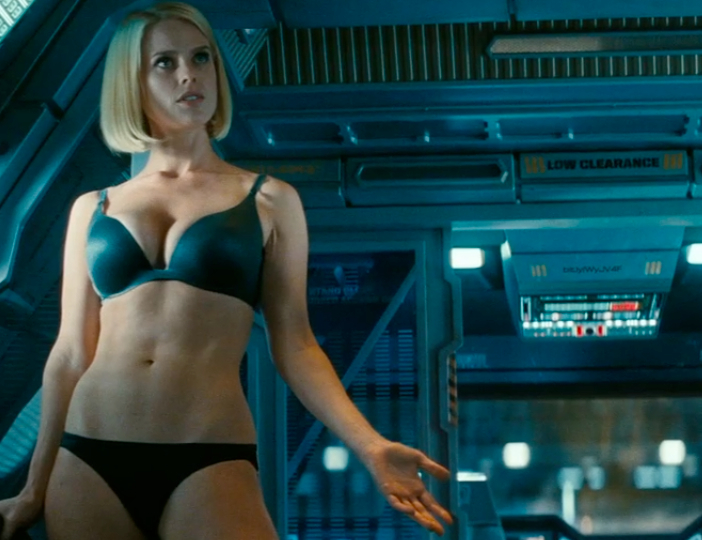
The crew has also taken on a new science/weapons officer (Alice Eve), one so slight and dull that Abrams cheats to keep us interested.