A beautiful picture, depicting the lassitude and lethality of post World War II Mississippi as two families, one white and one black, are challenged and near-consumed by the stifling climate and punishing soil, as well as the psychological toll of war and the rotting cancer of racism. It is rightly nominated for Best Cinematography and Adapted Screenplay, and Mary J. Blige stands-in as supporting actress nominee for any number of deserving performances (especially Rob Morgan as a stoic, beleaguered tenant farmer). There is a stretch where the budding friendship of haunted war vets Garrett Hedlund and Jason Mitchell skirts cliche’, but other than that, the film is rich with authenticity and heart. It is currently available to stream on Netflix.
Genre
Land of Mine-5 stars

During WWII, the Germans occupying Denmark laid 2.2 million mines on its coast in anticipation of an Allied invasion. The Danes employed their former occupiers to clean up those mines, the subject matter of this harrowing and haunting film. We follow a group of very young, very scared German soldiers who are given mine-clearing training and then a quadrant containing 45,000 mines. If they clear them at a certain rate, they will be allowed to go home in three months.
The process is nerve wracking. Mind you, these boys have instruction and some support, unlike the Iranian children during the Iran-Iraq war who were simply sent into the mine fields to clear by suicide in some glorious sacrifice. But the toll, both physical and psychological, is brutal, especially when inflicted on ones so young. They are homesick, hungry (their care was not paramount) and under the leadership of an embittered Danish sergeant who is fighting his own demons but is also humanized by their plight.
This is a beautiful picture, enhanced by touching, sensitive performances. There is talk every year of creating an Oscar for an ensemble, and this cast would be a deserving nominee. The film, however, is not for the faint of heart.
Darkest Hour – 1 star
Joe Wright’s (Atonement) film is repetitive, didactic, simplistic, and eventually, in one of the most cringe-inducing scenes you’ll ever see, when Winston Churchill finds himself on the Underground getting his back stiffened by “the people”, patently ridiculous. The only thing missing on that subway car is Tiny Tim exclaiming “God Bless Us, everyone” and thereby spurring Churchill to reject appeasement and declare that England would “never surrender.”
The picture is also unnecessarily arty (a bombing scene is a particular sin, evoking Michael Bay’s Pearl Harbor, a film you really don’t want to ape in any manner) and annoyingly expositive – we learn about Churchill’s background via random members of the House of Commons speaking to each other as if they – or we – are dunces (“and his father died of syphilis!” Harumph!)
Churchill was a lion. But he was also a snake. Now, one could argue that his lies were of necessity. But here, they are simply ignored or recast as tactical blunders. Don’t lie to the people, King George VI counsels. Be straightforward, and they shall corner you in a subway car and show their true mettle.
And, apparently, it was Churchill and Churchill alone who deduced that you could send civilian boats to pick up stranded men at Dunkirk. He is the oracle. Everyone else on his war council is a dimwit, a ninny or a quitter.
Ostensibly, the real reason to see this movie is Gary Oldman‘s performance, and it is not bad. But it is not great. Oldman gets the fussiness, the hidden mirth, and the anger, but his stabs at insecurity come off as petulance, and on balance, the performance feels more like a mimicry. Recently, John Lithgow (The Crown) turned in much more nuanced and effective turn as Churchill. The best performance in this film does not belong to Oldman, but to Ben Mendelsohn as King George, who is subtle and moving.
Watch The Crown. Hell, watch King Ralph.
Scrooge – 5 stars
Alistair Sim is by far and away the best Ebenezer Scrooge. He is hardened and fierce yet he carries a barely perceptible regret and tenderness that makes his eventual transformation more of a de-icing than a bullet-dodged. His exhilaration and mirth upon redemption are infectious, his realization he can play some awesome practical jokes on the likes of his housekeeper and clerk is hilarious, and his heartfelt apologies are actually very moving. This is my favorite of the film adaptations. DVR at once.
The Magnificent Seven – 0 stars

Almost everything wrong with modern cinema is exhibited in the first five minutes of this 2016 loose remake of the John Sturges classic. The bad guy (Peter Sarsgaard) arrives to plague a town, the surrounding land of which he needs to rape, er, mine. He tortures a child, burns a church, shoots an unarmed man in front of his wife, and then, one of his men throws an axe into the back of a fleeing woman churchgoer.
That’s what the filmmakers believe is necessary for you to give a shit.
It ain’t nearly enough.
It’s an execrable film. The score is excessive and deafening. The western garb is better suited to a Manhattan runway. The heroes escape no demons, and no one ever misses a shot. Everyone is twirling a gun or a knife or a mustache. Marvel movies have more depth and gravitas. Video games carry greater danger.
Worse, the film is plotted by a moron. In a seminal scene, Chris Pratt (aka, Billy Rocks, I shit you not) takes all of the money from a poker table, yet within 15 minutes, he miraculously does not have the five dollars to buy back his own horse. Thus, he is enticed by Denzel Washington to save the town!
Speaking of Pratt, he is fundamentally, constitutionally unserious and insubstantial. He’s perfect for light, wiseacre comedy. He can’t do much else, and when he tries the hard stare, Lord, is it painful.
Five more dummies sign up for the suicide mission because, well, just because. I suppose some inducement comes in the form of a frontier gal whose husband was shot in front of her. Her pitiful story serves to secure Washington‘s agreement to save the town. Or maybe it was her cleavage, which seems discordant to her “I am just a simple farm woman” mien.

Come on.
After Washington and Pratt, we get syrupy Southerner Ethan Hawke (hand to God, his name is Goodnight Robicheaux, and he had “23 confirmed kills at Antietam” – ha ha ha ha ha, you can’t make this dreck up); Vincent D’Onofrio (who comes off like Steinbeck’s Lenny had Lenny become a bounty hunter); the inevitable Indian (Martin Sensmeier as Red Harvest, who is mystical, perfectly painted and manicured, and accompanied by his own tom-tom score); and two other total nobodies, all of whom join up for similarly unexplained reasons.
Red Harvest is the easiest touch. Washington tells him, “we go to fight wicked men. Probably we all die” and Red Harvest is in. Washington did bring the gal with the ample bosom to this recruitment meeting, so maybe that did the trick. It is all I can figure.
Before signing on in cement, Red Harvest (which upon reflection sounds like a maize-based cereal rather than a fearsome warrior) does cut the heart out of a deer and makes Washington eat it. Later, Red Harvest kills a bad guy Indian, to whom he says, “You’re a disgrace.”
All to the tom-tom-tom-tom-tom-tom-tom score. Just in case we forgot Red Harvest was an Indian.
Of course, we learn in the end that Washington has a personal score to settle. Turns out Sarsgaard had men rape and murder Washington’s homesteader mother and sisters.
Which makes the recruitment effort by the buxom farm woman superfluous, as Washington should have been spending his every waking moment hunting Sarsgaard sintead of playing coy.
He needed to be talked into this?
The whole flick is a violation.

Lady Bird – 5 stars

Writer-director Greta Gerwig’s picture is assured, ingenious, and alternatively, hilarious and moving. A coming-of-age story that touches on the themes of leaving home and the mother-daughter relationship is not exactly original, but in Gerwig’s hands, it is fresh. Lady Bird (Saiorse Ronan of last year’s beautiful Brooklyn) is a Catholic school senior in Sacramento navigating her college choices, academic ennui, sexual inexperience, insecurity, and her family’s economic frailty, all while negotiating an increasingly strained relationship with her passive-aggressive (and sometimes, aggressive-aggressive) mother (Laurie Metcalf).
Gerwig stitches a narrative together with brisk and evocative vignettes, and her characters carry the nuance and surprise of real people. Lady Bird’s reach for popularity and desire for something beyond what she deems the stodgy and suffocating Sacramento might normally make her empathetic, but she is of her age, which means selfish and even cruel, in her ambition. This harsh light prevents the film from becoming maudlin. She’s a real girl and her world feels authentic. I watched the film with my wife and daughter, and their knowing glances and nonverbal communication throughout certified the truth of its nature.
I was reminded of different films at different times while watching Lady Bird. Gerwig’s command of pace and sharp timing evokes Wes Anderson’s The Royal Tenenbaums, shorn of his mannered style. Her strong portrayal of the bond of family and place also brought to mind last years’ incredibly under appreciated 20th Century Women. Finally, the mother-daughter dynamic on the eve of separation made me think of Nicole Holofcener’s Enough Said.
I don’t mean to convey that Gerwig’s picture is derivative, only exceedingly accomplished. These are great pictures for purposes of comparison.
This is one of the best of the year, and I expect nominations for best picture, best director and best original screenplay. At a time when Hollywood may very well want to go with films that are smaller and more pure, keep this one in mind when filling out your Oscar ballot.
Wind River – 5 stars

Taylor Sheridan, the writer of Sicario and Hell or High Water, has turned in a stunning directorial debut melding his signature economy of dialogue with an accomplished feel for the ebb and flow of backcountry America and a lyrical visual style. The frozen mountains of Wyoming serve as the locale to a murder investigation where FBI outsider (Elizabeth Olsen) partners with a fish and game tracker (Jeremy Renner) and an Indian reservation sheriff (Graham Greene) to solve the rape and murder of a teen found in the snow.
Sheridan is the nephew of a former U.S. Marshal and a Texas sheriff, and as with his prior films, his replication of the patter of law enforcement feels as if he has spent much time at their knee. His characters avoid the bravado and cliche’ of many movie cops. They inhabit a matter-of-fact world, not cartoonish macho, but one that exudes a professional cynicism. Like Emily Blunt in Sicario, Olsen is not the standard female law enforcement officer who has to “prove” herself in a near-all male world. There is no overcompensation. She just is.
The performances are understated and genuine, and Renner in particular well renders the pain of a haunted but determined man.
Sheridan is also deftly political, never overt but still seamlessly intertwining some of the cultural realities in rural American with the narrative. It never gets in the way of the pace, and Sheridan’s handling of the thrill part of thriller is expert. The crescendo to a violent explosion is damn near excruciating
One of the better films of the year, which admittedly ain’t saying much this year, but that shouldn’t be held against this picture.
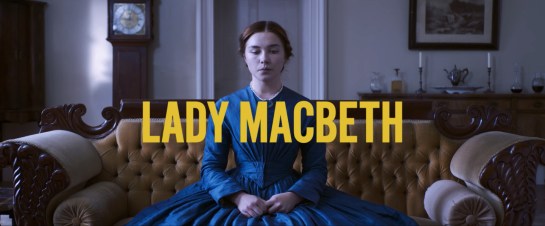
Lady MacBeth – 1 star
A period piece and feminist tract that soon devolves into The Hand that Rocks the Cradle, if you like icy, sterile, and bleak films featuring an unsympathetic sociopathic murderess, run, don’t walk, to the Redbox!
Stagecoach – 5 stars

John Ford’s classic alternates between deft commentary on social strata, hypocrisy and manners and, for its time, jaw-dropping action (the chase scene at the end almost certainly had to result in many a broken bone, if not worse). Orson Welles studied the picture obsessively prior to Citizen Kane, and the film’s influence is evident in everything from Eastwood’s westerns to Tarantino’s The Hateful Eight. As Eastwood correctly observed, “There’s something about the way he approached his subject that broke down clichés of the era.”
In the vein of these dimwitted times, you can leave it to Tarantino to lodge the standard p.c. indictment: “I hate him [Ford]. Forget about faceless Indians he killed like zombies. It really is people like that that kept alive this idea of Anglo-Saxon humanity compared to everybody else’s humanity—and the idea that that’s hogwash is a very new idea in relative terms.” Regardless, as is evident in Tarantino’s last film, which expertly apes and updates Ford’s socially diverse discourse, Ford’s influence is inescapable even if Tarantino believes himself immune to his charms. An excellent rebuttal to Tarantino’s juvenile approximation of Ford can be found here and properly notes:
His films don’t live apart from the shifts in American culture and the demands of the film industry, but in dialogue with them. Do those films provide the models of racial enlightenment that we expect today? Of course they don’t. On the other hand, they are far more nuanced and sophisticated in this regard than the streamlined commentaries that one reads about them, behaviorally, historically, and cinematically speaking, and the seeds of Ulzana’s Raid and Dead Man are already growing in Fort Apache and The Searchers. Is Ford’s vision “paternalistic?” I suppose it is (and that includes The Sun Shines Bright and Sergeant Rutledge), but the culture was paternalistic, and holding an artist working in a popular form to the standards of an activist or a statesman and condemning him for failing to escape the boundaries of his own moment is a fool’s game. Maybe it’s time to stop searching for moral perfection in artists.
The film also made John Wayne a star, and Ford’s introductory shot of the actor could hardly have done less:
Methinks the fix was in.
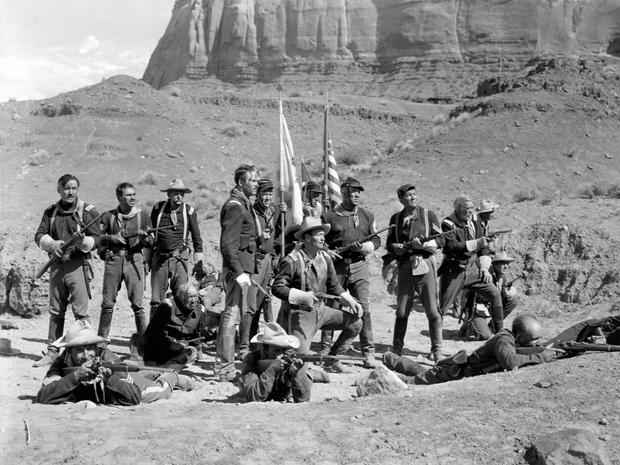
Fort Apache – 5 stars
John Ford’s western, an extremely loose re-imagining of the Custer massacre, surprises in numerous ways. The film has a heady sense of humor – the hard-boozing Irish of The Quiet Man are present, but not quite so cartoonishly so. It again reveals that John Wayne was quite underrated as a dramatic actor. But it is most unique in its melding of patriotic lore and bitter cynicism, ultimately concluding that the fraudulent propagation of patriotic heroism is at a minimum a necessary evil and perhaps even a critical component of the national ethos. What matters, ultimately, is the myth.
It is also, of course, beautiful in its use of Monument Valley.