Archive

Historical

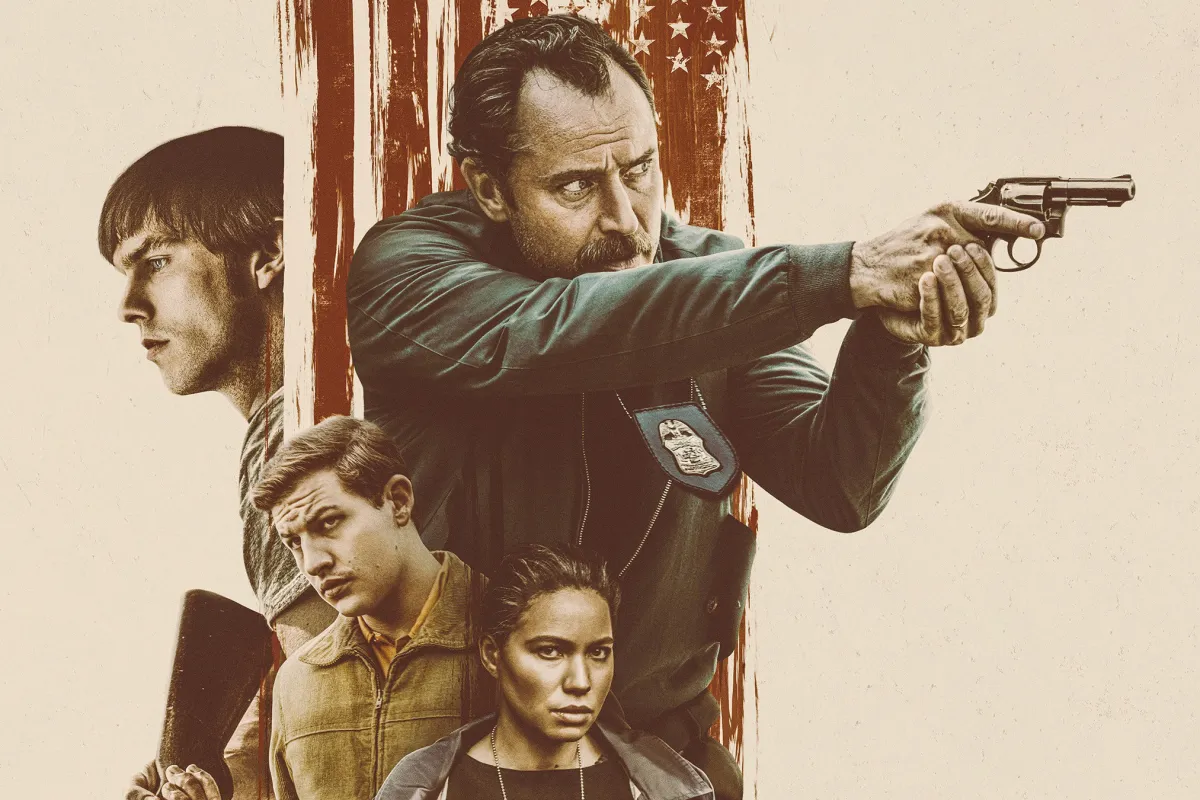
A straightforward procedural based on a true story, broke-down and ailing FBI agent Terry Husk (Jude Law, as unpretty as you’ll find him) arrives at his new desk in Idaho only to stumble upon the rise of The Order, an “action, not words” offshoot of The Aryan Nations in the early 1980s. The Order is led by the charismatic Bob Matthews (Nicholas Hoult), who guides it from counterfeiting to bank robbery to assassination to planned insurrection. As Matthews rises, Husk and the Feds close in, amidst a backdrop of the majestic and haunting Pacific Northwest.

There is nothing new here save for restraint, but restraint is in awful short supply these days. The pace is taut, the acting largely superb, and the photography memorable. In the hands of a lesser director or writer, the temptation to weigh in on the philosophy of The Order, and to jam it into whatever current bugaboo is in fashion, would be too much to resist. Here, writer Zach Baylin shows you what The Order believes and how, attenuated or not, those beliefs are connected to their criminal endeavors. To Law, who we learn has worked undercover on cases from The Klan to The Mob, the “the” doesn’t really matter. They’re all the same. And that keeps the story from stalling on the anticipated wordy handwringing that you expect.

As one article observed, “Ultimately, the hope of slipping an unsparing portrayal of domestic extremism—produced outside of the Hollywood studio system—into the December award season is to reintroduce a discussion of radicalization to American society. ‘If you don’t learn from history, you’re doomed to repeat it—how a guy that, in the way Nick depicted him, could live down anybody’s street,’ says Haas. ‘There are lots of people right now who are hurting and struggling and looking for answers.'”

Thankfully, this kind of easy, didactic tripe is little found in the actual picture.

We also aren’t loaded down with Law’s past. There is a medical issue and familial distress, but Baylin explains just enough to give you a sense as to their effect on Law’s nature and psyche. Husk is not out here for redemption or revenge. Even his obligatory “Let me tell you about this one horrible thing” speech is muted, his explanation almost perfunctory. Much like the father of one of the young men who joined The Order, a man who resignedly tells Husk, basically, “you do the best you can with your kids, but it’s a crapshoot.”

The film could have used a little more exposition (particularly with the doomed local deputy, Tye Sheridan), the tough gal FBI supervisor (Jurnee Smollett) is hackneyed even with the gender change, and maybe there should have been one more turn before reaching resolution.

But otherwise, very solid, entertaining crime flick. Reminded me of the equally impressive Under The Banner of Heaven.

On Hulu.

I pledged to go to the theater Saturday to see the three-and-a-half hour The Brutalist. I begged off at the last minute, but then, the guilt of it made me do penance.

I watched Killers of the Flower Moon, another glaring omission, especially on the part of an unpaid film reviewer. Killers was adapted from David Grann’s best-selling book about a series of murders of Osage Indians in the 1920s, crimes borne of their oil wealth and societal vulnerability.

The good.

Martin Scorsese is no slouch behind the camera, and he ably presents the grandeur and sweep of Osage life and the peculiar opulence that sprouted about it. The film looks and feels like a $200 million picture. The detail is impeccable and the feel authentic (not the garish, silly design of Gangs of New York).

Lily Gladstone. Her job as the stoic sufferer of any number of depredations could have been capably performed with simple solemnity. But she infuses it with charm, passion, and subtle resignation. In a film during which I often found myself stifling a yawn, she was captivating.     

To the bad.

Scorsese seems to be having a late-in-life problem with repetitive scenes. Here, we are treated to at least a half dozen scenes of Robert De Niro (the bad guy) telling Leonardo DiCaprio (his nephew and henchman) what to do, DiCaprio getting more and more upset, and De Niro just yelling at him again and again. Much like The Irishman, the movie is 3.5 hours. In that film, it was “1.5 hours … trying to get Jimmy Hoffa (Al Pacino) either to his senses or a meeting.” Here, it is De Niro and DiCaprio bickering.

Worse, their interminable mugging is to the detriment of more interesting characters and subplots, from the resistance of one white man (played quite ably by Jason Isbell), to the genesis of the federal investigation, to the intervention of an Indian investigator, to the actual murders themselves.  Simply put, no one gives a flying fig about these two one-dimensional, barking characters, but there they are, hogging all the scenery at the trough.

The film is also painfully confused. Is this a testament to a historical wrong? A little. But that factor seems mailed in, with scenes of Osage registering objection, but no real agency. Which is fine.  Most people in history have little to no agency. They are subject to the cruelties of their surroundings. It leaves us the machinations of the criminals. But they are so simple (Osage sheep, whites sheep shearers), they don’t lend themselves to captivating drama. Also, Scorsese’s tie to the Tulsa race massacre seems cheap and manipulative.

Is it a procedural or whodunit? Nope.  We know the villain from moment one, he only lacks a mustache to twirl, and when the case is cracked in the last third, it is by far the best part of the picture. But the way it is solved is mundane. They try to break a guy, he gives a bit of guff but soon talks. The book was very much a whodunit and a procedural, grippingly so.

Is it a love story? Scorsese tries, but there is no real chemistry between DiCaprio and Gladstone, certainly, not enough to sustain his serial abuses, i.e., his central part in the murder of her family and friends. The lovable scamp!

Is it a psychological portrait? Perhaps. DiCaprio is the guilty henchman, no doubt, but he is so glaringly stupid (Scorsese even give him pointless unwieldy teeth, this side of Simple Jack), you wonder if the character’s psychology is worth the inquiry.

The writing is not so much weak as it is misdirected. If you’re going to pay $5 million for adaptation rights to a book, why jettison the most interesting parts? The book really digs into the strange origins and dichotomy of the Osage and their oil wealth, which was borne of their savvy as much as their geographic fortune. Here, they hit oil, and the rest is a surface coverage of their spendthrift ways and the fact that to access the wealth, they need white guardians. Scorsese presents this in a sort of mashed up montage. Similarly, the book covers the birth of the FBI and the investigation of the corrupt locals from a federal agent, a first. Here, the Feds just show up (led by a criminally underutilized Jesse Plemons) and start to brace some dudes.          

Like The Irishman, I felt this would never end, and like The Irishman, the universal plaudits feel like they are being artificially elevated on the vapor of Scorsese’s status and the ennobling of the cause.          

In the Gary Oldman Churchill vehicle, I wrote of, “one of the most cringe-inducing scenes you’ll ever see, when Winston Churchill finds himself on the Underground getting his back stiffened by ‘the people’ [which was] patently ridiculous.  The only thing missing on that subway car is Tiny Tim exclaiming ‘God Bless Us, everyone,’ thereby spurring Churchill to reject appeasement and declare that England would ‘never surrender.’”

In Blitz, near every scene feels as authentic as THAT scene. Darkest Hour meets Sesame Street meets Yo’ Teach. Tired, anachronistic piffle.

If you can get past the Model U.N. in the Tube, you are made of very stern stuff.

Steve McQueen, not the actor but the director of 12 Years A Slave, needs some perspective. This film comes six years after his last, the uneven Widows, and the rust and ennui shows.

A friend put it perfectly: “It is as if he wanted to make a standard racial parable, but knowing how played out that could be, jammed it into a period piece.”  

McQueen did himself no favors in casting either. Saoirse Ronan opts for 90% beatific. Playing her son, Elliott Heffernan just doesn’t register, starting with sullen and eventually advancing to more sullen. When he stretches, it is more miss than hit. As he told Variety, when asked to cry, “I pretended my mom was taking away my PlayStation.” It is Heffernan’s first gig, and yes, it looked like his mom took away his PlayStation. 

I’ll give McQueen the accomplished look. The opening scene of men fighting a post-bombing fire and Heffernan’s journey across the English countryside to escape the terror are arrestingly resonant.

On Apple.

For a music bio, you can max-mythologize a dolt and maybe no one will notice the subject is super boring.  See The Doors. Elvis. Bohemian Rhapsody.

Or you can play it straight and overarching, maybe puncture the myth in parts, but ultimately, tell a big, soup-to-nuts, rags to riches story rather than create more ornament for the church.  See Ray. Straight Outta’ Compton. La Bamba.

But when you add kick-ass performances from people who can really sing, and a thoughtful, tight script, then I’m in.  See The Buddy Holly StoryCoal Miner’s Daughter. Walk the Line.

Luckily for Bob Dylan, the director of the latter, James Mangold, took this picture on.

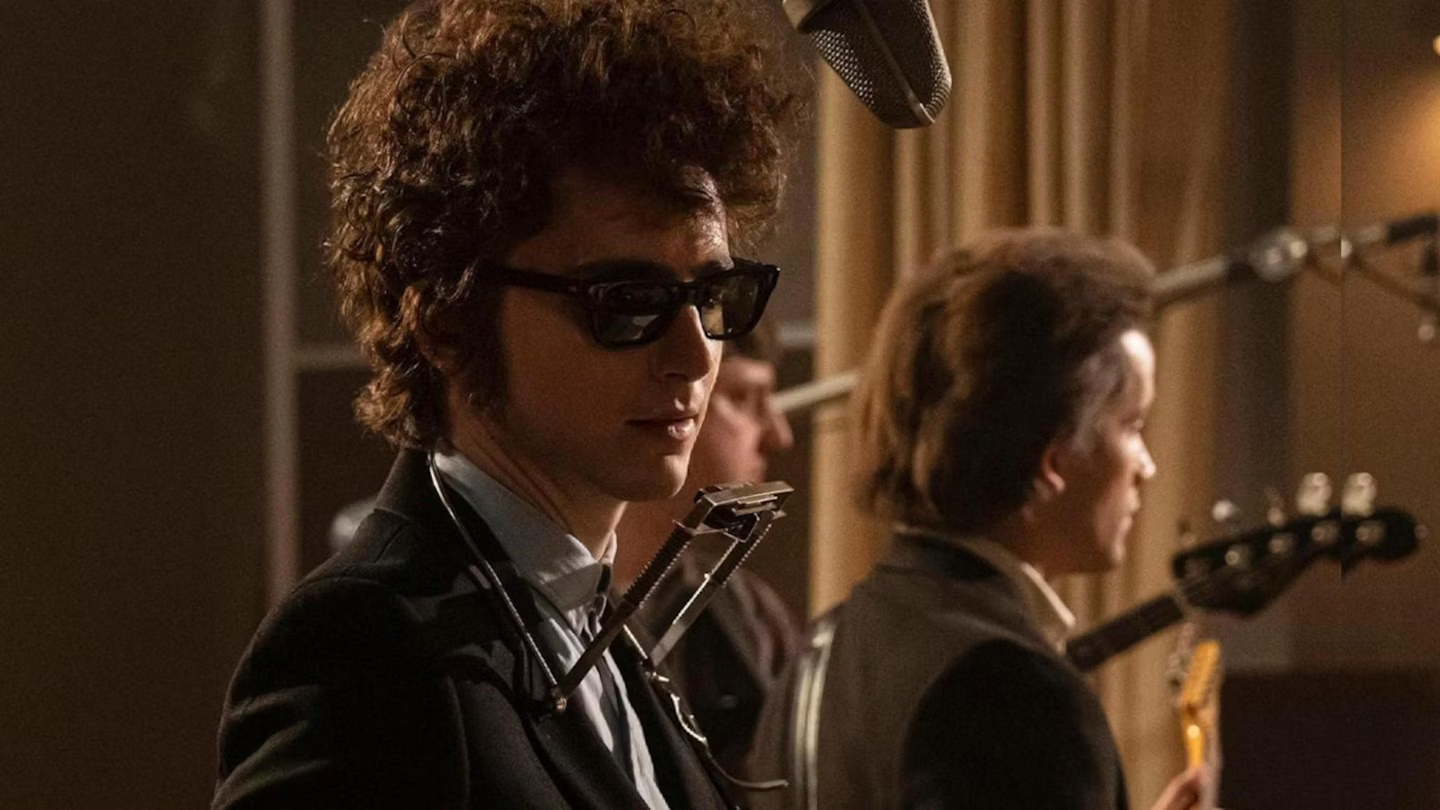
We meet Dylan as he is deposited in NYC to meet his idol, Woody Guthrie (Scoot McNairy) who, robbed of his voice, is tended to in a New Jersey hospital by Pete Seeger (Edward Norton). Seeger and Guthrie see greatness, Seeger takes Dylan under his wing and we are off to the races, from aspiring folkie in 1961 to superstar in 1965, as Dylan weighs the dilemma of a lifetime:

Willeth I go electric?

“Will he go electric?” is actually a big deal in Dylan’s world, one fleshed out by Mangold and screenwriter Jay Cocks (Silence, Gangs of New York), as the genesis and essence of the folk milieu is revealed to us.

Of course, we want electric, but Cocks makes us understand the instincts of the standard bearers. They are curmudgeons, maybe, but they are earnest. The folk movement is something they built, sure, a lot of it on Dylan’s back, but their protective nature is not ridiculed. Quite the opposite. Cocks gives Seeger a great speech wherein he urges Dylan to stay acoustic in the service of a larger musical aim.

Still, the film doesn’t make the tug larger than that, and Dylan’s switch does not stand in ostentatiously for “bigger” themes.

Similarly, the pressure of going from lauded unknown folkie to superstar is not treated as an excuse for bad behavior or a major unfairness. It’s an annoyance that informs Dylan’s desires, and while we get the pressure he is under, as played by Chalamet, Dylan is made kind of dick because of it, equal parts sympathetic and petulant.

Mangold also has fun with the times. The look is spot-on, particularly of early 60s Greenwich Village, and we get the fun interdiction of Johnny Cash (Boyd Holbrook), a Dylan supporter and pen pal. And Al Kooper just jumping in a studio to hit the organ for the start of “Like A Rolling Stone” because he could not play guitar on the track?

Goosebumps.

Ultimately, as with Walk the Line, the music is the star. Chalamet sinks smartly into the role, traversing the road from wise but sweet neophyte to badgered superstar, but he sings great and quite a lot. All the performances crackle but he really nails it.

Mangold also does a great job with Dylan and his first girlfriend (they have an exchange about the plate-spinners on variety shows that is touchingly smart and Elle Fanning really resonates as the gal who took Dylan in only to see him grow beyond her attentions).

The Joan Baez relationship is more ragged. She just seems like a bitch, angry that Dylan criticized her songwriting (“’Sunsets and seagulls.’ ‘The smell of buttercups…’ Your songs are like an oil painting at the dentist’s office”). Mind you, that would piss most anyone off, but they continue as a couple with no discernible attraction, and the why seems thin.

A minor nit.  Great fun, moving, and impressive. Top 5 of 2024.            

There are figures who defy biography. Some are dolts who we lionize because of an electric public persona, but after we peel back the skin, dig in, and nothing but soft goo is revealed, we adorn them with meaning if only to combat the dullness and our disappointment. Some are opaque, having lived a purposefully secretive life that does not lend itself to exposition. Some are so mythic, hagiography follows, lest a god be sullied. And many are just boring through and through, even if their impact was monumental.

How best to approach Donald Trump? I was thinking about why Saturday Night Live has such a problem caricaturing Trump and concluded that it is difficult to lampoon a cartoon. Trump is thuggish, brash, bombastic, ridiculous, and his persona – both before and during his political career – is that of someone who is already playing a part, man as product. Someone once observed that Bill Clinton was the most authentic phony they’d ever encountered, which makes him Trumpian on one level. The persona so effectively swallows the person that the former becomes innate.

Now, I don’t know what Donald Trump (or Bill Clinton, for that matter) is like privately, and Hollywood has yet to take on Clinton in biopic (we’ve had snippets, most recently Ryan Murphy’s rendition of the Lewinsky scandal, but nothing penetrating or overarching). And neither does screenwriter Gabriel Sherman. But he takes a fair stab, and it’s a game effort, for a time.

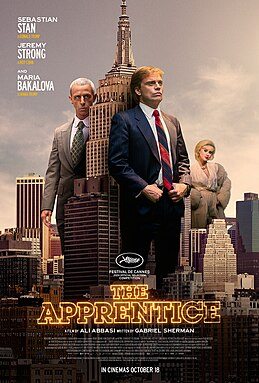
We meet Trump (Sebastian Stan) in the 70s, an ambitious son of an old-fashioned real estate developer who strives for entrée’ into tony Manhattan clubs while working for Daddy, collecting his rents in cheap New Jersey apartment housing. Donald has a dream – to develop a hotel in the then-hellscape of 42nd Street – something his father (Martin Donovan) considers an ill-advised fantasy. But Trump persists and soon, he meets another father figure, Roy Cohn (Jeremy Strong), who becomes his tutor and mentor. Cohn, a sybaritic fixer, protégé’ of Joe McCarthy, and executioner of the Rosenbergs, blackmails those who attempt to thwart his new charge, facilitating Trump’s rise. We watch Trump ascend, while negotiating the death of his alcoholic brother, eclipsing his father, and falling in love with Ivana (Maria Bakalova), all the while with Cohn in his ear. This is the part of the film that works, as we see a progression, both maturation and degeneration.

When we hit the 80s, Trump is on top, Cohn is crippled by AIDS, and their relationship deteriorates. With what feels like the snap of a finger, Trump is callous and brutal, as he repeats the Cohn mantra (attack, deny, always claim victory). But we don’t really see him ever employ those rules. In fact, he just reappears as a brute, and we are treated to the litany of rumor, concoction or well-known unflattering fact without context or explanation. Trump abandoned his brother, raped and verbally abused Ivana, tried to take financial advantage of his doddering father, gave Cohn fake diamond cufflinks, swung and missed in Atlantic City, took a lot of speed, wrote The Art of the Deal, mused about a political future, got liposuction and a scalp reduction, and is a germaphobe. One box after the other perfunctorily ticked. Just overt capsules, with all character-development jettisoned for dizzying visuals of the corrosive jet set life.

I suppose Sherman was trying to portray the seduction of Trump in concert with the go-go 80s, but it was done much better by Oliver Stone with Bud Fox in Wall Street, and even that movie can be garish and obvious.  

What does work, however, works very well. The Trump-Cohn relationship is beautifully drawn. The elder sees talent and vitality in the son he never had and a young man he refrains from seducing sexually, while the understudy finds the father who truly believes in him. When the former imparts his wisdom, it would have been nice if Sherman could have employed it more directly as the basis for Trump’s rejection, but it is enough that the devil gets his comeuppance from his Frankenstein, and you know it works, because you kind of feel bad for the devil.

Stan and Strong are riveting and I expect both actors to be nominated. Even if they were undeserving, Trump is irresistible bait for the Oscars and given the unflattering vignettes of the film and the fertile environment for decrying the Bad Orange Man, we and the Academy shall not be denied.  

Luckily, the actors are deserving. Strong is quickly becoming one of the most innovative character actors of his generation (I cannot so on enough about his turn in last years’ Armageddon Time, which, ironically, also included a young Trump character), and Stan manages to humanize a cartoon while incorporating the now ubiquitous Trump cadence and physicality, but doing so in a way that shows the features in infancy, so we can envision what they will be when we turn on our TVs today. Per Sherman, “And I think what Sebastian did so brilliantly is that he doesn’t try to impersonate Trump. He finds his own version of the character. And it works in a way where you feel like you’re watching a real person. You’re not watching Sebastian trying to be Donald Trump.” Dead on.

A solid, game, entertaining, very flawed near-hit that peters out.

On demand.

Imagine Gladiator, a fun, glorious, bloody romp. Now, forget about that film. It will only make things worse.

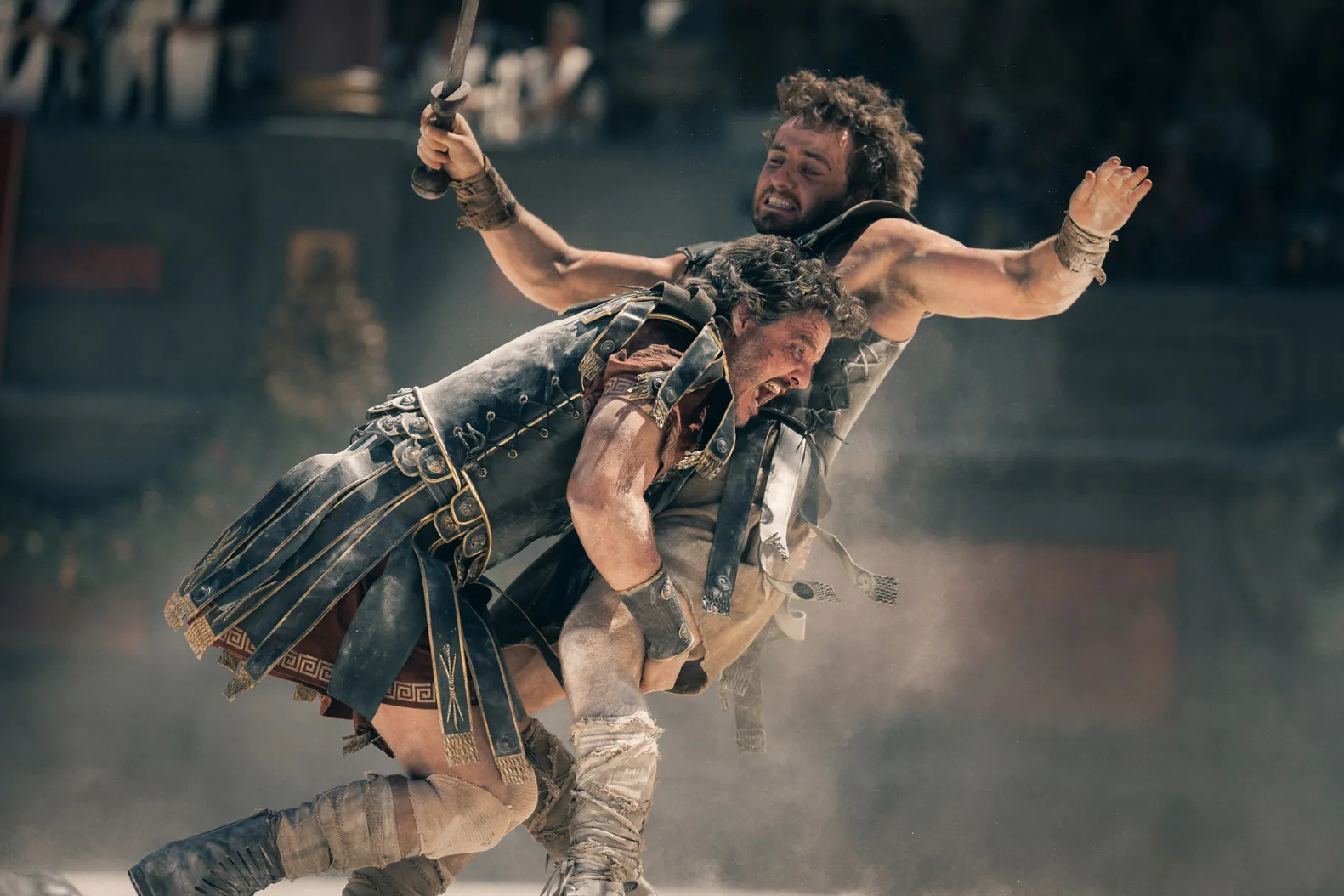
Here, the lead is not the captivating Russell Crowe but rather, the much younger Paul Mescal. Mescal has none of Crowe’s gravitas. He is not a Roman general, weary of war and politics, who just wants to go home to his wife and children. Instead, he’s a happy agrarian bean-picker, kissy-facing with his wife, when a new Roman general (Pedro Pascal) threatens their idyllic, multi-cultural commune in Africa. Mescal and wife strap on their gear and fight side-by-side. Pascal wins. The wife dies. And now, Mescal is a slave, soon to be gladiator, bent on revenge.

So, the same picture, but worse in all respects.

Every smart line in the original is replaced with “up with people” pablum and a dull dispute as to whether there is a “glory of Rome” or a “glory to the idea of Rome”, and every minor character who exuded their own agency and flair in the first film is replaced by cookie cutter figures infused with a boring wisdom that anachronistically presents as spiritually worldly.

While Gladiator II provides more combat than the original, it is juiced with unconvincing CGI monkeys, a big ass rhinoceros, and sharks. Even the hand-to-hand combat seems obligatory. You don’t care and no amount of spraying blood, gutting, and decapitation can involve you.

Our protagonist, Mescal, is supposed to be filled with “rage” but, at his most engaged, seems ironic and perhaps annoyed. The romanticism of the first picture was fueled in no small part by Crowe’s seething hatred at the needless and cruel slaughter of his family. Here, you think, “Maybe Mescal wasn’t so into his wife.”

There is little you don’t see coming. Mescal is the biggest non-mystery man ever and when the film finally gets to someone who can generate interest – gladiator merchant Denzel Washington – his grand plan and motive hit too late and quickly, right when you are nodding off. Washington, however, is at least having fun. Everyone else seems to be in mid-root canal.

And no one seems Roman here. The machinations are more on-the-fly than crafted, the concern for the people preposterous, and the finale – where two armies unite with “Huzzahs!” after an unconvincing “aren’t you sick of death?” speech by Mescal – has the feel of the old Coke ad where everyone wished they could teach the world to sing.

There is no greater dissonance than the emperors. In the original, Joaquin Phoenix was delicious, funny, just chewing scene after scene, but also substantial. Here, we have two emperors, sybaritic brothers who flounce about and exude a “let them eat cake” mien. They have no backstory, no goal, just dull, giggly, face-painted, effeminate schtick.  

Interminable. Avoid. 

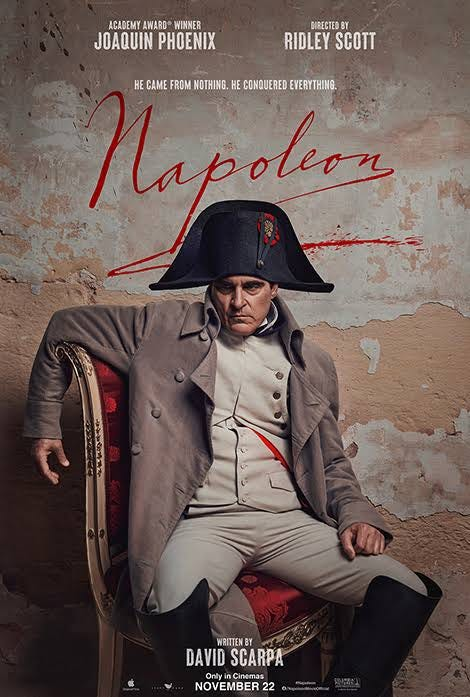
What can one say? Ahistorical, pointless, very near to spoof, it feels like an expensive practical joke. Napoleon is just . . . there.  Quiet, behatted, very dull, and you have no inkling as to what makes him special.

His torrid love for Josephine is perplexing – she spreads her legs to give him a look see, and he is forever entranced, even after he has to divorce her because she is barren.

That was the first half, before I took a gummie and got to The Battle of Austerlitz, and then, the film was more of a gas. Still terrible, but better attuned to my state.

Joaquin Phoenix gives one of the funniest, most wretched performances I’ve ever seen, defensible only because it seems justified, given director Ridley Scott’s recounting:

 “He’ll come in, and you’re fucking two weeks’ out, and he’ll say, ‘I don’t know what to do,’” Scott said about Phoenix. “I’ll say, ‘What?!’ ‘I don’t know what to do.’ Oh God. I said, ‘Come in, sit down.’ We sat for 10 days, all day, talking scene by scene. In a sense, we rehearsed. Absolutely detail by detail.”      

I kind of doubt there was any rehearsal.  Phoenix did not bother with a generic classical accent, nor Brit nor, God forbid, a French lilt, so he sounds like an assistant manager at the Petaluma Best Buy.

He is either heavy-lidded to the point of napping or he’s gonzo.

Destined to become a cult classic.

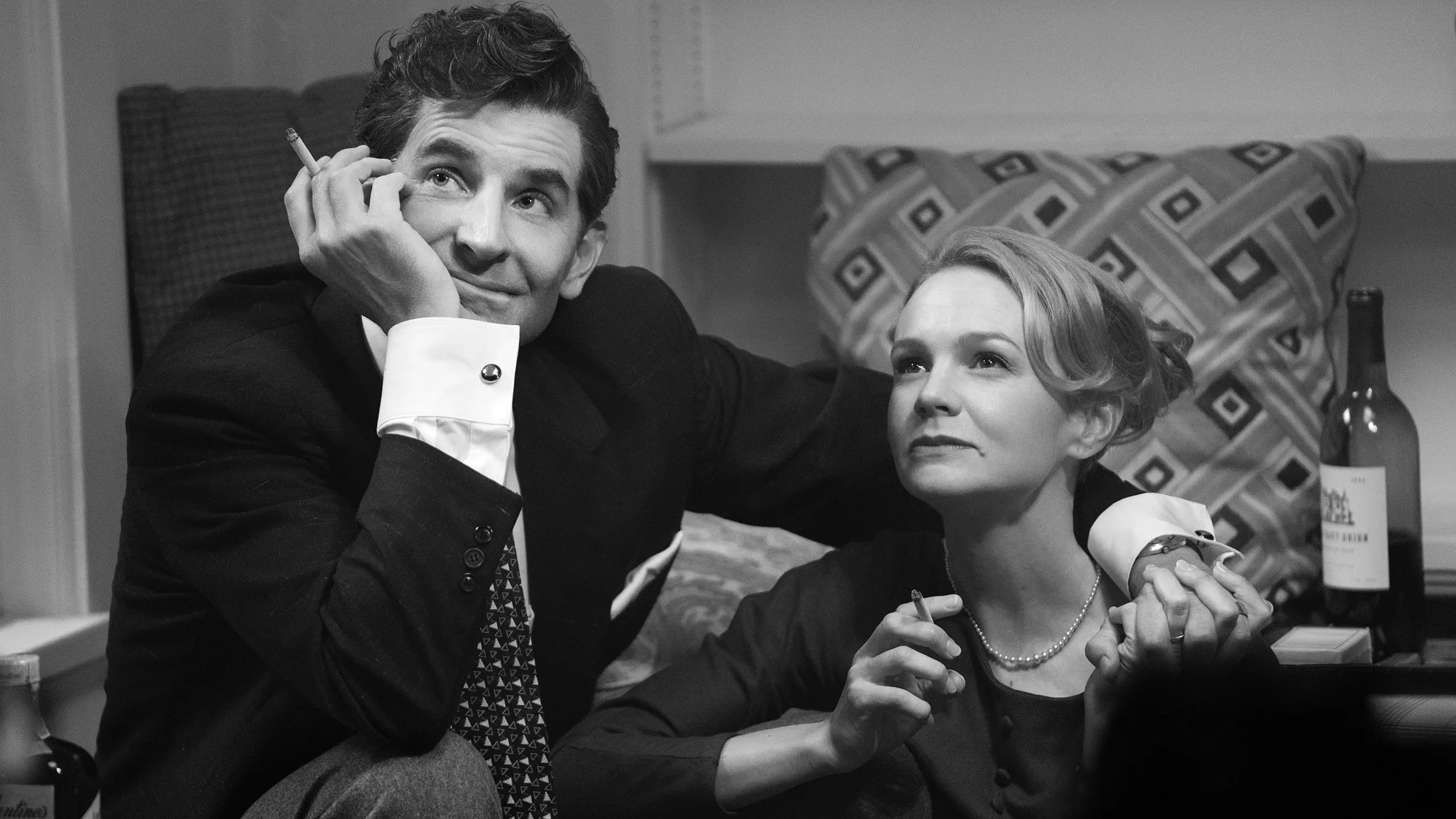
Leonard Bernstein was a significant man. But you wouldn’t know it from this film. Bradley Cooper’s labor of love makes Bernstein seem rather humdrum, and as the film progresses, Cooper certifies that reality, eventually discarding Bernstein’s story for that of his wife (Carey Mulligan).

Look, it is clear Cooper reveres Bernstein, but too much is too much. Think of when someone you know introduces you to someone they love. They are already in thrall, and they have explored every nook and cranny of their idol so, in your introduction, you don’t come to your appreciation organically, the way your friend did. You start with, “He is the greatest.” And then, after that, your friend just keeps saying, “Isn’t he? Told you!”

Here, Cooper is so entranced, he glosses over what makes Bernstein Bernstein – his music. Sure, there’s tons of scenes of Cooper directing with the panache and flourish of Bernstein, but Cooper is more interested in having mannerisms down pat than exploring why we’re here. Cooper’s meticulous impersonation cannot substitute character.

Worse, since Cooper has little interest in Bernstein’s craft, we focus on his domestic struggles, which are pedestrian, even for a famous man living a barely disguised double life. He is not denied his pleasures, nor is he punished for them. Rather, they create some marital strife. And that’s what we get to see until cancer closes the story out. No war time concert in Israel in 1948. No silly cocktail party for the Black Panthers (sent up so wonderfully by Tom Wolfe). No concerts after the assassinations of JFK and RFK. No philanthropy for AIDS as it decimated his profession (and killed his longtime lover Tom Cothran, for whom he left his wife). 

We learn very little about what Bernstein should be remembered for.  Hell, he could have been a periodontist.

A well shot chore. On Netflix.


My mother tells people that The Boys in the Boat is a book “every young man must read.” In point of fact, the book has been on the New York Times bestseller list for quite a long time. But I am not a young man, so I settled for taking her to the picture.

She was rightfully disappointed. I was bored to tears or underwhelmed. For the following reasons.

1. The actual boys in the boat were supposed to be destitute, desperate, and worn down from the Depression, lean, hungry, rough boys who found rowing as a way to eat. Unfortunately, they all look like this:

2. The lead, Calum Turner, has all of the character and nuance of a Nilla Wafer.

3. Rowing does not lend itself to film. We don’t learn much about the mechanics of it, so it’s difficult to discern the issue when the boys falter (they just start to bicker at each other and their stoic, forgettable coach merely shakes his head). In races, they start out slow, and through grit, pluck and determination, the boys pick up the pace and win. That’s it.

4. Hitler shows up. But he looks like Charlie Chaplin as The Little Dictator, and I’m not sure that was the effect Director George Clooney was aiming for. 

5. Jesse Owens also shows up. He says one line that is impactful and wise, with the effect being one’s own rumination: “Damn, I wish this movie were about Jesse Owens.”

The film looks classic, but presents as inauthentic. It has a hazy, postcard visage that feels both obligatory and unnatural.

Ultimately, the film is not terrible, but it is instantly forgettable, of no real moment, and about as safe a production as you’ll find.


Obviously, I am overwhelmingly pleased to see a three hour film about a historical figure (and to think, Ridley Scott’s next picture is … Napoleon!) Just the other night, I was having drinks with younger colleagues (I am the last year of the baby boom, I estimate that these folks are late 20s), who were excited to see the movie.  I took a pull from my pipe and asked them, “what do you know about Oppenheimer?“ One answered, “the atomic bomb.“ Then I thumbed my tweed jacket and said, “what else do you know about Oppenheimer?“ Neither knew anything further, which makes sense. Yet due to the cachet of Christopher Nolan and the buzz about the film, they couldn’t wait to go see it. One was teaming it up with Barbie for a Barbenheimer, which sounds both intriguing and daunting. But to each their own. 

They should not be disappointed. Nolan’s first two acts are so fully realized and lovingly shot, they are nothing less than stunning. And his narrative-hopping from time period to time period is not just for show. Nolan captures the important vignettes that underscore what you will see later. His rendition of the first atomic test is gripping and fraught. I was on the edge of my seat knowing full well that for the denizens of Hiroshima and Nagasaki, it was not a good day.

Alas, the third act is a bit clunky. In the end, a bureaucratic and personal feud between Oppenheimer and Robert Downey, Jr. eclipses some of the larger themes of the picture. It just struck me as a little bit beneath what preceded it, as if Oppenheimer’s undoing stemmed from a mere misunderstanding or snit. 

I read the book upon which the film was premised, American Prometheus, years ago (and had the honor of being taught a course entitled “Nuclear War Crises” by the book’s co-author, Martin Sherwin). The real Oppenheimer was a bit of a mess. His views on the efficacy, wisdom and impact of the bomb matured, but also wavered, and he could speak with confident enthusiasm and also wary trepidation. He could be thoughtful and also, cooly lethal (he once rejected a poisoning scheme with, “I think we should not attempt a plan unless we can poison food sufficient to kill a half a million men, since there is no doubt that the actual number affected will, because of non-uniform distribution, be much smaller than this”).

Cillian Murphy does a beautiful job of working it out in front of us with an internal, searching performance. We see him struggle, not by soliloquy, but by discussion and quiet deduction. Murphy is, rightfully, a lock for best actor (if the Oscars are still a thing next year). 

Murphy is ably complemented by Emily Blunt (wife), Florence Pugh (lover), Matt Damon (the glue guy, still Hollywood’s best and least heralded actor, as General Groves), and a slew of others, all solid (Josh Hartnett? Yes, Josh Hartnett has grown up) and of whom you invariably remark, “Damn. Where have I seen him?”

As Oppenheimer’s bureaucratic nemesis, Downey Jr. crackles, though, as mentioned, he is seminal to the weakest aspect of the movie. 

Talky, meticulous, massive, yet chock full of the little things, Nolan has made a grand, intelligent epic. I hope it spawns more to come.