Archive

Comedy

image

I loathe artistic political correctness in all its forms, be it the soul-sucking idiocy of demanding cultural authenticity in casting, the blanket condemnations of some “ism” by the cultural debt counters, or the wails of some grievance group as one of their own is skewered for comedic purposes (Robert Downey Jr.’s “retard” riff in Tropic Thunder comes to mind).  The effect is the same – to straightjacket creative endeavor so it presents like a PSA. The only good that comes of the p.c. influence are–

* the groveling apology (Cameron Crowe bootlicking because he cast Emma Stone as a quarter-Asian, quarter Hawaiian: “I have heard your words and your disappointment, and I offer you a heart-felt apology to all who felt this was an odd or misguided casting choice”);

* the unctuous backpedaling (Matt Damon, after having been caught on camera rejecting affirmative action and using the word “merit”: “My comments were part of a much broader conversation about diversity in Hollywood and the fundamental nature of ‘Project Greenlight’ which did not make the show. I am sorry that they offended some people, but, at the very least, I am happy that they started a conversation about diversity in Hollywood. That is an ongoing conversation that we all should be having”), and

* inane public proclamations (Viola Davis, who, when receiving an award for a TV drama, without a hint of irony or self-awareness equated her struggle to that of Harriet Tubman).

That said, Welcome to Me is an offensive film, and the heart of its offense is in how it portrays mental illness.   Kristen Wiig plays a sad shut-in, obsessed with Oprah, who wins the California lottery. She suffers from borderline personality and is off her medication, yet that doesn’t stop a local production company run by Wes Bentley and James Marsden from taking her millions so she can develop her own show. That show is a stage for Wiig to exhibit all the debilitating aspects of her un-medicated disease in a manner that at best is quirky and at worst is truly disturbing.

If done well, I don’t have a huge problem with making a dark comedy about a mentally disturbed person being taken advantage of.  I’ve gone down weirder, filmic roads.

So, to be clear, my objection is not to the premise nor do I advocate for the babying of any protected class in art.

But when you take this on, you can’t have your cake (using the disability as comedic tool) and then ask the audience to regurgitate it in shame after the eating.

Essentially, that’s what writer Elliot Lawrence does here. It’s not that the picture is poorly acted or directed or that there aren’t even a few funny scenes. Rather, the film is an exploitative movie about a sick person being exploited, and it wants to use mental illness for yucks while pretending to be brave in showing the true face of that illness.

You need a really deft hand for that kind of trick, and Lawrence and sophomore feature director Shira Piven do not have it.

Worse, the movie condescends with a throw-away lame anti-television theme, and in the end, Wiig is transformed into a “winner” with the help of a mere few pills.

The film has aspirations to Wes Anderson, but you’ll learn quickly, having Bill Murray in your cast isn’t enough. Murray plays an old Brooklyn codger, a man who drinks, smokes, and consorts with a pregnant Russian stripper/prostitute (Naomi Watts, sporting an accent so thick and implausible it would make Gary Oldman recoil and say, “no, no . . . too much”).  He also gambles at the track, is in deep with a bookie, and spits in the eye of anyone who might show him kindness. Yet, he’s cool because he listens to a Walkman that plays kitschy 70s pop or Dylan. So rest assured, this guy has a heart of gold. Naturally, when he gets new neighbors (newly divorced and fed up nurse Melissa McCarthy and her impossibly wise yet innocent son Jaeden Lieberher), he opens up a crack, takes the kid under his wing, and to the track, and to the bar, and in the vicinity of the prostitute.  Predictable hijinks ensue, but when the son gets the assignment at his Catholic school to find a saint here on earth, well . . . guess who?

It’s a testament to the effectiveness of first time writer-director Ted Melfi that he can get you to well up a little on occasion, but that doesn’t change the fact you want to punch him in his face for manipulating you so brazenly.  This is paint by numbers, hip treacle that might make even Zach Braff a little queasy.

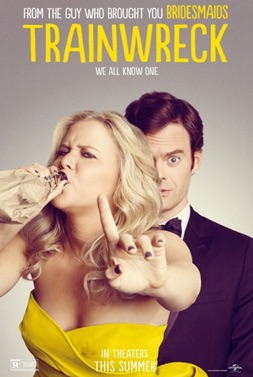
imageAfter the gruesome This is 40, it’s good to see Judd Apatow back.  He owes it to Amy Schumer’s crackling script and impressive breadth, as well as an unexpected Bill Hader as a rom-com lead and fantastic support, especially cameos by non-actors LeBron James and John Cena.  Schumer is a loose narcissist who shuns intimacy when she is given the assignment to write a magazine piece on Hader, surgeon to sports stars.  They click and he weans her off her casual cruelty, but, of course, she relapses and then . . .

Schumer is very funny, as evidenced by her Comedy Central sketch show, where she melds winning and loathsome, no small feat (Lena Dunham has mastered the same trick).  Schumer digs a little deeper here, showing some real depth in a few scenes of despair, so you’re rooting for her, a critical element for a rom-com.  As noted, she’s well-supported, and James is particularly memorable as himself, although I don’t know if he is notoriously cheap, into Downton Abbey, or so relentlessly competitive that he wouldn’t let up on the likes of Hader in a game of one-on-one.

There are some problems.  The film is too damn long at two hours, and the scenes that could be cut (an unfunny intervention, a scene where Schumer condescends to two stock, unhip suburbanites who don’t stand a chance, an overlong wacky seduction, one scene too many of an otherwise hilarious and barely recognizable Tilda Swinton as Schumer’s boss) are obvious.

Still, what’s funny is very funny and the picture sticks the landing.

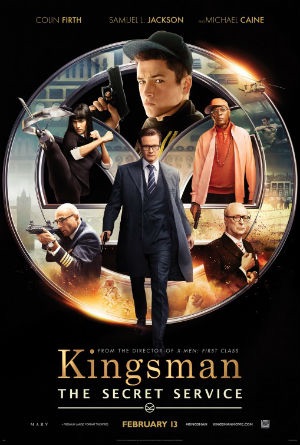
image This is a Roger Moore-era Bond flick, but with cheeky self-referential humor, first-rate, modern action sequences and a decidedly South Park sensibility. It features a budding, young James Bond from the wrong side of the tracks (Taron Egerton), his sophisticated mentor (Colin Firth), a megalomaniac, quirky villain (Samuel L. Jackson, with a lisp), his own Odd Job (Sofia Boutella, who slices you with her scythe legs instead of a hat) and a plan to destroy the world to save it from the menace that is man, much like Drax in Moonraker and Stromberg in The Spy Who Loved Me.

Spoilers follow. There’s no way to do the film justice without talking about the plot.

Jackson, a zillionaire, has decided, like his Bond forebears, that man is a virus. So, he enlists the upper reaches of society – prime ministers, royalty, heads of state (including President Obama) and the rich and powerful – to let him loose a transmitting signal that will make man kill man. And thus, the world will be saved from the global warming man has created through immediate, violent, hand-to-hand near self-extinction. Again, Jackson “enlists” the upper crust. But to ensure they stay the course, he implants a chip in all their necks so, if they do decide to balk, he can blow their heads up. But they don’t balk. The world’s leadership is mostly in on the gig.  They willingly and without reservation sign on to the plan that will have mankind wipe itself out, except for the rich and powerful.

This is a delightful, wildly politically incorrect “eat the rich” comic book, which just amps up the absurdity.  The Kingsmen not only thwart Jackson’s design, but we get to see it tested out on Westboro Baptist Church-types,  who dispatch each other out with gusto in a raucous church melee. Then, a Kingsman activates the implants, so we see the heads of state and the rest of their aristocratic collaborators, blow up.

Some world leaders do not collaborate, and they are jailed.  One is a beautiful Swedish princess, blonde and resolute, and when Egerton shows up to save her, as with Bond before, she offers him a kiss and more if he will free her and kill Jackson.  And if he saves the world?  His prize is enhanced.

That’s a couple of extra stars right there.

image

Nominated for Best Foreign Film, this Argentinian entry consists of several vignettes of revenge, the first being one of the best openings of a film I’ve ever seen. The stories that follow exhibit a sly and dark sense of humor, enlivened by writer-director Damian Szifron’s accomplished visual style. It’s difficult to criticize any of the decision-making that led to the massive hit that is Jurassic World. But that film is a charmless, forgettable visual mess, and I’ll never understand why such a project was given to a filmmaker whose last work, as much as I liked it, was on such a small scale. It’s a picture that should have been given to the likes of Szifron, who handles close-in dialogue and action, suspense and large-scale calamity with expertise and vision.  If I have a a criticism, it’s that it was all too much.  I needed a break.

image

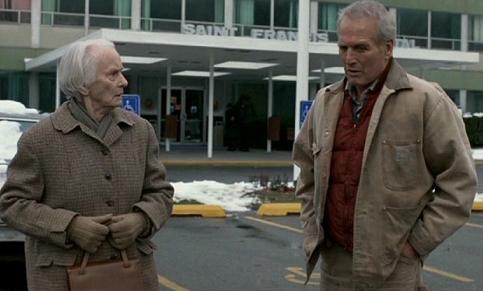
Robert Benton’s adaptation of this Richard Russo novel is centered in the wintry environs of North Bath, NY, where everyone knows each other so well they can be regular poker mates while simultaneously failing each other in any number of ways. Paul Newman plays Sully, an off again, on again employee of property contractor Bruce Willis (who he is suing in a personal injury claim) and the only tenant in an old Victorian owned by Jessica Tandy (in her last role before her death). Sully is woven into the fabric of the town, but he is at heart detached and cynical, and the only hint we get of any warmth are in his interactions with Willis’s wife, Melanie Griffith, who suffers her husband’s callous infidelities with a defiance that saps her verve. When Sully’s estranged son (Dylan Walsh) shows up in the midst of a marital and professional crisis, Sully becomes re-engaged, recognizing his role in the community and accepting the responsibility that comes with it, a George Bailey for the 1990s

The film is alternatively very funny and sneakily touching. Benton expertly captures the claustrophobia of a small town and even its collective ethos without letting eccentricity become cloying. Almost all of the characters are good, and Newman, who was rightly nominated for an Oscar, is perfectly suited to the material.   Of Newman, David Thomson wrote:

As a young man, Paul Newman was so handsome he developed a sneer as if to frighten away the fans – the women, especially – who assumed he was ready and available. There were times when this arrogant manner seemed ready to dismiss not just most of his work, but anyone who took it seriously. He seemed to be saying, “Can’t you see – I’m not like this. I’m a real person, unfairly afflicted with movie looks. I’m Jewish!”

Newman was 30 when he first appeared in a movie; it meant he was a grown man, with hard-earned experience, before he started pretending in public. He had been three years in the Navy, as a radio operator; he had helped run his father’s store in Cleveland; he had been married and had children.

Later in life, the sneer fell away, along with the prettiness, until he was left a stoical old man with pain and losses, as well as the abiding perplexity that anyone should take him or acting that seriously. By then, he was one of the finest and most resolute old men in pictures – some achievement in a culture horrified by age.

The observation perfectly captures Newman in this picture.  Newman communicates the pain and loss in Sully in barely perceptible ways, and when he does so, he doesn’t linger in a manner at odds with his core.  He retreats to the crass aside or the blithe “oh well” and that’s that, making those moments of introspection and dawning even more affecting.  It’s a sharp and knowing performance.

The film suffers a few missteps.  Dylan Walsh, as Newman’s son, is badly miscast. He not only looks nothing like Newman, but he doesn’t share a teaspoon of his inner strength or mystery.  Worse, when he arrives with family and children, they are played too broadly, with modern domestic woes and a miscreant younger child (who nicknames a child with a hitting problem “Whacker”?).  So too is a very young Phillip Seymour Hoffman as the anal town deputy, and Josef Sommer as Tandy’s cowardly son.  In a movie where every other character plays the line between comic and grounded beautifully, these turns are a shame, if easily overlooked.

image

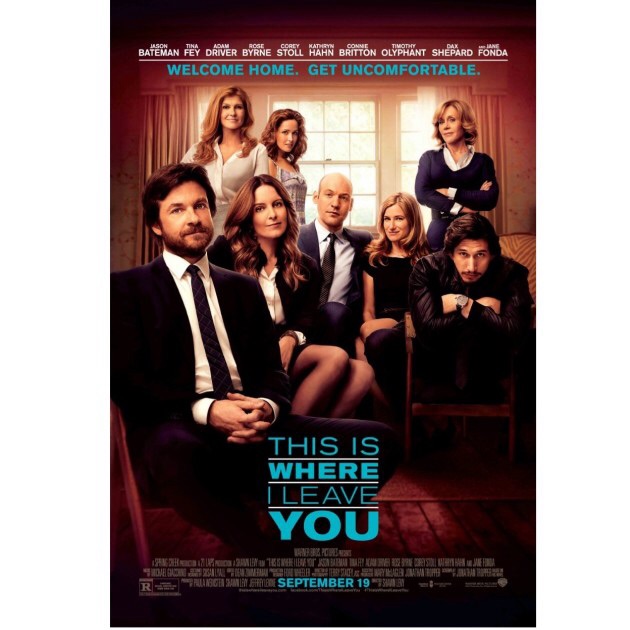
There is a certain kind of self satisfied dramedy that can only be written by a child of the affluent, over educated and beleaguered by the misery of his suburban upbringing, yet oh so smitten with its quirky coolness. Tragedy brings this writer into contact with his or her estranged family. Their hypersexualized mother (Jane Fonda) is overbearing and positively lords her “hip for her age” persona over them. One brother is the unreliable, manchild rebel (Adam Driver), one sister (Tina Fey) the angry perfectionist. Then there is the long suffering, stodgy older brother (Corey Stoll) and finally, there is the sarcastic, sad brother (Jason Bateman). What unites them is their fealty to stereotype and ostentatious progressivism, a condescension to every other non-familial character, 80s pop, odd folks from the old neighborhood, the fact that nothing that happens in the story would ever happen in real life, secrets revealed (“Mom’s a lesbian!”; “Dad was a bad businessman!”; “You slept with HIM?”), assigned stem winders, a scene where the sons smoke weed (found in Dad’s jacket!  Crazy!!!!) and heartfelt tributes immediately followed by crass one-liners.

And that is This Is Where I Leave You.

Truly terrible in every way.

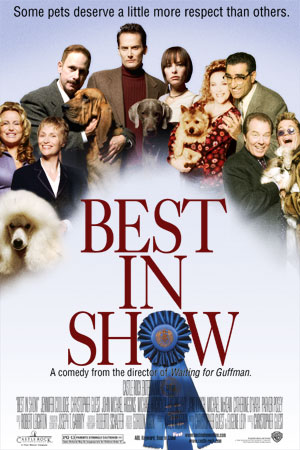
I caught this the other night and of the mockumentary films written and/or directed by Christopher Guest – This is Spinal Tap, Waiting for Guffman, A Mighty Wind, For Your Consideration – this is my favorite.  Perhaps not coincidentally, it’s also the sweetest on its subjects, an assortment of purebread dog owners who are competing at The Mayflower Kennel Club Show.  Catherine O’Hara and Eugene Levy stand out as the impoverished Florida couple who, unfortunately for Levy, run into O’Hara’s old lovers on their way north, but Jane Lynch shines as a driven, lesbian handler who has found a Sugar Mommy (Jennifer Coolidge) to fund her efforts, as well as the magazine American Bitch (“it’s a focus on the issues of the lesbian pure bred dog owner”).

But Fred Willard, as the disinterested but garrulous TV announcer, and Jim Piddick, who has to suffer him, steal the picture.

A hilarious mockumentary done in the style of The Real World and other reality dramatizations of domestic life. Four mates, distinct in style and manner, share a house in Wellington, New Zealand, and a documentary crew shadows them for a period of months to capture their lives. In the style of the genre, we get to witness petty fights about house rules, dirty dishes, who can have friends over and which clubs to frequent on the weekends. The twist is that our flat mates are all vampires of varying ages, and soon, they add a fifth (Nick) to their coterie, which rapidly undoes their dynamic. As the youngest, Nick is my second favorite, simply because he is so enthused by his new powers, repeatedly telling anyone who will listen that he is a vampire. My favorite of the household, however, is the oldest, Petyr, for the obvious reason that he is a Nosferatin curmudgeon who cannot speak and presents a brilliant deadpan:

This is consistently funny, with particularly great bits about the vampires’ fascination with technology and run-ins with self-improving werewolves.

Photo Gallery - Inherent Vice - Inherent Vice Movie Poster

Paul Thomas Anderson’s (Boogie Nights, Punch Drunk Love) private investigator noir evokes Robert Altman’s The Long Goodbye, but instead of Elliot Gould as Phillip Marlowe-meets-Jeff Bridges’ “The Dude”, Joaquin Phoenix is all 1970 Southern California hippie, all the time, so “out there” he has to keep a notepad with one word reminders to stay focused. The result is a detective yarn, but through the eyes of a stoner, in parts scintillating and in parts frustrating. If you approach the picture traditionally, you’ll find yourself trying to connect the dots of a plot that seemingly fuses murder, real estate, the FBI, the Las Vegas mob and a drug trade that profits from its customers on the front end and back. However, Phoenix is our guide on this trip (there is no scene without him), and he is unreliable. Two couples walked out of the theater during this movie, and while the thought never occurred to me, I could see it occurring to others. Anderson has a nice cheat at work here: the byzantine plot has promise, but rigor is unnecessary when viewed through the eyes of a doper. When you shake your head, you’re a square and not in on the joke. When you go with the flow, it’s a little tiresome, and at 148 minutes, even boring.

Anderson’s movies look fabulous, and this is no exception. His sundrenched beach LA is almost mystical, and his re-creation of Manson-era, Southern California weirdness is vivid. The picture can also be very funny, with nice contributions from Josh Brolin as a straight-laced, psychologically fragile LAPD detective, and Martin Short as an electric, drug-snorting dentist.  Katherine Waterston, as the femme fatale and the only character who seems to ground the picture, is a revelation, mesmerizing and completely believable as the woman who could penetrate even Phoenix’s lazy, listless existence.

Rottentomatoes.com critics gave this picture a 70%, with only a 57% from the audience. There may be a lesson there.  Even though Anderson is an auteur commodity, he should consider getting back into traditional storytelling. His last two films –The Master and this – have been beautifully shot and acted yet uninvolving and disaffecting.  Phoenix is presented to us as an archetype in both films, without backstory or motivation. As such, it’s hard to care, and that’s a problem.