Archive

90s

The Lion King's original ending was just too dark for the remake
There is a natural order to the jungle. Animals routinely slaughtered by lions accept their fate in the circle of life and, in fact, trek miles to bow at the birth of one who will one day be their new chief slaughterer – Simba. But Simba has an uncle, Scar, who has been passed over by Simba’s birth. So Scar implicates the son in the death of the father (Mufasa), while making a pact with the rapacious, vicious hyenas. The father is killed. Simba must flee after he is designated for murder. Scar rules, ravishing the land. The land dies, not because of the slaughter – that’s the natural order of things – but because Scar is lazy and a glutton and he allows the hyenas to kill without economic management. The lions respect the royal line, and do their hunting, however unhappily, at Scar’s command.

And Simba? He leaves, finds a warthog and a meerkat, and lives the bohemian lifestyle. He becomes a vegetarian. He lives a life bereft of responsibility. He is away from weighty decisions. He is personally, individually, happy. Hakuna matata, is his “Turn on, tune in, drop out.”

But soon, his old love (to whom he was promised to be betrothed in an arranged fashion as a cub) finds him, and asks him to return. Simba refuses. He is angry. She has intruded upon his summer of love. “You don’t know anything about me or what I’ve been through” he snarls, as only a self-possessed individualist/narcissist can snarl.

Next, Rafiki, the religious leader of the tribe, finds Simba, and conjures up the ghost of Mufasa, who reminds Simba that he is more than some San Francisco hippie- he is royalty. “Remember who you are” the ghost intones. Simba returns to the pride, confronts Scar, and gives him a choice – be banished or die. Scar blames the hyenas, feigns cowardice and lunges at Simba. Simba dashes Scar over a cliff, to his death (Scar does not die, but injured, is set upon by the hyenas who overheard his attempt to foist responsibility for the coup and ensuing disaster on them).

Simba assumes the throne. His well-placed meerkat and warthog pal are exempted from slaughter as they now sit in his court. He is served by the same majordomo bird who served his father. The films ends with the birth of a new king, and the same animals traveling to give that king – their soon-to-be killer in the great circle of life – their fealty.

Oh, were Disney thus today!

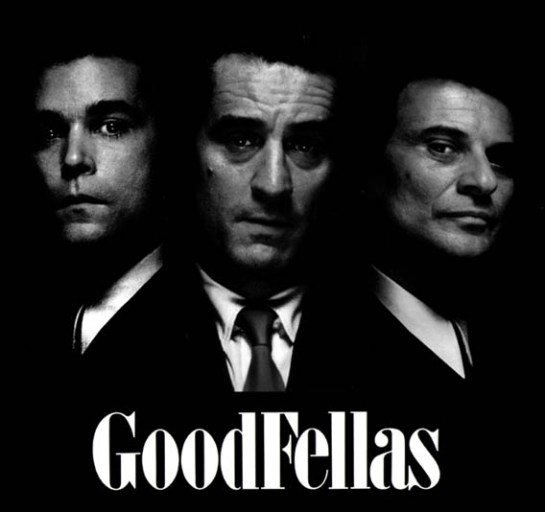
This movie is so good that AFI’s ranking of 94 is an embarrasment (Forrest Gump is rated almost 20 slots higher). From the moment of Ray Liotta’s first voice-over line (I don’t think there is more effective voice-over work in any film ever) to the maniacal, miserable fall, Scorsese chronicles the mob as fantasy to the crime as reality from Liotta’s boyhood to Witness Protection schlub. In re-viewing, here are my thoughts on what makes Goodfellas the greatest crime picture ever made.

The camera-work. The sheer audacity of Scorcese’s tracking shots make their counterparts in The Player and Boogie Nights seem gimmicky.  Scorcese goes on without an edit, not as flourish, but to introduce the cast of mob characters and their life  The uninterrupted trip of Liotta getting into a nightclub speaks volumes about the life – the excitement of his date (Lorraine Bracco) as they are being guided to the best table in the house is shared by the audience.  As we take the trip with Bracco, we are introduced to the glitz during a seemless dreamy waltz.  This is the difference between Spike Lee silliness (floating characters) and skill with purpose.

The Feel.  It looks and sounds right in every respect, from the kitschy Tiki bars to the outlandishly tacky apartments and home to the ghastly look of the mobster wives to the diners and late night drives.   Better, Scorsese, as always, picks the right song for each trip.

Liotta, Pesci and DeNiro, especially Pesci. Liotta, like us, is the outsider, though he is effortlessly conscripted.  Still, he plays Henry Hill as a shade removed from the crazy of DeNiro and Pesci.  He’s a brute but he is not an innate killer.  Thus we are capable of remaining empathetic.  Robert De Niro also keeps vestiges of humanity, though in fact, he is only one notch below Joe Pesci in terms of sociopathy. Pesci, however, is the most honest character and the heart of the picture.  He is a killer, his code is barbaric and his emotions uncontrolled. Which means that he can beat you near to death and comfortably have a meal right after.

Authenticity. The best example of this is not in the look or the sets or the music, but rather, in Scorcese’s portrayal of the easy violence, which one assumes he knows from his roots and/or from working with writer and former Mafia journalist Nicholas Pileggi. No better example is when Pesci comes back to kill the “made” guy (Scorsese and The Sopranos regular Frank Vincent) for busting his balls.  We know Pesci is going to snap, but the moment Pesci attacks him, De Niro jumps in viciously to assist, no hesitation. De Niro knows that killing the guy is stupid. In fact, De Niro was calming Pesci down earlier in the evening, trying to smooth things over. But the attack sets him off like a shark smelling blood, and he instinctively jumps in to rip the guy’s head apart. He’s an animal in a feeding frenzy.

Scorsese’s Casino is actually a deeper film about the Mob, but Goodfellas is the landmark, a precursor to the humor of The Sopranos and an obliteration of the operatic grandiosity of the life left to us by The Godfather.


Bulworth.  Warren Beatty advised George McGovern in the 1972 campaign. Nixon won in a landslide.  Later, he went on to have sex with Madonna and enjoyed it enough to allow himself to be filmed in her grotesque documentary Truth or Dare (wherein he actually looked to be a beacon of sanity and maturity).  Somewhere in between these ignominies, he must have conceived Bulworth.

Not Birth of a Nation but closer to Huggy Bear in “Starsky and Hutch” offensive, the film begins as a lampoon of the modern American politician beholden to the evil and corrupt corporations.  It ends as a morality tale that even “the brothers” are supposed to understand.  The senator, you see, has sold out and – gasp! (a gasp probably heard most audibly in the relative splendor of Beverly Hills) – is in the collective pockets of the health insurance industry, the welfare reformers, and the anti-affirmative action crowd.  For those of Beatty’s stripe, this is the modern equivalent to enslavement.

Beatty, as the senator, suffers a breakdown in the midst of his crisis of conscience (and finances).  On the eve of a primary, and, in a suicidal funk, he arranges his own murder to provide insurance money for his heirs.  Why?  Who cares? The cheap plot device allows Beatty to speak the plain truth in his final days.

He embraces the African-American urban culture, or at least, Beatty’s vision of same (it appears to be culturally tone-deaf, more “Jeffersons” than Beatty might want to admit).  As he speaks the truth, he raps, and wears the acoutrements of the urban ghetto.  He also fumbles his way through the closing days of his primary.  He preaches, in garbled rap, that the parties are all the same, the rich folk are bad, and the country is controlled by a monolithic entity (including the media) that keeps “the brothers” down.  As for the brothers, they are portrayed either as beatific, just-seen-the-light types, “You go, Bulworth” fly girls or mere background for the Beatty-as-homey sight gag. 

Message?  All it takes for racial justice is an addled but straight-up white man to stand up to the racist LAPD, eschew the drug trade and stick it to “the man.” In the telling, the black characters are relegated to the worst kind of condescension. Halle Berry, the whitest of the black characters in skin tone, is hired to be Beatty’s demise, yet becomes his soulmate (Beatty always gets the girl); the little drug-dealers are treated to ice cream by the kind white man who stands up to the bad white cops; and the drug lord (Don Cheadle) changes his ways at the sight of such honesty and compassion. 

Beatty not only touches the people, he is touched.  What he sees in the ‘hood – the desolation wrought by Cigna and Humana – almost brings him to tears. 

But let’s not get too maudlin. Beatty also eats collard greens.  Except, it isn’t collard greens.  It’s kale!  Get it? A funny white man eats collard greens, but it turns out, it isn’t collard greens, it is kale, and he doesn’t know the difference.

Knee slapped.

More yuks follow.  Because if the “the brothers” are to be engaged, it got to rap, it got to groove, and it got to be Jimmie JJ Walker funny.  So Beatty bounces from one venue to the next, saying “co**sucker” and “motherfu**er”  because that’s the truth both “the brothers” and the American people will understand.  And Beatty employs various get-ups, often approaching the comic genius of Eddie Murphy as The Nutty Professor

At the heart of this self-satisfied broadside against the status quo is the rich Hollywood conceit that, if only someone talked straight to the anaestethized, bamboozled people about the falsity of their existence, the system would be fixed, schools would be changed, health care would be free to all, the ghetto would be energized, and Huey Newton would get his props in the pantheon of social reformers.  And who better than an aging Hollywood type who dabbles in politics and used to hang with Hef to deliver this message?

By the end, Beatty’s revelation to the people (never fully realized through either McGovern or Madonna) is a big hit.  He wins his primary.  Hints of a presidential run are dropped.  We see the light!  He’s not Clinton. He’s not Gingrich.  He’s not Dole.  He’s Bulworth.  And he’s down.

On the plus side, the performances are all rather good.  Beatty exhibits deft physical comedy and Oliver Platt as his scum-sucking campaign manager has some very funny moments. 

I am glad of the film, for there are people who still adhere to the tripe Beatty is selling, and between hosting talk shows, touting anti-bullying, fighting trans-fat, and rushing to “Larry King” to bemoan the horror of celebrity when a Princess Diana dies, it is nice to know that they have a good rental. Still, in the genre of self-congratulatory, lefty sermons, they’d do better with Bob Roberts, An American President, or Wag the Dog.

All pretty awful films, but, in comparison to Bulworth, true gems.

Blair Witch Cry GIF - Blair Witch Cry Scared - Discover & Share GIFs
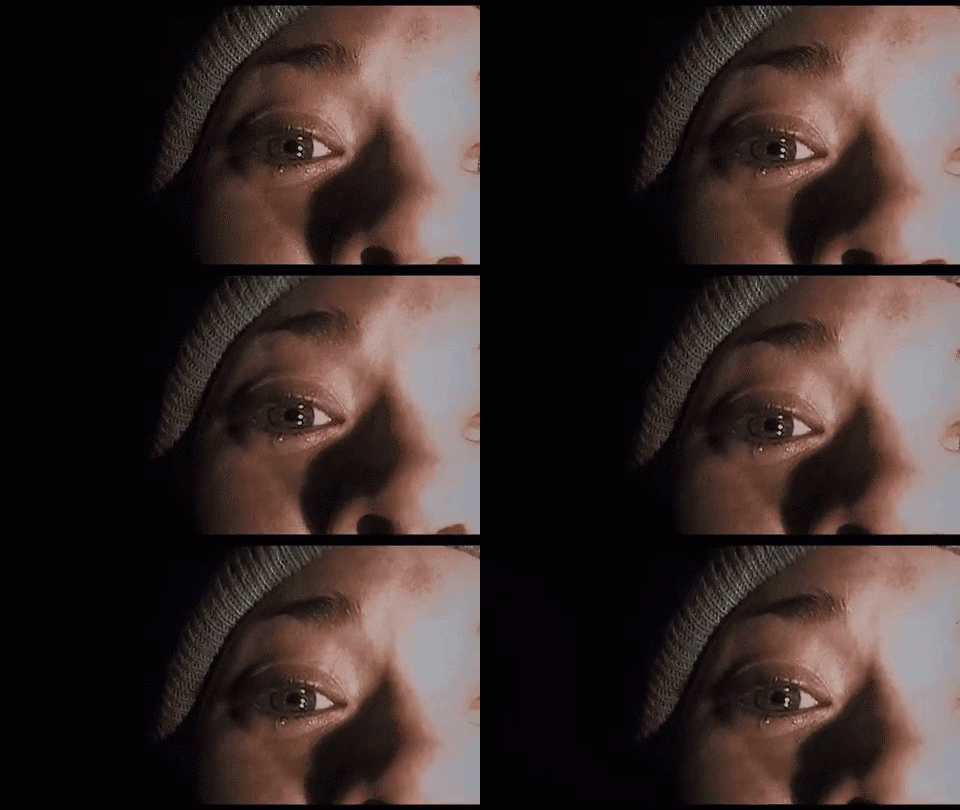
Three student filmmakers are on the hunt in the woods of Maryland for a legendary evil that may or may not have murdered seven children and five men in the 1940s. They become lost.  Their footage – the film – is found.

The introduction – as the kids meet and speak with the townsfolk to unearth the mystery – is clever and utilitarian.  The snippets of information given during these mostly humorous encounters are valuable, and the interviews are indistinguishable from any conversation you might have with a resident of a small Maryland town.

When the trio move from the town to the woods, in search of the sites of the murders, make no mistake, it is horrifying.  And not in the Kevin Williamson “tongue-in-cheek, stylish and ironic” sense.  It is not violent, nor gross, but bare-bones and primal.  They are hopelessly lost.  They begin to break down. Something is tracking them.  Your vantage point is their clumsy vantage point, through the eyes of a film and a video camera.

The reviews of the film state that the actors were given minimal training with film and video cameras, and then they were let loose to act spontaneously along the lines of the plot.  This may or may not be true, but either way, all three actors convey realism, and the camera-work (well edited) intensifies the terror.

I also thought about this film more than I expected to.  One scene in particular, where the female filmmaker films an apology to her parents and the mothers of her two companions – runs your blood cold.  It stuck with me, because the actress seemed so bare and alone.

Finally, the ending scene is one of the most gripping I’ve ever seen.  Through quick visuals (in a dark melee) much is revealed that stitches The Blair Witch Project together, proving it not only creepy, but accomplished.

Two personal anecdotes.  Some folks may feel the film stagey because the filmmakers shoot their personal interactions, which obviously helps the plot.  I participated in student films in college, and everything, including banter, tends to get filmed because video costs nothing, the film allotment is free or subject to a huge reduction, college students making films are hopeless hams, and everyone wants to laugh at “The Making of . . . . ”

Second, I went to summer camp in Southern Maryland off the Wicomico River.  Legends abound of witchcraft, strange worship, murder, and the like, in the woods off the camp (the stories were, of course, amplified by sadistic camp counselors ).  That said, you hike too far in any woods an hour outside of Washington, D.C., you can get real lost, real fast.

This film is not for everyone.  Some folks behind me in the theater were exasperated by the hand-held camera (which can make you queasy) and loudly complained, ‘What was the big deal?”  My guess, and it is only a guess, is that they heard the buzz, thought to see the work of young auteurs, and had no idea they were walking into a stripped-down, cleverly realized supernatural Deliverance.