Archive

90s

When Dead Again came out in 1991, 31 year old Kenneth Branagh was fresh off his stunning Henry V, and along with Emma Thompson, threatened to be the next big thing. So as a follow-up, why not try a modern Hitchcockian homage set in San Francisco, with Branagh playing the hard-bitten gumshoe who runs across Thompson, a mysterious woman who has lost her memory, is terrorized by nightmares from her past, and needs Branagh to sort it out.

At the time, the film was well-received (Roger Ebert – “I am a particular pushover for movies like this, movies that could go on the same list with Rebecca, Wuthering Heights or Vertigo”) and it holds an 82% on Rottentomatoes. I can’t scoff. In 1991, I thought it was clever and well-conceived.

How wrong I was.  Dead Again just became available on Netflix streaming. It is an atrocious film.  Branagh’s “American” accent is an awful, nasally annoyance; Thompson barely makes an impression; the story (Thompson and Branagh both lived past lives where he, a famous composer in the 40s, was executed for her murder) is a preposterous pile of pure Gouda; and the villain is so obvious and nonsensical that you are offended at the degradation of the fine actor playing him.

He’s also not so good with scissors.

I’ll give credit where credit is due – Robin Williams does a few decent cameo scenes as a disgraced former psychotherapist and a babyfaced Campbell Scott shows off some nifty ninja kicks. 

Jack Nicholson and Helen Hunt won Oscars in this James L. Brooks comedy about a cantankerous romance writer with OCD (Nicholson) and a worn-out, single mother waitress (Hunt) who meticulously serves him at the only Manhattan diner at which he will eat. Nicholson is a holy terror, complaining “there are Jews at my table” when it is occupied. At home, he is no better, throwing the dog of his gay artist neighbor (Greg Kinnear, who won a best supporting actor Oscar) down the trash chute. But Nicholson is soon drawn into the world he loathes out of necessity. Hunt has to leave her job because of the health of her son, and Kinnear is beaten into a wheelchair by local thugs, which leaves Nicholson to take care of his dog. The man has to eat, and he bonds totally with the pooch, so soon, he is arranging for medical treatment for Hunt’s child and acting as support for Kinnear. In the process, he and Hunt begin a relationship that is halting at best.

This picture can be riotously funny, and Nicholson gets all the good lines, including my favorite.

If I have a problem with the movie, it is Hunt’s character. Her harried waitress is overbearing, self-pitying and often bullying, and her demand for control is every bit as off-putting as Nicholson’s knee-jerk rudeness and his fear of cracks on the sidewalk. Yet Brooks denies us any judgment of her – she is presented as plagued, but somehow noble. Mind you, Hunt’s performance is excellent, but her character is unpleasant without the benefit of making me laugh, and my teeth are always set on edge during her scenes.

That’s probably my hang-up.


John Woo is an action hack, a Chinese director of minor renown who came to America and never looked back, making several big concept explosion-fests, like Broken Arrow, Mission Impossible II, Windtalkers (a Pacific theater World War II film that looks as if it was filmed in the Hollywood Hills) and Paycheck, which was once thought to be the coda to Ben Affleck’s career. You can only lose people so much money before you get benched, and Woo’s Windtalker‘s had a worldwide gross of $70 million on a budget of $115 million. Paycheck merely broke even domestically and appears to have signalled the end of the line for Woo.

But Woo left something for us, a ridiculous, giddy gem, to show that he had come to America and contributed. Face/Off stars Nicholas Cage as master terrorist Castor Troy. John Travolta is his Javert, Agent Sean Archer. Archer catches Troy, and puts him in a coma, which is fair play given that Troy murdered Archer’s young son. But Troy planted a bomb somewhere in LA before sleeping his deep sleep, and only Troy’s brother Pollox (Alessandra Nivola) knows the location of the bomb.

What to do?

Well, you surgically remove the face of Castor Troy, put it on Sean Archer, Archer goes into the super-max prison where Pollox is housed and elicits the whereabouts of the explosive. Duh.

Except, when Archer is in prison with Troy’s face, Troy wakes up from his coma, forces the doctors to give him Archer’s face, kills everyone who knows about the whole “face/off” plan, keeps Archer in prison, and then reinstates “date night” with Archer’s wife (Joan Allen).

Furious, Archer escapes prison, and then . . . slo-motion doves:

This is an absurd, dizzying, very funny movie, tailor-made for two of the greatest over-actors of our generation. Great film. Road House great.

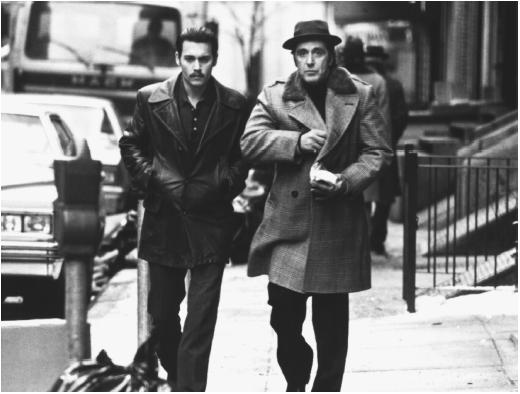
A year or so before The Sopranos, Mike Newell’s Donnie Brasco offered a glimpse of the series with this sharp, “deep cover” mob flick, alternatively brutal and funny, and at the end, touching. Donnie Brasco (Johnny Depp) is actually FBI agent Joe Pistone, who goes undercover to break a mob crew led by Michael Madsen. His entree is provided by a lower-level made guy, Lefty (Al Pacino), who vouches for Donnie, shows him the ropes, and, as Donnie loses his moorings and allegiances (to both the FBI and his suffering wife, Anne Heche), becomes a father figure.

Paul Attanasio’s (Quiz Show, Disclosure, and several episodes of Homicide: Life on the Street) script is tight and playful. We get harrowing scenes where Donnie is conscripted to dispose of a body via hacksaw or merely nearly found out:

These scenes are followed by amusing vignettes of what mobsters do on vacation in Miami (water slides, burying colleagues in sand, bad tennis) or the everyday humdrum of the criminal life, stealing boxes of steak knives or parking meters.  Attanasio even includes a wry stab at marriage counseling between Depp and Heche. David Chase would do the same thing for Tony and Carmella Soprano a few years latter, to similar tragicomic effect.

As Donnie becomes enmeshed in his crew, the audience becomes invested in their survival, if not from the FBI, from rival mob crews. Depp sells this kinship very effectively. This was one of his first major dramatic roles and he shows a depth and darkness that is highlighted by Heche’s increasing frustration and anger. Tempering both performances is a rare restrained turn by Pacino, who becomes Donnie’s family. It is always a treat to see an older Pacino performance that shelves histrionics.

There are a few weaknesses. The Heche-Depp marriage, rocky as it is, seems too indomitable for reality, and Depp’s introduction into the crew seems a tad effortless. But this is a picture every bit as strong as the best of The Sopranos episodes.

1993's "True Romance" | Films complets, Film, Affiche film

Quentin Tarantino’s bona fides, established by the success of Reservoir Dogs, led to production of his script for Tony Scott’s overpraised and over-copied True Romance, a deafening whiz-bang, shoot ’em up.  A comic book store clerk in Detroit, Clarence (Christian Slater) happens upon a whore named Alabama (Patricia Arquette) in a movie theater during a triple feature of kung fu flicks.  Alabama likes kung fu flicks, a true romance is born, and Slater is driven to confront her pimp (Gary Oldman, playing black), in the process unknowingly stealing a million dollars worth of cocaine from the mob. He and Alabama are soon off to L.A. to sell the coke, and bloodshed ensues.

Tarantino’s voice is dominant, and we get a steady dose of racial epithets, tough guy jargon borrowed from previous genres, movie references (two on Steve McQueen) and the like. On the plus side, we also get a few taut and funny exchanges, the best being the fencing between Slater’s father (Dennis Hopper) and the mob underboss (Christopher Walken).

Unfortunately, the actors all appear to be vying for the Best Supporting Actor in a Quirky Scene of Tarantinoesque Patter, and many are not up to the task. Hyped-up cops Tom Sizemore and Chris Penn are particularly awful, but Gary Oldman’s excess nears embarrassing and Saul Rubinek’s Hollywood producer is a tiresome cliche’ of every oily movie mogul you’ve ever seen in film. While Walken and Hopper can do something with Tarantino’s writing, they are aided by their set piece scene, which is essentially two monologues. Those who are asked to act have a rougher go.

Which bring me to the leads. Slater handles the tough-guy patois but there’s no heart. He’s a loser but doesn’t feel like one. He’s a tough guy but doesn’t project. Mainly, he’s a nasally Nicholson wannabe who becomes increasingly grating. Arquette is better, but she’s not good, nor is she much more convincing. Her “whore with a heart of gold” is trite and cloying, and it isn’t until a later scene, where she fights for her life with the psychotic hit man James Gandolfini (in prep for Tony Soprano), that she communicates any depth.

Recently deceased director Scott (Top Gun, Crimson Tide, Enemy of the State and numerous other flashy, soulless action pictures) papers over the dull leads with a brisk pace, but his super shootout clusterfu** of a finale is laughable. It’s hard to identify what is worse – the implausibility, the slo-mo explosions, or the fluttering feathers from shot up pillows – but coupled with Tarantino’s by now played out macho dialogue (before an execution, Penn actually says, “this is for Cody”), this is as bad as it gets. Sadly, this kind of thing spawned a generation of allegedly hip, super violent copycat films.

The exploration of the Tarantino oeuvre ended last night as me and the boy watched Tarantino’s opus (I will not subject my son to Death Proof from Grindhouse or Tarantino’s contribution to Four Rooms unless he’s really bad). Pulp Fiction is audacious in its break with continuity and vibrant in dialogue.  The film is essentially a series of riffs (and nobody riffs better than Samuel Jackson and Christopher Walken) or two person sketches. A stunning follow-up to Reservoir Dogs, the movie is a pop culture totem, demonstrating Tarantino’s love for kitsch as well as his sharp ear for a modern, urban, tough guy patter, Spillane-meets-Quisp.

Almost all of the performances are brilliant.  I’ve criticized Tarantino’s reclamation projects, but his insistence on JohnTravolta (over Daniel Day Lewis) was exactly right.  In the words of Tarantino’s agent, at the time, “John Travolta was at that time as cold as they get.  He was less than zero.” But Tarantino would not budge, and as hit man/enforcer Vincent Vega, Travolta is just the right amount of cool and introspection to Jackson’s ferocity. When the boss’s wife (Uma Thurman) mistakes his heroin for coke and overdoses, Travolta snaps out of his own drug-induced laze and, in one of many comic but harrowing scenes, becomes electric. The performance is artful, it resulted in an Academy Award nomination, and it resurrected his career.

If there is a criticism, it is of one vignette, after Jackson and Travolta accidentally shoot a man’s head off in their car. They need to get off the street, and end up at the home of one . . . Quentin Tarantino. Even the introduction of “The Wolf” (Harvey Keitel), a Mr. Fix-It who arrives to assist the stranded duo, cannot save this halting sequence or Tarantino’s amateurish acting. Rank has its privileges, but this particular hubris was detrimental.

But that’s a minor bump in the road in this highly engaging and original flick.  Related — The Pulp Fiction Oral History:  Uma Thurman, Quentin Tarantino, and John Travolta Retrace the Movie’s Making.

This is the most un-Tarantinoesque of Quentin Tarantino’s pictures, faithfully adapted by the director from an Elmore Leonard book. A flight attendant (Pam Grier) gets caught shuttling money and drugs for a gun seller (Samuel L. Jackson) and caught in between the ATF (represented by Michael Keaton) and Jackson, she devises her own scheme to steal all of the latter’s funds while extricating herself from prosecution, enlisting the help of a bail bondsman (Robert Forster) in the process.

Tarantino’s pace is languid, his body count minimal, and the film features long stretches of sharp dialogue and silent character reflection. As Jackson’s scheming girlfriend and dim accomplice, Bridget Fonda and Robert DeNiro shine in a cast of apt, funny secondary characters. This is a clever and straightforward crime story.

Like the two Tarantino pictures that preceded it, Jackie Brown utlizes the seedy environs of Los Angeles to great effect (the bar and nightclub locales are particularly well-chosen). In an interview, Tarantino explained his changing of the locale from Miami to LA:

I don’t really know anything about Miami. I had never been to Miami before. One of the things Elmore Leonard has to offer in his novels, is an expert sense of both Miami and Detroit. He has got his Detroit novels and he has got his Miami novels. I can’t compete with that, and Miami is very hot! You don’t want to got there to shoot! One of the things I do have to offer is that same kind of knowledge about Los Angeles; partly in the area that the area is shot in, in the South Bay. It is not used that often. Tequila Sunrise used it a little bit, and a few other movies have touched on it a little bit. I am very familiar with that area because I grew up around that area. It is one of the things I could bring to the piece; an expert knowledge of that area, the way he brings an expert knowledge to Miami.

While Jackson uses the “n” word with his usual vigor, the script is refreshingly shorn of the showy pop culture references found in Reservoir Dogs and Pulp Fiction. It’s also a lot moodier than those pictures.

The plot, however, is not wildly intricate and certainly doesn’t justify a 2 and a half hour running time. Also, while Tarantino loves reclamation projects like John Travolta and David Carradine, Pam Grier and Robert Forster are bridges too far. Neither are particularly good actors, and while Forster’s wooden approach isn’t terrible given his role, Grier is key, and she cannot convey the emotions necessary to really bring the character home.

She was a B picture star in the 70s for a reason other than acting.

Writer/director James Cameron’s blockbuster is lovingly grand and its atmospherics and visuals breathtaking.  But a single scene exemplifies the failure of the picture.

The moment before the lookouts spot the iceberg that would seal their fates, they’re dicking around watching Rose (Kate Winslet) and Jack (Leonardo DiCaprio) smooching on the foredeck.  As a result, a plausible argument can be made that the two leads sank both the ship as well as the film, because their insipid teen love affair is at the heart of this movie.

Rose is unhappily slotted for a marriage to a well-heeled snob (Billy Zane).  She intends to fling herself off the ship, but she is saved by and falls for roustabout Jack.  As the ship continues its doomed voyage, these two chuckleheads moon at each other, while blithely noticing things that are important:

Andrews leads the group back from the bridge along the boat deck.

                                   ROSE
Mr. Andrews, I did the sum in my head, and with the number of lifeboats
times the capacity you mentioned… forgive me, but it seems that there are
not enough for everyone aboard.

                                  ANDREWS
About half, actually. Rose, you miss nothing, do you? In fact, I put in
these new type davits, which can take an extra row of boats here.

                        (he gestures along the eck)

But it was thought… by some… that the deck would look too cluttered. So
I was overruled.

                                    CAL
                       (slapping the side of a boat)
Waste of deck space as it is, on an unsinkable ship!

                              ANDREWS
Sleep soundly, young Rose. I have built you a good ship, strong and true.
She’s all the lifeboat you need.

Not enough lifeboats, you say?

Soon, Rose is posing nude for Jack (he is a portraitist) and shortly thereafter, they’re going at it hot and heavy.  Zane is infuriated and sets his goon (David Warner) on Jack, leading to an implausible  cat-and-mouse chase through the ship while it is going under (Warner is truly Employee of the Century).

There are many, many other problems.  DiCaprio could not be more wrong for the part.  He looks as if he just started shaving, so his turn as a man-of-the-world is laughable.  It’s an Aidan Quinn role given to a near pre-pubescent.
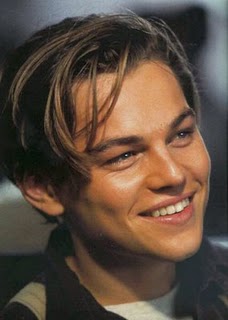
 Rose, did you see where I put my Bubble Yum?

Cameron’s script is also unbearably overt.  He trusts his audience not, as early exposition demonstrates:

HAROLD BRIDE, the 21 year old Junior Wireless Operator, hustles in and
skirts around Andrews’ tour group to hand a Marconigram to Captain Smith.

                                   BRIDE
Another ice warning, sir. This one from the “Baltic”.

                                   SMITH
Thank you, Sparks.

Smith glances at the message then nonchalantly puts it in his pocket. He
nods reassuringly to Rose and the group.

                                   SMITH
Not to worry, it’s quite normal for this time of year. In fact, we’re

speeding up. I’ve just ordered the last boilers lit.

Andrews scowls slightly before motioning the group toward the door. They
exit just as SECOND OFFICER CHARLES HERBERT LIGHTOLLER comes out of the
chartroom, stopping next to First Officer Murdoch.

                                LIGHTOLLER
Did we ever find those binoculars for the lookouts?

                           FIRST OFFICER MURDOCH
Haven’t seen them since Southampton.

Iceberg, speeding up, and no binoculars?  Uh oh.

The film unravels at the end.  The idiocy of Warner hunting Jack and Rose as the ship nears its final peril can no longer be ignored.  Meanwhile, Cameron becomes enamored of what he can do on his broad canvas.  Tragedy becomes an action caper as the director starts bouncing hapless victims off of fantails.

In the final scene, an aged Rose (Gloria Fisher) looks longingly into the icy waters that took her Jack, and throws a massive jewel in.  Leaving your last thought as, “That damned thing could have fed Sub-Saharan Africa for a few months.  What a selfish old hag!”

Wes Anderson’s breakout picture centers on Max Fischer (Jason Schwartzman), a sort-of prodigy, son of a barber on scholarship at the tony Rushmore Academy. Rushmore is Fischer’s domain. Not academically but in every extracurricular activity (he is President, Model UN; Founder, Bombardment
Society; Founder, Rushmore Beekeepers; Founder, Max Fischer Players; and Director, Piper Cub Club – 4.5 hours logged, to name a few).

It is natural that Max would claim the winning new teacher (Olivia Williams) as his first love. Fischer, however, finds himself in competition for her affections, first with the rich, dissolute father of
two bratty classmates, Herman Blume (Bill Murray) and then with the ghost of Wiiliams’s dead husband. Max can defeat neither, finds himself expelled, and must rise anew to atone for his selfishness and stupidity.

Following up on the promise of his debut (Bottle Rocket), Anderson made a picture quite unlike anything before it, a blend of the fables of boyhood, the adult cynicism that follows, a beautiful romance, and the tragedy of loss (Williams’ has lost a husband, Fischer his mother), all scored by
British invasion B sides. As with this year’s Moonrise Kingdom, Anderson revels in the adult as child and vice versa. The result is charming and wistful, but also heartfelt. There is something both clever and moving in exchanges where Max is earnest and Blume dry:

Max Fischer: So you were in Vietnam?

Herman Blume: Yeah.

Max Fischer: Were you in the shit?

Herman Blume: Yeah, I was in the shit.

There are numerous bravura scenes, all sharply written (the screenplay was the work of Anderson and Owen Wilson).  Fischer’s first “date” with Williams (he invites Murray as cover and Williams actually brings a real date, Luke Wilson) is an exemplar of Anderson’s melding of the comic and pathos.

Murray’s brief speech to the students of Rushmore is also noteworthy.

You guys have it real easy. I never had it like this where I grew up. But I send my kids here because the fact is you go to one of the best schools in the country: Rushmore. Now, for some of you it doesn’t matter. You were born rich and you’re going to stay rich. But here’s my advice to the rest of you: Take dead aim on the rich boys. Get them in the crosshairs and take them down. Just remember, they can buy anything but they can’t buy backbone. Don’t let them forget it. Thank you.

I also don’t think I’ve ever seen a better-scored film (Scorsese’s Casino, with the extended “Can’t You Hear Me Knocking” is close). Anderson originally wanted the entire soundtrack comprised of Kinks songs, but Mark Mothersbaugh of Devo chose a variety of classic-sounding, if not classic,
tunes. The effect is nostalgiac but a little unfamiliar, which tracks nicely with the whimsical, sometime sad story. “I Am Waiting” by The Rolling Stones is an example of an early, lesser know track where Jagger’s vocals are not confrontational and modern, but almost earlier century chamber music ala’ “Lady Jane.”  Anderson uses this track in a brilliant changing of seasons montage.  “A Summer Song” by Chad & Jeremy, “The Wind” by Cat Stevens, and “Oh Yoko!” by John Lennon are used in similar, successful fashion.

It’s may seem strange to call this an important film, but it really is.  With it, Anderson emerged on the scene as a unique storyteller.  When he showed the film to Pauline Kael, she loved it but told him, “I genuinely don’t know what to make of this movie” which strikes me as the highest of praise.  It is one of my favorite films.

The Straight Story movie review (1999) | Roger Ebert

David Lynch’s masterpiece is Blue Velvet, but the film produces near physical discomfort, much like Darren Aronofsky pictures, so it serves as a poor exemplar of his work.  Like Paul Thomas Anderson’s Magnolia, Lynch’s Mullholland Drive vied to be one of the finest first halves of a film ever made.  Then, inevitably, it became laughably obtuse and the whole thing unraveled.

That was in 2001 and since then, it’s been all shorts and documentaries for Lynch.  But before Mullholland Drive, Lynch directed his strongest film, a simple story about Alvin Straight (Richard Farnsworth)  who takes his ride-on lawn mower to visit his dying brother (Straight’s eyes are poor and he cannot drive a car) in Mt. Zion, Wisconsin.  The trip is 300 miles.

Lynch’s film is a testament to the small town communities of the Midwest.  Straight encounters nothing but kindness, empathy and assistance, none of it treacly or condescending or self-congratulatory.  As nicely put by Roger Ebert, “Lynch’s film is a lyrical beauty, and I cannot remember a picture more true to regular folk.”

There is a scene where Straight shares a beer with a man (Wiley Harker) in a bar.  They acknowledge their World War II service and then go to a place that evokes the horror they both encountered.  The scene is deeply delivered and is one of the most profoundly moving exchanges I’ve ever seen on film.

Farnsworth was deservedly nominated for an Academy Award for best actor.  Sadly, he was suffering from terminal bone cancer during the shooting of this film and he took his own life a year later at his ranch in New Mexico.  He could not have chosen a better epitaph than this film.