Archive

70s

image

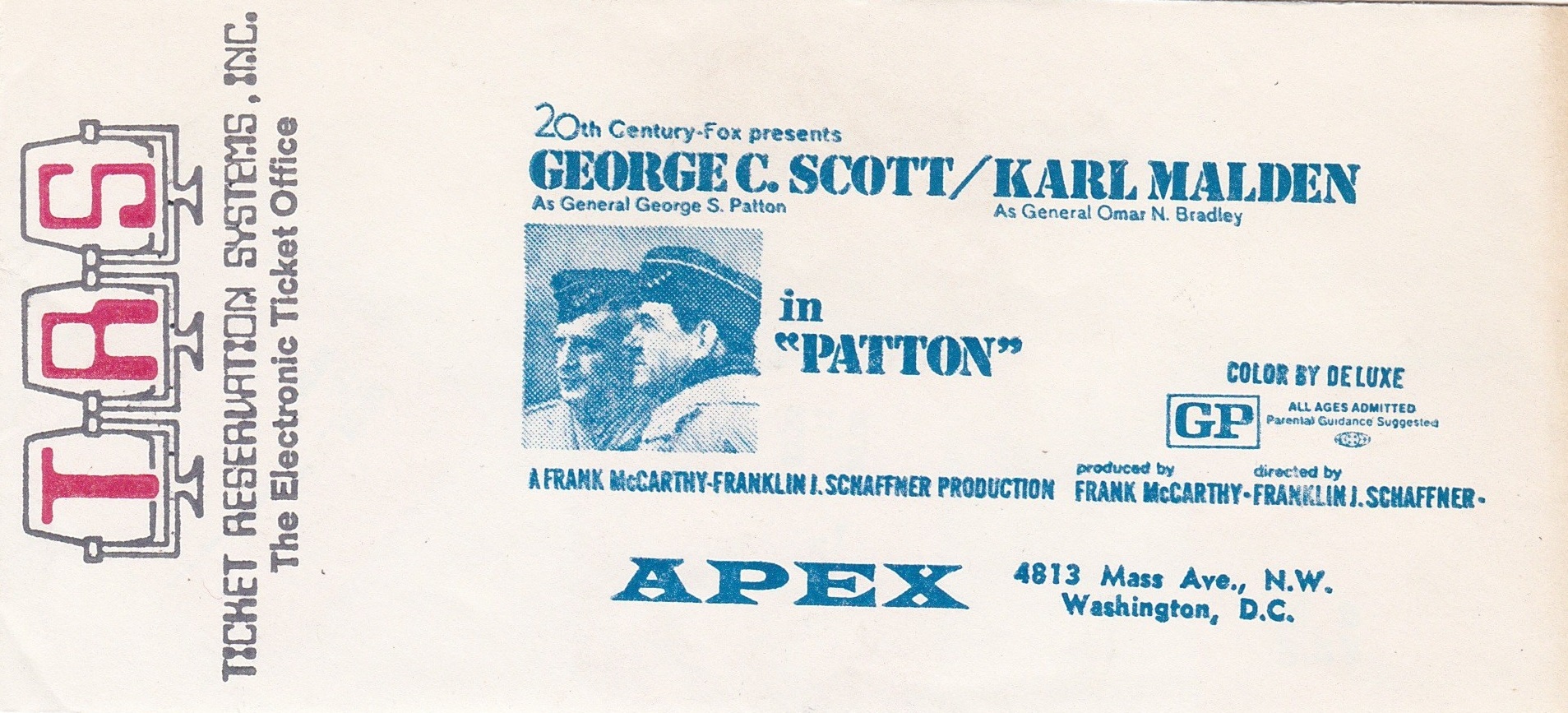
(actual ticket to a Washington, D.C. showing of the movie found in my father’s dresser drawer)

The quintessential biopic, Patton (which was co-written by Francis Ford Coppola) gets everything right.   Let me count the ways

It is content to present its subject without the context of some anachronistic cause. In Coppola’s hands, Patton is not emblematic of something larger and more ominous or glorious, be it the hubris of American imperialism, the degradation of war, blah blah blah. He is a flesh-and-bones person who grafted himself onto and shaped one of history’s more momentous times.

It is nuanced. Coppola never lets you get comfortable with Patton and by the end of the film, you remain torn as to the sum of his virtues and vices, which is so much more interesting than the hagiographies or hit jobs we see so often today.

It’s largely composed of true events. Patton did say the outrageous things attributed to him (if not in the form presented by the film), and he was every bit the preening ass and decisive, bold general portrayed in the film. The two incidents where Patton slaps soldiers are condensed into one, and Patton is given too much of a role in the plan to invade Sicily, but otherwise, the picture hews closely to history without becoming tedious. Most historical criticisms of the film zero in on what it doesn’t depict (much as with American Sniper), which is a legitimate criticism only if you give credence to the “I would have done it this way” school.  When it does take poetic license, it comports with other established facts. Patton did not shoot his pistol at attacking German aircraft, but the attack occurred just as he was berating the Brits for failure to provide air cover, and Patton’s risky bravado in the face of enemy fire was legendary. Patton did not shoot mules blocking a convoy, but he did order them shot and their cart dumped into the river.  Patton did not tell a British general that he had been in a battle centuries old, but he was a strong believer in reincarnation.  Indeed, he wrote a poem in 1922, “Through A Glass Darkly”, a stanza of which reveals his inclination:

Perhaps I stabbed our Savior
In His sacred helpless side.
Yet I’ve called His name in blessing
When in after times I died.

Patton is also noteworthy because the actor playing the subject gives a commanding performance. George C. Scott reportedly made a determined study of General Patton and by most accounts, captured him (save for Patton’s higher pitched voice). Incredibly, Rod Steiger, Lee Marvin, Robert Mitchum and Burt Lancaster all turned down the lead role.

It also looks authentic, in large part, because the producers rented out WWII-era materiel that had been sold to Spain and largely filmed the picture there.  Obviously, shortcuts were made (the Spaniards didn’t have a passel full of Tiger tanks), but director Franklin Schaffner (Planet of the Apes) does great work with what he has in terms of equipment and locale.

Finally, what a Jerry Goldsmith score.

The movie won 7 Oscars, including Best Picture, Best Actor, and Best Original Screenplay and sits at #89 in AFI’s top 100 films.
image

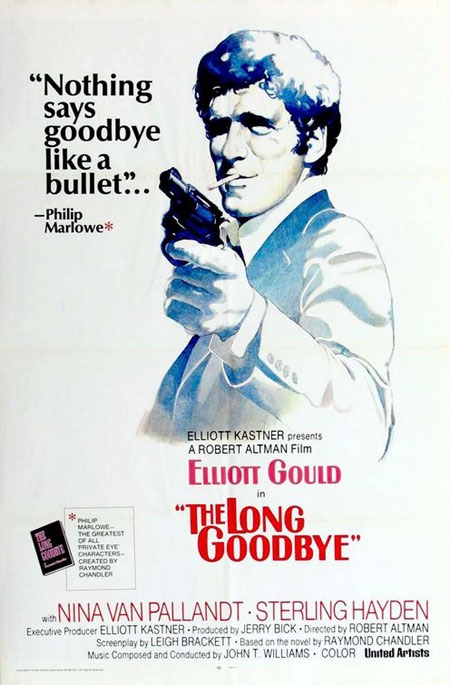
Robert Altman’s Phillip Marlowe (Elliot Gould) isn’t a hard-bitten cynic but rather, a seemingly scattered, chain-smoking hippie in a suit (his mantra? “it’s okay with me”), as bemused by the conservative cops who roughly bring him in for questioning (“Someday all the pigs are gonna’ be in here and all the people are gonna’ be out there. You can bet on that. You’re not in here. It’s just your body”) as the perpetually stoned yoga nudists who are his neighbors (“They’re not even there. It’s okay with me”). The truth is that much is decidedly not okay with Marlowe, in particular, his being used by old friend Terry Lennox (former NY Yankee pitcher and baseball whistleblower Jim Bouton) after the mysterious death of Lennox’s wife.  As Marlowe floats through a Los Angeles that feels desolate and burnt out, he moves closer and closer to the truth, navigating the authorities, hangers-on and brutes while standing by his friend.

Mark Rydell, who later became a decent director (Cinderella Liberty, On Golden Pond), stands out as a particularly chilling gangster who peppers his threats with loopy new age nonsense and boasts about his physical fitness regimen and the fact he lives near Nixon.

Altman and screenwriter Leigh Brackett aggressively revamp the source material, but Marlowe is still Chandler’s in many ways.  He needles the cops (“Is this where I’m supposed to say, ‘What’s all this about?’ and he says, ‘Shut up! I ask the questions’?”), can shake from his seeming fog to register a keen read on the situation, and when he arrives at the end of the journey, he is all Chandler’s Marlowe, with his own unyielding code.

Critic David Ehrenstein once told me that The Long Goodbye “was” Los Angeles and while the film doesn’t figure prominently in Los Angeles Plays Itself, it’s hard to argue it doesn’t have Hollywood in its marrow. Movie memorabilia can be found in Marlowe’s otherwise bare bones apartment (which was just recently available for rent), presumably from a prior occupant.  The security guard at a gated ocean community specializes in impressions, from Barbra Stanwyck to Jimmy Stewart to Walter Brennan.  The score is some version of the torch song “The Long Goodbye”, be it Muzak in a supermarket or a cocktail lounge piano number, the same ditty re-packaged as only Hollywood can.  Son of Old Hollywood Robert Carradine shows up as a jailhouse prophet and Altman exhibits prescience in his casting of Arnold Schwarzenegger as a mute thug.  LA itself seems an otherworldy ghost town, where everything seem to be trying to pass as a facsimile of the real thing.  As Ehrenstein noted, “Back then the city was a sprawling, sleepy, empty place — Altman’s The Long Goodbye capturing its ultra-casual look and feel perfectly.  ‘But there’s nothing there,” my east coast friends would say”).

This is a seminal picture, and a prime example of reinventing a genre.

It is a blessing to have children who like movies. We watched this classic John Huston film last night with my daughter, a movie I saw with my father in the theaters in the 70s. Based on a Rudyard Kipling short story, Michael Caine and Sean Connery are old vets in British India, cynical, loyal to each other and avarice. They make a compact to traverse Afghanistan to its upper northwest, into the wilds of Kafiristan, with provisions and weaponry to lend their talents as mercenaries. In doing so, they brave avalanches and the warring locals, and after allying with one in particular, Connery is deemed a god by virtue of an arrow that failed to pierce his heart and a Mason’s necklace.  It all goes to his head.

The sweep of the film is broadly romantic, though, visually, it suffers in comparison to today’s epics due mainly to technical advancement. Caine and Connery are very well-matched, and though Connery’s seduction and their estrangement is a bit rushed, their bond at the end is actually quite moving. This is a throwback adventure film, deliciously retrograde in attitude; the Brits are charming rogues and everyone around them is a cowardly or fundamentalist savage. As Vincent Canby wrote at the time, “Gloriously old-fashioned in its approach – right down to the characters’ politically incorrect attitudes toward anyone who isn’t one hundred per cent British – The Man Who Would Be King is pure entertainment in the grand tradition of Gunga Din.” The film would never be screened on an American campus today, but oh what fun if it were.

I was alerted to this film by David Thomson’s tribute to its writer, R.I.P. Alan Sharp, a Writer Too Dark for Hollywood.  Thomson credited two Sharp films, Ulzana’s Raid and Night Moves:  “Neither of them was nominated for anything, and only Ulzana’s Raid did any business.  But if you want to experience the richness of American films in the early 1970s, they are worth tracking down. You will be surprised how complex they are and how tense. They seem to understand movie narrative in a way so few films do today: He used mystery to draw audiences into his stories, trained them to answer the small puzzles, and then had them ready to grasp the implications he preferred not to underline. And both films are tough, bitter, and bleak, bearing the imprint of an unusual and talented outsider.”

Whenever we watch a movie from the 70s, my wife sighs and asks, “Is everybody going to die in this one?”  Night Moves is indeed a dark film, but Thomson is also dead-on in identifying its allure.  Gene Hackman plays a former pro football player turned private detective who is hired by an aging Hollywood not-quite-a-star (a dissipated but crafty Janet Ward) to find her wayward 16 year old daughter (Melanie Griffith, reprising her jailbait, tart role in The Drowning Pool, minus the malevolence).  Griffith has taken flight, bouncing between movie sets in Arizona and her creepy stepfather’s (John Crawford) compound in the Florida Keys.  In the meantime, Hackman discovers that his wife (Susan Clark) is having an affair, so he is in essence conducting two investigations, only one of which is really private.  The picture is leisurely and intricate, until, as Thomson notes, a “deeply upsetting” end.

Hackman turns in an interesting version of the traditional private investigator, part canny but part limited.  He is clever, but not the sharpest knife in the drawer.  He’s also very human, a vulnerability.  Along with Elliott Gould’s Phillip Marlowe in Robert Altman’s The Long Goodbye, Hackman’s p.i. is a marked and welcome departure from the type.

Sharp’s dialogue is noteworthy, especially in some of the exchanges between Hackman and Clark as they confront the state of their marriage and the import of her infidelity.  Hackman is also given some wonderful lines:

Ward: Are you the kind of detective who, once you get on a case nothing can get you off it? Bribes, beatings, the allure of a woman…

Hackman: That was true in the old days. Before we had a union.

* * *

Paula: How do you resist Delly?

Hackman: Oh, I just think good, clean thoughts, like Thanksgiving, George Washington’s teeth.

* * *

Crawford: (on his nubile stepdaughter Griffith)  You’ve seen her.  God, there should be a law.

Hackman:  There is.


image

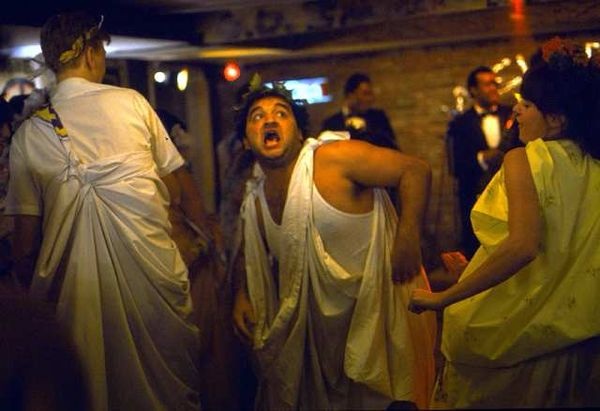
We were invited to the 50th birthday party of an old friend this weekend, and the theme was Animal House. In preparation of attending as Boon (Peter Riegert) and Katy (Karen Allen), my wife and I watched the movie to identify what they wore in the hopes of being identified as the characters. Our specific goal was delayed by our enjoyment of the movie, which neither of us had seen for twenty years or more.  It is sharply written, consistently inventive and enhanced by dozens of astute comic performances.  John Belushi’s physicality tends to get the lion’s share of accolades, but I’ve always been a bigger fan of Dean Wormer (John Vernon), who was chosen after Jack Webb turned the part down, and the pot-smoking Professor (Donald Sutherland), who took a $50,000 paycheck instead of the offer of 15% of the gross, a decision I’m certain haunts him to this day (the movie went on to gross $141 million).  His plaintive plea to his class is still one of my favorite moments of the movie:

Perhaps the greatest joy in these repressed, politically charged times is its dogged insistence on political incorrectness. Today, there would be a line of $46-an-article on-line ‘zine shitheads excoriating the film for its casual racism, sexism, insensitivity to the mentally disabled, and homophobia.   I can see the clickbait banners now:

“Animal House: The Genesis of the UVA Scandal”

“Nearly 40 Years Later, and We’re Still Laughing at Animal Cruelty”

“Animal House: A Frat Guy’s Birth of a Nation”

An effective spy thriller, in keeping with the post-Watergate cynicism and paranoia of so many American films (The Parallax View, Executive Action, The Conversation, Winter Kills). Robert Redford is a lowly CIA analyst at a New York City agency front (a historical society) who comes back from lunch one day to find all of his co-workers gunned down.  Redford goes on the run, commandeering Faye Dunaway, and as he flees the hitmen (led by Max Von Sydow) and negotiates with the Agency rep (Cliff Robertson), he woos Dunaway and uncovers the reason for the murders. Needless to say, that reason is of the times.

There are problems. Redford can be intense, but he cannot be harried or excitable. As such, he handles some pretty shocking developments in a discordantly world-weary way. As far as the plot, despite all the cloak-and-dagger, it’s very bare bones. The film is also horribly scored, sporting a 70s saxophone that makes the dullest love scene ridiculous. Redford and Dunaway don’t seem to be having sex so much as playing the “who blinks first” game.

Dunaway, however, is quite good, managing to convey a captive’s ability to bond with her captor, and as an Agency “contractor”, Von Sydow is understated and interesting. Robertson is also given respect, even though he’s ostensibly the government baddie. His speech to Redford at the end is a fair defense of the dirty tricks spy trade:

As Director Sydney Pollack noted about Robertson’s character, “I’m much more interested in the CIA guys who are trying to help us and do something [widely considered] immoral than I am about guys who are just immoral because they want to sell dope and make money. That’s boring to me. It’s much more complicated to say, here’s a bunch of guys whose job it is to protect us and they’re saying there’s no way we’re going to sell the fact that the Middle East [states] control the oil and if we don’t get control of the oil and they [seize its production], we’re going to end up with what we have now.”  Now, juxtapose Pollack’s view of Robertson with Oliver Stone’s Wall Street creation, Gordon Gecko, who at the height of his megalomania, answers a question as to why he wants to wreck a company with, “Because it’s WRECKABLE!” and you’ll understand why that film travels so poorly.

Pollack also makes great use of grimy 70s New York City – the World Trade Center figures very prominently in the film. More Pollack: “I was looking for the logic of where the [Central Intelligence Agency (CIA)] might be [located]. I didn’t want to have a building that said CIA on it because I didn’t think that would exist. I figured they would want some kind of anonymity and that the best kind of anonymity are these two massive buildings with thousands of offices and you wouldn’t know who’s where.”


50 Years Ago: 'The French Connection' Helps Kick Off '70s Cinema

Today, William Friedken’s 1971 Academy Award winner seems better-than-standard cop fare, but this is an extremely influential film, notable for its verisimilitude, grit and movement. Shot on the mean streets and ugly haunts of decrepit New York City, Friedken follows two detectives, Popeye Doyle (Gene Hackman) and Buddy Russo (Roy Scheider), as they try and take down a huge heroin shipment. No prior American film seemed as immediate or aggressive. Friedken’s camerawork is frenetic and edgy, and his virtuoso car chase scene is still one of the best in all of film.  Here is Friedken on the chase, which took 2 weeks to shoot.

Friedken’s insistence on visual authenticity extends to Ernest Tidyman’s script. Doyle is a casual racist and a simplistic bully, Scheider a slightly more pleasant accomplice. They are neither archetypes or anti-heroes. They’re just dogged, unremarkable cops. What is a little mystifying is the Best Actor win and Best Supporting Actor nomination for, respectively, Hackman and Scheider. These performances are almost 100% sweat, the equivalent of thespian calisthenics. There is no arc or development, and I don’t believe there has been this much running in any film save for Chariots of Fire, The Gods Must Be Crazy and any film about Steve Prefontaine.  Roger Ebert disagrees about Hackman’s performance, writing: “As Popeye Doyle, he generated an almost frightening single-mindedness, a cold determination to win at all costs, which elevated the stakes in the story from a simple police cat-and-mouse chase into the acting-out of Popeye’s pathology.”

Interestingly, Friedken didn’t want Hackman (they fought constantly and as Friedken writes in his memoir, “His outbursts [onscreen] were aimed directly at me… more than the drug smugglers”). But Paul Newman and Steve McQueen were too pricey, Peter Boyle objected to the film’s violence and Friedken’s first choice – Jackie Gleason! – was deemed unsuitable by the studio.

To the moon, drug dealers  To the moon!

Ranked 21 on AFI’s Top 100 films, Roman Polanski’s Chinatown opens with credits that suggest the romanticism of Rebecca, but what follows is a more cynical noir that reveals a pre-war Los Angeles rotten to its core. Private investigator Jake Giddes (Jack Nicholson) becomes embroiled in a snoop case that appears to be standard infidelity but the job embroils him in discovery of political corruption and sexual depravity. His client, Faye Dunaway, is hiding a horrible family secret that involves her titan of a father, John Huston. Giddes carries scars of his own, stemming from his time in the police force working Chinatown.

Polanski’s film is meticulously shot, presenting a classic LA that is mesmerizing and foreboding. Robert Towne’s script is taut and engrossing. Still, this is an overpraised film. Towne chooses to keep the demons of Giddes’ past a secret, which is ultimately unsatisfying, given how critical he is to the story. Moreover, the love affair between Nicholson and Dunaway is unconvincing, mainly because Nicholson is giving a modern performance, whereas Dunaway is mannered and breathlessly dramatic, as if they were working separate material. Nicholson is updating the tough talk of Sam Spade while Dunaway is embracing the older form. When Nicholson puts himself on the line for her, the act seems forced and inauthentic, and the closing line has the faint whiff of the Gouda.

A fine film but certainly not the 21st best picture of all time.

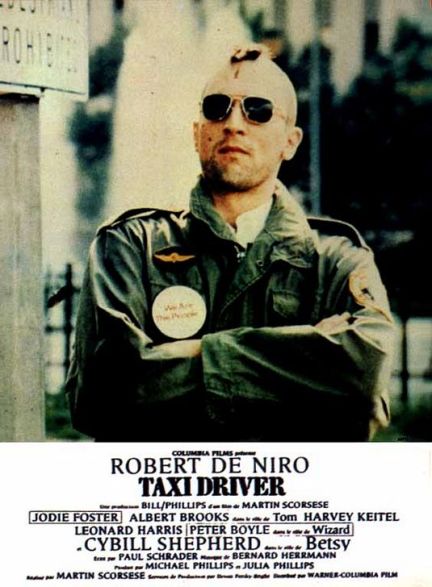
I was surprised to see several things in my recent re-viewing of Martin Scorsese’s classic, including Albert Brooks as the exact same character he has been playing for nearly 40 years; Scorsese himself making a Hitchcockian appearance in the background, but then taking a significant one-scene role as a lunatic in the back of Travis Bickle’s (Robert DeNiro) cab, suggesting he changed his mind about how much time he would spend in front of the camera; and the effectiveness of the score, which was Bernard Herrmann’s last one.

That aside, it holds up as the classic it is considered (47 on AFI’s Top 100). Scorsese’s New York is a modern hell.  He shoots the city so it almost reeks. Steam pulses out of the grates, rot is everywhere and kindness is non-existent (I couldn’t get a fantastic book, “Ladies and Gentlemen, the Bronx is Burning” out of my mind).  The viewer is immediately in kinship with Bickle’s voiceover, “All the animals come out at night – whores, skunk pussies, buggers, queens, fairies, dopers, junkies, sick, venal. Someday a real rain will come and wash all this scum off the streets.” Bickle is a Vietnam vet who can’t sleep and teeters on the edge of sanity. When he falls for a campaign worker (Cybill Shepherd) merely by viewing her through a plate glass window, it seems creepy only until he approaches her, and then there is charm and hope. He is similarly touching with teen prostitute Iris (Jodie Foster), passionately replying to her taunt that he is a square: “Hey, I’m not square, you’re the one that’s square. You’re full of shit, man. What are you talking about? You walk out with those fuckin’ creeps and low-lifes and degenerates out on the streets and you sell your little pussy for peanuts? For some low-life pimp who stands in the hall? And I’m square? You’re the one that’s square, man. I don’t go screwing fuck with a bunch of killers and junkies like you do. You call that bein’ hip? What world are you from?”

But they are from the same world. Bickle is not wired right, he sabotages himself with Shepherd, and soon, he retreats into the mode of a dangerous and unstable assassin, one who has gone from observer of the inferno to an extinguisher. Ahead of its time, Bickle’s would-be John Hinckley gets a Bernie Goetz makeover, cementing Scorsese’s theme that in the jungle, there’s often but a hair between hero and lunatic, moral beacon and dysfunctional threat. Woody Allen’s Blue Jasmine doesn’t seem a natural comparison to Taxi Driver, but in essence, when it ends with Cate Blanchett in rumpled clothes, talking to herself in the park, the directors are exposing the same reality.

After seeing Harper as part of the AFI Silver LA Modern series, me and my son watched Paul Newman’s follow-up turn as Ross McDonald’s P.I. in 1975’s The Drowning Pool.  Lew Harper finds himself in New Orleans in the middle of a scandal involving an ex-love (Joanne Woodward), a sleazy oil man (Murray Hamilton) and a protective local police chief (Tony Franciosa).  Newman again gives an infectious star turn as the cynical but funny private detective brought into to town by Woodward to get to the bottom of her being blackmailed.  When Franciosa is impressed by his $150 per day plus expenses rate, Harper explains that it isn’t all that much when you work four days a year.

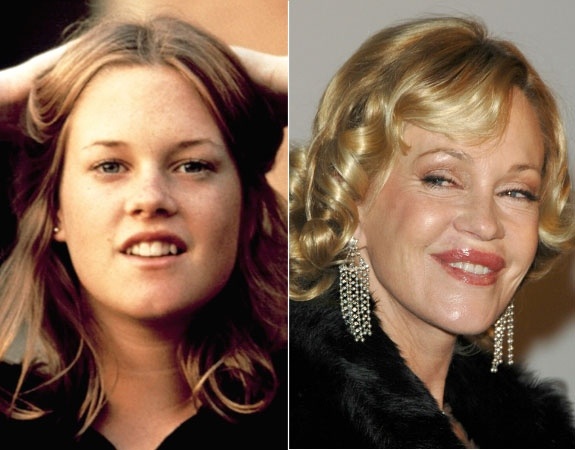
But the picture lacks too many elements that made its predecessor so good.  New Orleans ain’t LA, and while there is a certain fish-out-of-water charm to Harper’s investigation, the setting feels off.  The score is also very cheezy, alternating between musical interludes worthy of a Mannix or Barnaby Jones and an annoying symphonic riff of Roberta Flack’s “Killing Me Softly”.   Worse, Joanne Woodward’s Louisiana drawl is borrowed straight from The Long Hot Summer.  She’s ridiculous in her theatrics and a terrible replacement for Janet Leigh as Harper’s love interest. Hamilton does his best to give his character some flavor, and an 18 year old Melanie Griffith is an alluring near-jail bait, but most everyone else is either histrionic or blah.

While Woodward is a step down, Griffith as the poisonous Lolita is a significant upgrade from Harper’s Pamela Tiffin.

And a reminder of the horrors of plastic surgery.