Archive

00s

The Coen Brothers have taken many stabs at comedy, with varying results. On the plus side, Raising Arizona is a wild, human cartoon, with performances by Holly Hunter and Nick Cage approximating Claymation; Intolerable Cruelty an amusing facsimile of a screwball comedy; and The Big Lebowski a whimsical, goofy trip. The Ladykillers however, was a dud, The Hudsucker Proxy an ornate mess, and A Serious Man too self-loathing to support interest, much less humor.

The best of the bunch, by far, is 2008’s Burn After Reading, a crisp, tight ensemble that melds madcap and cloak-and-dagger. The story is too elaborate to capsule, but the tale – intersecting vanity, intrigue, the CIA and personal fitness – is almost besides the point. The actors could have let the serpentine twists carry the day, but to a person, they invest silly characters with pathos and even gravitas.  George Clooney’s philandering everyman goes from loathsome to sympathetic and is almost admirable in his pathological ardor. John Malkovich’s rage-filled civil servant stands in for all us “surrounded by idiots”, especially when we are introduced to his brittle, scheming, focused wife (Tilda Swinton). Frances McDormand’s novice blackmailer is annoyingly hilarious yet almost tragic in her desperate fights for companionship and against the ravages of time. And Brad Pitt, as her dim but lovable accomplice, should have been nominated for Best Supporting Actor. There is not a scene he doesn’t steal, and the one where he must contend with a maniacal Malkovich is one for the ages.

“You think that’s a Schwinn.”


I normally watch this during the holidays, but it is now on the HBO rotation, and I’ve been enjoying it in segments. Based on Nick Hornby’s novel (Hornby was also one of the screenwriters), this is a fine story of a charming but vacuous and intentionally isolated rich guy (Will, played by Hugh Grant) who corrals a neighborhood boy into playing his son in the hopes it will impress a romantic target. He is soon brought into the boy’s world, against all his selfish instincts.

This is a very funny film.  The comedic set pieces (including a harrowing talent show, the death of a park swan, and awkward support groups) are masterful.  The narrative is punctuated by voiceovers from Marcus or Will, and their observations are either hilarious or sentimental. The message is A Christmas Carol – no man is an island, and we are defined by how we treat each other, but for every sweet note, there is an arch counterpoint. My favorite is Will’s voiceover upon meeting Marcus’s earthy, liberal, disapproving mother, Fiona (Toni Collette) over lunch, where he lords his non-vegan ways by ordering steak while, in his mind, deriding her Yeti-like sweater.

About a Boy – 5 stars | filmvetter

Grant is usually reliant on an affected, stammering, faux-shy schtick (his performances in Notting Hill and Love Actually are of this stripe; cloying and relentlessly puppydog). But here, he’s pretty much a dick, playing Will as someone who enjoys a relationship only to the extent it provides him an opportunity or the solace of being kind-hearted. Once there is heavy lifting, he is out, as Grant explains:

Grant is really quite good in the role, especially upon the realization that he is worth nothing in this world. Nicholas Hoult plays Marcus with a sweet perseverance that never once smacks of child-actor manipulation, and Collette is truly vulnerable as Marcus’ crunchy, depressed mother, who is oblivious to the needs of Marcus, his desperation to save her, and the burdens she places on his shoulders.

It’s also heartening to know that poor, sweet Marcus

has grown up to date

Justice.

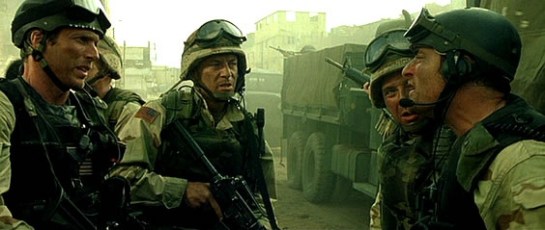
Ridley Scott’s depiction of The Battle of Mogadishu communicates the warrior culture, the confusion of urban battle, the domino effect of error therein, and the strain on its combatants. In 1993, after upwards of 300,000 Somalis perished through civil war-induced starvation, the U.S. sat on the ground in Somalia to support U.N. humanitarian efforts while attempting to capture the warlord Aidid. The movie recreates a mission to capture some of the warlord’s top lieutenants, a mission that unravels after two Black Hawk helicopters are shot down in the city and the goal of quick extraction transforms into a desperate rescue to the crash sites as the city inflames.

The film is astonishing in several respects. The mission itself is complicated, and in support, there are four squads (“chalks”), of which Josh Hartnett commands one, with all four being under the direction of Jason Isaacs; a motorized convoy led by Tom Sizemore; numerous helicopters, including two piloted by Ron Eldard and Jeremy Piven shot down by RPGs; a single helicopter acting as spotter for all action on the ground (that spotter being Zeljko Ivanek); and a command center helmed by Sam Shepard. Included is this vast ensemble cast is Eric Bana, Ewan McGregor, William Fichtner, Iaon Gruffud, Orlando Bloom, Hugh Dancy, Nikolaj Coster-Waldau, Tom Hardy, and Ty Burrell (it is a testament to the vagaries of a Hollywood that a post-Pearl Harbor Hartnett got his name above the title during the closing credits). Despite all of these moving parts in the midst of a confusing, hellish street-by-street battle, the viewer is never confused. You know who you are looking at, why they are there, and what has gone wrong with the objective at all times. Lesser directors can be flummoxed by a minor shoot-out in a western town.

The film won Oscars for sound editing and sound mixing. Given the melee, changes in topography and vantage point, it is nothing less than aural masterpiece.

Some critics took Scott to task for reducing the Somalis to props and/or cannon fodder. Much of that, however, is unavoidable given the disparity in firepower and casualties (18 American dead and 80 wounded to an estimated 1,500 to 3,000 Somali casualties) and the focus of the Mark Bowden book upon which the flick is based (the Somali view is barely represented and boiled down to a bromide in the film – “there will always be war . . . killing is negotiation”).

If there is a flaw, it is in Scott’s need for a message.  There is no political angle, and the aftermath is equivocal. On a broader scale, some might say we should never be in such a place, others might disagree but insist upon a defined goal, and still others decry the abrupt withdrawal after the battle as having elevated optics over lives (Osama bin Laden himself opined that the withdrawal showed American weakness). I’m perfectly happy with a conclusion that supports any stance, but happier with one that leaves a conclusion to the viewer.  But Scott fixes on an ultimate theme: that battle is first and foremost about the man next to you. After two-and-a-half hours of white-knuckle survival with the soldiers, the message is more than delivered. But just in case we missed it, Bana says exactly that to Hartnett.  Clunk.

There simply hasn’t been a better satire since . . . well, since South Park: Bigger, Longer and Uncut. Matt Stone and Trey Parker carve up American idiocies and icons, and as is their custom, they fear no maven of political correctness nor do they take the easy shot. Of course, they do that sort of thing regularly on South Park, but not with puppets, and not with Broadway-worthy anthems. Offensive on almost every level, from the hilarious spoof of Rent (Lease) and its signature song (“Everybody has AIDS!”) to the jingoistic, red-white-and-blue power chordy

Casting marionette Alec Baldwin as not only the greatest actor ever, but also the head of a subversive Film Actors Guild (yes, F.A.G.) is genius, and if you’ve ever wanted to see the coterie of noxious celebrity dunces portrayed as members of a S.P.E.C.T.R.E.-like organization, only to get their comeuppances in the form of horrifically violent deaths (as marionettes, mind you), you’re in for a special treat.

Susan Sarandon is particularly good:

Apparently, Sean Penn was offended, but Sean Penn was offended when Chris Rock poked fun at Jude Law during the Oscars.

Be warned.  If you supported the ouster of Baldwin from MSNBC because of his homophobic broadsides against paparazzi, or you were hurt and dismayed when that woman on MSNBC made fun of the Mitt Romney family photo, or Rush Limbaugh’s broadsides against just about anyone furrow your brow and get you thinking about “positive action” or “inclusion” and “dialogue”, or the recent South Park where the boys cannot comprehend that anyone would name a psychological condition “Assburgers” made you think, “Where is the FCC in all of this to protect the children?”, this is not the film for you.

Or, it’s a necessity.

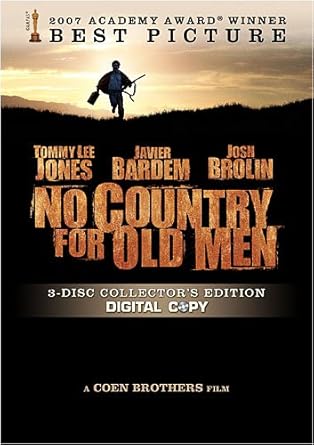
The Coen brothers’ finest film, a gritty, nerve-wracking crime story and an existential horror movie set in the harsh and desperate environs of dusty, bleak Texas.  Josh Brolin takes the wrong money from the wrong drug dealers, victims of a cocaine buy gone bad, after he happens upon their slaughtered bodies while hunting.  Javier Bardem is dispatched by the higher-ups to get it back, killing most everyone he encounters along the way (including rival bounty hunters sent by his employer).  The pacing is taut, the terror near-asphyxiating.   But interwoven in the story is a sense of generational disconnect, rot and the utter bewilderment of an older generation at the brutality and senseless violence of the new.  An observation from a friend is also spot on: “I thought the most important theme in the movie was that older men gradually lose contact with their country, and that this sad fact has nothing to do with the objective reality of what’s happening but is the natural consequence of getting older.”

Set in 1980, the young are depicted as callous and corrupt.  Brolin, shot and desperate to get to Mexico, encounters kids on the border bridge returning to the U.S. after a night of carousing.  He offers to buy a shirt from one of the trio to cover his bleeding, but they quickly demand money, and when he asks for a beer, they want more.  Similarly, at the end of the film, two boys encounter a wounded Bardem and bicker over the share of what he has given them for a shirt.

The Vietnam generation is represented by Brolin and Woody Harrelson, the latter sent to bring Brolin in before Bardem gets to him.  Brolin is not exactly honorable but he still maintains a tie to some principles.  He literally awakes with guilt because he can’t let a dying drug dealer go to his end without water, and it is that charity that brings Bardem his way.  Harrelson, also a Vietnam vet, has a similarly flexible code (he is a killer), but at least there is some code there.  As he says to Brolin about Bardem: “You can’t make a deal with him.  Let me say it again.  Even if you gave him the money he’d still kill you.  There’s no one alive on this planet that’s had even a cross word with him.  They’re all dead.  These are not good odds.  He’s a peculiar man.  You could even say that he has principles.”  When Brolin returns from Mexico, still hobbled but intent on stopping Bardem, a border guard lets him through on the strength of Brolin’s Vietnam service.

Then, there are the old men for whom there is no longer a country.  Tommy Lee Jones and his law enforcement contemporaries just don’t get it.  It’s all gone to hell and a hand basket and while they understand violence, they don’t understand the new violence.  As Jones says, bewildered, reading the paper: “Here last week they found this couple out in California they would rent out rooms to old people and then kill em and bury em in the yard and cash their social security checks.  They’d torture them first, I don’t know why.  Maybe their television set was broke. And this went on until, and here I quote… ‘Neighbors were alerted when a man ran from the premises wearing only a dog collar.’ You can’t make up such a thing as that. I dare you to even try.”

It is not Jones’ world anymore (my favorite Jones musing was from Cormac McCarthy’s book – “She kept on, kept on. Finally told me, said: I don’t like the way this country is headed.  I want my granddaughter to be able to have an abortion.  And I said well ma’am I dont think you got any worries about the way the country is headed.  The way I see it goin’ I dont have much doubt but what she’ll be able to have an abortion.  I’m goin’ to say that not only will she be able to have an abortion, she’ll be able to have you put to sleep.  Which pretty much ended the conversation”).

The film ends with Jones driven to retirement, talking to other older lawmen about what it all means:

Roscoe: It’s all the goddamned money, Ed Tom. The money and the drugs. It’s just goddamned beyond everything. What is it mean? What is it leading to?

Jones: Yes.

Roscoe: If you’d a told me twenty years ago I’d see children walkin the streets of our Texas towns with green hair and bones in their noses I just flat out wouldn’t of believed you.

Jones: Signs and wonders. But I think once you stop hearin’ sir and madam the rest is soon to follow.

Roscoe: It’s the tide. It’s the dismal tide. It is not the one thing.

And the end of the film, Jones has retired (he’s done, “overmatched,” he says) and he sits with an older retired lawman, Barry Corbin, who observes, “All the time you spend tryin to get back what’s been took from you there’s more goin’ out the door.  After a while you just try and get a tourniquet on it.”

And the coda:

Corbin: You’re discouraged.

Jones: I’m… discouraged.

Corbin: You can’t stop what’s comin.  Ain’t all waitin’ on you.

Bardem is what is waiting on us all. Certain, unstoppable, arbitrary death.

This is a beautiful, unrelenting movie, deservedly winning Oscars for best picture and supporting actor for Bardem.

Guillermo del Toro’s fairy tale is a rebuke to the taming of the Brothers Grimm.  His story of a young girl, Ofelia, is set at the tail end of the Spanish Civil War.  She has just been brought to the camp of her new father, Nationalist fascist Captain Vidal, by her pregnant mother.  The former is a sadistic, obsessive-compulsive, suicidal and the latter is simply desperate to have found a protector in the new Spain.  Ofelia escapes to the nearby woods of Vidal’s headquarters, and a world of faeries, fauns and monsters who give her arduous, often terrifying tasks that offer her majesty in a fairy tale land.

Unlike del Toro’s The Devil’s  Backbone, the films’s forerunner, the war makes a more pronounced, visceral appearance.  Vidal is cartoonishly vicious, obsessed with the birth of his son and a new Spain, bent on torture and extermination not just of his enemies, but of those who would infect the future. It borders overkill, but with with half of the deaths in the war attributed to executions and murder of the defenseless, the depiction is apt. The fate of Vidal’s son is del Toro’s rebuttal.

The film is visually stunning (it won Oscars for art direction, cinematography and makeup) and movingly juxtaposes the brutality of the war with Ofelia’s hidden place. But del Toro doesn’t make Ofelia’s choice easy.  Her fantasy world can be every bit as treacherous and horrifying as the war she seeks to escape.  In particular, Pale Man, who guards the quarry of Ofelia’s third task, is one of film’s most frightening visions (and has a gait similar to that of Mama, the spook in del Toro’s last film).

And you can be Pale Man at home!

The World’s End, the third installment of Director/Writer Edward Wright and Writer/Lead Simon Pegg’s Three Flavours Cornetto trilogy, melds their two prior comedies. There is the apocalyptic vision of Shaun of the Dead, as a troupe of 40-something high school mates (led by Pegg) take another shot at an epic pub crawl, only to learn that their pastoral hometown as been infiltrated, not by zombies, but by robots. There is also the town itself, which has become a sterile, cookie-cutter environment, not by the hand of the secret community beautification cult of Sandford, as in Hot Fuzz, but by aliens. All three films feature the great buddy tandem of Pegg and Nick Frost, Wright’s Abbott and Costello, but in The World’s End, Frost is the responsible member of the duo (a barrister, if you can believe it), until Pegg’s jabbering and the tenacity of the robots transform him into an unstoppable robot-killing machine.

These are great joy ride films, with inspired action sequences punctuated by some very funny lines. Forced to choose, I’d have to put Hot Fuzz at the top, if only for the best movie shootout ever, the beginning of which is below:

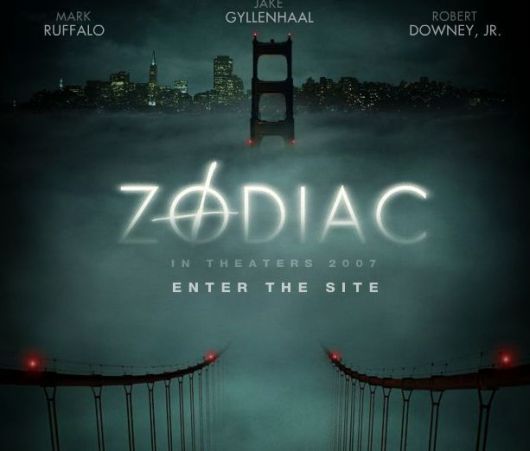
I would have given a great deal to have been at the studio screening of David Fincher’s Zodiac. I wonder who said first, “You mean, this movie is almost 3 hours and we never definitively learn whodunnit?”

The 1969-1970 Zodiac killings are unsolved and at least by serial killer standards, the Zodiac racked up a meager body count (only 5 victims are confirmed as by Zodiac’s hand).  Nonetheless, these narrative infirmities are more than compensated for by the killer’s panache.  Zodiac taunted the police departments of four different Northern California communities with letters to newspapers, including ciphers to be broken which promised to reveal his identity and wild threats (including one to shoot San Francisco kids as they left school buses). Like Jack the Ripper, the Zodiac wanted to lord his superiority over his pursuers.

Fincher takes the Zodiac case and uses it to dramatize exactly how such a crime burrows itself into the marrow of people, altering them profoundly. Jake Gyllenhaal is The San Francisco Chronicle cartoonist Robert Graysmith, who becomes obsessed with the killer the day his first letter to The Chronicle appears. Graysmith would eventually write the definitive book on the Zodiac, and as played by Gyllenhaal, he is sucked into the mystery to the near exclusion of all else. Robert Downey, Jr. plays Paul Avery, the Chronicle crime reporter who covered the case and received a threatening letter from the Zodiac. Avery had labeled the Zodiac a latent homosexual and the Zodiac wrote him a Halloween card warning, “You are doomed” (which resulted in the staff of The Chronicle creating buttons emblazoned with “I Am Not Paul Avery”).  Downey’s Avery is driven from The Chronicle, to drink and drugs and despair, exacerbated by his fear of the Zodiac. The two police officers assigned to the case are also damaged. William Armstrong (Anthony Edwards) eventually transfers to another division while Dave Toschi (Mark Ruffalo) is at one point accused of forging a Zodiac letter (he was cleared of all charges).  There are also the survivors. The Zodiac attacked 3 couples while they were alone and vulnerable, but two men survived, one of whom was the only living person to see the Zodiac. He is a shell, having escaped the country, found at the end of the film to provide one final clue.

The psychological study is encased in a meticulous yet accessible procedural. Screenwriter James Vanderbilt keeps myriad threads intertwined without sacrificing pace, no mean feat given a multi-jurisdictional crime reverberating in the worlds of the police and journalism.

Fincher re-creates those crimes in a manner that communicates their terror and the vulnerability of the victims without being sensationalist or gratuitous. Indeed, the most frightening scene is one where no violence is done. Five months after his last killing, the Zodiac killer pulled over a woman with her baby on a highway, letting her know her back tire was wobbly. He feigned assistance by tightening the lugnuts, but the wheel fell off immediately after she got back on the road. The killer came back, offered to bring her to a service station, but instead drove her around until she was able to escape into a nearby field with her baby (the connection to the Zodiac was made after he referenced the encounter in a letter to The Chronicle a few months later).

It’s hard to imagine that the director of the gruesome Seven made this picture, which is restrained, methodical and to my mind, infinitely scarier. Having to turn away and shut your mind off has less of an effect than when you cannot do so and you’re required to think.

This film has just recently been offered for streaming on Netflix so take advantage.

Released in 2005, The 40 year Old Virgin is raucous, frank, funny, well-grounded, and fortified by the sweet lead performance of Steve Carell. Carell, a 40 year old technician at an electronics chain, is a lonely man-child, surrounded by mint-condition action figures and video games. His younger co-workers (Paul Rudd, Seth Rogen, Romany Malco) learn he is a virgin and push him out in the world so he can “bust a nut.” They each have their own theories, which are terrible, but Carell does happen upon a young grandma, Catherine Keener, and a romance develops. It all ends well in a joyous finale, a brilliant post-coital rendition of “Aquarius” and one of the finest ends to any film.

This is a roller coaster ride of potential mates (the criminally drunk Leslie Mann, the creepily seductive Jane Lynch, and the sex freak Elizabeth Banks) and inevitably disastrous consequences.

Everyone is funny, including Jonah Hill, David Koechner, Kevin Hart, and Carell’s mate from The Office, Mindy Kaling, even in the briefest of scenes. The milieu – young working stiffs in retail – also lends itself to not only hilarity derived from the vagaries of the job, but communality. The bro’ talk is sharp and true, if occasionally overdone, but is counterbalanced by Carell’s sweet humanity and earnestness.

Fast forward 7 years.  Apatow is a film titan, producer of 14 movie comedies and two TV series, but director of only 3 feature films. His fourth is the execrable This is 40.  Gone is the working world and the empathetic center of a lost boy.  Instead, Rudd reappears in rich California suburbia, a struggling indie record company owner whose financial pressures still allow for nights away with his craven, hissing, shrewish wife (Mann) in what has to be a $1000 night oceanside resort. So much for communality.

Worse, the film is populated by unfortunate and unfunny characters. Rather than finding common cause or sympathizing in their plight, an exalted Apatow mocks them through his condescending leads. And as it all unravels, he amps up the gross-out factor to the point where Rudd is spreading his legs, demanding that Mann inspect his asshole for polyps or fissures.

Ah, success.

Search Results for gangs of new york GIFs on GIPHY | Gangs of new york,  Leonardo dicaprio, Gang

Martin Scorsese’s sprawling, excessive period piece, set in The Five Points of Civil War era New York City, is almost punishing in its immoderation. A directionless Leonardo DiCaprio works his way up the ladder of nativist gang chieftain Bill “the Butcher” Cutting (Daniel Day Lewis) to avenge the death of his father, Liam Neeson, who died at Cutting’s hand when DiCaprio was a boy. Scorsese sought to offer a steamy, vibrant and bloody portrait of the slum that was lower central Manhattan, but the feel is inauthentic and verisimilitude is overcome by the garish. The opening scene – the gang fight resulting in Neeson’s death – plays as a mash up of Walter Hill’s The Warriors and a really violent version of West Side Story. You almost expect Neeson to sing, “The Dead Rabbits are gonna’ get their way, toniiiiiight!” as he brings his crew to battle.

If only. The story is deathly dull, duller even than the featured Cameron Diaz, horribly miscast as an Irish lassie/grifter (her accent comes and goes like the viewer’s interest).

Day Lewis’s performance is widely lauded and he was nominated for a best actor Oscar, but he is so over-the-top as to appear foolish. Still, scene-chewing is bound to garner easy accolades, and Day Lewis is voracious. More surprising are the nominations of the phlegmatic script and Scorsese’s aimless helming. The film meanders, half-heartedly committing to DiCaprio’s vengeance but then veering into historical re-creation, such as the machinations of Boss Tweed and the draft riots. The former plot line is marred by DiCaprio’s sullen, disinterested performance, the latter by pat conclusions (including a pretentious morphing of old and new Manhattan that closes the film and nearly induces the gag reflex).

By the time Gangs of New York was released, Scorsese had suffered the indignities of having his classic Raging Bull lose to the tepid Ordinary People and Goodfellas go down to the overpraised and politically acceptable Dances with Wolves and certainly, the Academy felt bad about that. But guilt is a bad adviser, and this is Scorsese’s worst film (though the dull and similarly overpraised Hugo and the bruising Shutter Island are close seconds).