Archive

00s

Sunday was a lazy day, watching whatever came on and doing squat. I dusted off the serious tone of Doubt with one of the funniest romantic comedies I’ve ever seen. The nucleus of the hilarity is the relationship between Owen Wilson and Vince Vaughn, two domestic relations mediators who crash weddings, and thereby, rather effortlessly bed the bridesmaids and other female guests with their practiced charms. Sure, the sex is good, but watching them savor the mini-crab cakes, woo the kiddies with balloon animals or cut the rug with granny, feels like an equivalent joy. The moves are practiced, the aim morally questionable, but the love of it all is there.  

They crash the mother of all weddings, that of a daughter of the secretary of the Treasury (Christopher Walken), where Wilson falls head over heels for another daughter (Rachel McAdams) while the third (Isla Fisher, who is somewhere between effervescent and lunacy) takes a shine to Vaughn. Wilson and McAdams flirt madly, and he saves her from a “too-snarky by a million” wedding toast. Vaughn and Fisher expedite matters, as he seemingly deflowers her at a secluded cove near the reception (which, if memory serves, was the Inn at Perry Cabin in St. Michaels, MD). Naturally, Vaughn wants to flee (one of the bazillion rules of wedding crashing is that there be no emotional involvement or connection after the reception), but out of loyalty to his fellow crasher and in their deception as distant family members, both are invited and go to the secretary’s Eastern Maryland home for the weekend. Hijinks ensue.

Wilson and McAdams are really quite convincing and warm. Chemistry goes a long way and they have it in spades. But the real love story is that of Vaughn and Wilson, who have such a genuine and easy connection that their banter elevates above the normal bro’ babble – these guys really love each other, and their interplay is always very funny and strangely moving. My favorite scene:

They elevate an incredibly hilarious and smart comedy where even without their intimacy, it would be hard to pick the scene that makes you laugh the most, be it the over the top family touch football game (Wilson’s nemesis is a young Bradley Cooper, who exerted stardom even then as the eco-friendly, psychotic heavy) or Wilson, having fallen out with Vaughn, hooking up with the Edison of wedding crashing, Chaz (Will Ferrell), who lives with his Mom and has moved on to funerals.

Whenever I see Vaughn in this flick, I think of my oldest and dearest friend, 40 odd years now, my own big guy who wants to bring it in with the big paws and the hug, Leo

Total blast. And a great montage song straight out of the rom-com bin
As a social experiment, I would like to run this movie at Oberlin or Brown during Pride Week. In preparation, it would probably be best to stock up on smelling salts, fainting couches, and emergency room personnel. 

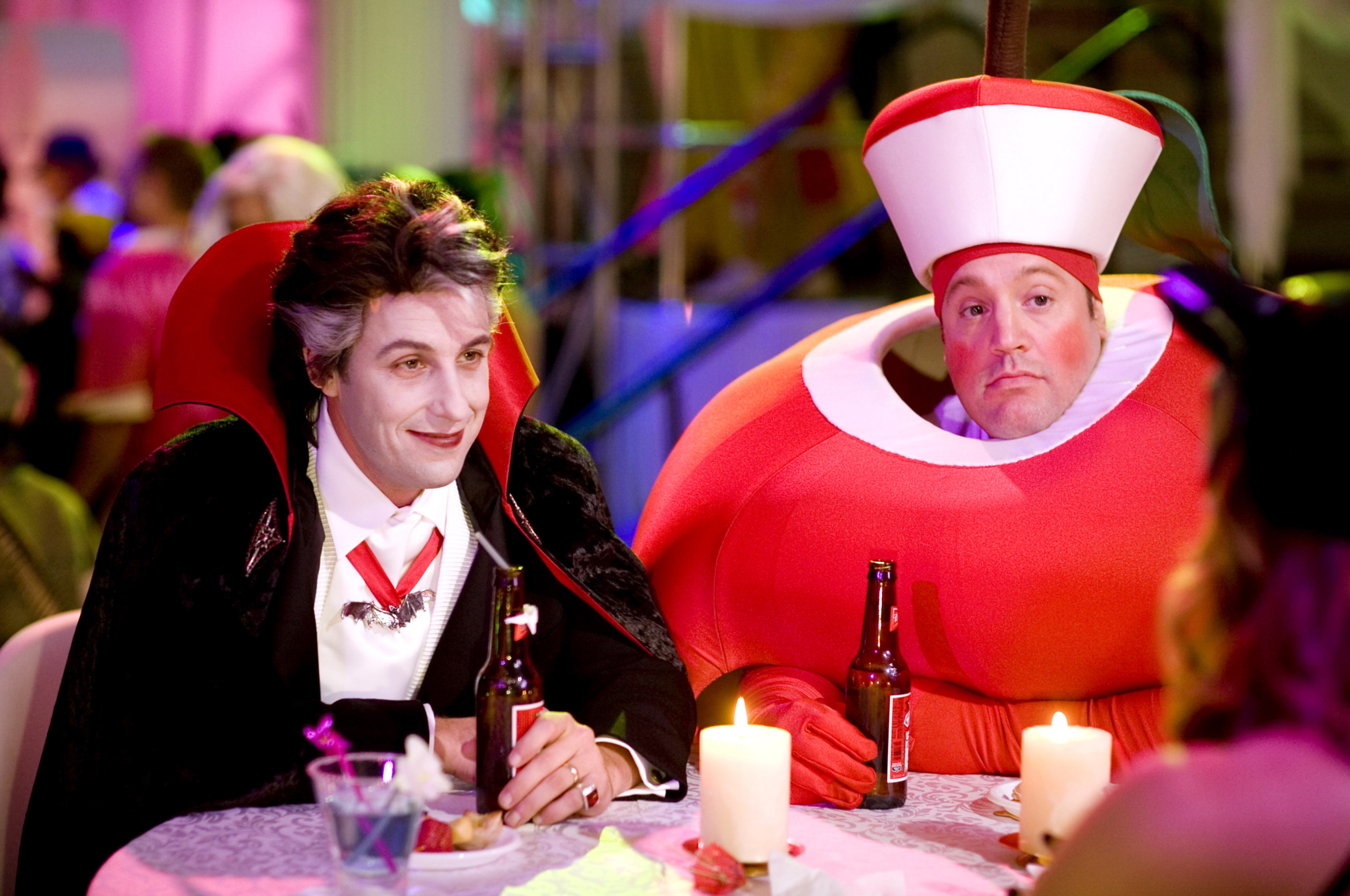
The set-up is standard Sandler. Two best friends and Brooklyn firefighters (Adam Sandler and Kevin James) pretend to be gay so they can establish a domestic partnership which will ensure benefits for James’ children. James is a widower. Sandler is a cocksman, bedding Hooters gals 5 at a time.

But then the city gets wind of the potential fraud, they must retain a beautiful lawyer (Jessica Biel) for whom Sandler falls, they become a cause celebre’, and hijinks ensue.

On the one hand, there’s scads of ass, tits, fart, balls, dick, poop, and pee jokes, overweight people are mercilessly skewered, and racial and ethnic stereotypes abound. No matter the subject or target, the Sandler brand is respected.

Indeed, this is the kind of landmine film that would normally result in serious reputational damage, like blackface. A few nuggets:

  • Rob Schneider plays gay and Asian. And by Asian, I mean, Bucktooth, Charlie Chan, as stereotypically offensive as it gets Asian. 
  • Dave Matthews plays in a wordless cameo where he mincingly makes eyes at Sandler. One can assume that his desire to make it to the big screen obliterated all judgment. 
  • When James goes to his child’s bring your father to school day, the following exchange occurs-

“Student:
Mr. Valentine, you said you’re a fireman.

Larry
Valentine: Yes, that is correct.

Student
Do you have two jobs? Because my dad said that you’re also a butt pirate.”

  • Dan Ackroyd plays their fire chief. His admonition? 

“Gentlemen, I have a very simple policy. What you shove up your ass is your own business.”

  • And when Larry springs his scheme on Chuck?

Larry
Valentine: Domestic partnership.

Chuck
Levine: Domestic partnership? You mean like faggots?

Larry
Valentine: No, I mean yeah but, no, not us. Obviously. Just on paper.

Chuck
Levine: Paper faggots?

Larry
Valentine: Well, the accepted vernacular is “gay”… but yes.

I mean, if Gone with the Wind requires a warning, this thing should come with a signed waiver. 

So, how did anyone who had anything to do with this film remain unscathed? I have thoughts.

First, the consistency of the folks with the torches and pitchforks has never been their strong suit. Some people get eviscerated, others get a pass. Here, everybody seems to have gotten a pass, which is to the good. I suspect the body count would have simply been too high.

Second, for all of its excess, the picture is “up-with-people, we-are-the-world” inclusive.  While the film luxuriates in its offensive stereotypes, it offers redemptions (unlike, say, Animal House, which is similarly politically incorrect yet doggedly cynical).  At the end, Ackroyd provides the necessary immunity:

No matter whom we choose to love, be they heterosexual, homosexual, asexual, bisexual, trisexual, quadrisexual, pansexual, transexual, omnisexual or that thing where the chick ties the belt around your neck and tinkles on a balloon, it has absolutely nothing to do with who we are as people.”

The fist of stereotype encased in the velvet glove of love.

Third, it is also not terrible. Like with Get Hard, I laughed more than I expected to and was impressed by the sheer gusto of James and Sandler. A solid A for effort if not execution. 

Fourth, the anti-gay bigots get a comeuppance (which is a word that, were it to be in the script, would soon be followed by “ass” or “butt”). Sandler even gets to play Harrison Ford amongst the Amish in Witness, because, as everyone knows, gay people don’t punch their tormentors, they only sass them. 

Finally, the picture was fortunate to precede the most recent spate of witch trials (see Bradley Cooper’s insensitive Jewish nose in the new Leonard Bernstein endeavor).  This is 2007, which seems modern, but it is almost a quarter of a century ago. 

Watch it.  It’s worth the time for historiographic purposes. And the ass, tits, fart, balls, dick, poop, and pee jokes.

I’ve seen this film, conservatively, a dozen times. I cannot turn it off. It is flawless, and I never tire of watching. It is not just an exemplary historical drama and period piece, which would appeal to me more than others, but it is one of the finest films ever made. 

Based on a Patrick O’Brian novel, it is 1805, the time of the Napoleonic wars, and we travel with Captain “Lucky Jack“ Aubrey (Russell Crowe), a protégé of Lord Admiral Nelson. Aubrey’s ship, The HMS Surprise, is hunted by, and then pursues, a French privateer with twice her guns and speed. As Aubrey drives his crew and spars with his more humanistic friend and subordinate, ship surgeon Stephen Maturin (Paul Bettany), we are immersed in the customs, allegiances and frailties of the crew.  Director Peter Weir (Witness) provides the feel of an early 19th-century war vessel, a routinized machine held together by the lash, grog, duty, honor, deep-seated universal superstition, and a shared sense of oneness with the sea.

The action sequences are jaw-dropping. The final sea battle is the most effective and stunning rendition of combat on film, save for the opening scene of Saving Private Ryan.  Weir is expert at close quarter action and translating the ebb and flow of a battle that has been explained in its strategy at the outset. What follows is a stunning, intelligible melee’, and the only respite is a brief, awesome aerial tracking shot to provide scope and a quick catch of breath. And then, Weir dives right back in.  The scene is even more impressive given the film’s commitment to authenticity.  As with Spielberg’s triumph, Weir has made, in the opinion of one reviewer, “one of the most historically accurate movies of this century”. 

Yet for all its visual delights and precision, the film is also memorable in its depiction of numerous secondary characters. Yes, the philosophical interplay between Aubrey and Maturin is well-honed, and both actors more than occupy the roles – their engagement is both familial and genuine, with a constant pull between friendship and chain-of-command. But the midshipmen, some as young as 12, and the salty crew, are the true stars. To see the former in such distress, under such pressure, and in the midst of terror and violence is heart rending. When one (Max Pirkis) must have his arm amputated, it is hard to choke back tears, such is his strength and vulnerability (if you have a son, it is doubly difficult). The mental breakdown of another young sailor is equally poignant. These boys, thrown into carnage, still do their duty, and Weir goes to great lengths to portray their bravery in tandem with their innocence. 

The film is also unreservedly old fashioned in its championing not only of manly camaraderie, but valor, pluck, and devotion to country. Most war films follow a certain post-Vietnam philosophy, often clumsily injected into period pieces of prior times. The combatants’ first devotion is to each other and then to the goal, and they are guided by training and solidarity. When the training fails and/or the goal is revealed as corrupt, or bleakness eclipses all, things break down, and atrocity normally follows. Which is all very modern and ignores any sense of longing for the sting of battle or patriotic instinct, both generally derided or characterized as the province of dimwits and cannon-fodder. It is always the smart guy anti-hero who says, “This is hell, we need to get out alive and with our souls intact, and [for the less cynical] the only thing that matters is the man next to you”’ or some such trope. 

Not here, as Weir flatly rejects anachronism save for a few moments with the good ship doctor, but even Maturin’s more liberal stances are suited to his position.  To put a finer point on it, there is a wonderful scene where one of the young midshipman, Calamy, implores Aubrey to share a tale of his service under the great Nelson. At first, Aubrey parries the request with a joke (Nelson once asked him to pass the salt, he laughs). The boy’s disappointment is palpable, and then Aubrey obliges:

Capt. Jack Aubrey The second time… The second time he told me a story… about how someone offered him a boat cloak on a cold night. And he said no, he didn’t need it. That he was quite warm. His zeal for his king and country kept him warm.

[Maturin sighs] 

Capt. Jack Aubrey I know it sounds absurb, and were it from another man, you’d cry out “Oh, what pitiful stuff” and dismiss it as mere enthusiasm. But with Nelson… you felt your heart glow.

[him and Calamy share a smile] 

Capt. Jack Aubrey Wouldn’t you say, Mr. Pullings?

1st Lt. Tom Pullings [sincerely]  You did indeed, sir.

As fewer people know or cherish history, it will become a less desirable vehicle for entertainment. And that just ain’t going to change.  But there will be this film and a few others that stand the test of time. Huzzah!

On HBO Max. 

With The Way of the Gun, writer-director Christopher McQuarrie assuredly expended the juice he’d earned writing The Usual Suspects to helm this noir-ish tale of a couple of fuck-ups (Benicio del Toro and Ryan Phillipe) who engineer a kidnapping with slapdash bravado and brutality. They have no idea the forces at play, and the greatest joy in the flick is their dogged aplomb as shit just gets worse and worse. These two losers are decent in the moment, but as exemplified in the movie’s best exchange, not exactly master planners:


Scenes like this one exemplify McQuarrie’s insistence on rejecting the cool in favor of the absurd. But that doesn’t mean he can’t direct an action sequence, and the final shootout is one for the ages. The film is also aided by Joe Kraemer’s moody, understated and anticipatory soundtrack (one of his firsts).

In America (2002) directed by Jim Sheridan • Reviews, film + cast •  Letterboxd

Ireland week continues in the Filmvetter household. Tuesday was Philomena. Last night, In America. Between them, I’ve crammed enough emotion in the pit of my stomach to fashion a golf-ball-sized tumor.

At least with Philomena, there were respites, where I could alleviate my welling up with some levity between Judi Dench and Steve Coogan.

Not so last night. I’ve seen many movies with incredibly poignant scenes and heartbreakingly rendered familial dynamics. There are scenes in Terms of Endearment that still create a lump in my throat. A friend, without warning, once recommended a Kevin Kline film, Life as a House, that I don’t know whether it was good or bad, but I do know it shattered me. And he knew my particular vulnerabilities. He knew I cried at Cocoon. He knew I cried harder at the Star Trek movie where Spock died, such that my wife was reduced to soothingly (no doubt, eyes rolling, as they should have been) imparting, “It’s alright. He comes back in the sequel.” But no warning was given, and Kevin Kline loses his job and gets a cancer diagnosis in the first 10 minutes, whereafter he reunites with his wayward son, and they build a house and Kline dies. Brutal. I hold the recommendation against him to this day.

I digress.

Jim Sheridan (In the Name of the Father, My Left Foot) portrays an Irish family escaping a tragedy to come to New York City in 1980. The parents, Paddy Considine and Samantha Morton, each deal with the loss in their own way; he shuts it off and turns inward, she insists the tragedy in no way hurt her daughters. They land at a run-down tenement where the drug addicts inhabit the stoop and an artist neighbor (Djimon Hounsou) screams and pounds the wall, plagued by his own tragedy. Given their innocence, their assimilation is nerve-wracking (the most harrowing scene being the playing of a carnival game) and uplifting, as they integrate into a community that is alternatively welcoming and hostile. It ends as an unforgettable fable, which allows for acceptance.

It’s the most beautiful film I’ve ever seen. I know I had seen it before, but I didn’t remember much of it, which seems impossible. I now assume it was so heart wrenching and piercing the first time that I probably wept uncontrollably and then did everything I could to ban it from my consciousness. Sheridan wrote it with his two daughters after his own personal tragedy, and their pain and tribute is stitched in the film’s marrow.

The performances are flawless (Morton and Hounsou were Oscar-nominated). The two girls who play the daughters (Sarah and Emma Bolger) give the most natural turns I’ve ever seen.

A gem.

BB25D191-021E-46FC-9F3F-E4CB44B5B54C
This film is now on the HBO rotation and I surprised myself when I realized I hadn’t reviewed it. It is an exceptional picture, a crisp and intelligent thriller.

Michael Clayton (George Clooney) is an attorney at a prestigious corporate law firm. But he’s no legal eagle. Rather, he’s a “fixer “, a guy who can get you a heads up on an indictment or bail out the son of a big client for a drunk and disorderly. Clayton also happens to be a gambling addict with a host of debts.  This is Clooney’s best role. There’s not a hint of his bankable but often annoying, self-satisfied “you know, I’m acting” grin.

His entire persona aligns with the disappointments of his endeavors. As a fixer, he is anything but glamorous or intrepid. When called to the home of a major corporate client after being oversold by his managing partner, Clayton has to firmly tell the man (who has just fled the scene of a hit-and-run after drinking and likely engaging in infidelity) that his talents are pretty pedestrian — the client needs a good criminal lawyer and Clayton “likes” someone local for the job. When the fuming and underwhelmed client taunts Clayton with, “A miracle worker. That’s Walter on the phone twenty minutes ago. Direct quote, okay, ‘Hang tight, I’m sending you a miracle worker’”, his response is a summation of his self-worth: “Well he misspoke . . . There’s no play here. There’s no angle. There’s no champagne room. I’m not a miracle worker, I’m a janitor. The math on this is simple. The smaller the mess the easier it is for me to clean up.“

Clayton’s game is poker, which, of course it is, because it is the only game where the winner can take your money and humiliate you in the process.  

Still, Clayton maintains a resolute decency and innocence as he is enveloped by a conspiracy involving the law firm’s largest client, its’ ambitious and single-minded general counsel (Tilda Swinton) and the firm’s mercurial wiz litigator (Tom Wilkinson), who  goes off his meds and imperils both the corporation and the firm. Clooney is almost pathetic as he feigns sophistication while asking the firm’s managing partner if, in fact, there is something truly insidious about the corporation. A perfectly cast Sydney Pollack replies, “This is news? This case reeked from day one. Fifteen years in I gotta tell you how we pay the rent?“

This is a legal thriller that more than meets both bars. The story is engrossing and writer-director Tony Gilroy must have spent some time in a modern law firm, because he has the milieu, the patter, and the casual arrogance of the place down cold. Big time law firms are funny places, populated by very smart people who convince themselves they are priests, and damned if they don’t attract their own sort of worshipful congregations.

Nominated for Best Picture in 2007, unfortunately for Gilroy and the film, the same year as No Country for Old Men.

Image result for The good shepherd

Robert De Niro‘s second film as director is methodical, atmospheric, and very well acted. It is also a long, hard slog. Ostensibly about the origins of the CIA through the eyes of altruistic Yale Skull and Bonesman Matt Damon, we watch as his sensitive poetry student becomes a soulless spy master, bringing dread and calamity to all he loves while doing the dirty work of the agency.

I like Matt Damon. He is perpetually ignored or overshadowed in films where he delivers. He was the engine of The Talented Mr. Ripley, yet all of the good notices went to Jude Law. He was the most interesting character in The Departed, but the buzz went to DiCaprio, Nicholson and Marky Mark. He was the best thing about The Martian by far, so good that when you left him on the lonely planet to check in with all of the smart, hip, “every day is casual Friday” types at NASA, you quickly became bored.  Here, he is again very good, even though you sense he is shadowing Michael Corleone, becoming more brittle, more shallow, and more sinister as each scene progresses. Yet, even at his most unconscionable, Damon gives you a glimpse into his tender and sensitive side.  His scenes with his son, both as a child and as an adult (Eddie Redmayne) are touching.  It is a very strong performance.

The story itself is also intriguing. The theme of the lure of patriotism and secrecy to the yearning and vulnerable Damon is well-developed, for a time. Unfortunately, the film is over long and eventually, repetitive. Characters tell Damon on at least half a dozen occasions “trust no one” or something to that effect, a sentiment that hardly needs to be verbalized when every single scene in the film communicates that you really shouldn’t trust anyone.

Still, this is a pretty decent flick.


Image result for shotgun stories

Anyone who watches movies knows that some of the greatest offerings of falsity come in the package of authenticity, and this is never more so than when a filmmaker takes his shot at rural or back home America. The pitfalls are many, and invariably, films about the small town succumb to oppressive nostalgia (Hoosiers), salt-of-the-earth worship (Promised Land), the presence of an impossibly attractive lead as he or she slums (Mel Gibson in The River, George Clooney in The Perfect Storm), cutesy “we’re jes’ folks” condescension (Passion Fish), amped up mythology (Out of the Furnace) or just plain old moronic messages, like money doesn’t buy happiness or home is where the heart is or safe sex is the best sex.

There are exceptions (Billy Bob Thornton’s Sling Blade, Carl Franklin’s One False Move, Debra Granik’s Winter’s Bone), but they are rare and they are not current. In Mud, Take Shelter, and this film, a story about two modern Arkansas families drawn into a violent confrontation upon the death of their shared patriarch, writer-director Jeff Nichols cements that he can translate the patterns, pace and feel of the small town like no other. The actors portraying the family members are natural and unburdened by archetype, and the town itself is not presented to you as a metaphor or cautionary tale, just a town.

What Nichols does with actors and setting he achieves with tone. The families are seemingly in as safe a place as you can be, but when their animosities surface, their very environment becomes foreboding, and the pressure mounts accordingly. As the calamities befall them, there are no revelations or Hollywood speeches or screenwriter dot-connecting. Nichols is content to let you be the judge of what it all means.

This was Echol’s first film, and that may explain its brevity (about 90 minutes). The result is some backstory that is a tad rushed, but nonetheless, this is a gripping, thoughtful picture.

image

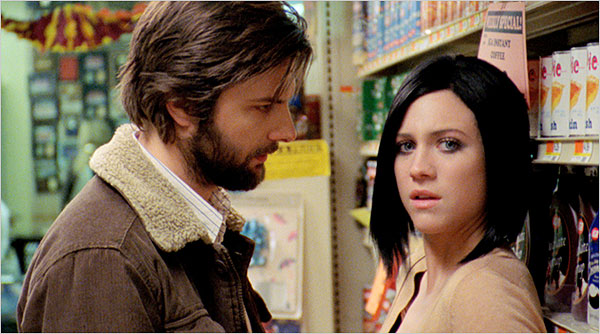
In the vein of “awful people who became awful because they suffered childhood trauma” family drama movies, this one is not half bad. That’s mainly due to Adam Scott, who is one of the more versatile and under-appreciated actors working today.  Scott plays the damaged, stuck in the hometown older brother who picks up his younger brother and the brother’s girlfriend from college and proceeds to fall in love with the latter. Scott is a depressive, an alternately cruel and then apologetic anti-hero, who maligns the girlfriend as a whore who will hurt his naive little brother. The problem is that she succumbs to his damaged entreaties, thus partially cementing his earlier uncharitable appraisal.

There is the obligatory childhood trauma and the big reveal, and it could all be so pat, except for Scott’s ability to communicate real suffering and writer-director Lee Toland Krieger’s insistence on taking these characters seriously instead of using them as charming archetypes to condescend to the audience. More to the credit, there is no wrap-up or deeper understanding. It starts messy and ends up hopeful but still messy, which is commendable.

There are problems.  The hometown is overpopulated by distinctive characters, the father (J.K. Simmons) is too seminal to be so underdeveloped and the hipster soundtrack is now so obligatory it borders on self-parody.  Still, a worthwhile watch on a rainy Saturday.  Thanks, Xmastime.

image

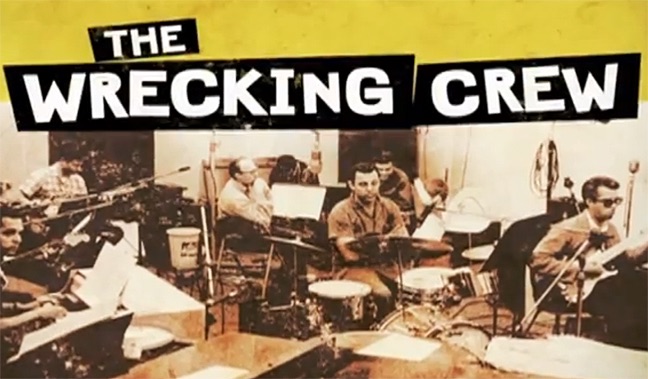
A significant portion of Love & Mercy is devoted to Brian Wilson’s production of The Beach Boys record “Pet Sounds.” Wilson enlists a room full of session musicians rather than the Beach Boys, who are utilized solely for vocals. The studio players were known as The Wrecking Crew, and it was from this group that the band found its replacement for Wilson on the road, Glen Campbell.

Denny Tedesco, the son of session guitarist Tommy Tedesco, has written and directed a fascinating documentary that chronicles the heyday of The Wrecking Crew, who played the music on a seemingly exhaustive list of pop records in the the 60s and 70s. Working from interviews of the players and the acts they backed, as well as home movies of his father, Tedesco provides great insight into the times as well as the life of a working musician.

The interviews are particularly fun. Roger McGuinn of The Byrds, who had been a session player himself, had to break it to the band that the rest of them wouldn’t be playing on their hit single “Mr. Tambourine Man” which didn’t go over well. As McGuinn recalls, The Byrds produced two tracks in three hours during the “Mr. Tambourine Man” session, while it took 77 takes to produce “Turn, Turn, Turn” which the band insisted on playing.

Tommy Tedesco tells the story of The Gary Lewis and the Playboys guitarist who confessed he could never play what Tedesco had played in studio on tour and always felt embarrassed when fans complimented his playing on the records.  Peter Tork of The Monkees tells a poignant story of the disappointment he felt when he was invited to come to the studio for the production of a Monkees tune only to learn that the invitation was solely as an observer.  On an up note, Mickey Dolenz reveals that the studio musicians taught him how to play the drums in preparation for his Monkees tour.

Obviously, the days of a small crew of players backing most of the pop radio play (and film and televisions tracks and radio and TV commercials) coming out of LA couldn’t last, but this is a blast of a documentary that also serves as a loving remembrance of the filmmaker for his father.