Archive

Monthly Archives: February 2026

This is not a film review, but some events require a detour from standard operating procedure.

A close friend and fellow film buff sent me the following:

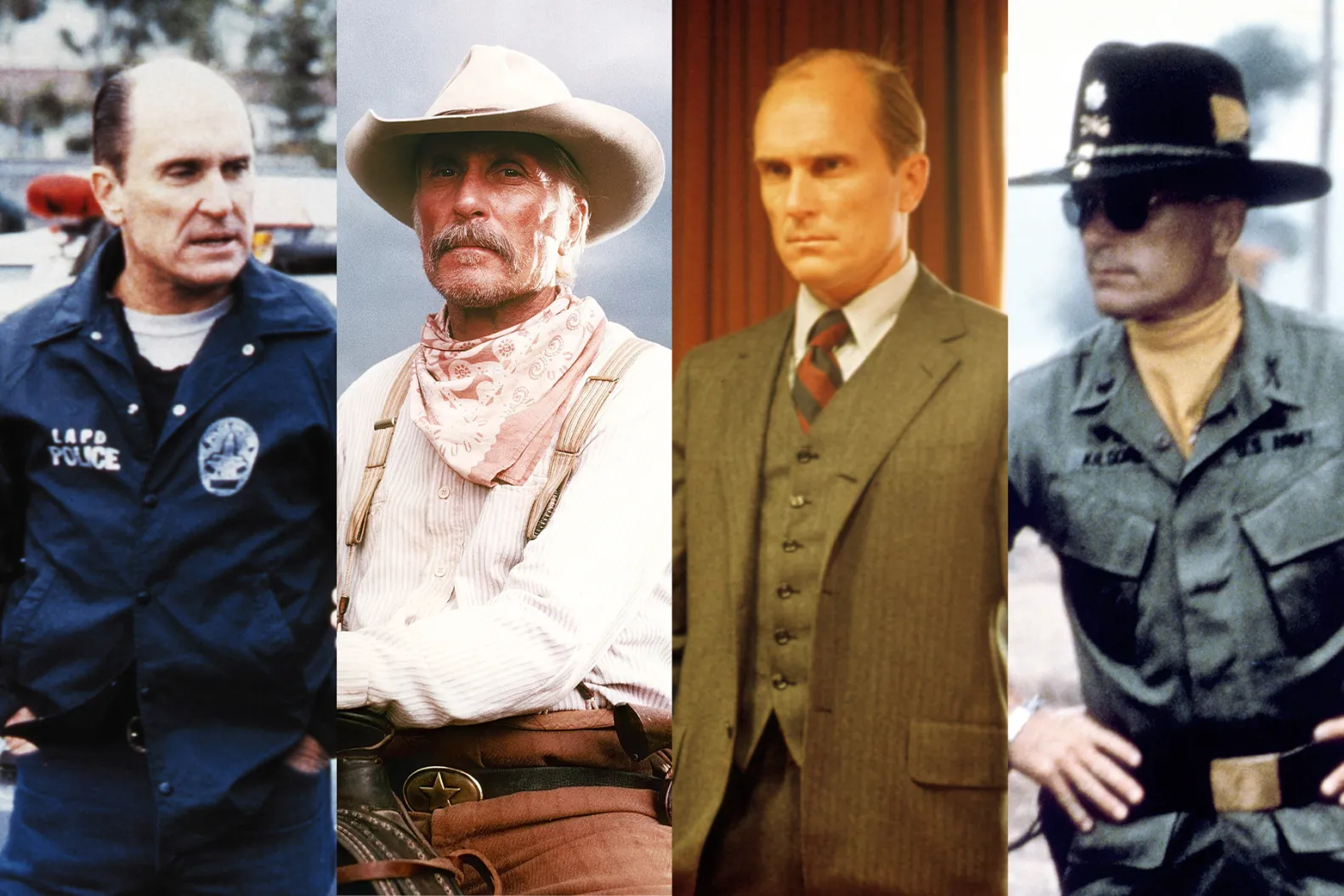
Robert Duvall’s very first film is hard to find and may not exist: a made for TV Playhouse 90, John Brown’s Raid, directed by Sidney Lumet starring James Mason as John Brown, filmed on location at Harper’s Ferry. In addition to Mason and Duvall, the movie had James Broderick and Ossie Davis. His second film and first feature was, of course, To Kill a Mockingbird. He made about 7 feature films in the 60s–mostly episodic TV. But those 7 features arguably set up the next decade of his career: Countdown, a failed film by Robert Altman, The Rain People, a failed film by Francis Ford Coppola, and then The Chase (Arthur Penn), True Grit and Bullitt (Peter Yates). Oh, yeah, he plays a gay biker and Richard Jaeckel’s lover in Nightmare in the Sun. So the 70s opened and he plays a lot of assholes: MASH, Network, Killer Elite, Great Northfield Minnesota Raid. Also a lot of fairly colorless people: I’m sorry, but Tom Hagen is a thankless role, and while he’s an interesting Doctor Watson, it’s not very showy. And a Good Nazi, kind of, in The Eagle Has Landed. Also a lot of movies we’ve forgotten about. But almost all of his movies share two characteristics: he’s getting much bigger parts and most are directed by or written by big names. So even though at the end of the 70s, the average person hadn’t heard of him, he’s got a lot of respect in the industry and criticis love his ass. Setting up The Great Santini, Apocalypse Now, True Confessions and Tender Mercies–and that’s a sequence of films that’s got few rivals, particularly given he’s starring in three of them. Now he’s kind of found his groove as a movie star–of this group, only True Confessions wasn’t Oscar nominated. Ironically, his 80s after that is a bit tame–probably taking some time off. And then the epic Lonesome Dove, where he creates Augustus, leading to his strongest decade not in movies (that’s the 70s by far) but in Robert Duvall Roles. He made 24 movies in the 70s, 12 in the 80s, and 23 in the 90s. He still worked up into his own 90s, getting another nomination and directing up into his 80s. From CNN, “…the family encourages those who wish to honor his memory to do so in a way that reflects the life he lived by watching a great film, telling a good story around a table with friends, or taking a drive in the countryside to appreciate the world’s beauty.” He was apparently a Republican, too. Long time buddies with Gene Hackman and Dustin Hoffman. I’m glad he had a better end than Hackman.

There is very little with which to disagree there, except for her misstep on Tom Hagen. Duvall’s turn as the “almost brother” is an understated, canny performance, pitch perfect to his co-stars, with quiet moments of real hurt. When Michael says, “You’re out, Tom,” Duvall shows piercing vulnerability, beseeching Vito with his eyes. When Michael attacks Tom for disloyalty, again, his bewilderment belies a greater fear (“Why do you hurt me, Michael? I’ve always been loyal to you”).

The scenes must be juxtaposed with Tom’s fights with Sonny, who also derided Tom, but with whom Tom was at ease, because for all his faults, Sonny was human, they were blood even if Sonny could cruelly suggests otherwise. And Sonny was dumber than Tom, a reality so patently obvious to Tom that his worth was never in doubt. They’d fight, Tom took it with a grain, and Sonny immediately apologized.

Michael, however, was inhuman and smarter.

The performance is masterful, like so much of what Duvall did.

Last thought. A Civil Action is an underrated legal thriller about a class action case brought against local polluters. John Travolta is the engine, a plaintiff’s lawyer fighting a massive, all-enveloping case and his own sense of inadequacy, and he is quite good. Duvall represents one of two corporate defendants, a wily, eccentric old line senior partner with a white shoe Boston firm. I’ve been around lawyers of all stripes my whole life. He is spot-on, brilliant, and inhabits the quirky-but-wise character entirely:
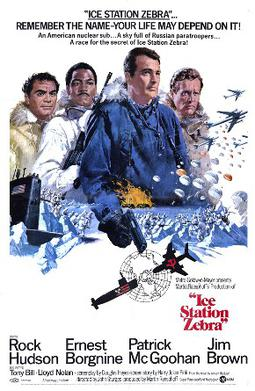
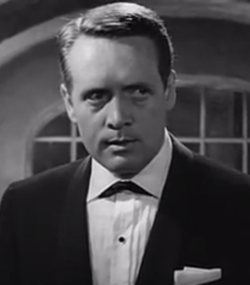
A perfectly serviceable John Sturges (The Magnificent Seven) Cold War action/espionage thriller from 1968, currently on Tubi. The Soviets take photographs of all of our missile installations from space, but in attempting to retrieve the film, things go awry. The canister lands near a British scientific weather station in the Arctic, and the race is on for retrieval before the Soviets get there. The mission is led by nuclear submarine skipper Rock Hudson, who has MI6 spook Patrick McGoohan, friendly Soviet Ernest Borgnine, and Marine squad leader Jim Brown along for the ride.

I watched the flick when I was a little kid on TV. It was thrilling.

50 years later, it still holds up somewhat. It’s really worth catching for three particularities.

First, clearly of its time, a significant portion of this rather long picdture (it has both an overture and an intermission) is devoted to the inner workings of a nuclear submarine, sometimes, pedantically so. But you have to remind yourself that in 1968, film audiences would have been thrilled with a long dissertation on the inner workings of a nuclear submarine.

Second, I never understood why McGoohan was not a massive star. He is a great villain, but he also has a charming smile and twinkle in the eye that communicates humor and a little menace.

I read up on him. He was swallowed up by television, which probably suppressed a budding film career. He was also extremely Catholic, and would not take any role in which he was required to kiss a woman other than his wife, thereby taking him off the James Bond list (and apparently, he was on it).  Modern audiences would know McGoohan as the villainous king who steals and chews scenes in Mel Gibson’s Braveheart.

Lastly, Jim Brown is still cool, even in a winter parka.

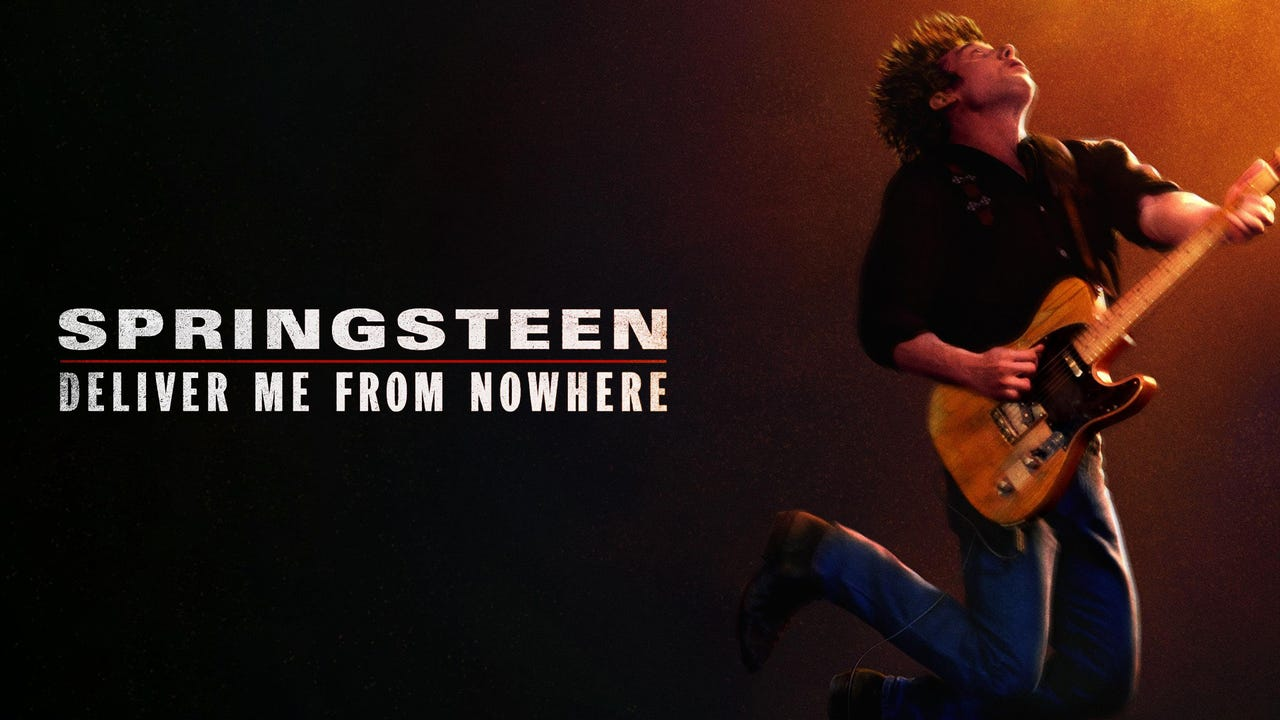
In one of the first moments of the film, we meet Bruce Springsteen (Jeremy Allen White) as a little boy, hearing his father (Stephen Graham) coming up the stairs, drunk, to spar with him. In the process, Bruce catches a slap. We know it’s gonna’ be these two guys the whole picture, as the shy, depressed superstar makes his most personal, least commercial opus, Nebraska, while grappling with his troubled upbringing.  

I read Bruce’s autobiography and was mightily impressed with its honesty, charity, and equanimity. There was little, however, about the ghost of his abusive father. Maybe Bruce wasn’t ready to share. But the point is relevant because while his father seems to be a handful, he is not portrayed as such a monster so as to justify the depths of Bruce’s torment. In fact, when Bruce is writing Nebraska, he seems more influenced by Terence Malick’s Badlands than Daddy issues.

In the midst of his struggle, Bruce has a relationship with a single mother (Odessa Young). It is supposed to be a simple, earthy union, a local rocker and a “heart of gold” fan who sees through The Boss’ facade, a ludicrous conceit. This is post The River. He’s massive. He’s been on the cover of Newsweek and Time. But the picture persists in the silliness of Bruce the regular guy. When Bruce drops his waitress gal off, because of course she’s a waitress, in a diner, it is in a blue collar neighborhood, oil storage tanks in the background. Her father comes out and says, in a hackneyed, suspicious New Jersey small townie way, “is that the … uh … guitar player fella’?” Dad then sneeringly harkens to Uncle Dave, who “played guitar” and presumably, was not much of a success.

Oof.

Worse, the relationship doesn’t add much if anything to the story. Given the woman didn’t exist, one would expect writer/director Scott Cooper (Hostiles) to do more with the character. But she is there solely to be dumped by the angsty Bruce and to utter pap like, “if you can’t be honest with yourself, I don’t know how I can expect you to be honest with me.”

Oof.

The second half of the film is where we go straight into the ditch. Bruce is struggling to present Nebraska in his stripped down vision while fending off pressure to release Born in the USA. In the doing, he engages some more with his father both then and now while struggling with depression. It’s a long slog, with Bruce upset that his cassette tape cannot be replicated in the studio. This principal struggle is treated as if we were watching Oppenheimer and his team of scientists discussing the moral conundrum of unleashing nuclear power onto the world. In these moments, the film has absolutely no sense of proportion and lapses into the ridiculous. The Boss’ head is in his hands. A lot.

Another negative. Jon Landau (Jeremy Strong) is laughably written. As Springsteen’s manager, he is supposed to provide some obvious tension between the Boss’ failure to follow up The River with something more commercial as opposed to his sparse, acoustic passion project. But there really is none because Landau is all therapist, uber reverential. With no concerted pushback, only soothing support, we near ennui. If Bruce said he wanted to follow up The River with hand puppetry, from this Landau, we’d get:

“Hey [deep soulful look into Bruce’s eyes, hand on shoulder]. I Iove you. You do you.”

When Landau and his wife discuss the Nebraska demo, their conversation is the most elemental thing you’ll hear in film, as if Cooper fears the audience is so stupid it must be painstakingly explained just what a departure this record is and just how “dark” it seems. The couple have two such conversations. She contributes to the first one, but during the second, Landau is so smitten and high falutin’ about his plagued client, she just kind of looks at him.

And when Bruce plays the hit Born in the USA, Landau says, “I think a Muse came down and kissed you on the mouth.”

Oof.

Ultimately, Cooper cannot land on any one thing for very long, and it is just not very cinematically interesting to watch a film about a guy writing a singularly personal solo record. It’s all in Bruce’s head. And the memories of his Dad, the ghost, are drab and not all that shocking.

The resolutions at the end are brutally maudlin. Like, shield your eyes syrupy. “You need therapy man” bad. Like sitting on his father‘s lap as an adult and saying, “you did the best you could. You had your own battles to fight” bad. 

A positive. Jeremy Allen White is really quite good as Springsteen. One has to be really careful with such a mythic figure, and White does a very understated job while still capturing the persona. The script calls for him to be perpetually tortured but he pushes back with a refreshing natural humanity. This is no small thing given how humorless and dour the script portrays him.  

It’s not grotesquely terrible. But it’s pretty bad, hopelessly muddled and much duller and pedestrian than it had to be.

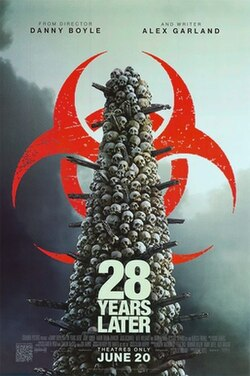
No doubt, Danny Boyle movies are easy on the eyes. This one is no different. But as good-looking as the film may be, tonally, it’s a mess.

Boyle updates us on the world 28 years after the release of the rage virus, and we find ourselves in the Scottish Highlands, where an isolated community is celebrating a 12 year old boy, Spike (Alfie Williams), and his passage into manhood. No, they don’t put Spike outside the gates of the town to fend for himself, like the Spartans. But he does accompany his father (Aaron Taylor Johnson) to the mainland, which has been quarantined for 28 years, to get Spike his first kill. There are a few fraught moments, and Spike does … okay. But he shows very natural terror during the terrifying chore, and when they return to their small burg to tell tales of his bravery, he is a bit ashamed.

He shouldn’t be. During his trip, we see that the infected have either regressed, stayed the same, or progressed. So, they are either crawling sloth-like behemoths who move at a glacial pace and eat worms (unless they can get near a human) and standard rage lunatics who speed attack in packs and have learned to eat. There is also an Alpha, a rage survivor so big and powerful that when he grabs your head, he can pull it off your body and your entire spinal column will follow. Spike also sees a fire, suggesting the presence of an un-infected.

Things go awry shortly after Spike’s return. He learns of a mysterious doctor (Ralph Fiennes) who may or may not be a lunatic, but is still on the mainland and may be the keeper of the fire. Spike’s mother )Jodie Comer) is bedridden, afflicted by crippling headaches and memory issues. After Spike sees his father with another woman, the revelation pushes him into a decision so monumentally stupid, all allowances you might give other failures in the film are immediately expended.

Looking to find the doctor who can help his mother, Spike enters the dangerous world of the mainland, but this time, not with his adroit and capable father, who got them out of several close calls the first trip, but with his infirm mother. On their first night, Spike almost buys it from one of the sloths, who was moving 30 yards over at least an hour, such is his capability.

Regardless, after some time on the mainland, which is beautifully rendered by Boyle, they find a pregnant infected. Spike’s mom and the woman hold hands to get her through delivery, a laughable conceit. Then, Mom and Spike tote the baby around (unlike the baby in Zack Snyder’s Dawn of the Dead, this baby “appears” healthy, though the immediate acceptance of that reality is in keeping with Spike’s guileless approach to the dangerous mainland) and find the doctor. They also defeat the Alpha, who, lo’ and behold, is the baby’s father.

Before and after that victory, a bunch of pseudo philosophical mumbo-jumbo about love and death is bandied about.

And then Spike meets up with some locals who have been roving and fighting the infected.

They all look like members of A-ha. Or a grubbier Duran Duran.

A watchable, scenic, silly, pointless film.