Archive

Monthly Archives: January 2025

Great, wondrous fun, a spectacle that exceeds its promise.

Ariana Grande (Glinda the Good) and Cynthia Erivo (Elphaba the Wicked) are young schoolmates in the land of the Emerald City (at a brighter, more colorful Hogwarts), immediately antagonistic, then fast friends, and we see them as they begin their journey to Elphaba’s ultimate end (“I’m melting!”). History, as they say, is written by the winners, and now, we have the real story, to song.

Both actors are splendid, mastering very difficult vocals while establishing strong chemistry and exhibiting astute comic timing. Director Jon Chu (Crazy Rich Asians) moves the film at a dizzying pace but keeps space for the tender moments. And while I always felt the Broadway musical was marred slightly by a few uneven or underwhelming numbers, as committed to screen, “Dancing Through Life” is majestically choreographed and “I’m Not That Girl” subtly moving.

A few issues. First, there is an underdeveloped subplot of official antipathy to animals, who were once contributors to Emerald society but are now being shunned and caged. Not that this is a political potboiler, but the issue is presented perfunctorily as a fait accompli. Given that the matter is the breaking moment between the Wicked Witch and the Wizard (underplayed in a disinterested, almost blase’ manner by Jeff Goldblum), there needed to be more, and it could have been provided in the existing framework.

Similarly, when the girls get to Oz to meet the Wizard, there is an expository number to provide the basis for the rise of the Wizard and the source of his power. The number allows for the return of the Broadway originals Idina Menzel and Kristin Chenoweth, but it is clunky and not really all that explanatory. I needed my daughter to explain to me what the hell was going on.

Again, minor nits. Total blast!
For a music bio, you can max-mythologize a dolt and maybe no one will notice the subject is super boring.  See The Doors. Elvis. Bohemian Rhapsody.

Or you can play it straight and overarching, maybe puncture the myth in parts, but ultimately, tell a big, soup-to-nuts, rags to riches story rather than create more ornament for the church.  See Ray. Straight Outta’ Compton. La Bamba.

But when you add kick-ass performances from people who can really sing, and a thoughtful, tight script, then I’m in.  See The Buddy Holly StoryCoal Miner’s Daughter. Walk the Line.

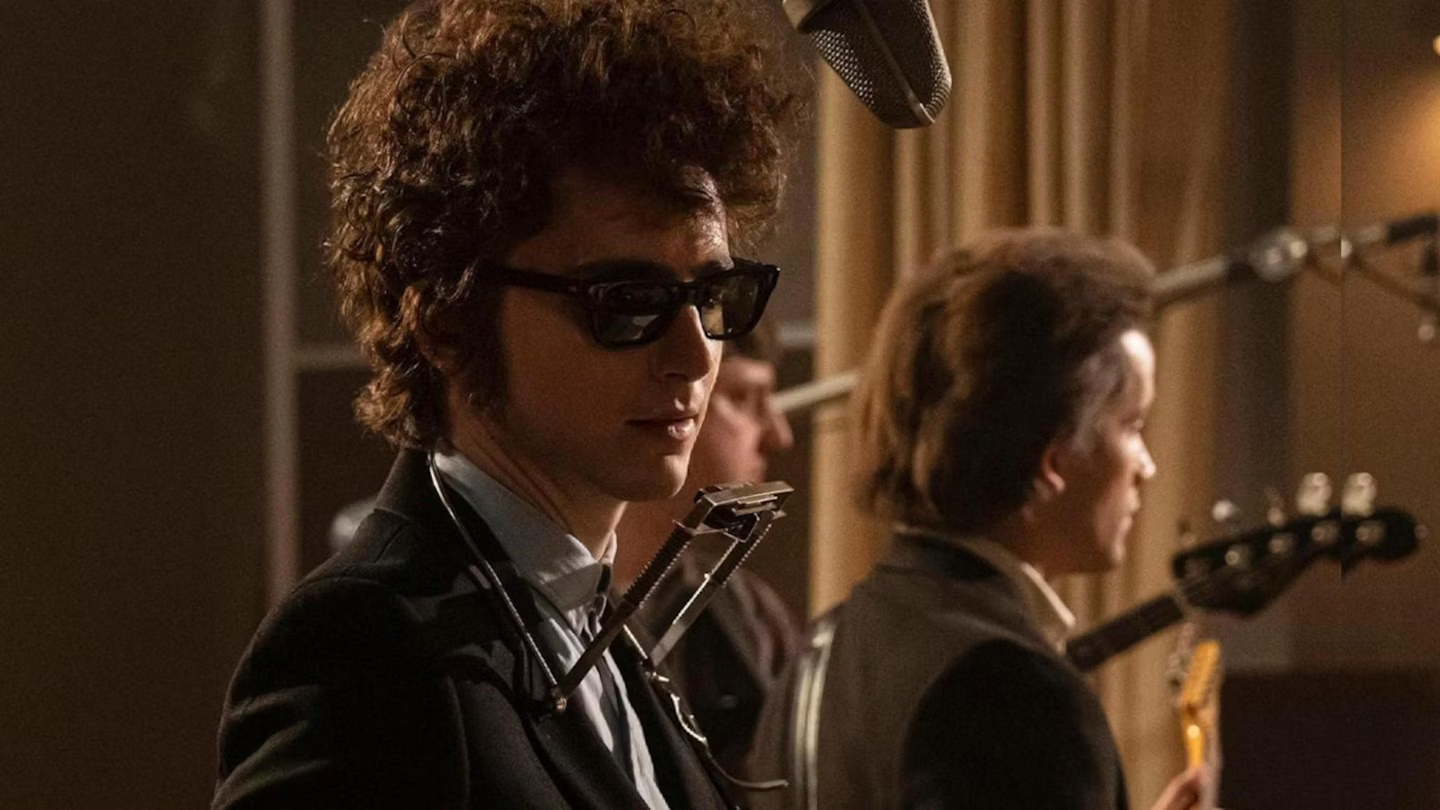
Luckily for Bob Dylan, the director of the latter, James Mangold, took this picture on.

We meet Dylan as he is deposited in NYC to meet his idol, Woody Guthrie (Scoot McNairy) who, robbed of his voice, is tended to in a New Jersey hospital by Pete Seeger (Edward Norton). Seeger and Guthrie see greatness, Seeger takes Dylan under his wing and we are off to the races, from aspiring folkie in 1961 to superstar in 1965, as Dylan weighs the dilemma of a lifetime:

Willeth I go electric?

“Will he go electric?” is actually a big deal in Dylan’s world, one fleshed out by Mangold and screenwriter Jay Cocks (Silence, Gangs of New York), as the genesis and essence of the folk milieu is revealed to us.

Of course, we want electric, but Cocks makes us understand the instincts of the standard bearers. They are curmudgeons, maybe, but they are earnest. The folk movement is something they built, sure, a lot of it on Dylan’s back, but their protective nature is not ridiculed. Quite the opposite. Cocks gives Seeger a great speech wherein he urges Dylan to stay acoustic in the service of a larger musical aim.

Still, the film doesn’t make the tug larger than that, and Dylan’s switch does not stand in ostentatiously for “bigger” themes.

Similarly, the pressure of going from lauded unknown folkie to superstar is not treated as an excuse for bad behavior or a major unfairness. It’s an annoyance that informs Dylan’s desires, and while we get the pressure he is under, as played by Chalamet, Dylan is made kind of dick because of it, equal parts sympathetic and petulant.

Mangold also has fun with the times. The look is spot-on, particularly of early 60s Greenwich Village, and we get the fun interdiction of Johnny Cash (Boyd Holbrook), a Dylan supporter and pen pal. And Al Kooper just jumping in a studio to hit the organ for the start of “Like A Rolling Stone” because he could not play guitar on the track?

Goosebumps.

Ultimately, as with Walk the Line, the music is the star. Chalamet sinks smartly into the role, traversing the road from wise but sweet neophyte to badgered superstar, but he sings great and quite a lot. All the performances crackle but he really nails it.

Mangold also does a great job with Dylan and his first girlfriend (they have an exchange about the plate-spinners on variety shows that is touchingly smart and Elle Fanning really resonates as the gal who took Dylan in only to see him grow beyond her attentions).

The Joan Baez relationship is more ragged. She just seems like a bitch, angry that Dylan criticized her songwriting (“’Sunsets and seagulls.’ ‘The smell of buttercups…’ Your songs are like an oil painting at the dentist’s office”). Mind you, that would piss most anyone off, but they continue as a couple with no discernible attraction, and the why seems thin.

A minor nit.  Great fun, moving, and impressive. Top 5 of 2024.            

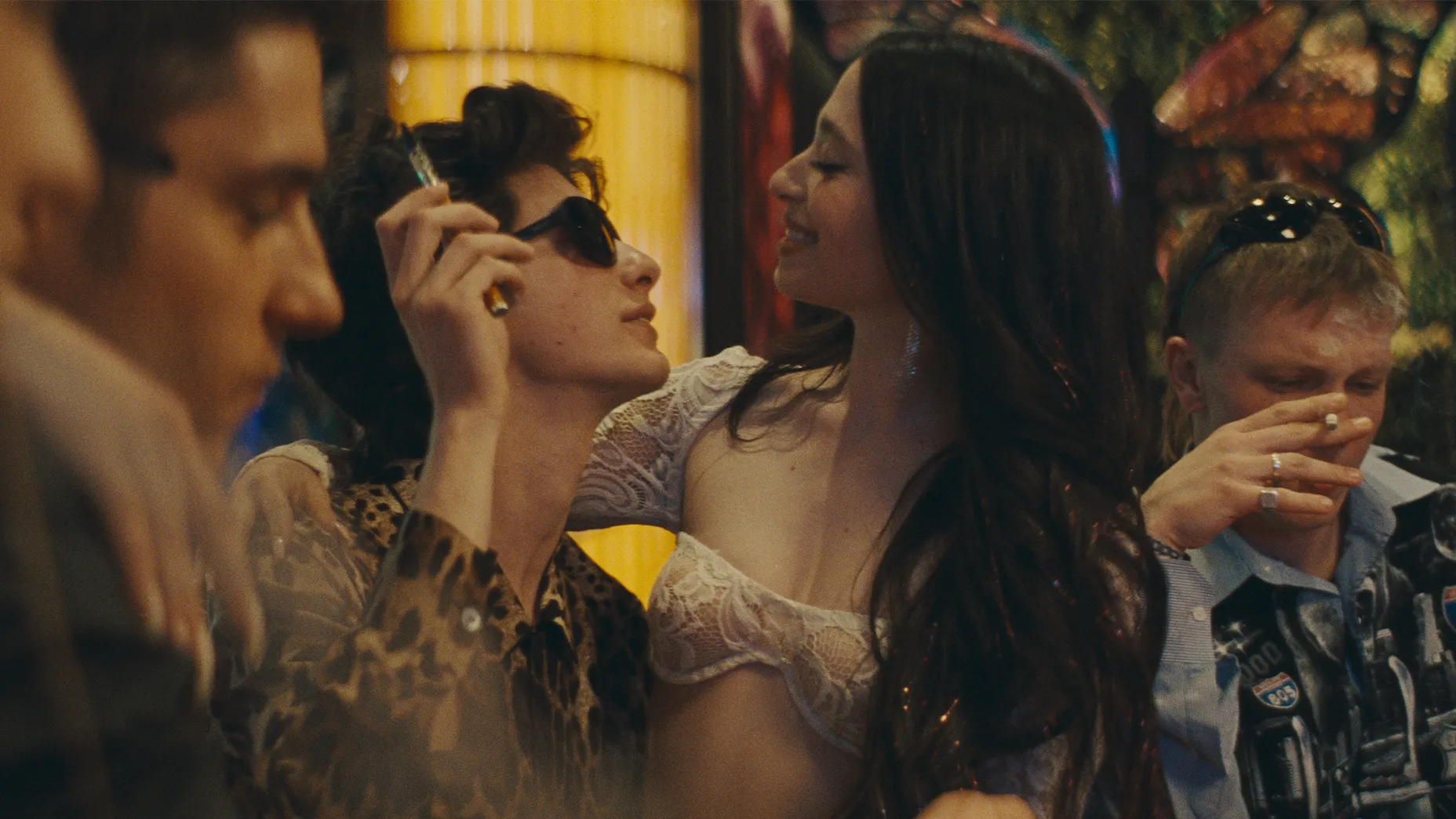
Sean Baker (The Florida Project) delivers an uproarious, tender, unexpected love story, powered by a rollicking, unyielding performance from Mikey Madison as the lead (last seen by me as one the Manson gals of Once Upon a Time in Hollywood, the one who Leonardo DiCaprio ultimately dispatches with a flamethrower).

Anora, or Ani, works as a stripper at Headquarters in Midtown, a sanctum where she peddles her wares (simple company, lap dances, and in the private rooms, maybe more). She supplements her income as an escort. Sex is transactional, which does not devalue her ability to enjoy it, but the financial nature permeates the act such that her brittle nature seems organic rather than a symptom.

Then, she meets her knight in shining armor, Vanya, the child-like, fun-loving son of a Russian oligarch (Mark Eydelshteyn), who blows through Daddy’s rubles like water, rents her for the week, and then, after a bender in Vegas, marries her. This obviously does not go down well, and the oligarch must rely on his Armenian reps in New York to rectify the situation. They are not quite the Eastern thugs of lore, and their intercession is more Three Stooges than John Wick.

As they say, hilarity ensues.

As does much more. The connection between the man-child Vanya and Anora is in part about money, yes, but you can feel a spark, and even though Anora remains focused on the payments, soon, she fancies herself Julia Roberts. This is love, and he is hers, even if he just started shaving. You know that it cannot be, but Baker has you as enthralled as Anora, on pins and needles, hoping against all hope and reason. When the forces of power intercede, they are partially represented by an Armenian thug Igor (Boris Yurasov) who reveals a gentle, protective disposition and an alternative approach, one that Anora fights with the same verve and fire she exhibits to hold on to Vanya.

Ultimately, there is a reckoning, a declaration of independence, and a new beginning, but before we get there, Anora and her unwelcome coterie of Armenian minders endure an evening that harkens to Scorsese’s After Hours.

As with The Florida Project, Baker has such command of place, you feel immersed. Here, due to the whirlwind nature of the story, Baker’s pace is not Florida languid, but Big Apple urgent and exhilarating. It’s a joy ride with heart.

Madison, Eydelshteyn, and Yurasov all deserve Oscar nominations, and my fingers are crossed, as Madison and Yurasov received nominations for the Golden Globes.    

I have many films to see, but this is currently the leader in the clubhouse for best of the year.

Elliott, a vacuous, self-satisfied, snarky Canadian teenager (Maisy Stella) is visited by her 39 year old self (Aubrey Plaza) during a mushroom trip. Plaza’s old ass has much to say to Elliott’s young ass, much of it a violation of the Prime Directive, the guiding principle of Starfleet that prohibits its members from interfering with the natural development of alien civilizations.

Yes. I watched Star Trek. What of it?

The set-up is well worn. Elliott wants to get off the family cranberry farm and find herself in the big city of Toronto. She is meant to be celebrated for her freedom and grab-life-by-the fistful approach. She’s gonna’ shake the red juice off her small town boots and let loose before global warming interferes with her cell service. She’s a rebel. But she’s also a loudly stupid and narcissistic rebel, and all the soft piano, oboe, and terrible acoustic dirges cannot make her interesting.

With a lead who could act and a less obvious, smarter script, My Old Ass could have been a clever twist on the coming of age flick, Freaky Friday meets A Christmas Carol.

Stella (member of the music duo Lennon & Maisy), however, cannot act. She is one-note, snotty, and charmless. She makes Disney Channel kids seem method. 

The film has a few genuine moments where Plaza, Elliott’s mother, and her would-be first boyfriend all present Elliott with a remembrance, a well-rendered insight, a moment of tenderness. In response, Elliott – not allowed to say “dude, what the fuck? for the umpteenth time- offers a “dude, what the fuck?” countenance. Any expressed emotion crashes into her stubbornly smug visage, where it thuds. Such that we are thinking, “Miley Cyrus could have really done something with this role!”

Worse, no one has bothered to make the trick explainable. After the drug trip ends, inexplicably, Plaza still texts and calls and visits Elliott. Tripping as portal to an Apple data plan? This is lazy mush and indicative of the ragged nature of this endeavor. 

The script is mostly middling sitcom. Plaza and Elliott say cool stuff like “when do we …?” Followed by “oh my God. This happens …” Plaza says to Elliott: “Moisturize!” Elliott replies with a form of “What the fuck? Dude!???” Elliott to Plaza: “Can I kiss you?” Plaza replies with “ewwwwwwwwwwww!” or some derivation of same. Stella says “fuck” and “dude” and “like” and “sick” a lot. She spouts hip cliche’-ridden observations that may tickle the fancy of an 18 year old peer, but test the patience of anyone who has read a magazine. Or a cereal box.

When we get to the meat, Plaza reveals a particular thing Elliott must prepare for, something so obvious, it seems a perfunctorily preordained. It is asked to serve as the emotional linchpin of the movie, yet the most Stella can muster is the disappointment of a girl who pours a bowl of Lucky Charms only to find a low marshmallow count. 

Sometimes, in these flicks, you get some funny, well-drawn secondary characters who maybe could drag Stella along. But everybody is pretty vanilla and meh. When they have something to say, it is leaden with announcement and unforgivably banal. 

The film might have been saved if Plaza told Elliott not to take a particular hike and she did it anyway and then she was almost murdered by the Green River killer.

Missed opportunity. 

Last point. Yes, teens say “like” and “fuck” nonstop, like men in war curse beyond any comprehension. But to actually let characters lapse into this doggerel in a script? Jesus. It may as well be serial farting. 

The picture was on a few top 25s and 50s and very highly rated on Rottentomatoes.com.

Undeservedly so. Like dude, what the fuck. 

On Amazon. Thankfully, for free. 

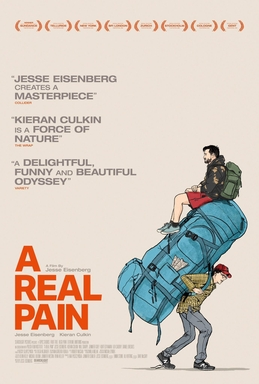
A beautiful, meditative story about family, and the disconnect between ancestry, past, and shared blood. Writer-director Jesse Eisenberg (The Social Network), and Kieran Culkin (Succession) are disconnected cousins who used to be very close when young, and are now held together by a strong attachment to their recently deceased grandmother. In remembrance and per her wishes, they join a tour group to Poland to visit her origins, including the concentration camp she survived. In that journey, they hash out some old differences, reveal their insecurities and grievances, and otherwise, commune with the past. Culkin is enagaging,  charming, yet emotionally dictatorial, and peripatetic. Eisenberg is OCD, eclipsed, a little bit pissed off about it, and, yet, desperate for his cousin’s ability to connect while at the same time weary of having to clean up his emotional messes.

The film is never overt, but it is very touching, particularly when the fissures between the cousins arise in the midst of a supportive group of fellow tourists (one of whom is Jennifer Grey, from Dirty Dancing, who is really quite good, even if she looks nothing like she used to given the radical plastic surgery she underwent many years ago). They are all on their own journey for different reasons, and they quickly become another family to the two protagonists.

Eisenberg’s script is sharp and his direction leisurely. At times, his take felt a little like Sofia Coppola, such is his comfort with the silences and the scenery (his shooting at the camp is haunting). The pain of the characters, as juxtaposed against the history, is made more acute, but again, there is no resolution, no great battle royale, no truly deeper understanding. But, quite tenderly, the bonds are strengthened. The experience may not change their trajectories, but that seems baked into Eisenberg‘s cake.

A lovely, bittersweet picture.