
Archive

Monthly Archives: August 2023

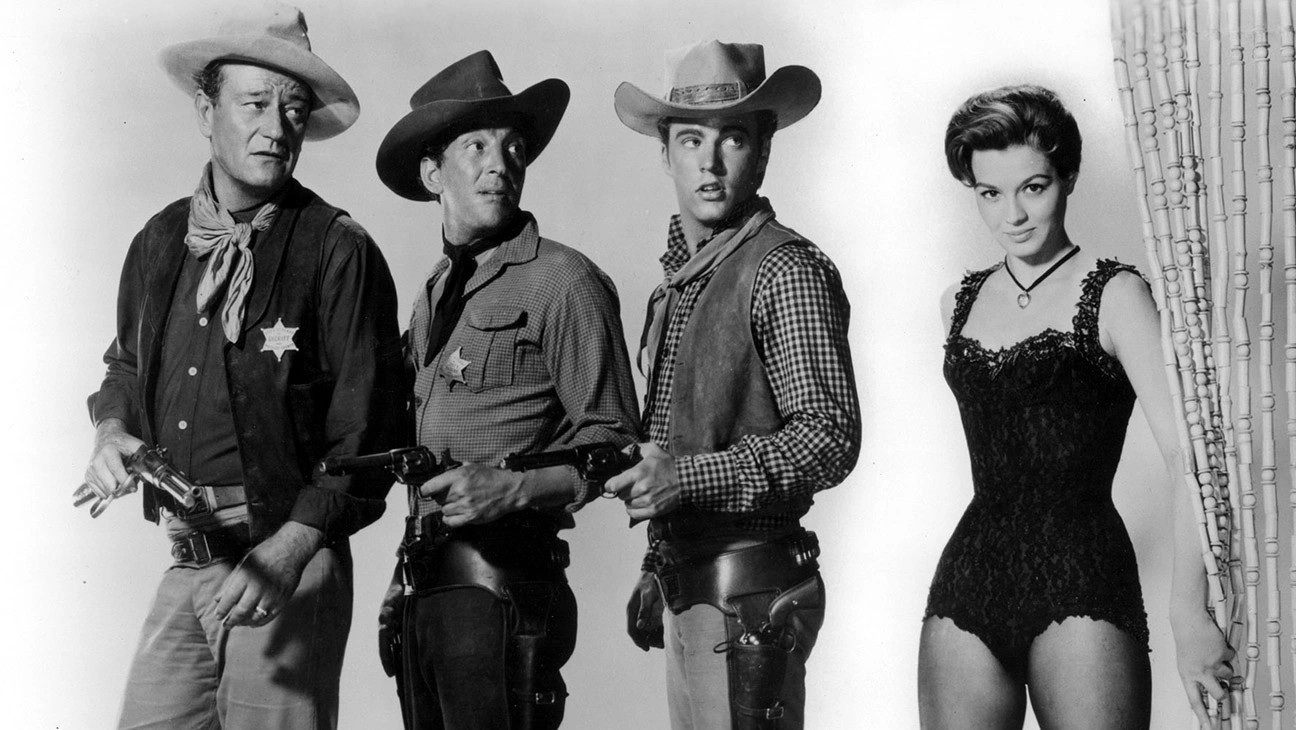
Howard Hawks’ western is competent, light, entertaining, and currently on MAX. The film also sports a few surprises, the most enjoyable of which is the performance of Dean Martin as the shaky alcoholic deputy trying to go cold turkey. It’s a hell of a dark and moving turn from a guy who you normally think is all easy-breezy, no heavy lifting.

Other notes.

1) If you have Dean Martin and Ricky Nelson in a movie, they’re going to sing, and while it’s a little bit clunky when they do, the tunes are still a lot of fun. It would’ve been better if they just had Nelson playing guitar and Martin and Nelson singing together in the live shoot, but I presume the sound obstacles were too great, so they used a studio track and lip-synched instead. The dissonance between the music and the normal soundtrack is dramatic, but I imagine audiences in 1959 didn’t give two hoots.

2) I laud Martin’s performance, but Nelson is pretty damn good too as a youthful medium cool gun hand. He’s not asked to do much, but what tasks are given, he fulfills well.

3) Wayne made the picture in part as a rebuttal to the more cynical High Noon. Per Wayne, “A whole city of people that have come across the plains and suffered all kinds of hardships are suddenly afraid to help out a sheriff because three men are coming into the town that are tough. I don’t think that ever happens in the United States.”

4) Other than The Quiet Man, this is the only film I can remember where John Wayne is a romantic lead. It half works. Wayne smartly plays flummoxed, and Angie Dickinson’s magnetic performance nearly carries the day (when she kisses Wayne the first time, and he is stunned, they kiss again, and she says to him, “it’s even better when two people do it”).  Romance works a little better in The Quiet Man, because Wayne was not asked to woo Maureen O’Hara so much tame her, an endeavor that seemed a lot like breaking a colt.

5) If my recollection is correct, Kevin Spacey modeled his performance in L.A. Confidential on Martin’s here. You can see it. 

6) Trigger warning. Back to Angie Dickinson – va va voom! 
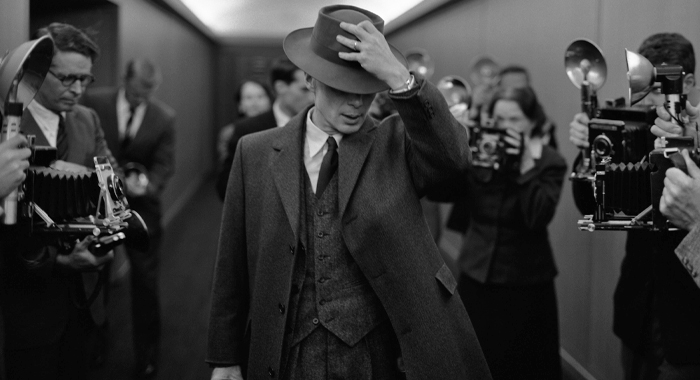

Obviously, I am overwhelmingly pleased to see a three hour film about a historical figure (and to think, Ridley Scott’s next picture is … Napoleon!) Just the other night, I was having drinks with younger colleagues (I am the last year of the baby boom, I estimate that these folks are late 20s), who were excited to see the movie.  I took a pull from my pipe and asked them, “what do you know about Oppenheimer?“ One answered, “the atomic bomb.“ Then I thumbed my tweed jacket and said, “what else do you know about Oppenheimer?“ Neither knew anything further, which makes sense. Yet due to the cachet of Christopher Nolan and the buzz about the film, they couldn’t wait to go see it. One was teaming it up with Barbie for a Barbenheimer, which sounds both intriguing and daunting. But to each their own. 

They should not be disappointed. Nolan’s first two acts are so fully realized and lovingly shot, they are nothing less than stunning. And his narrative-hopping from time period to time period is not just for show. Nolan captures the important vignettes that underscore what you will see later. His rendition of the first atomic test is gripping and fraught. I was on the edge of my seat knowing full well that for the denizens of Hiroshima and Nagasaki, it was not a good day.

Alas, the third act is a bit clunky. In the end, a bureaucratic and personal feud between Oppenheimer and Robert Downey, Jr. eclipses some of the larger themes of the picture. It just struck me as a little bit beneath what preceded it, as if Oppenheimer’s undoing stemmed from a mere misunderstanding or snit. 

I read the book upon which the film was premised, American Prometheus, years ago (and had the honor of being taught a course entitled “Nuclear War Crises” by the book’s co-author, Martin Sherwin). The real Oppenheimer was a bit of a mess. His views on the efficacy, wisdom and impact of the bomb matured, but also wavered, and he could speak with confident enthusiasm and also wary trepidation. He could be thoughtful and also, cooly lethal (he once rejected a poisoning scheme with, “I think we should not attempt a plan unless we can poison food sufficient to kill a half a million men, since there is no doubt that the actual number affected will, because of non-uniform distribution, be much smaller than this”).

Cillian Murphy does a beautiful job of working it out in front of us with an internal, searching performance. We see him struggle, not by soliloquy, but by discussion and quiet deduction. Murphy is, rightfully, a lock for best actor (if the Oscars are still a thing next year). 

Murphy is ably complemented by Emily Blunt (wife), Florence Pugh (lover), Matt Damon (the glue guy, still Hollywood’s best and least heralded actor, as General Groves), and a slew of others, all solid (Josh Hartnett? Yes, Josh Hartnett has grown up) and of whom you invariably remark, “Damn. Where have I seen him?”

As Oppenheimer’s bureaucratic nemesis, Downey Jr. crackles, though, as mentioned, he is seminal to the weakest aspect of the movie. 

Talky, meticulous, massive, yet chock full of the little things, Nolan has made a grand, intelligent epic. I hope it spawns more to come.